Part 1
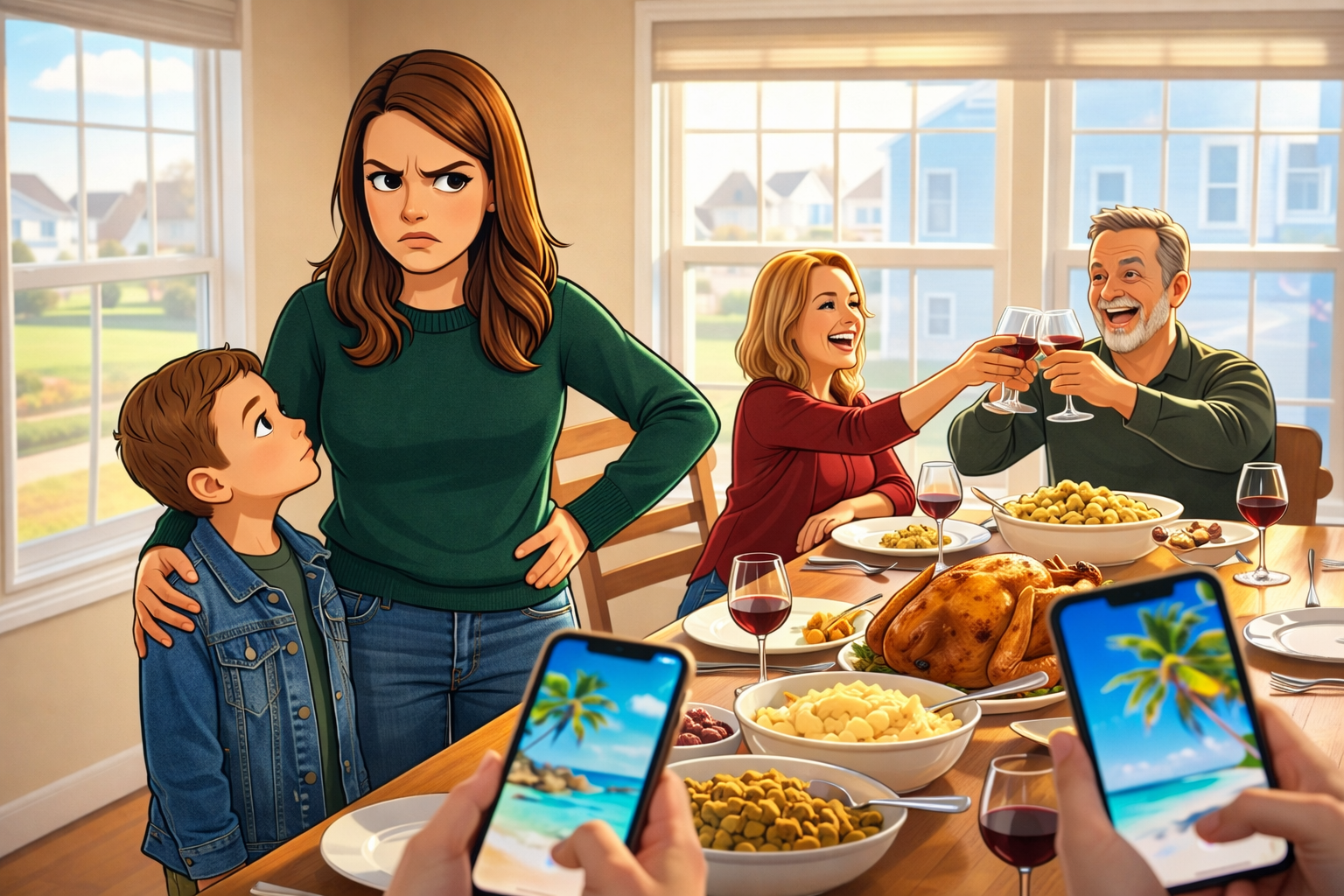
The second Caroline leaned toward my son and called him sweetheart, my fork started shaking above my plate.
“Sweetheart,” she said—loud enough for the entire table—“Thanksgiving turkey is for family.”
And then she actually did it. She slid the platter away from Luke like he’d reached for a decoration, not dinner.
Someone snorted. One of my uncles released a tight, guilty chuckle—the kind people make when they know it’s wrong, but they’d rather laugh than be the only one not laughing.
My mom stared into her wine like answers lived at the bottom. My dad kept carving, pretending he hadn’t heard, as if looking down could erase the moment. Luke froze with his plate half-extended, his hand hovering in midair. His ears turned pink. His gaze dropped to the tablecloth with the tiny orange leaves my mom only brought out on “nice holidays.”
He didn’t argue.
He didn’t say, I’m family.
He just pulled his plate back slowly, stared at the lonely scoop of mashed potatoes, and swallowed like it hurt. Heat rose behind my eyes. My chest tightened, like someone had strapped my ribs and started pulling.
My first impulse was to stand up, flip the table, hurl the turkey at the wall, and scream until every person there was forced to see themselves.
Instead, I went still.
Caroline laughed and pushed the turkey closer to her own kids. “You can have more potatoes, Luke,” she added, as if she were being kind. “You had pizza at your dad’s this week, right? You’re not missing anything.”
Luke nodded fast. “Yeah. It’s okay.” His voice came out tiny—too tiny for ten.
I scanned the table, waiting for anyone—anyone—to speak up. My mom cleared her throat like she might, but Caroline cut in first with a bright, brittle smile.
“Relax, Mom. It’s just a joke. He knows we love him.”
That word joke did what it always did in my family: it tried to spray perfume over cruelty.
People shifted in their seats. Someone clinked a glass. Conversation stumbled forward, pretending nothing happened.
Except it had.
Luke stared at his plate like if he looked at me, I’d make it real by saying it out loud. I shoved my chair back. The scrape against the tile was louder than I meant.
“Hey, buddy,” I said, standing. My voice sounded calmer than I felt. “Go grab your hoodie.”
He blinked. “We’re leaving?”
“Yeah.” I reached for his hand. My palm was damp. “Let’s go.”
For a beat, no one spoke. Then my dad finally looked up, turkey knife paused midair. “Lucy, come on. We just sat down.”
I didn’t look at him. “Luke,” I repeated. “Hoodie.”
Caroline let out that sharp, familiar laugh—the one I’d heard since we were kids whenever she made me the punchline.
“You’re seriously walking out over turkey?”
I tightened my grip on Luke’s hand. “We’re walking out because I don’t let anyone talk to my son like that.”
Luke’s chair scraped as he stood. He didn’t look at anyone. He kept his eyes on our joined hands, like that was the only solid thing left in the room.
We passed the buffet table, passed the framed family photos—Luke appeared in only one, half cut off at the edge. The smell of roasted turkey and cinnamon candles chased us down the hallway. No one stopped us.
When I opened the front door, November air hit my face like a slap I actually needed. I stepped onto the porch with my son and breathed in the cold.
Behind us, laughter restarted—nervous, relieved laughter—like now that we were gone, everything could return to normal.
In the car, Luke sat in the back, hands tucked into his hoodie pocket. Streetlights made halos on wet pavement. He watched the passing cars like he was counting something only he could see.
I replayed it all—Caroline’s hand, my dad’s silence, my mom’s eyes fixed on her glass.
“Hey,” I said finally, quiet. “You hungry?”
“I’m fine,” he lied.
He’d eaten half a roll and a spoon of potatoes. He should’ve been sleepy, not hollow.
“We’re getting food,” I said, pulling into the first drive-thru. I ordered him a huge chicken tenders meal with extra fries.
He didn’t speak until the bag sat in his lap.
“Mom,” he said softly.
“Yeah, buddy?”
“Did I do something?”
My hands tightened on the steering wheel. “No. You did nothing. Sometimes adults forget how to be kind. That’s not your fault.”
He stared at the bag, then whispered, “Her kids are more family than me, right?”
That hit harder than Caroline’s “joke” because it wasn’t the first time Luke had done this math—gifts, photos, trips. He’d been collecting evidence for years.
And I’d been ignoring it.
That night, after Luke fell asleep, I opened my laptop and my bank account. I scrolled through scheduled payments and found it—like pressing on a bruise.
Dec 1: $1,480 — Caroline and Todd / Mortgage.
My cursor hovered. The fridge hummed. Luke’s fan whispered down the hall.
I clicked edit.
I clicked cancel.
A confirmation box appeared: Are you sure you want to cancel this automatic payment?
“Yes,” I whispered, and hit confirm.
The cancellation email arrived at 11:47 p.m. I stared at it, then opened my finance spreadsheet and removed that line for the next twelve months.
My projected balance jumped—like it had been holding its breath.
I added a new line item: Experiences with Luke.
For the first time in years, my money looked like it belonged to my life—not theirs.
Part 2
The next morning, my mom texted.
Your father is upset. We don’t leave family dinners like that.
I stared at it while the coffee machine hissed. Luke sat at the counter eating cereal, eyes on his bowl.
I typed back: I didn’t leave dinner. I left disrespect.
Three dots appeared. Vanished. Appeared again. Then nothing.
Luke didn’t mention the text. He didn’t mention turkey. He moved through the morning like someone trying to take up less space. That made me angrier than any punchline ever could.
At work, I did what I always did when life got chaotic: I turned it into a problem I could solve with numbers—campaigns, budgets, forecasts, click-throughs, conversion rates.
Only now the signals were coming from my own family, and the conversion they wanted was my silence.
Caroline called that afternoon—not to apologize. Caroline didn’t apologize. Caroline performed.
“Lu-ssyyyy,” she sang like we were twelve and she’d just stolen my hairbrush. “Are you still being dramatic?”
I put her on speaker and kept rinsing dishes. “What do you want, Caroline?”
“Oh wow. Okay. I hear the attitude.” She sighed like my tone wounded her. “Mom says you’re telling people I was mean to Luke.”
“I’m telling nobody,” I said. “I’m replaying what you said, and I’m trying to decide what kind of adult says that to a child.”
“It was a joke,” she snapped.
“Explain it,” I said evenly. “Explain why it’s funny.”
Silence. Then, “You always do this. You take everything too seriously. Luke knows he’s loved.”
“He didn’t look like he knew,” I said. “He looked like he wanted to disappear.”
“Well, maybe he’s sensitive,” Caroline said, like she could shrug through the cruelty. “He’s not like my kids. They’re tough.”
“He’s kind,” I corrected. “And you take advantage of that.”
Caroline exhaled hard. “Whatever. I’m not calling to fight. I’m calling because Todd’s paycheck is late again, and the mortgage—”
I laughed once, surprised by myself. It wasn’t joyful.
“Oh my God,” Caroline said, offended. “Did you seriously just laugh?”
“You were about to ask me for money,” I said.
She lowered her voice like the walls might report her. “It’s not money. It’s the mortgage you already pay.”
I set a plate in the rack. “I canceled it.”
This silence wasn’t strategy. It was impact—Caroline hitting a wall she didn’t know existed.
“You… what?” she said slowly.
“I canceled the recurring payment.”
“You can’t,” she said like it belonged to her.
“I can,” I said. “And I did.”
Her voice went thin. “Lucy, you promised.”
“I promised three years ago for three months,” I said. “You turned it into forever. You didn’t ask. You assumed.”
“Because you said you’d help,” she snapped. “That’s what family does.”
I stared at my reflection in the kitchen window—tired eyes, messy bun, the face of someone who’d been working too long for a seat at a table that never wanted her kid.
“Funny,” I said. “That’s what you said last night too. Family.”
“Don’t do that,” she hissed. “Don’t guilt me.”
“I’m not guilting you,” I said. “I’m telling the truth. I won’t fund a home where my child is treated like a guest.”
Her breathing sped up. “What are we supposed to do?”
I thought of Luke’s pink ears. The dry potatoes. The laughter.
“I don’t know,” I said. “Figure it out the way I’ve been figuring things out my whole life.”
Then she switched tactics.
She started crying—loud, theatrical crying. “Lucy, please. The kids—your nieces and nephew—”
“Don’t,” I said, sharper. “Don’t hide behind them. If you cared about kids, you wouldn’t humiliate mine.”
She stopped instantly—like turning off a faucet.
“You’re going to ruin us,” she said flatly.
“No,” I said. “You’re meeting the consequences of your choices.”
She hung up.
My hands shook as I put my phone down—not because I regretted it, but because my body didn’t know how to live without bracing for backlash.
The backlash came fast.
My dad called. “You embarrassed your sister.”
I almost asked if he noticed she embarrassed my son, but I already knew the answer.
“Dad,” I said, “do you remember what she said to Luke?”
Pause. Then: “It was inappropriate.”
“Inappropriate,” I repeated. “That’s the word you’re choosing?”
“Lucy,” he warned, “Caroline has three kids. They can’t just—”
“I have one,” I cut in. “And he’s mine to protect.”
“He needs family,” my dad said, and for a second I thought we’d get somewhere.
“Yes,” I said softly. “He does.”
“Then don’t tear this one apart,” my dad finished.
My mouth went dry. “I’m not tearing it apart. I’m holding it accountable.”
He exhaled. “We’ll talk later.”
We didn’t.
That weekend, Luke and I went to the park. We played basketball while teenagers showed off and ignored us. Luke laughed when he missed shots—an actual laugh, the first since Thanksgiving.
On Monday night I opened my laptop again. Flights. Dates. Resort photos too blue to be real. Luke padded in wearing pajamas and paused behind me.
“What’re you doing?” he asked.
I minimized the screen out of habit, like hiding a surprise, then stopped. I wanted him to see. I wanted him to know.
“I’m planning a trip,” I said.
“Like… where?” His eyes widened.
I turned the laptop. Ocean.
“The Bahamas,” I said.
He stared like the image might vanish. “For us?”
“For us,” I said. “Just us.”
He didn’t squeal. He just blinked hard.
“Is it real?” he whispered.
“It’s real,” I told him. “And you don’t have to earn it. You already belong with me.”
Part 3
The Friday we flew out, Luke wore his nicest hoodie like it was formalwear. He’d cleaned his sneakers twice. At the airport he kept checking the departure board, like the letters might rearrange and cancel our life.

