Everyone Loved the Perfect Grandma Until My Daughter Whispered the Truth
The call came while I was folding laundry that smelled like cheap detergent and too many second chances.
I remember that because when life splits cleanly into a before and an after, your brain saves ridiculous details.
The dryer had left one of Lily’s socks inside out.
There was spaghetti sauce on one of my work T-shirts.
My phone buzzed across the couch cushion with an unknown number, and something in me tightened before I even answered.
When I heard Lily whisper, I knew.
I didn’t know the details yet, but I knew something had gone wrong in a way that wasn’t normal childhood wrong.
Not a scraped knee.
Not a tantrum.
Not a disagreement over bedtime.
Her voice was too careful.
Children do not sound careful unless they are frightened of being overheard.
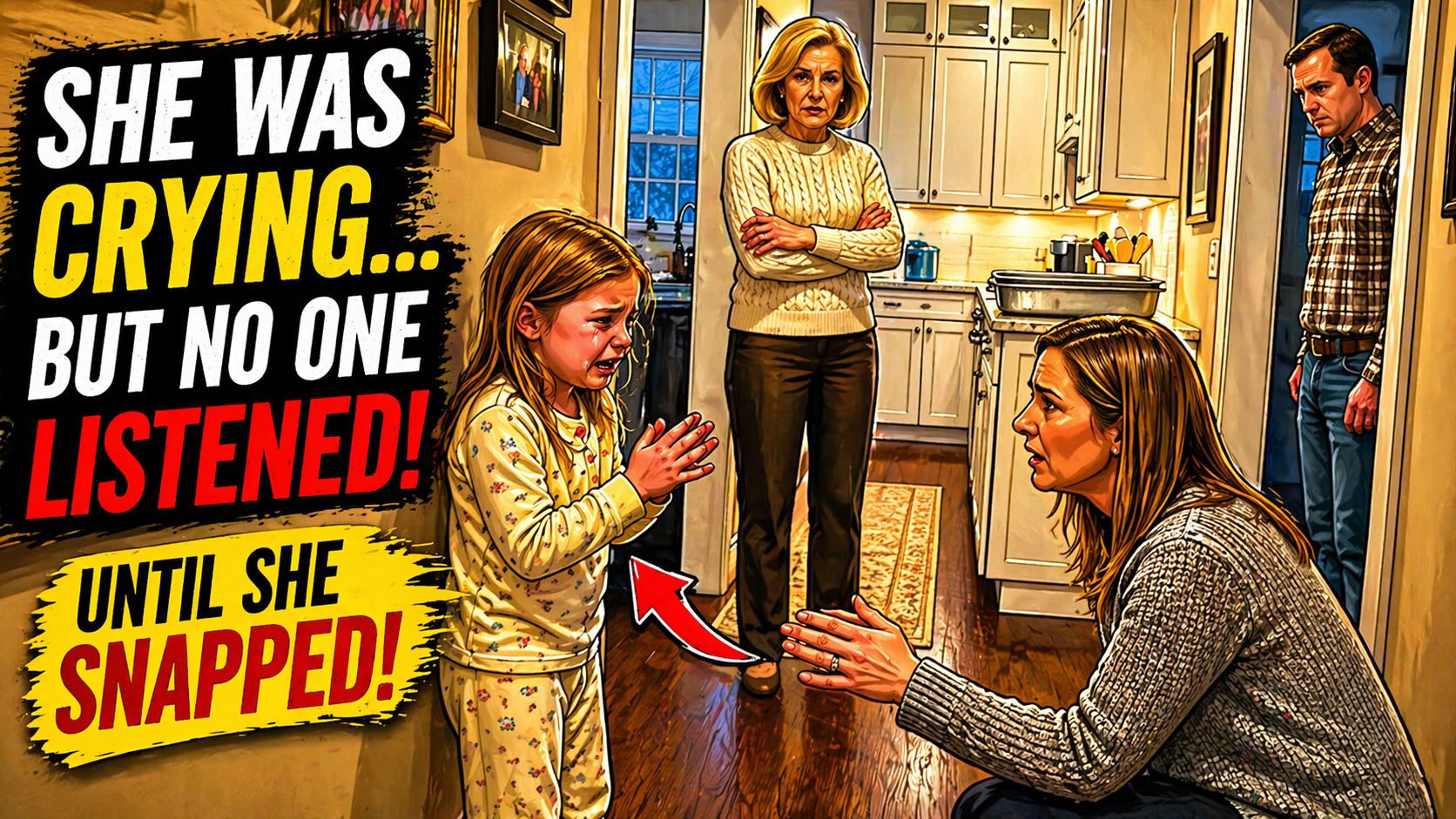
She told me she was locked in the bathroom at her grandmother’s house.
She told me not to be mad.
Then she said the sentence that made the room tilt: Janice had burned her hands for stealing bread.
She said Janice had made her hold a hot pan because she took a piece before dinner.
She repeated the phrase like she was reciting something she had been forced to memorize: pain teaches thieves.
Evan had taken Lily to his parents’ house that weekend because he said she needed stability.
We were not fully divorced yet, but our marriage had been limping for a year.
We still knew each other’s habits and weak spots, but not each other’s hearts.
He had started talking about his parents’ home like it was evidence in a custody hearing.
Their house was large.
Their lawn was edged.
Their refrigerator was full.
Their curtains matched.
In his mother’s opinion, all of that added up to morality.
I grabbed my keys and dialed 911 before I reached the parking lot.
I told the dispatcher my daughter was seven years old and had burns on both hands.
I said my mother-in-law had done it intentionally.
I said I was on my way to the house in Brookside Estates, the one with the white columns and the fake brass pineapple on the front step.
The dispatcher asked if Lily was in immediate danger.
I said yes, because anyone willing to teach a child with heat was willing to do worse once they felt cornered.
Janice opened the door before I had fully stopped knocking.
She wore a cream sweater and a practiced expression.
That woman could have hosted a charity lunch ten minutes after hurting a child.
She looked at me like I had come to return an item without a receipt.
I did not ask permission to enter.
I brushed past her and called Lily’s name until I found her huddled in the hallway by the downstairs bathroom.
She was still in the same yellow pajamas she had left my apartment in the day before.
Her face was blotchy from crying.
Her little hands were lifted in front of her as if even air hurt.
When I looked closely, I saw angry red patches across both palms and the beginning of pale swelling in the center of each one.
I had worked enough service jobs and burned myself enough times on cheap pans to know what an accidental kitchen burn looked like.
matched.
Centered.
Deliberate.
I asked who had touched her.
Lily looked over my shoulder and whispered, ‘Grandma.’ Janice did not deny it.
That is the part that still chills me more than anything else.
She did not rush forward.
She did not say it was an accident.
She did not panic.
She squared her shoulders and said she had corrected Lily because the child took bread after being told to wait.
In that moment, I slipped my phone deeper into my coat pocket and hit record.
I asked her whether she had put my daughter’s hands on a hot pan.
Janice lifted her chin and said, in a voice so composed it sounded rehearsed, that she had allowed Lily to feel the heat briefly so she would understand consequences.
She said it would be kinder to teach that lesson at seven than to let her grow into a woman who thought taking what was not hers was acceptable.
I have replayed that recording many times since.
Even now, the calmness is the worst part.
Evan came in from the garage while I was still kneeling beside Lily.
He looked at her hands, then at me, then at his mother.
I waited for the look on his face to match mine.
It never did.
He rubbed the back of his neck and asked whether we could handle it without making everything bigger than it needed to be.
I asked him whether he was hearing himself.
He said his mother had been disciplining Lily, not trying to hurt her.
It was the moment I understood that cowardice can be as dangerous to a child as cruelty.
The officers arrived within minutes, followed by paramedics.
One officer looked at Lily’s hands and his whole expression changed.
The paramedic crouched to her level, asked permission before even coming close, and then told me in a low voice that these needed to be examined at the hospital.
Janice kept trying to speak over everyone, calling it a family misunderstanding.
Evan kept saying nobody meant for it to get out of hand.
Lily buried her face in my shoulder and flinched every time Janice used the word lesson.
At the emergency room, the physician cleaned the burns and documented them from every angle.
He told me they appeared consistent with forced contact against a heated surface rather than a quick accidental touch.
He used careful language because doctors are trained to be precise, but I could still hear the meaning underneath.
A hospital social worker interviewed Lily alone with a child specialist present.
When they brought me back in, the specialist explained that Lily had repeated the same sequence several times without changing it: she took bread, Janice accused her of stealing, Janice told her thieves remember pain, and Janice pressed her hands down when she tried to pull away.
That night Lily slept in a hospital bed with both palms wrapped in white dressing.
She cried when the nurse brought her a dinner tray because there was a roll on it.
She looked at the bread and whispered, ‘I didn’t mean to be bad.’ I sat beside her and felt something inside me harden into shape.
I told her she had not stolen anything.
I told her hungry children reaching for food were not criminals.
I told her no decent adult turns shame into discipline.
Then I called the legal aid number a nurse wrote on the back of a brochure and left a message before midnight.
By nine the next morning, I was sitting in a cramped office across from a family-law attorney named Denise who wore drugstore reading glasses on a beaded chain and spoke with the calm of someone who had seen every variety of manipulative relative.
She did not waste a second.
She copied the hospital discharge papers, downloaded the audio recording from my phone onto two devices, told me to photograph Lily’s bandages every day, and helped me file for an emergency protective order and emergency temporary custody.
Janice and Evan moved fast too.
By afternoon, Evan was texting me that this had all been misunderstood.
Janice sent a message through him claiming Lily had grabbed a hot baking sheet while trying to sneak food, and that I was exploiting a minor kitchen accident because I hated his family.
The problem for them was timing.
Lily had called me from a locked bathroom before anyone sought medical care.
I had a 911 call logged while I was driving to the house.
I had a recording of Janice admitting she had let Lily ‘feel the heat’ to teach consequences.
Their polished version of events collapsed the moment it touched evidence.
The first family-court hearing happened two days later.
I borrowed a blazer from a coworker because mine still had a grease stain near the cuff.
Janice came in with pearls and a lawyer who looked expensive.
Evan sat beside them, which hurt more than I expected even after everything.
Denise put the medical photographs, the ER report, my 911 call log, and the audio recording into evidence.
When the judge heard Janice say it was better for Lily to learn now than grow into a thief, the courtroom went still.
Judges hear excuses every day.
They do not often hear a grandmother calmly rationalize hurting a child over bread.
The judge granted me temporary sole physical and legal custody on the spot.
Evan’s visitation was reduced to supervised visits at a monitored center until further review.
Janice was ordered to have no contact whatsoever with Lily.
Outside the courtroom, she looked at me with a face full of offended superiority and said I was ruining this family.
I said, very quietly, that she had done that when she decided pain was an acceptable teaching tool for a second piece of bread.
The criminal case moved more slowly, but once child-protective investigators and detectives finished their interviews, Janice was charged with child abuse and assault.
Because she had no prior record and because first-time defendants almost always believe the world will bend for them, she expected sympathy.
What she got instead was a booking photo in the county blotter and a very public unraveling of the reputation she had spent decades polishing.
Janice chaired a church donation drive, volunteered at school events, and sat on the welcome committee in that immaculate neighborhood.
For exactly forty-eight hours, a few people tried to explain the whole thing away as an unfortunate misunderstanding.
Then the police affidavit became part of the record.
Then neighbors learned the victim was seven.
Then people heard that the alleged
offense involved forcing a child’s hands onto hot metal over bread.
The excuses dried up fast.
The church removed Janice from every volunteer role.
The school sent a notice that she would no longer be participating in any student-facing activities.
In Brookside Estates, curtains twitched every time a reporter parked nearby.
I did not call the press.
I did not need to.
Truth has a way of becoming loud when the facts are ugly enough.
Evan kept trying to convince me that the criminal case was punishment enough and that we should work out the custody issue privately.
Denise told me never to negotiate from pity when a child had already been harmed.
During discovery, we got copies of text messages between Evan and Janice from earlier that weekend.
In them, Janice complained that I was raising Lily without structure and that she would show Evan what real discipline looked like.
Evan replied with a thumbs-up and a message that he was tired of Lily getting away with everything.
He heard her crying that evening and stayed in the garage because his mother told him she was learning consequences.
Those messages changed the custody case from negligence in theory to negligence on paper.
The final custody order was entered four months later.
I was granted sole legal and primary physical custody.
Evan was allowed supervised contact only, contingent on completing a parenting program, individual therapy, and a child-safety course.
He cried in court when the order was read.
I believed the tears were real.
I also believed they were late.
Love that arrives only after consequences is not the kind of love a child can safely rely on.
I did not stop Lily from seeing him under supervision, but I stopped confusing his regret with protection.
Janice refused an early plea offer because she was convinced a jury would see her as strict, not dangerous.
That illusion lasted until her own recorded words were played during a pretrial hearing.
She sat at the defense table in a navy suit, hands folded, while the courtroom heard her say she had let Lily feel the heat on purpose.
You could almost see the realization move across her face: she was not being judged for an attitude anymore; she was being judged for an act.
A month later, she entered a plea that spared Lily from testifying in a full trial.
At sentencing, I read my victim-impact statement with both hands shaking.
I talked about the burns, yes, but I also talked about the bread.
About how my daughter cried in a hospital room because she thought reaching for food made her bad.
About how adults who weaponize hunger and shame do damage long after skin closes.
The judge sentenced Janice to county jail, probation, court-ordered counseling, restitution for Lily’s medical expenses and therapy, and a strict no-contact order.
The sentence did not erase what she did, but it did something important: it put a legal name on it.
It told Lily, in the plain language of the court, that what happened to her was wrong.
I was not finished.
Denise referred me to a civil attorney who agreed to take our case for damages.
Janice’s homeowners insurer denied coverage because the harm was intentional, which meant her family’s beautiful house finally became
more than a backdrop.
Faced with the criminal conviction, the medical evidence, the recording, and the custody findings, Janice and her husband settled before trial.
They had to refinance against the house she had worshipped for years to pay medical costs, future therapy, legal fees, and a fund for Lily’s ongoing care.
The same address she thought made her untouchable ended up paying for my child’s healing.
Healing, I learned, did not happen in one triumphant moment.
It happened in fragments.
It happened when Lily let a nurse change her bandages without hiding her face.
It happened when she stopped asking permission before taking a snack from our own pantry.
It happened when her occupational therapist turned hand exercises into games and she laughed in spite of herself.
It happened in the therapist’s office when she finally said, without whispering, that Grandma had been wrong and that being hungry did not make her a thief.
For a long time, bread was the hardest part.
Toast made her tense.
Dinner rolls made her stare.
The smell of something baking could send her quiet for an hour.
So we started small.
We made grilled cheese together, and I let her place the slices on the plate herself.
We tore supermarket rolls into little pieces and fed pigeons at the park so bread could become silly instead of frightening.
Months later, when the skin on her palms had healed into faint silver-pink marks, we tried baking our own loaf.
She was nervous standing in front of the oven.
I could see it in the way she tucked her elbows close.
So I showed her the oven mitts first.
Then I showed her how I set the timer.
Then I showed her that nobody would touch anything hot without protection and that in our home rules existed to keep people safe, not to humiliate them.
When the loaf was done, I pulled it out and set it on the stove.
Lily watched the steam rise, took a breath, and asked if she could have the first piece.
I said yes before she finished the sentence.
A year after the call, our life looked ordinary in the way I had once craved.
Ordinary had become a luxury.
The divorce was final.
Evan was still working through supervised visitation and, to his credit, had stopped asking for shortcuts.
Janice was out of jail but remained under a no-contact order.
Brookside Estates no longer interested me, though I did hear through the usual neighborhood chain that the house with the white columns was eventually sold.
I did not celebrate that.
Houses are just wood and drywall.
The real victory was smaller and infinitely more important.
It happened on a Saturday morning in our apartment kitchen.
Sunlight hit the table.
The kettle hissed.
Lily, now a little taller and a lot louder, stood on a chair and tore a warm slice from the loaf we had baked together.
Then she tore off another piece without asking.
She caught herself, looked at me for one tiny second, and I watched the old fear try to return.
I smiled and slid the butter toward her.
‘Take what you want,’ I said.
‘It’s yours.’
She grinned, took a second piece, and started talking about a school art project with butter on
her lip and no fear in her hands.
The scars on her palms were still there if you knew where to look, fine pale reminders of what had happened in that perfect-looking house.
But they were no longer the end of the story.
In our kitchen, with bread cooling on the counter and no one mistaking cruelty for character, my daughter finally understood something Janice never did: a lesson built on pain deserves consequences, and a child deserves safety before anyone else’s image.