Trump 2028 Hats Appear During White House Meeting—Then Hakeem Jeffries Reveals What Happened
President Donald Trump’s Unusual Display During a September 2025 Government Funding Meeting Sparked Renewed Questions About a Third Presidential Term. But the Constitution Places a Clear Limit on How Many Times Someone Can Be Elected President.
What was supposed to be a serious meeting about preventing a United States government shutdown took an unexpected turn when red baseball caps appeared on the president’s desk.
They looked similar to the political merchandise that had become familiar at Donald Trump’s campaign rallies.
But their message was different.
Instead of promoting his current presidency, the hats carried two words.
“Trump 2028.”
The unusual display happened in the Oval Office on Monday, September 29, 2025, during a meeting between President Trump and senior congressional leaders.
Democrats and Republicans had gathered to discuss a federal funding dispute that threatened to shut down government operations.
But the hats quickly became a separate political story.
They raised questions about Trump’s repeated comments regarding the possibility of remaining president beyond his second elected term.
They also prompted a sharp reaction from House Democratic leader Hakeem Jeffries.
And later that evening, another development intensified the controversy.
Trump shared an AI-generated video mocking Democratic leaders.
The combination of the hats and the video shifted public attention from the budget negotiations to the president’s approach to his political opponents.
But behind the headlines was an important constitutional question.
Could Trump actually run for president again in 2028?
The answer depends on the distinction between political messaging and the legal limits imposed by the United States Constitution.
The Meeting Was Supposed to Prevent a Government Shutdown
The September 29 meeting took place shortly before a deadline for federal government funding.
Congress needed to approve legislation to keep government operations funded beyond September 30.
Republican and Democratic lawmakers disagreed about how the legislation should be structured.
Democratic leaders were particularly concerned about health care funding and subsidies affecting insurance premiums.
Republican leaders favored moving forward with a funding measure without accepting the Democrats’ principal demands.
With the deadline approaching, the White House meeting provided an opportunity for the two sides to discuss their differences directly.
Those attending included President Trump, Vice President JD Vance, House Speaker Mike Johnson, Senate Majority Leader John Thune, House Minority Leader Hakeem Jeffries, and Senate Minority Leader Chuck Schumer.
The stakes were substantial.
Without a funding agreement, federal agencies faced the prospect of a shutdown.
Then Two Red Hats Appeared on the Desk
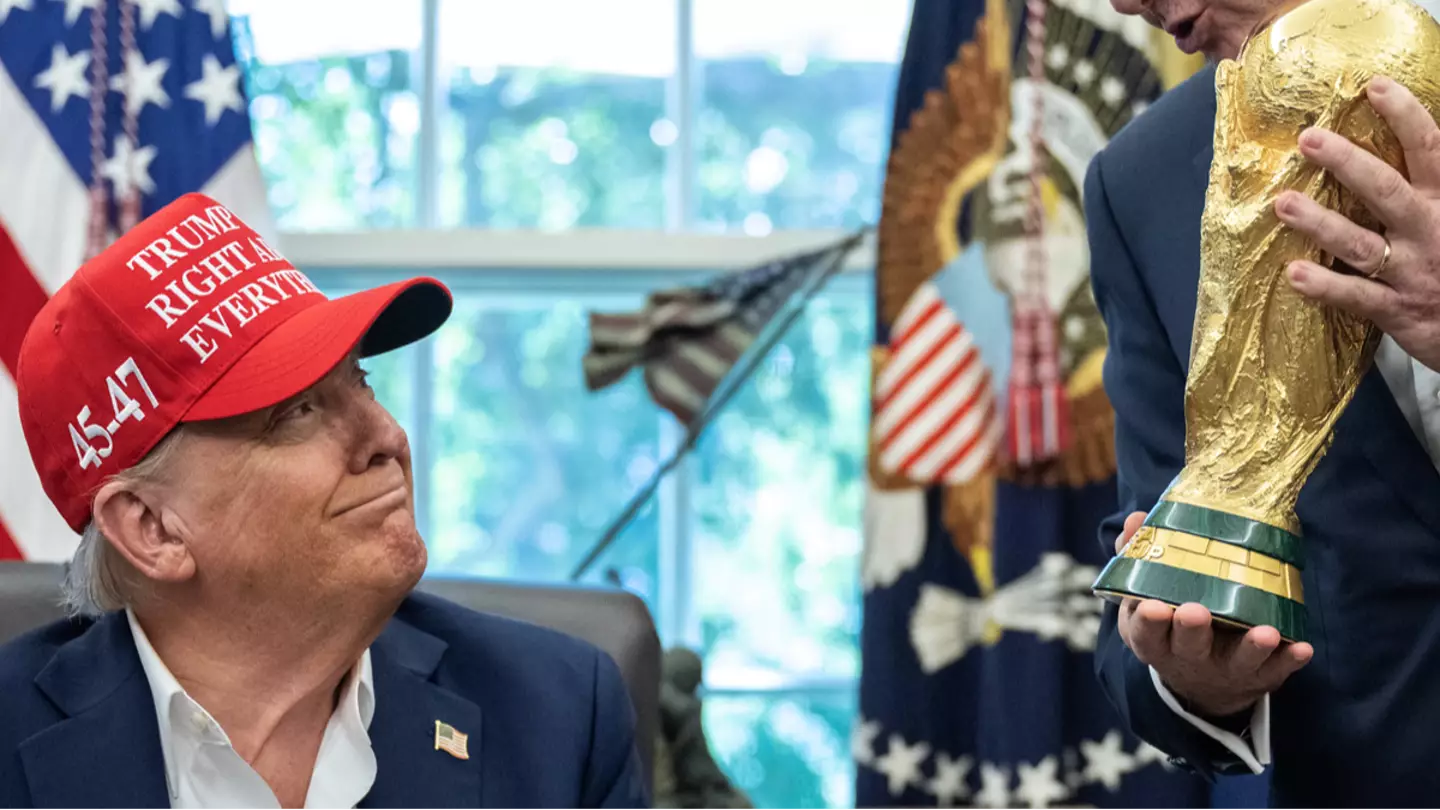
According to the Associated Press, the meeting was underway when two red hats bearing the words “Trump 2028” appeared on the president’s desk.
They were positioned in front of the congressional leaders.
Jeffries later described the moment as surprising.
He said the hats appeared while the participants were attempting to discuss serious policy differences.
The Democratic leader recalled looking toward Vice President JD Vance and questioning whether he had a problem with the message on the hats.
Jeffries said Vance did not offer a substantive reply.
The moment produced laughter inside the room.
But it also left Democrats questioning the purpose of the display.
Hakeem Jeffries Revealed His Reaction
During a September 30 appearance on CNN, Jeffries explained what had happened.
He said Trump had not personally tried to hand the hats to him or Schumer.
Instead, they appeared on the desk during the meeting.
Jeffries described the incident as unusual and distracting.
He also indicated that his attention remained on the approaching funding deadline.
The Democratic leader believed the negotiations should focus on preventing disruptions to government services and addressing health care costs.
His account helped clarify the sequence of events inside the Oval Office.
The Photograph Quickly Attracted Attention
Images showing the hats circulated through social media and news coverage.
Political observers noticed the year printed on them.
Trump’s second presidential term began in January 2025.
Under the existing Constitution, a president who has already been elected twice cannot be elected to a third term.
That made the phrase “Trump 2028” especially provocative.
Some viewers interpreted the hats as political theater intended to unsettle opponents.
Others regarded them as a reference to Trump’s past comments about serving beyond his current term.
But the display did not announce an official presidential campaign.
Nor did it change the Constitution.
Why 2028 Is Such a Controversial Date
Donald Trump won the 2016 presidential election.
He served as president from January 2017 until January 2021.
He lost his reelection campaign in 2020 to Joe Biden.
Four years later, Trump won the 2024 election and returned to the White House in January 2025.
That made him the second United States president to serve two nonconsecutive terms, following Grover Cleveland.
However, the nonconsecutive nature of his presidencies does not create an exception to the constitutional limit.
Trump has already been elected president twice.
The 22nd Amendment therefore prevents him from being elected president a third time under current constitutional law.
What Does the 22nd Amendment Actually Say?
The 22nd Amendment was ratified in 1951.
It established a limit on the number of times an individual may be elected president.
Its central rule states that no person may be elected to the office more than twice.
The amendment also contains a separate provision for individuals who assume the presidency during another person’s term.
For Trump, the principal issue is straightforward.
He won presidential elections in 2016 and 2024.
Those two victories do not violate the amendment.
But a third presidential election victory would conflict with its express limitation.
Could the Constitution Be Changed?
The Constitution can be amended.
However, the process requires exceptionally broad political support.
One established method requires an amendment to be proposed by two-thirds of both chambers of Congress.
It must then be ratified by three-fourths of the states.
The Constitution also provides an alternative proposal process involving a convention requested by two-thirds of state legislatures.
Neither method allows a president to change constitutional term limits by executive order or personal declaration.
Simply selling hats, posting campaign-style slogans, or discussing another election does not remove the restriction.
Trump Has Previously Discussed a Third Term
The September 2025 photograph was not the first occasion when Trump had raised the idea of remaining in office beyond his second term.
He had made remarks about the possibility during conversations with journalists and public appearances.
Some of those comments were delivered humorously.
Others prompted questions about whether he was seriously considering a constitutional challenge.
Trump’s statements have varied over time.
That history helps explain why the 2028 hats attracted substantial attention.
But public comments do not establish that a lawful route to a third elected term exists.
The Legal Questions Are More Complicated Than the Slogan
Most discussion of a potential third term begins with the 22nd Amendment.
But commentators have also debated hypothetical succession scenarios involving a former two-term president.
Those arguments raise additional questions under the 12th Amendment and other constitutional provisions.
Legal scholars disagree about certain hypothetical interpretations.
However, there is no settled, court-approved mechanism that would allow Trump to circumvent the 22nd Amendment and be elected president for a third time.
The clear constitutional rule remains that a person cannot be elected to the presidency more than twice.
The Shutdown Negotiations Continued Despite the Hats
The unusual display did not eliminate the policy differences between the parties.
Congressional leaders continued discussing the funding deadline.
Democrats wanted assurances involving health care subsidies and other budget-related concerns.
Republicans favored their proposed short-term funding approach.
The meeting ended without a breakthrough.
Both sides subsequently presented their positions to reporters.
Democratic leaders argued that their health care concerns had not been adequately addressed.
Republican leaders maintained that the immediate priority was keeping government agencies operating.
Health Care Was a Major Point of Disagreement
One central issue involved health insurance subsidies under the Affordable Care Act.
Democratic lawmakers wanted an agreement that would preserve financial assistance for eligible insurance customers.
They argued that allowing the subsidies to expire could lead to higher premiums for many families.
Republican leaders disputed the need to include those provisions in the immediate government funding measure.
These disagreements were central to the negotiation.
They also illustrate why the meeting carried consequences far beyond political messaging.
The outcome could affect federal operations and the finances of households relying on health coverage.
Later, Trump Posted an AI-Generated Video
After the Oval Office meeting, Trump posted a separate video on Truth Social.
The video used artificial intelligence to mock Democratic leaders Jeffries and Schumer.
It included fabricated dialogue and altered visual elements.
The production falsely attributed statements to Schumer about Democrats’ policy goals.
Jeffries was depicted using stereotypical imagery associated with Mexican culture.
The clip attracted criticism from Democratic leaders and others who viewed the imagery as offensive.
It also prompted renewed questions about the use of synthetic media in political communication.
Jeffries Strongly Criticized the Video
Jeffries condemned the AI-generated clip.
During a CNN interview, he described Trump’s conduct as unserious and criticized what he viewed as a lack of good-faith engagement from Republican leaders.
He argued that lawmakers should be concentrating on protecting government services and addressing health care costs.
The Democratic leader also characterized the video as racist.
Those criticisms represented Jeffries’ assessment of the president’s actions.
Trump and his supporters have often defended provocative social media posts as humor or political commentary.
The episode nevertheless created a new controversy during an already tense funding debate.
Chuck Schumer Also Responded
Senate Democratic leader Chuck Schumer criticized the president’s social media activity after the meeting.
He argued that the video undermined the seriousness of the negotiations.
Schumer maintained that Democrats had come to the White House seeking a funding agreement.
He also expressed concern that the administration was not adequately engaging with their demands.
Republican leaders, meanwhile, continued blaming Democratic opposition for the lack of a funding deal.
Each side argued that the other bore responsibility for the risk of a shutdown.
The Debate Extended Across Social Media
The image of the “Trump 2028” hats generated extensive discussion online.
Some users described the display as political trolling.
Others argued that it was inappropriate during an important government funding negotiation.
Still others focused on the constitutional implications of a third presidential term.
Supporters of Trump sometimes interpreted the merchandise as a joke intended to provoke political opponents.
Critics worried that repeated references to an additional term could normalize challenges to established constitutional restrictions.
The different reactions showed how the same political symbol could be interpreted in sharply contrasting ways.
Did Trump Actually Announce a 2028 Campaign?
No formal presidential campaign announcement was established by the Oval Office photographs.
The hats were political merchandise.
They communicated a provocative message.
But they were not legal documents or filings establishing candidacy.
They also did not provide any basis for disregarding the 22nd Amendment.
The distinction between campaign-style rhetoric and lawful eligibility is essential when evaluating claims about 2028.
The Government Shutdown Was Not Averted
The September 29 meeting failed to produce an agreement before the funding deadline.
The federal government entered a shutdown on October 1, 2025.
Its effects varied across federal agencies and services.
Some essential personnel continued working under applicable rules.
Other government activities were suspended or disrupted.
The dispute demonstrated how unresolved spending disagreements can affect public services and federal employees.
It also showed why the negotiations had been considered urgent.
The Hats Became a Symbol of the Meeting
Although the funding debate involved complicated policy questions, the photograph of the hats became one of the meeting’s most widely shared images.
It was visually simple.
Two red hats.
A familiar political slogan.
And a year that raised obvious constitutional questions.
Those elements made the photograph easy to recognize and discuss.
But they also risked overshadowing the immediate dispute over government funding.
That tension between political spectacle and policy substance became a central theme of the subsequent coverage.
Why the Timing Made the Display Particularly Notable
The meeting took place less than nine months into Trump’s second presidency.
The next presidential election was still more than three years away.
Congress was facing an immediate funding deadline.
Democratic and Republican leaders were attempting to resolve significant budget disagreements.
Yet the political message on the hats referred to a potential future election.
For critics, that contrast was the central concern.
For those who saw the hats as deliberate humor, the display fit Trump’s long-standing approach to political provocation.
Either way, the moment drew attention away from the negotiations themselves.
What the Photograph Does and Does Not Prove
The photographs show that “Trump 2028” hats appeared in the Oval Office during the September 29, 2025 meeting.
Multiple news outlets confirmed the incident.
Jeffries described it in a subsequent interview.
The images therefore document a real event.
But they do not prove that Trump could lawfully win a third presidential election.
They do not establish that the Constitution had been amended.
And they do not demonstrate that a specific future election plan had been formally adopted.
Those would require separate evidence.
A Reminder of the Two-Term Presidential Limit
The 22nd Amendment was adopted after Franklin D. Roosevelt won four presidential elections.
Roosevelt’s unusually long presidency prompted renewed debate about how long one individual should hold the nation’s highest office.
The amendment established an explicit restriction on repeated election to the presidency.
Since its ratification, it has been part of the constitutional framework governing presidential eligibility.
Its application does not depend on whether two terms are consecutive.
That means Trump’s break from office between 2021 and 2025 does not reset the count.
Why Some People Mention Barack Obama
During online discussions about the hats, several commenters referred to former President Barack Obama.
Obama won the presidential elections of 2008 and 2012.
He therefore also reached the constitutional two-election limit.
The 22nd Amendment applies equally to both men.
Political party affiliation does not change the restriction.
Neither Trump nor Obama can be elected president for a third time under the amendment’s existing language.
The Legal Rule Is Separate From Political Popularity
A candidate’s public support does not override constitutional eligibility requirements.
Even if a former president attracts substantial political enthusiasm, the legal restrictions remain applicable.
The same principle applies regardless of political party.
Constitutional amendments establish rules that cannot simply be set aside because a campaign slogan becomes popular.
Any change to those rules would require a valid constitutional process.
That is why discussions about a third Trump term need to distinguish political messaging from legal reality.
What Hakeem Jeffries Wanted the Meeting to Address
Jeffries argued that the immediate focus should be on government funding and health care costs.
His public statements emphasized preserving financial assistance for people purchasing insurance and preventing disruptions to federal services.
He criticized the hats because he considered them a distraction from those priorities.
Republican leaders disputed Democrats’ demands and argued for passing a temporary funding measure.
These differences remained unresolved at the conclusion of the meeting.
The subsequent shutdown was the result of the failure to enact funding legislation by the deadline.
A Photograph That Raised Questions About 2028
In September 2025, the red hats briefly became the center of attention during an important White House meeting.
The words “Trump 2028” immediately triggered discussion about the possibility of a third presidential term.
The image also generated political criticism because it appeared during negotiations intended to prevent a government shutdown.
Jeffries later described how the hats appeared and expressed frustration with the president’s conduct.
Trump then posted an AI-generated video mocking Democratic leaders, adding to the controversy.
But the constitutional position remained unchanged.
Trump had been elected president twice.
His 2016 and 2024 victories were lawful.
And the 22nd Amendment prohibited his election to the presidency for a third time.
The hats did not alter that rule.
The Real Story Behind the Trump 2028 Hats
President Donald Trump met with congressional leaders on September 29, 2025, during an urgent effort to prevent a federal government shutdown.
During the discussion, red hats bearing the words “Trump 2028” appeared on the Oval Office desk.
House Democratic leader Hakeem Jeffries later confirmed the incident.
He described the hats as an unexpected distraction during negotiations over government funding.
The event became more controversial when Trump posted an AI-generated video mocking Jeffries and Senate Democratic leader Chuck Schumer.
Democrats condemned the video.
Republicans continued arguing for their preferred funding legislation.
And the negotiations failed to prevent the October 1 shutdown.
Meanwhile, the “Trump 2028” message raised a separate question about the president’s future.
Could he seek another elected term?
Under the current 22nd Amendment, he cannot be elected president a third time.
His nonconsecutive terms do not create an exception.
And political merchandise cannot change constitutional law.
The Oval Office photograph remains a documented example of the unusual political messaging that surrounded the 2025 funding dispute.
It also illustrates how a brief, highly visible moment can dominate headlines even when the central issue involves complex government policy.
For lawmakers, the immediate challenge was funding the federal government.
For political observers, the hats reopened debate about presidential term limits.
And for anyone trying to understand the controversy, the essential distinction remains simple.
The message on the hats was real.
The meeting was real.
But the Constitution’s two-election limit remained in force.
Editor’s note: This article covers events from September and October 2025, not a new 2026 meeting. As of October 2026, the 22nd Amendment continues to prohibit an individual from being elected president more than twice.

