The Day My Sister Aimed Her Car at My Daughter
Part 1
The first thing I remember is the sound.
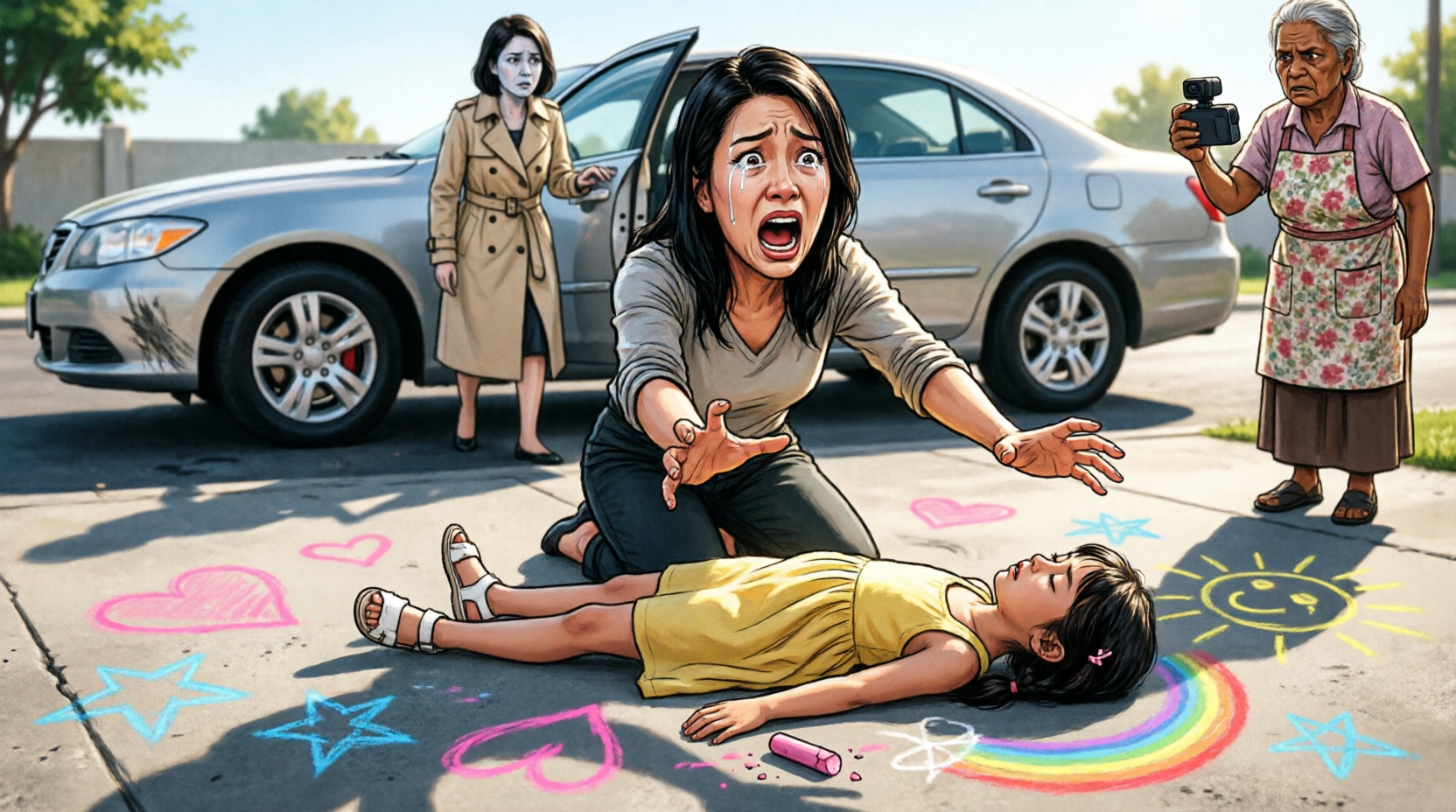
Not the scream that ripped out of me a second later. Not my mother’s voice floating from the porch like she was annoyed dinner had been interrupted. I remember the engine first—a sharp, ugly roar that did not belong in a quiet August driveway where my six-year-old daughter had been kneeling with pink sidewalk chalk all over her fingers.
Chloe had been drawing a rainbow. That detail still haunts me. The yellow stripe was unfinished when Briana’s silver sedan lunged forward.
For one frozen instant, I thought my sister was going to brake. She had turned into my parents’ driveway too fast, but she slowed, and Chloe looked up. I saw my daughter’s face change from concentration to confusion. Then the car surged.
The impact made a sound I had never heard before and hope I never hear again. A heavy, sickening thud followed by the scrape of small bones and skin on concrete. Chloe’s body flew sideways, hit the pavement, and rolled once before going still. Her little white T-shirt bloomed red at the shoulder.
I dropped the grocery bag I was carrying. Peaches rolled across the driveway and split open in the heat, sweet juice running into the chalk dust. One of the jars of pasta sauce shattered near my foot. I was already moving before I realized I was screaming.
“Chloe!”
My knees slammed into the concrete beside her. The heat from the driveway burned through my skin, but I barely felt it. My daughter’s blonde curls were matted with blood near her temple. Her left arm bent wrong, curved where no arm should curve. Her lips were parted, but no sound came out.
I hovered my hands over her, terrified to touch her, terrified not to. My phone felt slippery in my palm when I grabbed it from my purse.
Behind me, Briana’s driver-side door swung open.
“She shouldn’t have been standing there,” my sister said.
Not gasping. Not crying. Not apologizing. Just annoyed. Her voice had the same bored edge she used when restaurant service was slow.
I turned so fast I nearly fell. Briana stood next to her car in linen pants and oversized sunglasses, one hand still on the door. She had that polished, expensive look she always favored at family gatherings, like she expected every ordinary moment to become a photograph. Her mouth twitched at the corner in something that made my stomach go cold.
My parents came onto the porch then, drawn by my screaming.
Mom pressed a hand to her chest, her bracelets catching the sun. Dad came slower, one arm braced on the railing, his forehead lined with irritation instead of urgency. The air smelled like gasoline, hot pavement, and the metallic tang of blood.
“Call 911!” I screamed.
Mom frowned like I had raised my voice at church. “Lindsay, calm down.”
Chloe didn’t move. I put two shaking fingers against her neck and nearly collapsed from relief when I found a pulse. Thin. Faint. There.
“Mom!” I shouted. “Call an ambulance!”
“You’re overreacting as usual,” she snapped.
That sentence hit me almost as hard as the car had hit Chloe. My brain could not make sense of it. My daughter lay limp on the driveway, and my mother was using the same tone she used when I was fifteen and accused Briana of stealing money from my room.
Dad didn’t even look at Chloe first. He went straight to Briana.
“Are you okay, sweetheart?” he asked.
Sweetheart.
He put his arm around the woman who had just run down his granddaughter.
My fingers shook so violently I almost dropped my phone while dialing emergency services. The operator answered, and I heard my own voice from very far away, brittle and too high.
“My daughter’s been hit by a car,” I said. “She’s six. She’s unconscious. Please hurry.”
The operator asked for the address, whether she was breathing, whether the driver was still on scene. I answered while staring at Briana over Chloe’s body.
My sister had taken off her sunglasses. Her eyes met mine briefly, and there it was again—that same tiny upward curl in her mouth. If you weren’t looking for it, you might have missed it. I didn’t miss it.
I had seen her face through the windshield just before impact. Focused. Deliberate.
Not confused. Not panicked.
Focused.
The operator told me not to move Chloe unless she stopped breathing. I stayed on my knees, one hand inches from my daughter’s cheek, counting every breath like I could hold her here by force if I kept track of them.
Mom descended the steps finally, but not toward us. She stopped near Briana’s car and stared at the bumper.
“Oh, Briana,” she said softly. “There’s a scratch.”
I looked up at her. For one insane second, I wondered if I had lost my mind. If maybe heatstroke had cracked something in me and this was all some grotesque hallucination, because no real grandmother would say that while her grandchild bled on the ground.
“She was drawing,” I said, my voice shaking. “You both saw her. She was right there.”
Dad gave me that look I’d known since childhood—the one that meant I was being inconvenient, emotional, exhausting.
“Your sister would never do that on purpose.”
Briana crossed her arms. “She came out of nowhere.”
“She was in the driveway,” I said. “She was in the exact same place for ten minutes.”
“Lindsay,” Mom said sharply, “stop making this worse.”
Worse.
The word nearly made me laugh. My body was vibrating with so much adrenaline I could taste metal. A fly landed on Chloe’s chalk drawing and crawled over the blue arc of the rainbow. Somewhere down the block, a dog barked once and went silent.
Then I heard sirens.
The ambulance arrived in what the paramedic later told me was seven minutes. It felt like an hour. By then my throat was raw, my dress was stained with Chloe’s blood from where I had leaned over her, and Briana had managed to compose herself into the posture of a wronged woman enduring someone else’s dramatics.
The paramedics moved quickly, kneeling beside Chloe, fitting a collar around her neck, checking her airway. One of them, a woman with freckles and kind eyes, asked me what happened.
“My sister hit her,” I said.
“It was an accident,” Briana cut in immediately.
The paramedic glanced between us but said nothing. Her jaw tightened just slightly. They loaded Chloe onto a stretcher, and when they lifted her, my daughter made a soft sound, almost a whimper, that tore straight through me.
I climbed into the ambulance with her. I did not look back at my family. I couldn’t. I knew if I did, I’d either break down or say something I could never take back.
As the ambulance doors slammed shut, I caught one last glimpse through the small rear window.
My father’s arm was around Briana’s shoulders.
My mother was rubbing Briana’s back.
And my sister, standing in the August sunlight beside the car that had nearly killed my child, looked right at me and smiled.
That was when I knew this was not an accident.
And by the time we reached the hospital, I was already beginning to understand something even worse: I might be the only one willing to say it.
Part 2
Riverside Memorial always smelled too clean.
Bleach, lemon disinfectant, cold air from the vents—everything bright and polished and scrubbed within an inch of humanity. The emergency entrance swallowed us fast. One set of doors opened, another hissed shut behind us, and Chloe disappeared into a blur of blue scrubs and clipped instructions before I could do anything except keep moving.
“Possible skull fracture.”
“BP’s dropping.”
“Page pediatric trauma.”
The words flew past me like birds. I clung to fragments. Chloe is breathing. We’re stabilizing her. You need to wait here.
Wait.
That was the first cruelty of hospitals. They reduce you to the most helpless version of yourself and call it protocol.
I sat in the pediatric ICU waiting room with dried blood on my calves and my hair stuck damply to the back of my neck. My sundress, yellow that morning, now had rust-colored smears across the skirt where I’d knelt in the driveway. My sandals left chalk dust on the shiny floor when I moved. There was a vending machine humming in the corner, a TV mounted high on the wall showing a muted cooking show, and a little basket of stale coffee stirrers no one had touched.
The doctor came out after twenty-two minutes. I know because I watched the second hand on the clock over the reception desk like it might punish me if I stopped.
Tall. Gray at the temples. Tired eyes.
“She has a fractured skull,” he said gently. “A broken left arm. We’re monitoring internal bleeding, but at the moment she’s stable. She’s unconscious. The next few hours are important.”
I gripped the armrests of the plastic chair so hard my fingertips went numb.
“Is she going to die?”
“No,” he said quickly. “We don’t think so. Right now, she’s holding steady.”
I nodded even though I didn’t feel my head move. A nurse handed me a clipboard full of forms. Insurance. Emergency contacts. Allergies. I wrote with shaking fingers, letters coming out crooked and too dark because I kept pressing the pen too hard.
Then I called Marcus.
He answered on the second ring, all background airport noise and business-trip brightness until he heard my voice.
“What happened?”
The words came apart while I said them. Car. Chloe. Hospital. Briana.
Silence on the other end. Then a chair scraping. Then Marcus breathing hard like he’d been punched.
“I’m booking the first flight back,” he said. “Don’t hang up.”
I did anyway, because a nurse was calling my name, and then because I couldn’t bear to hear how frightened he sounded when I already felt like my bones had been hollowed out.
I was alone for thirty-eight minutes after that.
Long enough for the blood on my dress to dry stiff.
Long enough to stare at the double doors leading to the ICU until my eyes burned.
Long enough to think, maybe stupidly, that my parents would come to their senses.
They did come.
Just not to their senses.
The three of them entered together like a unit—Mom in linen slacks and lipstick she’d reapplied, Dad in loafers and an expression of forced patience, Briana wearing a pale blouse I’d seen her wear to brunches where she wanted to look innocent and expensive at the same time.
The sight of them made every muscle in my body lock.
Before I could stand, Mom crossed the waiting room and intercepted the doctor as he came back through the doors.
“Doctor,” she said in that warm social voice she used on clergy and real estate agents, “I need you to understand something about my daughter Lindsay.”
I froze.
The doctor stopped politely, one hand still on Chloe’s chart.
Mom lowered her voice, but not enough. “She has a long history of exaggerating situations. She makes things dramatic when they don’t need to be.”
The doctor’s expression changed almost imperceptibly. Not agreement. Discomfort.
I pushed up from my chair so fast it screeched across the linoleum.
“My daughter is in there with a fractured skull.”
Mom didn’t even look at me. “Exactly. She’s upset, understandably, but Lindsay has always had a tendency to turn accidents into conspiracies.”
Dad joined her, resting two fingers lightly on the doctor’s forearm as though they were peers discussing a mutual friend. “Briana is an extremely careful driver. Whatever my other daughter thinks she saw, I’m sure this was a terrible mistake.”
My mouth went dry.
“Are you hearing yourselves?”
Briana let out a shaky breath and dabbed at the corners of her eyes with a tissue. Still not crying. Just performing the shape of a woman who might.
“I feel awful,” she whispered. “Chloe darted out and I panicked. I must have hit the wrong pedal.”
Hit the wrong pedal.
The lie was so cleanly prepared it almost impressed me.
“She was sitting in the driveway,” I said. “You saw her.”
The doctor glanced between us, then said, “Excuse me, I need to check on the patient,” and left before the argument could attach itself to him any harder.
The minute he was gone, my mother turned on me fully.
“This is exactly what I was afraid you’d do,” she hissed. “You are trying to turn your sister’s mistake into some kind of crime.”
“Mistake?” I laughed once, a cracked ugly sound. “She almost killed my child.”
“Lower your voice,” Dad snapped.
“No.”
The waiting room smelled suddenly too sharp, the fluorescent lights too bright. An old man down the hall looked over his magazine and then quickly looked away.
Briana sat down in one of the molded plastic chairs and crossed her legs neatly. Her heel swung once, once, as if this were a delayed appointment, not a pediatric trauma floor.
“You always do this,” she said. “You take everything personally.”
I stared at her.
Something old shifted inside me then, something I had spent years refusing to name. It was not just rage. It was recognition. The same oily unreality I’d felt at twelve when she shoved me down the basement steps and Mom told me not to be so clumsy. At sixteen when Briana stole money from my prom envelope and Dad grounded me for “causing division” by accusing her. At twenty-three when she flirted with my then-boyfriend all through Thanksgiving and my mother later said I was imagining tension because I “always needed to be the victim.”
The floor under me felt suddenly very thin.
“She meant to do it,” I said quietly.
Mom gave an impatient sigh. “There you go again.”
Dad rubbed his jaw. “Lindsay, no jury in the world is going to believe that a woman would intentionally run over her own niece.”
I looked at Briana.
She was examining one of her fingernails, thumb tracing the fresh almond-shaped edge.
Not crying.
Not shaking.
Not horrified.
Just annoyed.
And then she made the mistake that changed everything.
She looked up at me and said, “Honestly, she shouldn’t have been in the way.”
There are sentences that split your life down the middle. That was one of them.
I stepped toward her before I even realized I had moved. Dad got between us instantly, palms up, protecting her again.
“Don’t you touch her.”
“Get out of my way.”
“Lindsay!”
My mother’s voice carried down the hall. A nurse turned, frowned, then retreated when she saw we were “family,” that magic word that lets people ignore a fire if it’s burning in a nice neighborhood.
I wanted to claw the truth out of the air and make someone else breathe it.
“She said Chloe was in the way,” I said to both of them. “Your granddaughter is unconscious, and all you care about is Briana’s version.”
Mom folded her arms. “Because Briana is not malicious. You are.”
That hit deep because it was old, practiced, familiar. My mother had been using that script on me for so long she didn’t even have to think about it anymore. I was the emotional one. The unstable one. The unreliable narrator of my own life.
Across from us, Briana leaned back and said softly, “This is why nobody takes you seriously.”
I think something in my face changed then, because for the first time, she stopped smirking.
The automatic doors slid open.
An elderly man entered, moving carefully but with purpose, cardigan buttoned wrong at the top, white hair flattened on one side like he’d come in a hurry. He was carrying a black device in both hands.
At first I only noticed the cardigan because it was familiar—brown, with one elbow patched in darker wool. Then his face resolved through the haze in my mind.
Harold Brennan.
He lived two houses down from my parents. He used to wave at me from behind his rose bushes when I was a girl.
He looked from my mother to Briana to me, then came straight toward me.
“Lindsay,” he said. “I came as fast as I could.”
His hands trembled, but not enough to hide what he was holding.
A dashcam.
My family fell silent.
Harold lifted it slightly and said, “I was in my car when your sister hit Chloe. And I got the whole thing on video.”
For one second, no one breathed.
Then my mother said, too sharply, “What did you just say?”
Harold didn’t even glance at her.
He kept his eyes on mine and spoke very quietly, the way people speak when they know the truth is heavy enough without extra volume.
“I saw everything,” he said. “And this was no accident.”
That was the moment the room changed.
And when Harold turned the tiny screen toward us, my sister’s face lost all its color.
Part 3
Harold’s hands were steadier than mine.
That’s what I remember most when he pressed the button on the dashcam. My fingers were shaking so hard I nearly dropped my phone every time it buzzed with hospital updates or Marcus’s flight details, but Harold—seventy-eight, stooped, one elbow patched, cardigan half-buttoned—held that little black device like it was a blueprint and not a bomb.
The waiting room lights reflected off the tiny screen as the footage began.
My mother took one step forward. “You have no right—”
Harold raised a hand without looking at her. “Be quiet, Patricia.”
She actually obeyed. Maybe because no one had ever spoken to her that way. Maybe because for the first time in my life, someone else’s certainty was bigger than hers.
The video started with a timestamp in the corner. Same day. Same hour. Harold’s windshield framed the view of my parents’ street from across the way, his dashboard and steering wheel visible at the bottom. The image was absurdly clear. Every leaf shadow, every crack in the driveway, every chalk line Chloe had drawn.
There she was. My daughter, tiny in pink shorts and a white T-shirt, one knee on the concrete, blonde hair shining in the afternoon sun. Her tongue poked between her teeth the way it always did when she concentrated. She was drawing a rainbow so carefully I could almost hear her narrating the colors to herself.
Briana’s silver sedan appeared at the edge of the frame.
The car turned in too fast, then slowed.
My stomach clenched because I remembered this part. The false pause. The fraction of a second where anyone with a pulse would have braked and corrected and apologized later.
Then the sedan jerked forward.
Not drifted.
Not rolled.
Surged.
Chloe looked up.
The impact came a heartbeat later.
Someone in the waiting room gasped. It took me a second to realize it was me.
The frame rattled from the force. Chloe’s small body hit the hood, spun, and landed hard. I heard my own scream on the recording, thin and distant, as if it belonged to someone standing a mile away.
And then—God—the brake lights came on.
After.
Harold stopped the video before the ambulance arrived. His thumb pressed the button carefully, almost tenderly, like he understood nobody needed to see the rest again right then.
“It also captured her face through the windshield,” he said.
He rewound a few seconds, enlarged the frame with surprising skill, and there it was.
Briana. Clear enough that even my parents could not lie to themselves if they looked honestly. Her eyes fixed forward. Mouth set. No shock. No panic. No scrambling confusion. Just intention.
“That’s not what it looks like,” Briana said immediately, but her voice had gone thin and high.
Harold finally turned to face her. “What does it look like, then?”
She opened her mouth. Closed it.
My father stepped in fast, always faster when Briana needed protecting.
“She hit the wrong pedal,” he said. “That’s a known phenomenon.”
Harold’s expression barely changed. “I spent forty years as a mechanical engineer. I know the difference between accidental pedal confusion and deliberate acceleration.”
Dad’s jaw tightened. “You’re an old man with a grudge.”
“I’m an old man with a camera,” Harold said. “And a clear view.”
My mother reached for his sleeve. “This is family business.”
He looked down at her hand like it was something damp he hadn’t expected to touch him. “A six-year-old child being run down in broad daylight stopped being family business the second it happened.”
Something in me unclenched so suddenly it hurt.
Not relief. Not yet. Chloe was still behind those double doors with a fractured skull and a broken arm. But for the first time since the driveway, someone besides me was standing in the truth and refusing to move.
Harold turned back to me. His face softened.
“I already called the police,” he said.
Briana’s head snapped toward him. “You what?”
“I told them I had dashcam footage of what appears to be deliberate vehicular assault on a child.”
My mother actually made a choking sound.
“Harold, how dare you,” she said. “Do you have any idea what you’re accusing our daughter of?”
His eyes, magnified behind thick lenses, sharpened. “Yes. I do.”
The hospital automatic doors opened again before she could continue. Two police officers entered—one woman, one man, both in dark uniforms still damp at the shoulders from the summer humidity outside. The female officer carried a slim laptop case. The male officer scanned the room once, took in my bloodstained dress, Briana’s pale face, Harold’s dashcam, and something in his posture changed from routine to alert.
“Mr. Brennan?” the female officer asked.
Harold lifted the camera slightly. “That’s me.”
They moved us to a smaller consultation room off the waiting area. It smelled like stale coffee and old carpet. Someone had left a paper cup with lipstick on the rim in the trash. Through the narrow window in the door I could still see part of the ICU hallway, and I kept turning my head to make sure no doctor was coming out looking for me.
The officers watched the footage in silence.
I watched their faces instead.
At first: professional neutrality.
Then concentration.
Then the tightening around the eyes that told me they had seen the same thing I had.
The man officer looked at Briana. “Ma’am, do you want to explain why your vehicle accelerates three seconds after the child becomes visible?”
Briana crossed her arms. “I panicked.”
“You panicked and hit the gas harder?”
“I told you, I pressed the wrong pedal.”
The female officer glanced back down at the screen, replayed the segment, and asked, “Then why does your brake light engage only after impact?”
Silence.
Dad stepped between them like that could still work. “My daughter is upset. You can’t interrogate her like this without—”
“We’re not interrogating,” the male officer said. “We are asking questions regarding an incident in which a minor suffered severe trauma.”
My mother drew herself up, pearls gleaming against her throat. “This is outrageous. Briana is a careful driver. My other daughter has always been unstable, and now an elderly neighbor with too much time on his hands—”
“Ma’am,” the female officer said flatly, “the video is the video.”
That shut her up for exactly three seconds.
Briana looked around the room, saw no opening, and changed tactics. Tears finally appeared—small, perfect ones that caught at the corners of her eyes without ruining her mascara.
“I didn’t mean to hurt her,” she whispered.
The officer did not soften.
“That’s not what I asked.”
Harold stood by the wall with both hands clasped over the dashcam now that it had been downloaded, his face lined with exhaustion. He looked about ten years older than when he walked in, but his spine stayed straight.
My phone buzzed in my hand. Marcus.
I stepped into the hall to answer. He was boarding his connecting flight now, voice tight and wrecked.
“How is she?”
“Still unconscious.”
“Is Briana there?”
“Yes.”
“Did she say it was an accident?”
“Yes.”
He exhaled hard. “Do you believe that?”
I looked through the narrow glass window into the consultation room. Briana sat with her chin lifted and Dad’s hand on her shoulder. Mom leaned toward the officers, lips moving fast, trying to turn reality by force of social confidence.
“No,” I said. “Not for a second.”
When I went back in, the female officer was asking for Briana’s phone.
“My phone?” Briana repeated. “Why?”
“We’d like to review any communications related to the incident.”
“That’s ridiculous.”
“It’s also voluntary right now,” the officer said. “If you’d prefer, we can obtain a warrant.”
That landed.
Briana looked at my father.
He said the exact thing I expected. “Don’t hand them anything until we speak with counsel.”
Of course.
My family had never met a moral crisis they couldn’t translate into legal strategy.
The officers exchanged a look. The male officer closed the laptop and said, “Ms. Holloway, based on the footage and witness statement, we need you to come with us for formal questioning.”
Briana stood. “Am I under arrest?”
“Not at this time.”
Mom moved instantly, linking an arm through Briana’s. “Then we’re leaving.”
The female officer blocked the door with one step. “No. She’s coming with us, or we’ll seek a warrant and make this significantly less pleasant.”
That was when Dad lost his composure.
He jabbed a finger toward me. “This is because of her. She’s blowing up an accident because she’s always been jealous.”
The male officer looked at him for a long second and said, “Sir, your granddaughter is in intensive care.”
I will never forget the silence after that.
Not because it changed my parents. It didn’t. But because it finally made visible what they were willing to ignore.
Briana went with the officers. My parents followed, outraged and indignant, Mom hissing promises about attorneys and reputations and “what this will do to the family.”
As they passed me, Briana turned her head just enough to murmur, “You’re unbelievable.”
I stared at her.
“My daughter is in ICU,” I said. “And you still think this is about you.”
She didn’t answer. For the first time all day, she looked uncertain.
The officers led her out. My parents trailed behind, my father already on his phone with someone he probably called “our guy.” The doors shut. Their noise went with them.
Suddenly the hospital was quiet again. Or maybe I was just too tired to hear anything but the pounding in my ears.
Harold stayed.
He sat beside me in the waiting room for nearly an hour, hands folded over his cane now, cardigan smelling faintly of mothballs and peppermint. He did not fill the silence with platitudes. He did not tell me everything would be okay. He just sat there like a steady object in a room full of collapsing ones.
At one point he said, very quietly, “I’m sorry I didn’t do more sooner.”
I turned to him. “What do you mean?”
He looked at the floor. “I’ve seen things from that house over the years. Things I didn’t understand completely, but enough to know something was wrong.”
A chill moved through me that had nothing to do with hospital air.
“What things?”
He opened his mouth.
Then the ICU doors pushed open, and a nurse came toward us fast, her face serious. My whole body went rigid.
“She’s stable,” the nurse said before I could ask. “But we need you in with the attending.”
I stood so quickly the room tilted.
As I followed the nurse down the hall, I looked back once.
Harold was still seated beneath the waiting-room clock, his hands wrapped over the handle of his cane, his lined face full of a grief so old and familiar that it stopped me cold.
And in that moment, before he said another word, I understood something terrible:
What happened to Chloe hadn’t started with Chloe.
It had started years earlier.
Maybe with me.
Part 4
Marcus got to the hospital at 2:07 in the morning.
I know because I had been watching the blue digital numbers on the ICU clock change one minute at a time while Chloe slept under a nest of wires and white sheets. The room was dark except for the glow of the monitor screens and the city lights beyond the sealed window. Every beep felt personal. Every shift in the line of her oxygen levels made my whole body tense.
When Marcus walked in, he looked like he’d aged five years since breakfast.
His hair was damp with sweat from travel. His shirt was wrinkled, carry-on strap still digging into one shoulder because he hadn’t even stopped to put it down before crossing the room. His eyes found Chloe first, and the sound that came out of him was so small I almost didn’t recognize it as human.
Then he wrapped both arms around me.
I didn’t realize how close I was to falling apart until then. I had been functioning on something sharp and ugly—adrenaline, fury, terror—but Marcus’s chest against my forehead broke the seal. I shook so hard he had to guide me into the chair by the bed.
“She’s alive,” I kept saying, because that was the sentence I needed more than I needed air. “She’s alive, she’s alive, she’s alive.”
He knelt beside me and held my hand while I told him everything in a voice so hoarse I barely recognized it.
The driveway.
The impact.
My mother.
The hospital.
Harold.
The video.
When I got to Briana’s smile, Marcus went still in a way I’d only seen twice before—once when his brother died, once when Chloe had a seizure at age three from a high fever and we didn’t know yet that it was a one-time thing. It was the stillness of a man whose rage had gone cold enough to become precise.
“She did it on purpose,” he said.
“Yes.”
“And your parents defended her.”
“Yes.”
He stood and walked to the window, palms braced against the ledge. The city outside was black glass and scattered lights. Rain had started at some point after midnight, streaking the pane in thin lines.
“I am going to kill someone,” he said very quietly.
I would have been more alarmed if the thought hadn’t crossed my own mind at least ten times in the last twelve hours.
Instead I said, “Please don’t. I need you not in prison.”
That made him laugh once, brokenly. Then he came back and sat beside me until the nurse came in near dawn to adjust Chloe’s IV and tell us the swelling in her brain was holding steady.
She opened her eyes at sunrise.
Not dramatically. No movie-moment gasp. Just a flutter beneath bruised lids, then a confused little groan and the smallest whisper.
“Mommy?”
My entire body gave out with relief.
I pressed the call button so hard I nearly cracked it. Marcus burst into tears openly, covering his mouth with both hands. Chloe blinked at us through the haze of pain medication, one arm wrapped in a cast, a bandage around her head like a too-big white crown.
“Did I fall?” she asked.
I leaned over carefully, kissing the uninjured side of her forehead. “You got hurt, baby. But you’re safe.”
She frowned, trying to remember something her mind had already hidden from her. “My rainbow.”
I cried so hard I had to turn my face away.
The doctors told us later that morning she might not remember the impact itself. That memory could stay patchy or disappear entirely. I clung to that like mercy.
What I could not cling to was the illusion that any of this would stay private.
By noon, the police had enough to search Briana’s phone.
By evening, they had enough to charge her.
I learned this not from the officers, but from my mother, because some forms of cruelty cannot resist dramatic timing. She called from an unrecognized number while Marcus was helping Chloe sip apple juice through a straw.
I stepped into the hall to answer because some ugly instinct told me I should hear whatever she was about to say.
“This is your fault,” she said before I could speak.
Not hello.
Not how is Chloe.
Not are you all right.
Just accusation, immediate and familiar.
“Briana’s being charged because you encouraged that nosy old man to turn a family matter into a legal circus.”
I stared at the blank hospital wall across from me. Someone had taped a faded paper butterfly there, probably for the pediatric patients. One wing was peeling off.
“She nearly killed my daughter.”
“It was an accident.”
“There’s video.”
“Video can be misleading.”
I laughed once, softly, because the alternative was throwing the phone at the wall hard enough to crack drywall.
Mom’s voice sharpened. “You’ve always been vindictive when Briana gets attention.”
My mouth went dry.
There it was again—that old rearranging trick. Blood into water. Harm into misunderstanding. My child in a hospital bed and somehow, magically, I was still the problem.
“She texted someone before it happened,” I said.
Silence.
Not long. Half a second, maybe. But enough.
I felt my spine straighten.
“What text?”
Mom recovered fast. “People say stupid things when they’re upset.”
“How do you know what she said?”
More silence. Then: “Your sister is under enormous stress. The divorce has been hard. Her career isn’t where she thought it would be. She didn’t mean—”
I ended the call.
Then I blocked the number.
That night the detective came by with an update. He was gentle in the way people get when they’ve stopped needing to convince you something bad happened.
They found messages.
A thread with Briana’s best friend, Danielle. Complaints about Chloe. About having to attend “another family thing where that brat gets all the attention.” A reference to the wine incident from three weeks earlier, when Chloe had spilled red wine onto Briana’s designer bag and I’d made her apologize twice even though she was only six and trembling by the end of it.
And then the one that mattered most.
I’m so done with that kid. She ruins everything. Something needs to change.
Danielle’s reply:
Don’t do anything crazy lol
Briana’s answer:
A car emoji.
I sat there in the hospital family room while the detective read it aloud from his notebook, and all I could think was that my daughter had been kneeling on hot concrete, drawing a rainbow, while my sister carried that text in her pocket.
Premeditation does not always arrive dressed in elaborate plans. Sometimes it arrives in resentment with good timing.
Marcus asked the detective what the likely charges were. The man hesitated, then said, “Attempted murder of a minor is on the table.”
My body went cold all over again.
Attempted murder.
The phrase was too large for the room. Too clean. Too official. It made what happened feel both more real and more impossible.
The detective left. The fluorescent lights hummed. Chloe slept. Marcus stood with both hands on the sink in the tiny family kitchenette, staring at nothing.
I went back into my daughter’s room and sat beside her bed.
The bandage around her head covered part of her left eyebrow. Her cast was decorated already with shaky signatures from nurses and one bright purple smiley face. Her breathing was even. Soft.
I brushed a strand of hair from her forehead and thought about all the times Briana had made comments I ignored because I was trained to dismiss them.
That kid is exhausting.
You let her get away with too much.
No wonder she acts spoiled.
Maybe some children need to learn limits.
Always in that brittle joking tone.
Always with a little laugh after, in case anyone challenged her.
I had told myself she just didn’t like children.
I had not wanted to see what sat underneath dislike when it was fed for years by entitlement and family worship. My parents had spent our entire lives teaching Briana that she was blameless, central, deserving. And they had spent the same years teaching me to second-guess my own eyes.
No wonder she thought she could do this.
No wonder they thought I would stay quiet.
Near midnight, Marcus fell asleep in the chair by the window, chin dropped to his chest, fingers still curled around his phone. I stayed awake listening to Chloe breathe and watching storm-light flash faintly over the city.
Just before dawn, the detective called again.
They had formally arrested Briana.
My parents were at the station screaming about defamation, incompetence, family betrayal, and how my sister was “fragile.” My father had apparently told one officer that if he knew anything about “good families,” he would stop humiliating theirs.
I almost admired the consistency of it. Even now—even now—image mattered more to them than what happened to Chloe.
The detective also said something else before hanging up.
“Mrs. Holloway? Mr. Brennan asked me to pass along that he’s thinking of you.”
I stared at the dark hospital window after the call ended.
Not Chloe.
Not me and Marcus.
Us.
As if Harold knew this wasn’t only about the driveway. As if he knew whatever Briana had done with that car was just the most visible piece of something older and meaner.
I didn’t sleep at all after that.
At eight in the morning, while the nurses changed Chloe’s dressing and the breakfast tray arrived with rubbery eggs she was too nauseous to touch, the prosecutor came by to introduce herself. Smart navy suit. No wasted movement. Clear eyes.
She explained the charges. Explained the process. Explained that the texts and dashcam together gave them a strong case.
Then she paused, thumb resting on a manila folder she had not yet opened.
“There’s another matter,” she said carefully. “Something that surfaced during the preliminary review of family records.”
I looked up.
Marcus did too.
The prosecutor studied my face for half a second, as if measuring whether she should go on. Then she set the folder on the bed tray table and said, “I think you need to know that what happened to Chloe may not be the first serious violence connected to your family.”
Something inside me went utterly still.
She opened the folder.
And the first page was a hospital record with my name on it.
Age seven.
Part 5
At first, I thought it had to be a mistake.
The paper was thin and yellowed at the edges, the photocopy slightly crooked, my name typed across the top in block capitals: LINDSAY HOLLOWAY, AGE 7. Memorial Pediatric Intake. I stared at it while the world narrowed to the white rectangle in front of me.
Date of admission.
Three-day stay.
Multiple contusions.
Forearm bruising inconsistent with reported mechanism.
Possible defensive wounds.
My mouth went dry.
“What is this?” I asked, though I already knew the answer in my body before my mind allowed it.
The prosecutor’s voice softened. “It came up during discovery. The defense subpoenaed broader family medical records in support of a mental-health argument. These files were among the documents produced.”
Marcus moved to my side instantly. I could feel him reading over my shoulder, the warmth of him at my back, one hand settling lightly between my shoulder blades as if he sensed gravity had changed in the room.
I turned the page.
Reported cause of injury: fall down basement stairs.
Attached note from pediatric social worker:
Bruising pattern raises concern. Child guarded during interview. Avoids eye contact when mother present. Recommend follow-up home assessment.
The next page was stamped CLOSED.
No action taken.
No explanation.
The room seemed to tilt.
I had no memory of falling down stairs at seven.
No memory of a three-day hospital stay.
No memory of any social worker.
I looked up at the prosecutor. “There has to be more.”
She hesitated, then nodded.
“There is.”
She handed me three more photocopies.
Age nine: fractured collarbone, bicycle accident.
Age eleven: concussion, cabinet-door impact.
Age fourteen: fractured wrist, gym-class fall.
Each time, the medical notes said the same thing in different clinical language. Injury pattern inconsistent. Child anxious. Parent narrative does not fully align.
Each time, no further action.
Each time, Briana’s name absent.
My pulse beat too hard in my throat. I could hear Chloe’s heart monitor in the next room through the partly open door, steady and small, and I clung to that rhythm like a rope.
“I don’t remember any of this,” I said.
The prosecutor gave a slow nod. “That’s not unusual.”
Marcus took the pages from my trembling hand and laid them flat on the tray table because I had started to crumple them without realizing it.
Something cold and old moved under my skin.
Not memory, exactly. More like the outline of it. A smell. Basement mildew. Wet cement. A yellow bulb behind a metal pull chain. The sound of a door shutting from the outside.
I sat down so abruptly the chair wheels squeaked.
The prosecutor spoke carefully, choosing each word as if she didn’t want any of them to cut deeper than necessary. “I’m not raising this to complicate the case against your sister. What happened to Chloe is separate and sufficient. But I thought you deserved to know before the records entered broader review.”
“Did my parents do this?”
The question came out small. Child-sized.
She didn’t answer directly, which was answer enough. “The records show a pattern. They also show repeated closure of concern without intervention.”
Marcus swore under his breath.
I stared at the stack of paper until the typed words blurred into gray bands.
Suddenly I was fourteen again, standing in my parents’ kitchen with my wrist throbbing while my mother hissed through clenched teeth, “If anyone asks, you slipped in gym, do you understand?” Briana standing behind her, arms folded, eyes bright with that same nasty little stillness she had at the hospital when she blamed Chloe for standing in the way.
The memory hit so hard I doubled over.
Marcus was beside me in an instant. “Lindsay.”
I pressed both palms to my eyes. Not because I was crying. Because something had started opening in me, fast and painful, and I needed pressure, darkness, containment.
“I remember the wrist,” I whispered. “Not all of it. Just—Mom in the kitchen. Briana smiling.”
The prosecutor gently closed the folder. “You don’t need to process this right now.”
But right now was exactly when it began.
Fragments came over the next few days in no order that made sense.
A flash of my father’s watchband glinting while someone shouted downstairs.
The smell of chlorine and blood together.
Hiding under my bed with one sneaker on because I’d heard Briana coming down the hall.
My mother’s voice saying, “Look what you make us do.”
The dizzy hot shame of being told I was dramatic when I cried.
Not a movie reel. Not clean recovered memories. Just pieces. Jagged and bright.
I stayed beside Chloe as much as I could. Her small body in the hospital bed became my anchor. She liked grape Popsicles even after the concussion, though only if I broke them into little pieces. She hated the blood pressure cuff because it startled her when it tightened. She asked twice where her sidewalk chalk was and then frowned when I told her we’d get new chalk later, as if the loss of color in the driveway was the most unfair part of any of it.
Children know how to move toward life even while adults drown in meaning.
I envied that.
Marcus handled everything practical. Insurance. Police calls. Lawyers. He made lists on the notes app in his phone and checked them off with a focus so intense it was almost holy. Every now and then he would stop moving and just look at me, really look, with a kind of devastation I had to turn away from because I knew what he was seeing.
Not only his injured daughter.
His wife, who was learning in fluorescent hospital light that her childhood had not been “difficult,” not “chaotic,” not “complicated.”
It had been violent.
My parents tried to reach me through every route they had left.
Unknown numbers.
Voicemails from my aunt.
A priest from their parish leaving a message about reconciliation and grace, as if he’d been handed a script with the words mother and child in the margins and no other facts.
I deleted all of it.
When my father finally sent a text from a borrowed phone—We need to discuss strategy before Briana’s arraignment—Marcus took my phone from my hand, blocked the number, and said, “They do not get to use that word.”
Strategy.
As if Chloe were a stain to treat, not a child to mourn over and protect.
Harold came by once, moving carefully with a Tupperware of oatmeal cookies his daughter had baked because, in his words, “Nobody makes anything decent at hospitals.” He sat by Chloe’s bed and let her tell him in a hushed voice about the dolphin sticker the nurse gave her. He listened like it mattered more than anything.
When she fell asleep again, he asked if we could speak privately.
We stepped into the hall. The afternoon sun had gone strange and white through the windows, flattening everything.
“I was not surprised,” he said softly.
“By Briana?”
He looked down at his hands. “Not entirely. By your parents, no.”
I swallowed.
He didn’t continue right away. One of the nurses passed us pushing a cart of folded blankets that smelled like industrial detergent and static.
“I saw things, Lindsay,” he said at last. “Over the years. I told myself I didn’t know enough. Told myself families were complicated. Told myself children got hurt in rough homes, that maybe I was imagining patterns where there weren’t any.” His jaw tightened. “That was cowardice dressed up as restraint.”
I could not speak.
He met my eyes, and there was something in his face I recognized suddenly—not pity. Regret with a long history.
“I should have called someone long before your daughter’s blood forced me to,” he said.
Something in me cracked open at that. Not because it was healing. Because it was the first honest sentence anyone from that neighborhood had ever offered me.
The trial preparations started while Chloe was still in recovery.
The prosecutor, Dana Wells, came twice more with updates. Briana’s defense would likely argue pedal confusion, mental strain, maybe some temporary dissociative episode. Dana said it all with the same crisp voice she used to explain filing deadlines and evidentiary standards, but I could hear the edge beneath it. She had children, she told me once, and then immediately apologized as if mentioning that might blur professional lines.
“It doesn’t,” I said. “I’m glad you do.”
She nodded once, relieved.
On the fifth day after the incident, Chloe asked if Grandma was coming.
I had prepared for nightmares, pain, anger, but not that. Not the sweet normal question from a child who still believed family meant everybody who ever kissed your forehead and brought you coloring books.
“No,” I said carefully.
“Why?”
I looked at Marcus. He looked back at me with the exact same helplessness.
“Because Grandma made a bad choice,” I said.
Chloe thought about that with the gravity only children can bring to simple things. Then she said, “Like Aunt Briana?”
“Yes.”
She nodded, accepted it, and asked for orange Jell-O.
I went into the bathroom afterward and cried so hard my ribs hurt.
A week later, Chloe was discharged.
The August sun outside the hospital was obscene in its normalcy—hot asphalt, somebody mowing a median strip, car doors slamming, a woman laughing into her Bluetooth headset like no one’s world had split open.
We got Chloe settled in the back seat with pillows and her little blanket from home. Marcus buckled her carefully, then shut the door.
I stood there for a second longer than necessary, one hand on the roof of the car.
Because I knew that once we drove away, the next stage would begin.
Not survival. Not hospital terror.
War.
And before the first hearing had even been scheduled, Dana called me with one more update that made everything colder.
They had finished extracting the deleted data from Briana’s phone.
There were more messages than anyone expected.
And one of them had been sent only three hours before she drove into my parents’ driveway:
I’m so done with that kid. She ruins everything. Something needs to change.
I leaned against the car and closed my eyes.
When I opened them, Marcus was watching me over the hood, his face gone hard and pale.
“What is it?” he asked.
I looked at Chloe in the back seat, her cast propped on a pillow, her head turned toward the window, alive.
Then I looked at my husband and said the words that made the future real.
“They’re charging Briana with attempted murder.”
And somewhere deep under the fear, beneath the grief and the fury and the old, sick recognition of what my family had always been, I felt something else rise for the first time:
I was done protecting them.
Part 6
The trial started four months later on a Monday so cold the courthouse windows looked frosted from the inside.
By then, Chloe’s cast was off, her scar hidden under a fringe of growing bangs, and her nightmares had dropped from nightly to once or twice a week. She still froze at the sound of an engine revving too close. She still gripped my hand in parking lots with bone-deep seriousness. But she laughed again. She colored dolphins and rainbows and jellyfish with all the shameless brightness children should have.
I held onto that when the courthouse doors swallowed me.
Marcus came every day he could. On the mornings he stayed home with Chloe, I walked into that building alone, heels clicking over marble floors, throat tight with coffee and dread, and reminded myself that there was nothing fragile about surviving.
The courtroom smelled like old wood, paper, and the faint sourness of too many anxious bodies in one room. The benches creaked. The air vent above the jury box rattled every twenty seconds. Briana sat at the defense table in a navy suit chosen, no doubt, to suggest dignity rather than privilege. Her hair was softer than usual, her makeup subdued. She looked like the kind of woman who brought casseroles to sick neighbors.
My mother sat directly behind her.
Dad beside her.
Both wearing expressions so grimly self-righteous they might have been attending a ceremony for a fallen saint.
Dana Wells stood at the prosecution table with three binders, a legal pad, and the kind of calm that came from knowing facts were stronger than performance. When she glanced at me before opening statements, she gave one small nod. Ready or not, here we go.
The defense went first.
Pedal confusion.
Stress response.
A tragic accident weaponized by an unstable sister with longstanding jealousy.
I sat on the second bench and listened to a stranger describe my life in language my family had been workshopping for decades. Emotional. Exaggerating. Competitive. Difficult. The words should have hurt more than they did. Maybe because by then I could hear the scaffolding beneath them.