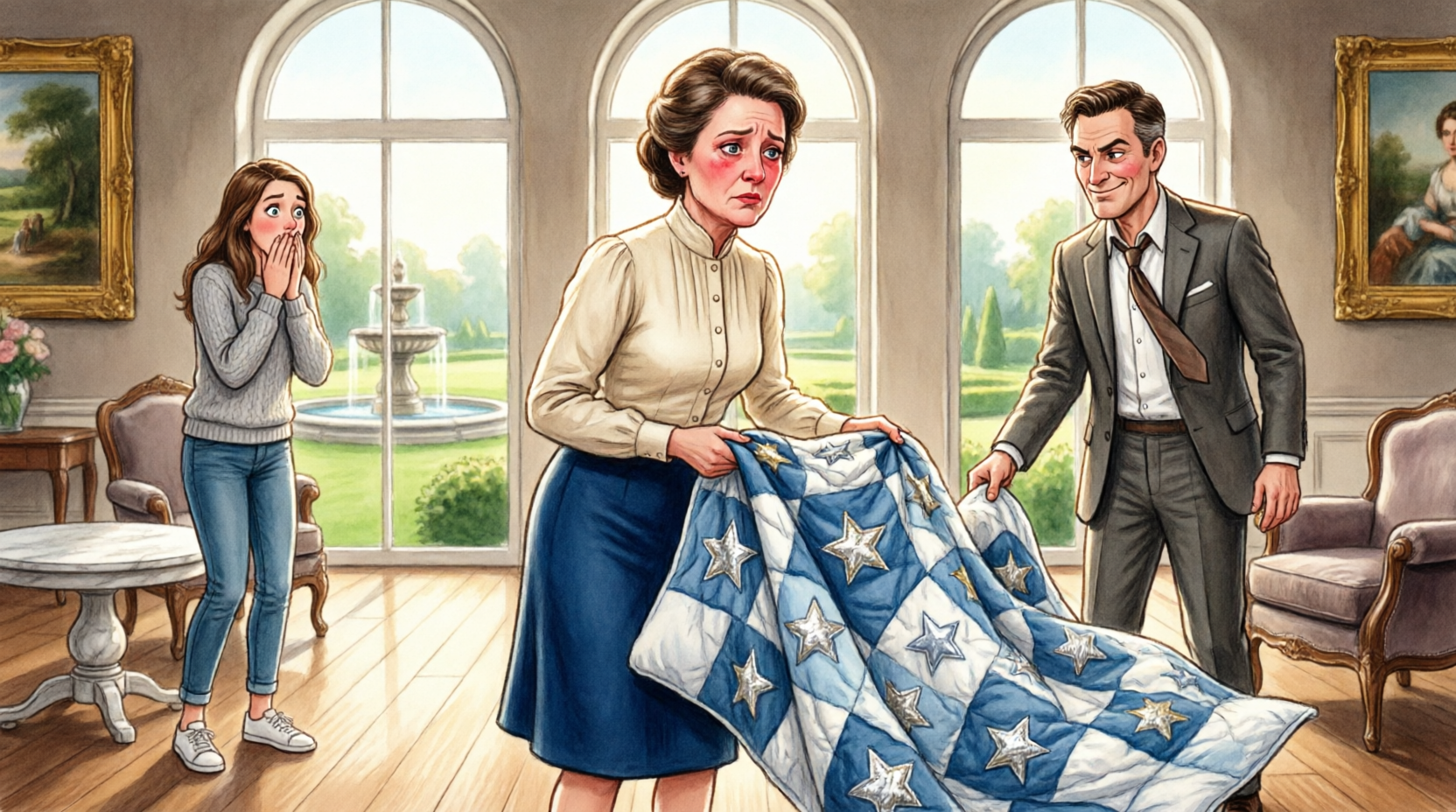
By the time the baby shower started, my hands were still aching from the last row of blind stitching.
Nine months. That was how long I had worked on the quilt folded inside the white gift box on my lap. Nine months of double shifts at Roosevelt Middle School’s cafeteria, early mornings cracking eggs, late evenings under a yellow lamp at my kitchen table, feeding squares of fabric through a machine older than my marriage had been. I had used pieces from my daughter Ellie’s life without telling her—one corner from the blue dress she wore on her first day of kindergarten, a strip from the flannel pajamas she refused to take off one winter, little printed stars from the nursery curtains I had saved in a box for twenty-six years.
The shower was being held in a restored barn outside Lexington, Kentucky, one of those expensive event spaces with chandeliers hanging from rafters to make rough wood look elegant. Everything about it screamed money. Ivory roses. Gold ribbon. A dessert table longer than the cafeteria line I managed every day.
Ellie looked beautiful in a pale green dress, one hand cupping her stomach, laughing as women from her husband’s family passed around champagne flutes filled with sparkling cider for appearances. Her husband, Grant Whitmore, stood beside her in pressed khakis and a navy blazer, smiling like a man campaigning for office.
“Open Mom’s next,” Ellie said, spotting me at the edge of the room.
My throat tightened. “It’s nothing fancy.”
Ellie lifted the lid. When she pulled back the tissue paper, the room quieted in a way I hadn’t expected. The quilt spilled over her hands in soft cream, sage, and faded blue, each square hand-embroidered with tiny initials, dates, and stitched flowers. For one second, my daughter’s face opened with pure feeling.
“Mom,” she whispered. “You made this?”
I nodded. “For the baby. And for you.”
She touched the border and I saw her recognize the old nursery fabric. Her eyes glassed over.
Then Grant leaned in, took one look, and gave a short laugh.
“It’s homemade?” he said.
No one answered.
He pinched one corner of the quilt between two fingers, as if it were damp laundry. Then he let it fall to the floor beside his shoe.
“Your mom’s just a lunch lady, babe,” he said lightly, smiling at Ellie as if he’d made some harmless joke. “We can buy a real one.”
The silence after that was so complete I could hear the low hum of the air-conditioning.
Ellie stared at him. I stared at the quilt on the hardwood floor.
My body moved before my mind did. I bent, picked it up carefully, folded it once against my chest, and set the box on a nearby chair. I didn’t cry. I didn’t speak. I walked past the mimosa bar, past the balloon arch, past women suddenly fascinated by their phones, and out into the parking lot with my car keys cutting into my palm.
That night I slept two hours.
At 8:10 the next morning, I called my attorney, Daniel Harmon, the man who had handled my divorce and later my will.
“I need to change everything,” I told his receptionist.
There was a pause. Papers shuffled. Then her voice dropped.
“Mrs. Bennett… Mr. Harmon asked me to tell you something if you called.” Another pause, sharper this time. “You need to come out here. Now.”
When I arrived, his secretary, Lisa, was standing in the doorway, pale as printer paper.
Inside Daniel’s office sat my daughter.
And across from her, rigid and gray-faced, sat Grant.
On Daniel’s desk, between us all, lay a file marked with my late father’s name.
For a second I thought I had walked into the wrong office.
My father, Walter Mercer, had been dead for eleven years. He had been a welder, then a foreman, then the owner of a steel supply company in Cincinnati that he sold before his first stroke. To everyone outside the family, he was a hard man with a rough laugh and a gift for turning scrap into contracts. To me, he had been harder than that—strict, proud, almost impossible to please—but he had also been careful with money in a way people with empty childhoods often are. He trusted cash, land, and documents locked behind fireproof steel.
When he died, I received what I thought was my share: the little ranch house in Frankfort, a conservative investment account, and a note in his uneven handwriting that said, For what you stayed and endured. My younger brother, Steven, got farmland he later sold for less than it was worth. We all assumed the estate had been settled.
Daniel stood as I entered. “Marian, sit down.”
I didn’t. “Why is my daughter here?”
Ellie rose first. Her mascara was smudged, as if she had already cried that morning. “Mom, please don’t leave.”
Grant stayed seated, jaw tight. He wouldn’t meet my eyes.
Daniel removed his glasses and rubbed the bridge of his nose. “Three days ago, my office was contacted by a law firm in Chicago. They were releasing a sealed instruction packet from your father’s estate. It concerned a separate asset, one not disclosed at the original probate because it was placed in a private holding arrangement decades ago.”
I looked at him blankly. “English, Daniel.”
He nodded. “Your father retained minority equity in Mercer Industrial Fastening, a manufacturing company that expanded aggressively in the Midwest after he sold his controlling interest. That minority stake was small at the time. It is not small now.”
The room went still.
“How much?” I asked.
Daniel slid a paper across the desk.
I read the figure once. Then again.
Twenty-eight million, four hundred thousand dollars.
My knees weakened so suddenly I had to sit.
“There has to be some mistake,” I said.
“There isn’t,” Daniel replied. “The holding matured and the legal restrictions expired this month. Under the instructions, the stake was to be liquidated and the proceeds distributed to you personally, not jointly, not through marital claim, and not before the birth of your first grandchild.”
Ellie sucked in a breath. Grant finally looked up.
I turned to my daughter. “You knew?”
Her mouth trembled. “Not yesterday. Not before the shower. I swear.”
Grant spoke then, smooth but strained. “We found out this morning. Daniel called because Ellie is named as contingent beneficiary if something happens to you before distribution.”
“You found out this morning,” I repeated. “And yet somehow you both got here before I did.”
Daniel answered before either of them could. “I asked Ellie to come because of the beneficiary language. Grant insisted on driving her.”
That sounded exactly like him. Insisted. Inserted. Claimed space that wasn’t his.
I looked at Ellie, at her swollen eyes and clasped hands. “Did he apologize?”
Grant leaned forward. “Mrs. Bennett, what I said yesterday was a joke that came out wrong.”
“A joke.” I let the words sit there.
Ellie turned on him with a force I had not seen since she was fifteen. “No. Don’t do that. Don’t call it a joke.”
He stared at her.
She continued, voice shaking. “You humiliated my mother. In front of everyone. You threw away the most meaningful gift anyone gave our son. And then on the drive home you said she was being dramatic.”
Grant’s face hardened. “Ellie, not here.”
“Yes, here.”
Daniel quietly pushed a box of tissues toward her.
Ellie wiped her eyes and looked at me. “I called him cruel. We argued half the night. He told me I was too emotional because I’m pregnant. Then this morning your lawyer called and he suddenly wanted coffee for me, wanted to carry my purse, wanted to come in with me.” She laughed once, bitterly. “You know what he said in the car? He said maybe this was a sign we should all start over as a family.”
Grant stood so fast his chair scraped. “That’s not what I meant.”
I stood too. “I know exactly what you meant.”
He straightened his blazer, dropping the practiced charm altogether. “With respect, Marian, you’re taking this personally because of your insecurities.”
Daniel looked up sharply. “Mr. Whitmore—”
“No,” I said. “Let him talk.”
Grant exhaled through his nose. “Ellie was raised to think struggle is noble. It isn’t. I’ve spent years trying to help her step into a better life, and every time your side of the family shows up with casseroles, handmade things, old stories about clipping coupons and making do—”
“My side of the family?” I said softly.
He stopped, realizing too late he had said the quiet part out loud.
Ellie looked at him as if she had never seen him before. “You’re ashamed of where I come from.”
“I’m trying to elevate you.”
“No,” she said. “You’re trying to erase us.”
That landed. I saw it hit him.
Daniel cleared his throat. “There’s another matter. Marian, your father’s instructions included a handwritten memorandum. It is not legally binding, but it explains why the asset was structured this way.”
He handed me a copy. My father’s square block handwriting stared up at me.
Marian knows the price of things because she paid it. If she ever has a grandchild, the money is to come to her then, when she will be tempted to give it away out of love. She is not to be pressured by husbands, children, churches, or charmers. Let her decide who has character when real money is in the room.
When I finished reading, I set the paper down and looked at Grant.
For the first time since the shower, he looked uncertain.
Not ashamed. Not sorry.
Uncertain.
And that was when I understood something clean and final: my father, dead eleven years, had managed to do what I had not.
He had created a test.
By noon, Grant had already failed it.
I did not speak to Grant for six days after that meeting.
That was easy enough, because Ellie left him the same afternoon.
Not forever, at least not at first. She packed a suitcase, took the quilt from where she had hidden it in the hall closet of their town house, and moved into my guest room with two maternity dresses, her prenatal vitamins, and a silence so deep it scared me. She was thirty, married, highly educated, and pregnant with her first child, yet when I helped her fold her clothes into my old cedar dresser, she looked heartbreakingly like the little girl who used to crawl into my bed after thunderstorms.
On the third night, she finally said, “I think I built my life around proving I belonged in his world.”
I was sitting at the kitchen table mending a uniform apron. “And?”
“And maybe I stopped asking whether he belonged in mine.”
That was the sentence that changed everything.
Grant called. Texted. Sent flowers. Then he sent a written apology long enough to look expensive. It was polished, strategic, and bloodless. He apologized for “an unfortunate comment,” for “misunderstandings heightened by stress,” for “family tensions around changing circumstances.” Not once did he write, I was cruel. Not once did he mention the quilt.
Ellie read the letter twice and handed it back. “This sounds like a press release.”
Daniel, meanwhile, moved quickly. At his advice, I placed the pending funds into a temporary trust, insulated from marital claims and outside any immediate emotional decision-making. He connected me with a financial planner in Louisville and a family law attorney for Ellie. I had enough sense to know that sudden money can ruin people as efficiently as poverty can, just with prettier furniture.
Then the rest of the story started to surface.
It came first from Tasha, one of Ellie’s friends from graduate school, who called to “check in” and accidentally said too much. She assumed I knew Grant had been under pressure for months. His startup consultancy was struggling. He had borrowed against future contracts that never materialized. He owed back rent on office space he pretended to still occupy. He had quietly taken money from a joint savings account Ellie thought they were preserving for the baby.
When Ellie confronted him, he denied it until she opened the statements herself.
Then came the ugliest part.
He had told at least two people before the shower that “Ellie’s family has nothing, but old people die with surprises.” A joke, he might have called it. A pattern, I called it.
Three weeks later, seated in a conference room with neutral artwork and a box of tissues no one touched, Ellie told him she wanted a legal separation.
Grant tried every version of himself. First the wounded husband. Then the practical negotiator. Then the man who insisted everyone was overreacting to a single sentence. Finally, when none of those worked, the anger came out bare.
“You’re blowing up your child’s family because your mother can’t take a joke.”
Ellie didn’t raise her voice. “I’m protecting my child from a man who measures human worth in money.”
He laughed once, sharp and ugly. “That’s rich, considering the timing.”
I had promised to stay silent unless addressed, but then he looked at me and said, “This is what you wanted.”
He was wrong.
What I had wanted was simpler. I had wanted him to bend, pick up that quilt, and understand what hands can mean when they have spent a lifetime making things hold together.
But some people are born into abundance and still learn nothing about value.
The separation became a divorce before the baby was born. Grant fought for appearances more than assets once Daniel’s trust structure became clear and Ellie’s attorney uncovered the financial deceptions. By then, his professional reputation had started to crack. The kind of people impressed by polish are also quick to retreat when the finish peels.
My grandson, Henry James Bennett-Whitmore, was born on a bright October morning in Lexington. Eight pounds, one ounce. Long fingers. Serious eyes. Ellie labored for nineteen hours, cursed everybody, crushed my hand, and cried when the nurse wrapped him in the quilt.
Not a store-bought one.
Mine.
The cream and sage and faded blue looked soft against his red newborn face. Ellie kissed his forehead and said, “He goes home with this.”
Months later, after the lawyers were done and the noise had died, I used part of the money to do three things. I paid off my house. I set up education trusts for Henry and, quietly, for two scholarship funds at Roosevelt Middle School for cafeteria workers’ children. Then I opened a small community sewing studio in Frankfort called Mercer House, where women who had spent their lives mending everyone else’s lives could come make something of their own.
At the ribbon cutting, Ellie stood beside me with Henry on her hip.
A local reporter asked about the name and the funding, and whether I had always planned this chapter of my life.
I looked through the studio window at women laughing over fabric and coffee, at my daughter adjusting the quilt around my grandson’s legs.
“No,” I said. “But I’ve learned that what gets dropped is not always what gets lost.”
And that, at last, was true.