The entire ballroom erupted in laughter when Grant Whitmore offered to marry me.
Two hundred wealthy guests stood beneath glittering chandeliers, watching Chicago’s most feared mafia boss extend his hand toward a housekeeper whose gray uniform was stained with red wine.
His beautiful fiancée laughed so hard that she nearly spilled her champagne.
Someone raised a phone.
Then another.
Within seconds, dozens of people were recording.
They expected humiliation.
They expected me to stumble across the marble floor, embarrass myself in front of Chicago’s wealthiest families, and disappear into the servants’ quarters with tears running down my face.
But they didn’t know who my father had been.
And they certainly didn’t know what would happen when the orchestra began playing the tango he had taught me.
My name is Emily Brooks.
I was thirty-two years old, and for almost two years, I had worked as a housekeeper at the Whitmore estate in Lake Forest, Illinois.
The mansion stood behind iron gates and towering oak trees, overlooking a private stretch of Lake Michigan. Its forty-two rooms contained paintings worth more than most people earned in a lifetime, and its underground garage held automobiles that cost more than my sister’s house.
The owner was Grant Whitmore.
Forty-one years old.
Dark-haired.
Dangerously handsome.
And powerful enough that politicians returned his telephone calls before their own families’.
Officially, Grant controlled Whitmore Reserve, a collection of whiskey distribution companies, shipping operations, luxury hotels, and exclusive private clubs.
Unofficially, he controlled an organized-crime network that had dominated parts of Chicago for decades.
People whispered his name in restaurants.
Businessmen lowered their voices when he entered a room.
And employees at his estate understood one important rule.
Never attract his attention.
For twenty-three months, I had followed that rule.
I cleaned his study, polished his silver, changed the sheets in his guest bedrooms, and occasionally served coffee during private meetings.
I never asked questions.
I never lingered.
And I never allowed anyone to discover that before becoming a housekeeper, I had once been a professional dancer.
Not merely a good dancer.
A nationally recognized Argentine tango competitor.
The daughter of Daniel Brooks, a man whose name had once been spoken with admiration in dance studios from Chicago to Buenos Aires.
But that life belonged to another woman.
A woman who had disappeared seven years earlier.
The woman standing in the Whitmore ballroom wore practical black shoes, kept her hair pinned into a plain bun, and worried constantly about paying her younger sister’s rent.
Rachel was twenty-eight, divorced, and raising two little boys.
Her former husband had left behind unpaid bills, broken promises, and a mortgage she could no longer afford.
Every month, I sent her half my paycheck.
I told myself that working for Grant Whitmore was temporary.
Then temporary became two years.
And eventually, survival replaced ambition.
That evening, the mansion was celebrating the fortieth anniversary of Whitmore Reserve.
Grant’s late father, Thomas Whitmore, had founded the company.
The celebration was extravagant even by Whitmore standards.
White roses filled silver urns.
A twelve-piece orchestra performed beneath the balcony.
Champagne flowed from crystal fountains.
Women wore diamonds that flashed beneath the chandeliers, while men discussed investments, political appointments, and shipping contracts over glasses of whiskey older than I was.
I had been working since six that morning.
By nine that evening, my feet ached so badly that every step sent pain through my calves.
Then Vanessa Hale decided to entertain herself.
Vanessa was thirty-six, a former fashion model and the daughter of a wealthy real estate developer.
She had been engaged to Grant for eleven months.
Beautiful, polished, and spectacularly cruel, she treated household employees as though we existed solely to remind her how important she was.
At approximately eight-fifteen, I approached her table carrying a silver tray.
She was seated with four women whose combined jewelry probably exceeded the value of my entire neighborhood.
“More champagne, Ms. Hale?”
Vanessa looked at me.
Then at my uniform.
Then at the glass of Cabernet beside her plate.
“Actually, Emily, there’s something on the floor.”
I glanced down.
Nothing.
Before I could respond, she tipped the glass.
Red wine splashed across the marble.
“Oh, dear.”
Her friends giggled.
“Please clean that before someone ruins their shoes.”
I knelt.
“Of course, Ms. Hale.”
May you like


I had barely begun wiping the floor when cold liquid ran down the back of my neck.
Vanessa had poured the remaining wine over my uniform.
Her friends burst into laughter.
“Oh my God,” she said sweetly. “I’m so clumsy tonight.”
I closed my eyes.
For one brief second, I imagined standing up and telling her exactly what I thought.
Then I remembered Rachel’s youngest son, Noah, asking whether I could help buy him new winter boots.
I remembered the overdue electricity bill on Rachel’s kitchen counter.
I remembered the envelope of cash hidden in my bedroom drawer.
So I swallowed my anger.
“It’s all right, Ms. Hale.”
I finished cleaning the floor.
Then I stood.
The wine had soaked through my collar.
My skin felt sticky.
My cheeks burned.
As I turned away, Vanessa called after me.
“Try not to look so miserable, Emily. You’re ruining the atmosphere.”
I kept walking.
Then a familiar voice stopped me.
“Emily.”
I turned.
Eleanor Whitmore sat beside the tall windows overlooking the lake.
At eighty-three, Grant’s grandmother was the only person in the mansion who could silence him with a raised eyebrow.
She had silver hair, intelligent blue eyes, and a habit of speaking truths that everyone else was too frightened to say.
“Come here, dear.”
I approached.
She handed me a clean linen napkin.
“Get that wine off your neck.”
“Thank you, Mrs. Whitmore.”
Her gaze moved toward Vanessa.
“That girl has expensive jewelry and cheap manners.”
I nearly laughed.
Eleanor smiled faintly.
“Don’t let her convince you that money is the same thing as class.”
“I won’t.”
She studied my face.
“You look tired.”
“It’s been a long day.”
“How is Rachel?”
I blinked.
“She’s doing better.”
“And the boys?”
“Growing faster than she can afford to buy shoes.”
Eleanor chuckled.
“That sounds familiar.”
She was the only Whitmore who remembered my family’s names.
Sometimes she asked about Noah’s school.
Sometimes she sent leftover pastries home for the boys.
Once, when Rachel had pneumonia, Eleanor quietly arranged for me to have three paid days off.
I had never forgotten it.
“Emily,” she said softly, “you deserve better than being treated like this.”
I looked down.
“I need the job.”
Her expression changed.
“I know.”
For a moment, she seemed about to say something else.
Then Grant stepped onto the raised platform at the front of the ballroom.
The orchestra stopped.
Conversations faded.
Grant raised a glass.
“Forty years ago, my father started Whitmore Reserve with one warehouse, three trucks, and a belief that our family could build something permanent.”
Applause filled the room.
I watched him from beside the service entrance.
Grant was a complicated man.
He could be frighteningly cold during business meetings.
Yet I had also seen him kneel beside Eleanor’s chair to adjust her blanket.
He remembered employees’ names when it suited him.
He paid generous salaries.
But he rarely interfered when Vanessa humiliated the staff.
That silence had always bothered me.
“My father believed loyalty was everything,” Grant continued. “And tonight, we honor the people who helped build his legacy.”
He raised his glass.
“To Thomas Whitmore.”
The guests repeated the toast.
Then the orchestra resumed.
A violin began a slow introduction.
A piano followed.
And then I heard it.
The bandoneon.
Its mournful sound moved through the ballroom like a voice returning from the dead.
My breath caught.
I knew that arrangement.
Every pause.
Every rising phrase.
Every deliberate silence between the notes.
My father had played that exact version of the tango every Saturday morning at the Brooks Dance Studio.
I could almost see him.
White shirt.
Rolled sleeves.
A pencil tucked behind one ear.
His hand resting gently against my shoulder.
“Again, sweetheart.”
“Dad, we’ve practiced for two hours.”
“And we’ll practice until you stop thinking about your feet.”
I remembered laughing.
He would smile.
“A good tango isn’t about controlling someone, Emily. It’s about making sure they never lose their balance.”
The memory hit me so hard that I had to grip the back of a chair.
Seven years.
Seven years since I had danced that choreography.
Seven years since my father disappeared from my life.
Officially, Daniel Brooks had died in a warehouse fire near the Chicago River.
The authorities had identified his remains through personal belongings and dental records.
But I had never believed the explanation was complete.
He had been a dance instructor.
A gentle man who hated violence.
Why had he been inside a warehouse belonging to a company connected to organized crime?
Nobody had ever answered that question.
I had spent years searching.
Eventually, the money ran out.
The studio closed.
My mother died after a long illness.
Rachel’s marriage collapsed.
And I became a housekeeper.
Now, standing beneath the Whitmore chandeliers, I heard my father’s music.
Without thinking, I moved my feet.
Heel.
Toe.
Pause.
A tiny shift of weight.
A movement so natural that my body remembered it before my mind did.
Then Vanessa noticed.
“Look!”
Her voice cut through the music.
“Everyone, look at the maid!”
Several guests turned.
Vanessa pointed toward my feet.
“She thinks she’s a dancer!”
Laughter rippled across the room.
I froze.
“Please, Ms. Hale. I was just—”
“Oh, don’t stop now.”
She stood.
“Grant, darling, come here.”
Grant approached with a champagne glass.
“What is it?”
Vanessa slipped her arm through his.
“Your little housekeeper has been practicing tango behind the chairs.”
Grant glanced at me.
His expression was unreadable.
“Is that so?”
I lowered my eyes.
“I apologize, sir.”
Vanessa laughed.
“Maybe she thinks she can dance her way into a better job.”
Someone shouted, “Give her a chance!”
Another guest laughed.
“Let her dance with the boss!”
Grant looked around.
The crowd was enjoying itself.
And instead of ending the humiliation, he smiled.
“Well, Emily.”
He placed his champagne glass on a nearby table.
“What’s your name again?”
The question hurt more than I expected.
He had employed me for almost two years.
“Emily, sir.”
“Emily.”
He repeated it slowly.
Then extended his hand.
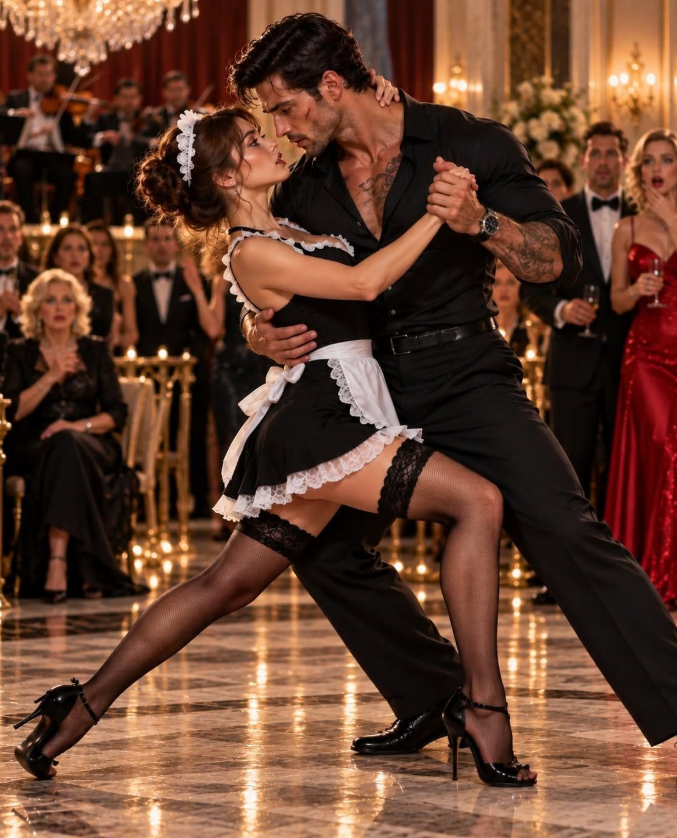
“If you can dance this tango with me, I’ll marry you.”
The ballroom exploded with laughter.
Vanessa bent forward, laughing hardest of all.
Phones rose.
Someone shouted, “Go on, sweetheart! Here’s your chance to become rich!”
I stared at Grant’s hand.
He expected me to refuse.
Or stumble.
Or cry.
I could see it in the amusement surrounding his eyes.
But then I looked toward Eleanor.
She wasn’t laughing.
She was staring at my feet.
Her face had gone pale.
And tears were gathering in her eyes.
I removed my stained apron.
Folded it carefully.
Placed it over a chair.
Then I stepped toward Grant.
“Are you sure you want to make that promise, Mr. Whitmore?”
His smile faltered.
“Excuse me?”
“Are you certain?”
A few guests stopped laughing.
Grant studied me.
Then his smile returned.
“Absolutely.”
Vanessa clapped.
“Oh, this is going to be wonderful.”
I looked toward the orchestra.
The bandoneon player was an older Argentine musician with silver hair.
I recognized him.
Mateo Alvarez.
He had performed with my father years earlier.
He stared at me as though he had seen a ghost.
I raised my chin.
“Maestro, would you begin from the second introduction?”
Mateo’s fingers froze above his instrument.
“Emily?”
His voice was barely audible.
I nodded.
He looked toward Eleanor.
Something passed between them.
Fear.
Recognition.
And a memory neither of them seemed prepared to confront.
Grant offered his hand again.
I accepted it.
His palm was warm.
His grip was confident.
But when I placed my other hand against his shoulder, I noticed something.
He wasn’t positioning himself correctly.
He knew the basic tango hold.
But he didn’t understand the particular arrangement the orchestra was playing.
I leaned closer.
“Don’t try to lead the first eight counts.”
His eyebrows rose.
“You’re giving me instructions?”
“Unless you’d prefer to fall.”
A few nearby guests laughed.
This time, not at me.
Grant’s expression sharpened.
“Interesting.”
The music began.
One note.
Then another.
I closed my eyes.
And for the first time in seven years, I allowed myself to become the woman I had buried.
My right foot moved backward.
My left followed.
A pause.
A turn.
Then the first sweeping movement.
Grant reacted instinctively.
His body stiffened.
I adjusted.
Not by pulling.
Not by forcing.
By changing my center of gravity.
Exactly as my father had taught me.
The orchestra swelled.
I pivoted.
My skirt moved around my knees.
The stained uniform disappeared from my awareness.
The ballroom disappeared.
There was only the music.
And the memory of my father’s voice.
“Trust the floor, Emily.”
Grant’s hand tightened.
He was no longer smiling.
I guided him through the opening sequence.
Then I shifted.
A sharp turn.
A controlled pause.
A sweeping step that carried us across the marble.
Gasps replaced laughter.
Someone lowered a phone.
Vanessa’s smile vanished.
Grant stared at me.
“Where did you learn this?”
I didn’t answer.
The music continued.
I moved faster.
A sequence of intricate pivots.
A dramatic change of direction.
A pause so precise that the orchestra seemed to hold its breath.
Grant followed.
Barely.
But he followed.
Then came the movement my father had invented.
A distinctive three-step turn followed by a suspended backward lean.
He called it the Falling Star.
Only a handful of dancers knew it.
I performed it without hesitation.
Grant caught me.
The movement ended perfectly.
The ballroom fell silent.
For one suspended second, nobody moved.
Then Eleanor stood.
Her chair scraped across the floor.
She was trembling.
“Stop the music.”
Mateo lowered his bandoneon.
Eleanor stared at me.
“Who taught you that?”
I straightened.
“My father.”
Her lips parted.
“Daniel Brooks?”
I nodded.
The old woman’s eyes filled.
“Oh, my God.”
Grant released my hand.
“Grandmother?”
Eleanor didn’t look at him.
She took one unsteady step toward me.
“Emily, how old were you when your father died?”
“Twenty-five.”
She pressed a hand against her chest.
“And did he ever tell you why he stopped teaching at the Whitmore private club?”
I froze.
“My father never worked for your family.”
Eleanor closed her eyes.
“Yes, sweetheart.”
Her voice broke.
“He did.”
Grant looked sharply at her.
“What are you talking about?”
Eleanor opened her eyes.
Then she said something that made every person near us fall silent.
“Daniel Brooks wasn’t just a dance instructor.”
She turned toward Grant.
“He was the man who saved your life.”
Grant went completely still.
“What?”
Eleanor looked back at me.
“And the night he disappeared, he was carrying something your father had trusted him to protect.”
I felt the floor shift beneath me.
“What was it?”
Eleanor’s hands trembled.
“A ledger.”
Grant’s expression darkened.
“What ledger?”
She looked toward the portrait of Thomas Whitmore hanging above the ballroom entrance.
“The one that could have destroyed this family.”
Then Mateo Alvarez spoke from the orchestra platform.
His voice was shaking.
“Mrs. Whitmore, there’s something you need to know.”
Everyone turned.
Mateo stared at me.
“Daniel Brooks didn’t die in that warehouse fire.”
And before anyone could speak, he added:
“I saw him alive three days afterward.”