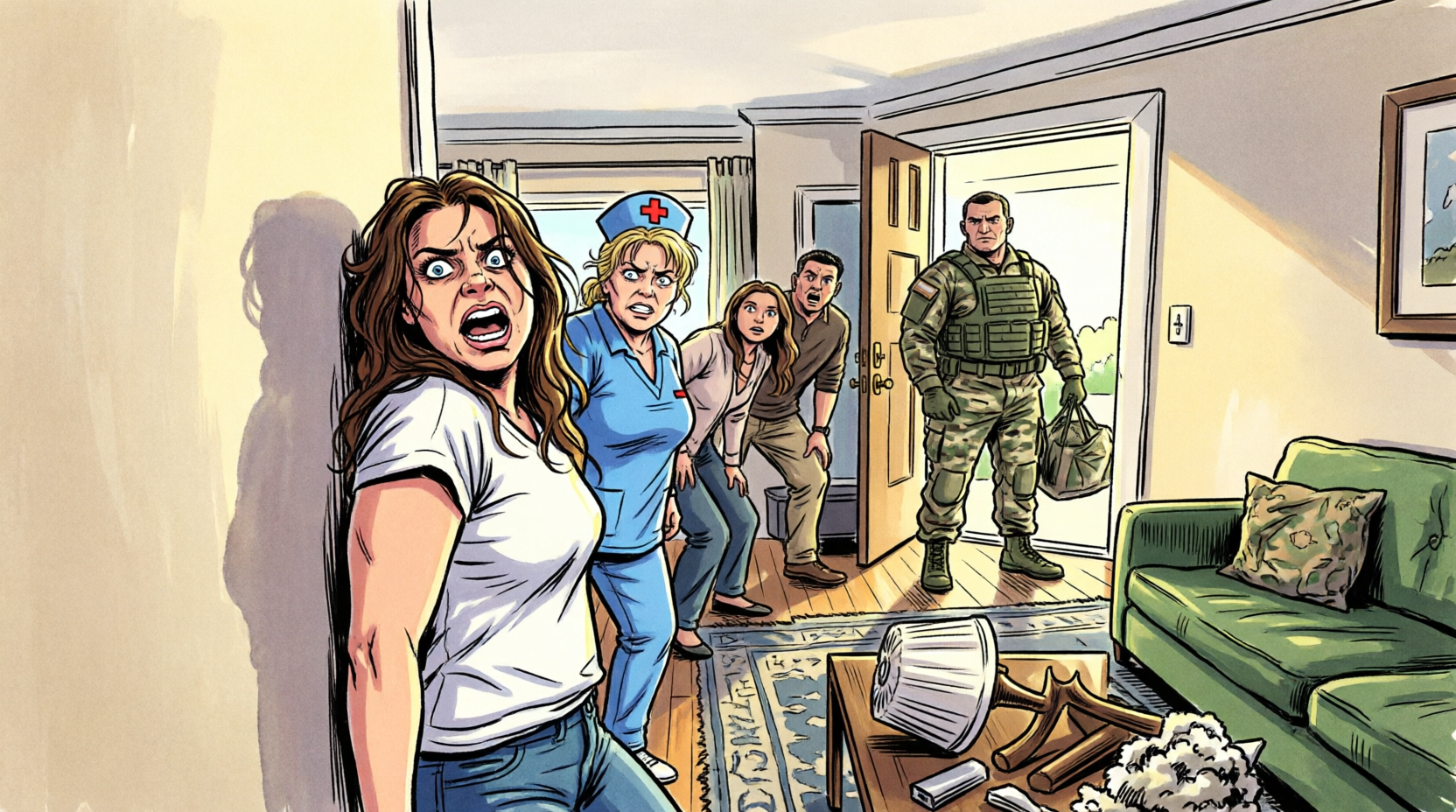
Mrs. Chun appeared at the door again as if summoned by fear itself.
“Hospital,” Marcus said.
She grabbed my coat.
By the time we reached the car, cold rain was falling sideways and the parking lot lights smeared gold across the pavement.
Marcus helped me into the passenger seat, buckled me in, and kissed my forehead with shaking lips.
“We’re okay,” he said.
But halfway to the hospital, another contraction hit, and this time I felt something warm and wet soak through my leggings.
Marcus saw my face.
“What?”
I looked down, then back at him.
“My water,” I whispered.
And for the first time that day, Marcus looked truly afraid.
Part 8
The emergency room smelled like disinfectant, coffee, and wet coats.
I remember that more clearly than I remember checking in. I remember fluorescent lights buzzing overhead. I remember Marcus’s hand around mine, warm and too tight. I remember a nurse asking how far along I was, and my mouth not working, so Marcus answered.
“Thirty-two weeks. Twins. High-risk.”
After that, everything moved fast.
A wheelchair.
A blood pressure cuff.
A fetal monitor strapped around my belly.
Another nurse lifting the hem of Marcus’s hoodie and saying, “Mama, I need you to breathe for me.”
Mama.
Not gold digger.
Not burden.
Not trash.
Mama.
I clung to that word like a rope.
The contractions were not steady enough for full labor at first, but my water had broken. Twin A’s heartbeat galloped strong. Twin B’s dipped once, then recovered. That dip emptied the room of all softness.
Doctors came in.
Steroid shots for the babies’ lungs.
Medication to slow contractions.
Possible C-section if things changed.
NICU team alerted.
Marcus stood by my bed, answering questions, signing forms, rubbing circles into the back of my hand. He looked like a soldier forced to watch a battle he could not enter.
“I’m sorry,” he kept whispering.
“Stop,” I said. “You didn’t do this.”
His eyes flicked to my cheek, still swollen under the hospital lights.
He did not answer.
By midnight, the contractions eased. Not gone, but less cruel. The doctor decided to monitor me overnight and hope to buy more time.
“Even twenty-four hours helps,” she said.
I nodded like I understood.
Really, I was listening to the babies’ heartbeats on the monitor. Two rapid rhythms filling the room. Two little horses running in the dark.
Marcus stepped out to call his CO, and I lay alone for maybe three minutes before my phone buzzed on the rolling table.
Unknown number.
I should not have looked.
But fear is curious.
The message said: You can’t keep us from our grandchildren.
Attached was a photo of the hospital entrance.
My whole body went cold.
When Marcus returned, I was already pressing the call button.
Security came first. Then Officer Ramirez. Then a hospital administrator with kind eyes and a tablet. Marcus gave them names, descriptions, screenshots, police report numbers. The administrator put a privacy flag on my file and a password on all information.
“No visitors without your approval,” she said. “No confirmation you’re even here.”
“Thank you,” I whispered.
Marcus stood beside the bed. “If Sandra Carter shows up, she is not family.”
The administrator nodded without judgment.
That sentence hurt him. I saw it.
But he did not take it back.
At two in the morning, Sandra showed up anyway.
We didn’t see her at first. We heard her.
Hospital walls have a way of carrying panic in pieces. A raised voice near the nurses’ station. Shoes squeaking. A security guard saying, “Ma’am, step back.”
Then Sandra’s voice, unmistakable.
“I am their grandmother!”
My heart rate spiked so sharply the monitor complained.
Marcus leaned over me. “Don’t move.”
He went to the door, but a nurse blocked him gently.
“You stay with your wife,” she said. “Security has it.”
It should have been comforting, but Sandra’s voice sliced through again.
“My son is being manipulated! That woman is unstable!”
My eyes burned.
Even here.
Even with monitors strapped to me and premature babies fighting for time inside me, she was still telling her story.
Marcus opened the door despite the nurse’s protest.
“I’m right here,” he called down the hall.
The shouting stopped.
I could not see Sandra from the bed, but I could hear her change tactics. Her voice softened, sweetened.
“Marcus, please. I was scared. I made mistakes. But those babies need family.”
Marcus stepped into the hall just far enough that I could see his back.
“They have family.”
“Not her,” Sandra snapped, mask slipping. “She can’t even carry them right.”
The nurse beside me inhaled sharply.
That was the sentence that ended something in Marcus.
Not loudly. Not dramatically. I could feel it end from the bed.
He spoke so quietly I barely heard him.
“You blamed my wife for premature labor after you spent months terrorizing her.”
“I never—”
“You sent a man into our bedroom while she slept.”
“I was worried.”
“You wrote about my death on my babies’ ultrasound.”
Silence.
A security guard murmured something.
Then Monica’s voice appeared, smaller than I had ever heard it.
“Marcus, Mom’s crying. Can you just come talk?”
“No.”
“Please.”
“No.”
There was a long pause.
Then Brett said, “Sandra, give him the folder.”
My eyes opened wider.
Folder?
Paper rustled.
Marcus said, “What is this?”
Sandra’s answer came too fast. “Protection.”
“For who?”
“For the babies.”
I saw Marcus turn slightly, enough that the light hit his face. He was looking down at papers.
Then he went very still.
The nurse glanced at the monitor, then at me. “Mama, slow breaths.”
But I couldn’t.
Because Marcus looked back into the room at me, and the expression on his face was not just anger anymore.
It was horror.
He walked to my bedside holding a document with his name at the bottom.
His signature.
Or something trying to be his signature.
“Haley,” he said, voice rough. “This says if you’re declared unfit, my mother gets temporary custody.”
The room narrowed to the paper in his hand.
And beneath the forged signature, someone had written today’s date.
Part 9
The hospital became a fortress after that.
Security moved Sandra, Monica, and Brett out of the maternity wing. Officer Ramirez arrived with another officer and took the folder into evidence. A second police report number joined the first. Marcus called legal again, his voice so controlled it frightened me more than yelling would have.
Forgery.
Harassment.
Unlawful entry.
Threats.
Attempted interference with medical care.
The words stacked up until Sandra stopped sounding like a difficult mother-in-law and started sounding like what she was: dangerous.
I stayed in that hospital bed while the babies’ monitors galloped and clicked. Every time Twin B’s heartbeat dipped, my whole soul seemed to stop. Every time it recovered, I wanted to promise the ceiling I would never let anyone near them who treated love like ownership.
By morning, the contractions had slowed.
The doctor looked cautiously pleased.
“We may have bought some time,” she said.
Marcus exhaled like he had been holding his breath all night.
I slept for two hours.
When I woke, sunlight was leaking around the blinds, pale and thin. Marcus sat in the chair beside my bed, still in yesterday’s clothes, staring at his phone. He looked older than he had when he came through our door.
“What happened?” I asked.
He looked up immediately. “Nothing you need to worry about.”
“Marcus.”
He rubbed his eyes. “Brett called.”
I waited.
“He wants to make a statement.”
That woke me fully. “Against Sandra?”
“Against Sandra. Maybe Monica too. He says he didn’t know about the forged custody paper until last night.”
“Do you believe him?”
Marcus’s jaw tightened. “I believe he’s scared.”
That was enough.
Later that afternoon, Officer Ramirez came by to update us. Brett had admitted Sandra hired Ron Keller to watch me. He admitted they entered the apartment using copied keys. He said Sandra believed I had “trapped” Marcus and that if anything happened during deployment, she wanted to control the benefits, the memorial decisions, and the babies.
The babies.
Not grandchildren. Not family.
Assets in onesies.
I turned my face toward the window and watched a helicopter move across the blue sky.
The truth did not explode.
It settled.
Heavy. Final.
Sandra had not misunderstood me. She had not been overwhelmed. She had not simply loved her son too much.
She had studied my weak points and pressed until something broke.
My isolation.
My pregnancy.
My fear of distracting Marcus.
My need to be kind.
She had used them all.
Marcus sat beside me when Officer Ramirez left.
“I need to say something,” he said.
I looked at him.
“I don’t want you to forgive them for me.”
The directness of it pierced something tender.
He continued, “Not now. Not later. Not when the babies are born. Not if my mom cries. Not if Monica apologizes. Not if the rest of the family says we’re being cruel. You do not have to soften this to make my life easier.”
Tears filled my eyes.
“I’m not going to,” I said.
He nodded, and his eyes filled too. “Good.”
“I mean it,” I said. “I’m done. They don’t get to hurt me and call it love. They don’t get to scare our babies into the world and then hold them for pictures. They don’t get a redemption scene because they’re embarrassed they got caught.”
Marcus took my hand and kissed my knuckles.
“Okay.”
“You’re okay with that?”
“No,” he said honestly. “I’m devastated. But I’m with you.”
That was the Marcus I loved. Not perfect. Not magically unhurt. Just honest enough to stand in the wreckage without asking me to decorate it.
We spent the next two days in the hospital.
Sandra tried calling from different numbers.
Blocked.
Monica sent one text: I’m sorry things got out of hand.
Marcus showed it to me.
I stared at the words.
Things.
Not I spit on you.
Not I lied.
Not I helped Mom terrorize you.
Things.
“Do you want to answer?” Marcus asked.
“No.”
He deleted it.
Brett’s statement helped the police move faster. Ron Keller was found with copies of photos and notes. He claimed Sandra told him I was abusing drugs and neglecting the pregnancy. He claimed he entered only because Sandra said it was her son’s apartment and I had given permission.
The lie sounded ridiculous once said out loud.
That comforted me in a bitter way.
On the fourth morning, the doctor smiled and said we might get me stable enough to go home on strict bed rest.
Home.
I wanted to go.
I was terrified to go.
Marcus solved that before I said it.
“We’re not going back there,” he said.
“What?”
“I talked to housing. My CO helped. We can get temporary lodging on base, then transfer. Locks are changed at the apartment, but you shouldn’t have to heal inside the crime scene.”
Crime scene.
That was what our little apartment had become.
I pictured the crooked wedding photo, the grocery money on the floor, the USB drive flashing under the table.
Then I pictured never sleeping there again.
For the first time in days, my lungs opened all the way.
“Okay,” I said.
Marcus smiled tiredly. “Okay.”
That evening, Mrs. Chun visited with soup in a thermos and a plastic bag full of baby hats she had knitted in colors soft as candy. She hugged me carefully and scolded Marcus for not eating enough.
Before she left, she placed one tiny yellow hat on my belly.
“Strong babies,” she said. “Like mother.”
I cried after she left, but those tears felt different.
The next morning, just as discharge papers were being prepared, Twin B’s monitor dipped.
Once.
Twice.
The nurse came in fast.
The doctor followed.
Marcus stood.
The room filled with people again, but this time the fear did not come from the hallway. It came from the screen beside my bed.
The doctor looked at me and said, “Haley, it’s time.”
Marcus grabbed my hand.
And our daughters decided they were done waiting for a peaceful world.
Part 10
They were born in an operating room so bright it felt unreal.
Twin A came first, red and furious, crying before the doctor even lifted her fully into the world. The sound cracked my heart open. It was tiny, indignant, alive.
“Girl,” someone said.
Marcus laughed and sobbed at the same time.
Twin B came two minutes later, smaller, quieter, the room sharpening around her silence. I turned my head, trying to see past the blue drape, trying to read faces. Marcus’s hand tightened around mine until it almost hurt.
Then she made a sound.
Not a full cry. More like a kitten arguing with God.
It was enough.
I burst into tears.
Our daughters were named Lily and June.
Lily because she came out loud and bright, demanding space.
June because Marcus once told me June felt like a promise that winter would eventually end.
They went to the NICU, tiny under plastic and wires, wearing hats Mrs. Chun had knitted. I was wheeled into recovery with an empty belly and a body that felt like it belonged to someone who had survived a car accident and a miracle at the same time.
Marcus stayed between me and the door even there.
No one unwanted got in.
Not Sandra.
Not Monica.
Not any relative who suddenly remembered we existed because babies had arrived.
His CO visited once, respectful and brief, bringing a card signed by half the unit. Williams and Davis came with vending-machine snacks and ridiculous little stuffed bears in Army T-shirts. Mrs. Chun came with soup, because apparently soup was her answer to every disaster and most celebrations.
The NICU nurses taught us how to touch our daughters through portholes, how to cup their tiny feet without overstimulating them, how to celebrate one extra milliliter of milk like a graduation.
I pumped every three hours.
Marcus washed the parts.
I cried in bathroom stalls.
Marcus cried in the parking garage where he thought I couldn’t see.
We were not instantly okay.
That mattered.
Healing was not a montage. It was paperwork and pain medication. It was waking up sweating from dreams of a man in my bedroom. It was flinching when a nurse opened the door too quickly. It was Marcus staring at his phone after blocking another relative and looking like someone had carved out a piece of his childhood.
But the girls grew.
Ounce by ounce.
Breath by breath.
The legal side moved slower, but it moved.
Sandra was charged. So was Ron Keller. Brett cooperated, which did not make him noble, only useful. Monica tried to float above consequences by claiming she had been manipulated, but video has a way of making excuses look small. The hospital hallway incident, the apartment recording, the messages, the USB drive, the forged custody paper—all of it became part of a file too thick for Sandra to dismiss as family drama.
Marcus requested a no-contact order.
We got it.
He updated every password, every emergency contact, every beneficiary form, every access point. He removed his mother from places I hadn’t known she still existed. Old bank permissions. An emergency contact from years before. A storage unit code. Little hooks she had left in his life, waiting to pull.
Then he put in for instructor duty stateside.
“I thought you loved deploying,” I said one night.
We were sitting in temporary base lodging, the kind with beige walls and stiff towels, eating microwave pasta while the girls slept at the NICU across the street.
“I loved serving,” he said. “I still do. But there are different ways to serve.”
“Your career—”
“My career is not more important than coming home to you.” He paused. “Or making sure home is safe when I leave.”
I believed him.
Not because love fixes everything, but because action had weight. He was building protection one decision at a time.
Two months later, Lily and June came home.
Not to the old apartment.
To a small rental house thirty minutes from base, with a porch that sagged on one corner and a kitchen window over the sink. Mrs. Chun cried when we moved, then announced she was coming every Sunday, so apparently distance meant nothing to her. Williams and Davis helped carry boxes. Davis labeled one box “Marcus’s ugly socks” and another “Tiny bosses’ supplies.”
The nursery had pale curtains and secondhand cribs. Nothing matched. Everything mattered.
The first night, I barely slept. Not because I was scared, though I checked the locks three times. Because every squeak from the bassinets pulled me upright.
Marcus woke too, every time.
By dawn, we were wrecked and happy in the gray light, each holding one baby while coffee went cold on the table.
A week after the girls came home, a letter arrived.
No return address, but I knew the handwriting.
Sandra.
Marcus found me standing by the mailbox, staring at it.
“You don’t have to open it,” he said.
“I know.”
I opened it anyway.
The apology was three pages long and somehow never apologized.
She wrote about being a mother.
She wrote about fear.
She wrote about how women sometimes misunderstand each other.
She wrote that she hoped I would not punish innocent children by keeping them from their grandmother.
At the bottom, in a line squeezed between two tear stains, she wrote: I am willing to forgive you for turning my son against me.
I laughed.
It surprised both of us.
Not a happy laugh. Not even bitter. Just amazed.
Marcus held out his hand. “May I?”
I gave him the letter.
He read it once, folded it carefully, and handed it back.
“What do you want to do?”
That question again.
The gift of it.
I walked inside, past the bassinets, past the pile of burp cloths, past the kitchen sink full of bottles. I took the letter to the shredder Marcus had bought for old documents.
Then I fed it in.
The machine chewed Sandra’s words into thin white strips.
Lily startled in her sleep.
June sighed like an old woman.
Marcus stood behind me, one hand resting gently at my waist.
“I don’t forgive her,” I said.
He kissed the top of my head. “You don’t have to.”
“I don’t forgive Monica either.”
“No.”
“Or Brett.”
“No.”
“And I’m not going to let anyone tell the girls someday that this was just a misunderstanding.”
Marcus turned me toward him. His eyes were tired and warm and completely clear.
“We’ll tell them the truth in a way they can understand,” he said. “That family is supposed to be safe. And when people choose cruelty, we choose distance.”
I leaned into him.
Outside, morning light spread across the porch boards. Somewhere down the street, a lawn mower started. The house smelled like coffee, baby lotion, and the toast Marcus had burned because Lily sneezed and distracted him.
It smelled like a beginning.
Years from now, my daughters may ask why they don’t know their grandmother.
I will not hand them hatred as an inheritance. I will not make them carry my fear.
But I will not lie.
I will tell them that some people think blood gives them permission to hurt you. I will tell them their father stood in a doorway and chose us without hesitation. I will tell them their mother learned that peace is not something you beg cruel people to give you.
Sometimes peace is a locked door.
Sometimes it is a police report.
Sometimes it is a shredded letter and two babies sleeping safely in the next room.
Sandra once told me I would never be enough for Marcus.
She was right about one thing.
I was not enough for the life she wanted to control.
I was enough for the one we built without her.
THE END!
Disclaimer: Our stories are inspired by real-life events but are carefully rewritten for entertainment. Any resemblance to actual people or situations is purely coincidental.