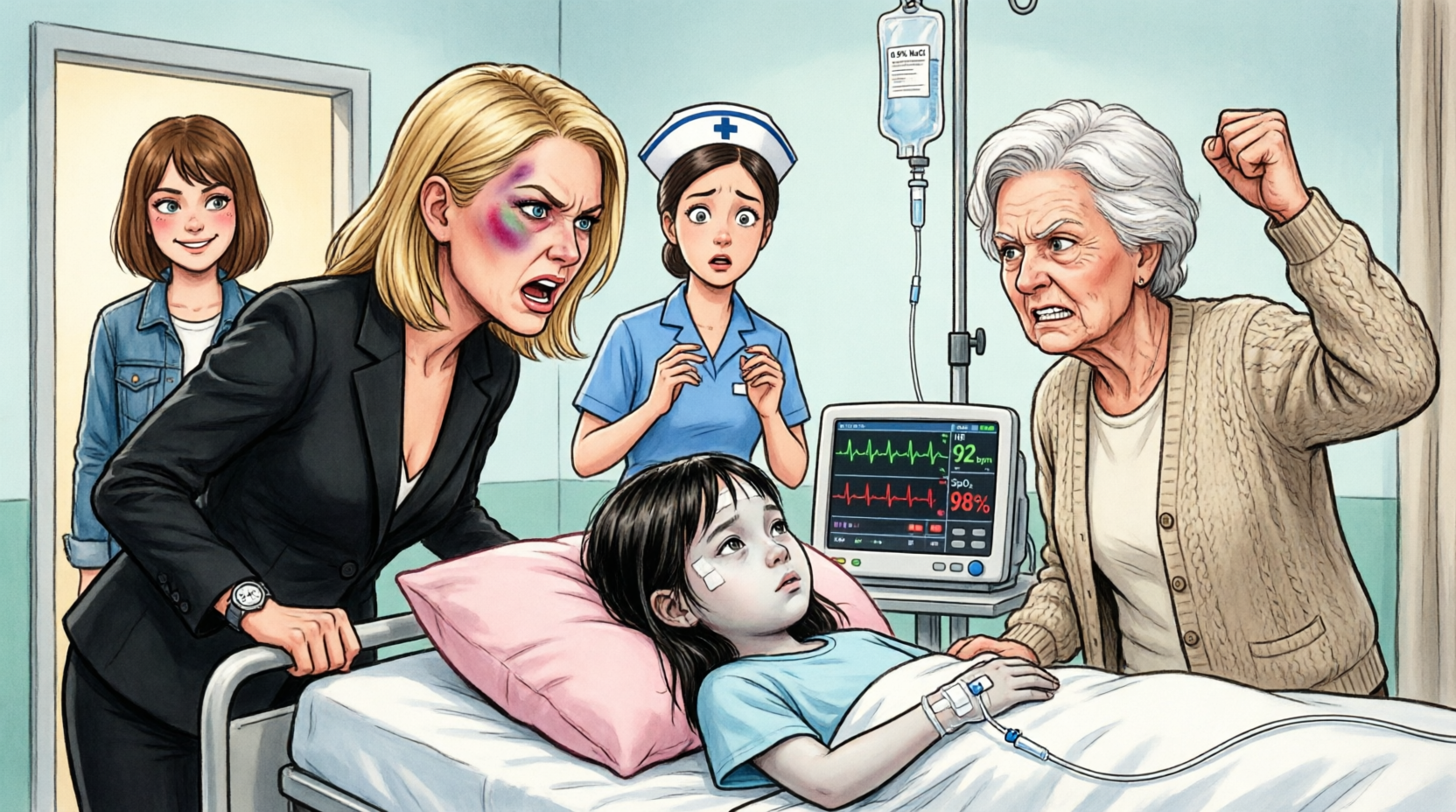
While my four-year-old daughter was sleeping, my sister tampered with her insulin pump as a joke, changing all the settings. When my daughter woke up shaking and sweating, I rushed her to the hospital. My parents defended my sister, Mom slapped me. How dare you accuse your sister. But when I …
The memory came to me so sharply that for a second I forgot where I was.
I forgot the hospital hallway, the smell of antiseptic, the buzz of fluorescent lights, the ache on my cheek where my mother’s handprint still burned.
I forgot my daughter lying in a bed behind a half-closed curtain, too small beneath a hospital blanket, her curls damp against her forehead, her little fingers taped around an IV line.
All I saw was the tiny black camera sitting on the bookshelf in my living room, tucked between a stack of Ivy’s picture books and a ceramic vase shaped like a swan.
The camera.
I had bought it six months earlier after Ivy started sleepwalking during a fever. It was a simple indoor camera, nothing fancy, connected to an app on my phone. I rarely checked it anymore. It watched the living room because Ivy loved falling asleep on the couch, and sometimes I liked to glance at her while I folded laundry upstairs or took a shower.
Mallerie knew about it.
At least, she had seen it before.
But Mallerie also never noticed anything that did not directly interest her.
My hand flew to my pocket. My phone felt heavy, almost hot, as I pulled it out. My fingers trembled so badly I missed the app twice before opening it. The police had not arrived yet. A nurse named Carmen stood a few feet away, pretending not to stare while very obviously staying close in case I collapsed or screamed or did something that proved my family right when they called me unstable.
The app loaded slowly.
Too slowly.
A spinning circle mocked me from the screen.
“Come on,” I whispered.
Carmen looked over. “Is everything okay?”
I could not answer. My throat had closed. The footage list appeared, each recording stamped with a date and time. The camera saved motion-triggered clips for forty-eight hours unless downloaded. My stomach dropped. Forty-eight hours. The incident had happened less than two days ago. Barely.
I scrolled with frantic precision, searching through clips of my empty living room, Ivy asleep on the couch, the light changing through the evening, my own blurred figure passing by with laundry in my arms.
Then I found it.
9:07 p.m.
Motion detected.
My thumb hovered over the file.
For a moment I was terrified to press play. Not because I doubted the truth. I had stopped doubting it the instant I saw those altered pump settings. But there is a difference between knowing someone harmed your child and watching it happen. There is a difference between hearing a monster laugh and seeing her face while she does it.
I pressed play.
The screen filled with my living room.
Ivy was asleep on the couch, her cheek pressed into a pillow decorated with yellow stars. Her hair spilled across her face. The television was off. A lamp glowed warmly in the corner. For several seconds, nothing happened.
Then Mallerie entered the frame.
She moved lightly, glancing over her shoulder toward the kitchen. Toward me.
My breath left me in a thin, broken sound.
Mallerie leaned over Ivy, her expression not confused, not curious, not childish. She smiled. It was not a silly smile. It was not nervous. It was cruelly delighted, like a person about to press a bruise.
On the audio, faint but clear, I heard the rush of water from the kitchen sink. My own voice hummed something under my breath while washing dishes, completely unaware that behind the wall my sister was bending over my sleeping daughter.
Mallerie reached for the insulin pump.
“No,” Carmen said softly from beside me.
I had not realized she had moved close enough to see the screen.
In the video, Mallerie held the pump in both hands. She tapped through the screen. I could not see exactly what she pressed, and I was grateful for that because some part of me knew I would never sleep again if I memorized the sequence. But I could see enough. She was not merely touching it. She was exploring it with intention, pausing, scrolling, selecting.
Then she whispered, very softly, but the camera caught it.
“Let’s see if Mommy really checks everything.”
My knees weakened.
Carmen grabbed my elbow. “Sit down.”
I did not sit. I could not. I watched as Mallerie looked once more toward the kitchen, then bent closer to the device. She giggled, covering her mouth like a child sneaking candy.
“You’re such a spoiled little princess,” she whispered to Ivy. “Everyone has to stop breathing because of you.”
Ivy stirred slightly in her sleep.
Mallerie froze.
Then Ivy settled again, and my sister smirked.
The video ended after one minute and seventeen seconds.
My hands were numb.
Carmen said something I did not understand. Her voice sounded far away, muffled by a roaring in my ears. I replayed the clip. Then I replayed it again, not because I wanted to, but because my mind refused to accept it after seeing it only once.
Mallerie’s face.
Mallerie’s hand.
Mallerie’s whisper.
“Let’s see if Mommy really checks everything.”
A sound came out of me then, low and animal, the kind of sound I did not know a human body could make until it had been gutted from the inside. Carmen took the phone gently from my hands before I dropped it.
“We need to preserve this,” she said. “Do you know how to download it?”
I nodded, though I could barely see through tears. “Yes.”
“Do it now,” she said, her voice calm but urgent. “Send it to yourself. Send it to someone you trust. Send it to the police when they arrive. Do not let anyone near that phone.”
Someone I trusted.
The words landed like a stone at the bottom of an empty well.
I had no one.
Not really.
For years, I had thought that being the older daughter meant being the responsible one, the forgiving one, the one who understood that Mallerie was younger, sensitive, impulsive, special in ways my parents never fully explained but always used as a shield. I had thought loyalty meant absorbing the blows and calling them family. I had thought my job was to keep the peace.
But peace had nearly killed my child.
I downloaded the clip. I saved it to my phone. I emailed it to myself. I uploaded it to a cloud folder. Then I sent it to the one person whose name made my chest ache when it appeared in my contacts.
Daniel Reeves.
I had not spoken to Daniel in three months except through careful co-parenting messages about pickup times, medication supplies, and school forms. Ivy’s father and I had divorced quietly the year before, not because of betrayal or cruelty, but because grief and exhaustion had hollowed out our marriage until there was no room left for tenderness. We still loved Ivy more than anything. We simply could not remember how to be soft with each other after years of hospital visits, insurance battles, sleepless nights, and my family’s constant interference.
I attached the video and typed with shaking fingers.
Mallerie did it. Ivy is stable but still admitted. Police are coming. Please come to the hospital.
I stared at the message, then added one more sentence.
I am sorry I didn’t call you sooner.
I hit send.
For the first time since Ivy had whispered that she felt weird, I allowed myself to bend forward and press one hand against my mouth. Tears came hot and fast, not graceful tears but ugly, wrenching sobs that made my ribs hurt. Carmen wrapped one arm around my shoulders.
“You found proof,” she said quietly. “That matters.”
I nodded because I knew it mattered legally, practically, factually.
But proof did not undo anything.
Proof did not erase the memory of Ivy’s body trembling in my arms. Proof did not change the fact that my sister had looked at a sleeping four-year-old and decided to gamble with her life for amusement. Proof did not make my parents love my daughter more than they loved pretending Mallerie was innocent.
Carmen guided me back into Ivy’s room. The torn medical report still lay scattered on the floor near the foot of the bed, white sheets of paper ripped into jagged pieces by my father’s hands. Security had photographed them before collecting most of the pieces, but a small corner remained under the chair, a triangle of paper with Ivy’s name printed on it.
I bent and picked it up.
Ivy’s full name looked impossibly small.
Ivy Grace Reeves.
My miracle. My alarm clock. My pancake thief. My stubborn little girl who insisted on wearing rain boots in sunshine and tutus over pajamas.
My daughter opened her eyes as if she had heard me thinking about her.
“Mommy?” she whispered.
I moved to her side instantly. “I’m here, baby.”
Her eyelids fluttered. “Did Grandma go home?”
I swallowed. “Yes.”
“Why was she mad?”
A thousand answers fought inside me. Because she would rather protect a lie than protect you. Because she has spent her life confusing control with love. Because your aunt hurt you, and Grandma wanted me to pretend she didn’t.
Instead, I brushed damp curls from Ivy’s forehead and said, “Grown-ups sometimes behave badly when they’re scared.”
Ivy considered that with the solemn concentration only a four-year-old could bring to adult failure.
“Was Aunt Mallerie scared too?”
My heart tightened so hard it hurt. “I don’t know.”
“She touched my pump,” Ivy said.
The room went silent.
I stared at her. “You remember that?”
Ivy nodded faintly. “I woke up a little. She said shhh.”
Carmen stepped closer, her expression changing from sympathy to professional alertness.
“What else did she say, sweetheart?” I asked, keeping my voice gentle though every cell in my body screamed.
Ivy’s face scrunched, not crying, just trying to remember through the fog of exhaustion and treatment.
“She said I get too much attention.”
I closed my eyes.
Carmen turned away, one hand pressed to her lips.
“She said Mommy thinks I’m special but I’m not.”
Ivy looked at me then, her eyes suddenly shiny with fear.
“Am I special?”
The question broke something in me more thoroughly than any slap could have.
I climbed carefully onto the edge of the hospital bed, mindful of the IV lines, and gathered her as close as I safely could.
“You are special,” I said, my voice shaking. “You are so special. You are the best thing in my whole life. Nothing anyone says can change that.”
Ivy tucked her face against my chest.
“My tummy feels funny,” she murmured.
“I know, baby. The doctors are helping.”
“Can we go home?”
“Not yet.”
“Is Aunt Mallerie coming back?”
“No,” I said, and for the first time in my life, I made a promise without making room for my parents’ feelings. “She is never coming near you again.”
Ivy relaxed slightly, as if my words had tucked a blanket around her heart.
Twenty minutes later, two police officers arrived.
Officer Grant was a broad-shouldered man with tired eyes and a notepad in his hand. Officer Patel was younger, her dark hair pulled into a severe bun, her expression composed but not cold. Carmen led them inside and gave them the basic outline while I sat beside Ivy, one hand resting on her blanket.
When Officer Patel asked if I was ready to speak in the hallway, I looked at Ivy.
“I’ll stay with her,” Carmen said.
Ivy’s fingers tightened around mine.
“Mommy?”
“I’ll be right outside the door,” I promised. “Carmen is staying right here. I won’t go far.”
In the hallway, I told the officers everything.
I told them about Mallerie’s visit. I told them about the warning. I told them about the pump settings, the hypoglycemia, the drive to the ER, the report. I told them about my parents refusing to believe me, my father ripping medical documents, my sister laughing, my mother slapping me.
Officer Grant wrote steadily.
Officer Patel listened without interrupting, but her eyes sharpened when I mentioned the video.
“You have footage?” she asked.
I handed her my phone. “I downloaded it. I emailed it to myself too.”
She watched it once. Then again.
Officer Grant watched over her shoulder. His jaw flexed.
“Can you send this to us?” he asked.
“Yes.”
He gave me an email address and case number. I forwarded the video. I also sent screenshots of the pump history that I had taken in the ER before staff took over. The pediatric endocrinologist, Dr. Elise Monroe, joined us and provided a calm, devastating explanation of what had happened medically.
“I cannot speak to intent,” Dr. Monroe said, though her expression suggested she had an opinion she was professionally containing. “But the settings were changed in a way that caused excessive insulin delivery. Ivy’s blood glucose level on arrival was critically low. Given the timing, the pump history, and now the video, this appears consistent with external tampering.”
Officer Patel asked, “Could a four-year-old child have made these changes herself?”
“No,” Dr. Monroe said immediately. “Not realistically. Not with that sequence of alterations. Also, the child was asleep.”
“Could it have happened accidentally by someone holding the device?”
“No.”
That single word landed cleanly.
No.
No ambiguity.
No family spin.
No, Mallerie had not accidentally almost killed Ivy. No, I had not overreacted. No, my fear had not made me unreasonable. No, my mother’s slap had not changed reality.
Officer Grant closed his notebook. “We’ll need to speak with your sister.”
“My parents will protect her,” I said.
“Then they can explain that to us.”
I almost laughed, but there was no humor left in me.
Officer Patel’s voice softened. “Do you have somewhere safe to stay after discharge?”
“My house,” I said automatically.
“Do your parents or sister have keys?”
The question hit me like cold water.
My parents had keys. Mallerie might have copied one at some point. I did not know. I had never imagined needing to keep family out.
“Yes,” I admitted.
Officer Patel nodded. “You should consider changing the locks before your daughter goes home. Also, given what happened here today, you may be able to request an emergency protective order. We can explain the process.”
A protective order.
Against my sister.
Possibly against my parents.
The words should have felt extreme. Instead they felt late.
I was answering another question when footsteps pounded down the hallway. I turned just as Daniel appeared around the corner, wild-eyed, unshaven, still wearing the gray sweatshirt he wore when working from home.
He saw me.
Then he saw the officers.
Then he saw the red mark on my cheek.
“What happened?” he demanded.
His voice was not loud, but it had a dangerous steadiness I had heard only once before, the night Ivy was diagnosed and an exhausted resident spoke too casually about long-term complications. Daniel had stood up from a plastic hospital chair and said, very quietly, “Choose your next words carefully.”
Now he looked at me the same way.
“Ivy is stable,” I said quickly.
His face crumpled with relief so intense it nearly took him to his knees. Then the rest of my message caught up with him.
“Mallerie?”
I nodded.
He dragged both hands over his face. “Where is she?”
“Gone. With my parents.”
Daniel looked at the officers. “You saw the video?”
“We did,” Officer Patel said.
“Good,” he said. “Then arrest her.”
Officer Grant maintained professional calm. “We’re investigating.”
Daniel stepped closer, rage tightening every line of his body. “She tampered with my daughter’s insulin pump while she slept. That is not a prank. That is not teenage stupidity. That is attempted murder.”
The hallway seemed to hold its breath.
Officer Patel did not correct him.
“We understand the seriousness,” she said.
Daniel turned to me. “Why didn’t you call me the second she was admitted?”
The hurt in his voice struck deeper than anger would have.
“I should have,” I said. “I was scared and everything was happening so fast, and I—”
“You’re her mother,” he cut in.
“I know.”
“I’m her father.”
“I know.”
His eyes shone, furious and terrified. “I should have been here.”
“You’re right,” I said.
The apology was not strategic. It was not defensive. It was simply true.
Daniel’s anger faltered, confused by the lack of resistance. We had become so used to turning every wound into a courtroom where both of us argued our pain that I think he expected me to fight. Instead, I stood there with my cheek burning and my hands still shaking and my heart laid bare.
“I’m sorry,” I said. “I am so sorry.”
For a second he looked like he might say something sharp. Then he glanced toward Ivy’s room, and whatever remained of the argument drained from him.
“Can I see her?”
“Of course.”
I led him in.
Ivy was awake again, watching a cartoon on mute because the sound bothered her head. The moment she saw Daniel, her lower lip trembled.
“Daddy.”
Daniel crossed the room in three strides and bent over her bed, gathering her as carefully as if she were made of glass.
“Hey, bug,” he whispered. “I’m here.”
“I got sick.”
“I know.”
“Mommy drove fast.”
“I bet she did.”
“Grandma yelled.”
Daniel’s eyes flicked to mine.
I shook my head slightly. Not now.
He nodded and kissed Ivy’s forehead.
“You don’t have to worry about Grandma right now,” he said. “You just rest.”
Ivy touched his beard with weak fingers. “You scratchy.”
He laughed, and it came out broken. “Yeah, I forgot to shave.”
“Mommy cried.”
His eyes closed.
“Mommy was scared,” he said.
“I was scared too,” Ivy whispered.
Daniel looked at me then, and for the first time in years, we were not ex-spouses standing on opposite sides of old grief. We were two parents staring at the same nightmare.
“I know, baby,” he said, turning back to her. “But you’re safe now.”
The words sounded solid when he said them.
I wanted to believe them.
By evening, the hospital room had become a fortress.
Daniel stayed. Carmen’s shift ended, but before leaving she squeezed my shoulder and told me she had given a written statement about what she witnessed. Dr. Monroe documented everything again. The hospital social worker, Ms. Hargrove, came in with a folder and the careful expression of someone trained to speak gently about terrible things.
She explained that because a child with a chronic medical condition had been intentionally endangered by a family member, a report to child protective services was required.
I flinched at the name.
“I didn’t endanger her,” I said quickly.
Ms. Hargrove’s eyes softened. “I understand. The report is not an accusation against you. It documents that Ivy was harmed by someone in her extended family and that protective steps are needed.”
Daniel sat forward. “What steps?”
“Ensuring the alleged perpetrator has no access to Ivy,” she said. “Reviewing the home environment. Confirming medical supplies are secure. Identifying safe caregivers. In situations where family members defended or minimized the harm, we also recommend no unsupervised contact with those individuals.”
“My parents will say I’m lying,” I said.
“They can say what they want,” Daniel replied sharply.
Ms. Hargrove glanced between us. “The video will matter. So will medical records. So will witness statements from staff.”
I looked down at my hands.
For years, my parents’ version of reality had been the only one that counted. If Mallerie broke something, I had left it too close to the edge. If she stole money from my purse, I should not have tempted her. If she screamed insults, she was overwhelmed. If I cried, I was dramatic. If I objected, I was jealous. If I withdrew, I was cold.
Now strangers in scrubs and uniforms were telling me evidence mattered more than family mythology.
It felt like stepping out of a house filled with gas and realizing fresh air had existed all along.
Around eight that night, Officer Patel called.
They had gone to my parents’ house.
Mallerie had denied everything.
Then they had told her there was video.
She had stopped talking.
My mother had screamed that the footage was taken out of context.
My father had demanded a lawyer.
Mallerie had been taken in for questioning.
I sat down before my legs gave out.
Daniel watched me from the other side of Ivy’s bed. “What did they say?”
“They took her in.”
His face hardened. “Good.”
Ivy stirred at the sound of his voice.
We both quieted instantly.
Officer Patel continued, “We’ll update you as we can. I strongly recommend you do not communicate directly with your parents or sister tonight. If they call, don’t answer. Save any messages.”
“They’re going to come here,” I said.
“We’ve informed hospital security. They are not to be allowed onto the pediatric floor.”
I looked toward the closed door.
Hospital security suddenly seemed like the only wall between my daughter and the people who raised me.
“Thank you,” I whispered.
After the call ended, my phone began vibrating almost immediately.
Mom.
I stared at the screen until it stopped.
Then Dad called.
Then Mom again.
Then an unknown number.
Then messages arrived.
How could you do this to your sister?
You have destroyed this family.
Call me right now.
Mallerie is terrified.
I hope you are proud of yourself.
Your father is sick over this.
This is what happens when you let doctors fill your head.
You always wanted to punish her.
Answer your phone.
Answer your phone.
ANSWER YOUR PHONE.
Daniel took the phone from my hand before I crushed it.
“Don’t read anymore,” he said.
“I have to save them.”
“I’ll screenshot them.”
“You don’t know my password.”
He gave me a look. “Your password is Ivy’s birthday.”
I almost smiled. “It is not.”
“Then it’s the dog’s name from your childhood.”
“We never had a dog.”
“Then I’m out of guesses.”
For one strange second, the absurdity of that exchange existed in the room like a fragile bubble. I gave him the passcode. He sat beside the window and took screenshots of every message, forwarding them to the case email Officer Grant had provided. He did it methodically, with the focused calm that had once made me fall in love with him.
Ivy slept.
Machines beeped.
The city moved beyond the window, headlights threading through the dark.
At eleven, Daniel handed my phone back.
“There’s one from Mallerie,” he said.
My stomach turned. “What does it say?”
He hesitated. “You should read it.”
The message was short.
You’re insane. It was funny. Nothing even happened. She’s fine. You ruined my life over a joke.
I stared at the words until they blurred.
Nothing even happened.
Nothing.
Not the ER. Not the IV. Not the glucose crash. Not Ivy asking if she was special. Not the hours of watching monitors while terror gnawed my bones hollow.
Nothing happened because Ivy had lived.
To Mallerie, survival erased the crime.
I forwarded it to Officer Patel.
Then I blocked Mallerie’s number.
My thumb hovered over my mother’s contact.
I blocked her too.
Then my father.
The silence that followed was terrifying.
Not peaceful.
Not yet.
But terrifying in the way an unlocked door becomes terrifying after you finally close it and realize you should have done it years ago.
I expected to feel grief immediately. Instead, I felt space.
The next morning, Ivy asked for pancakes.
Hospital pancakes, she soon discovered, were an insult to pancakes everywhere. She poked one with her fork and frowned as if the kitchen staff had personally betrayed her.
“This is a sponge,” she declared.
Daniel leaned over the tray. “It does look sponge-adjacent.”
“What does adjacent mean?”
“Next to.”
“This pancake is next to a sponge?”
“Emotionally, yes.”
Ivy giggled, weak but real, and the sound filled my chest with sunlight.
I cried again, silently this time, turning toward the window so she would not see. Daniel saw anyway. He always did when it mattered. He pulled a tissue from the box and held it out without comment.
Later that morning, Dr. Monroe cleared Ivy for discharge with strict instructions for continued monitoring and follow-up care. The replacement pump had been arranged through our supply company, and Ivy would use backup injections temporarily under the care plan Dr. Monroe reviewed with us. She spoke carefully, focusing on safety without making Ivy afraid of her own body.
“Ivy did nothing wrong,” Dr. Monroe said, kneeling beside the bed so she was eye level with my daughter. “Your pump is supposed to help you. Someone else made a bad choice. The grown-ups are going to make sure your medicine is safe.”
Ivy nodded, serious.
“Do I still get stickers?”
Dr. Monroe smiled. “Absolutely.”
She gave Ivy six.
Before leaving, Ms. Hargrove returned with paperwork and a list of resources. A victim advocate would contact us. Police would follow up. CPS would schedule a home visit. Emergency protective order forms could be filed at the courthouse that afternoon.
Daniel looked at me. “I’ll go with you.”
“You don’t have to.”
“Yes,” he said. “I do.”
There was no softness in his tone, but there was no anger either. Only certainty.
Ivy was discharged just after noon. We did not go home right away. Daniel took her to his apartment while I met a locksmith at my house. Walking through my front door felt like entering a crime scene, though nothing looked different.
The couch still held the star pillow.
Ivy’s blanket was folded over the armrest.
Her crayons were scattered across the coffee table beside a drawing of three stick figures holding hands: Mommy, Daddy, Ivy.
The camera watched silently from the bookshelf.
I stood in the doorway for a long time before stepping inside.
The locksmith, a kind older man named Luis, changed both exterior locks and installed an additional deadbolt. He did not ask many questions, but when I told him I needed every old key rendered useless, his expression shifted with quiet understanding.
“Family?” he asked once.
I looked at him.
He nodded. “You don’t have to answer. I’ve been doing this thirty years. Half the time it’s family.”
That sentence stayed with me.
Half the time it’s family.
After he left, I packed every medical supply into a locking cabinet Daniel ordered for same-day pickup. I changed passwords on the camera, the Wi-Fi, my email, Ivy’s medical accounts, everything I could think of. I gathered every spare key hidden under flowerpots or tucked in drawers. I walked room to room making a list of what needed to change.
Then I reached Ivy’s bedroom.
Her bed was unmade from the morning before. Her stuffed animals sat in a row like witnesses. On her nightstand, beside a pink plastic lamp, was a framed photo of her with my parents and Mallerie at her last birthday party.
Grandma smiling.
Grandpa holding a balloon.
Mallerie crouched beside Ivy with one arm around her shoulders.
In the picture, Ivy was laughing.
I picked up the frame and sat on the edge of the bed.
A memory rose uninvited.
Mallerie at thirteen, refusing to come to my high school graduation unless my parents bought her a new dress.
Mallerie at fifteen, “borrowing” my car without permission and scratching the bumper, then crying until Dad told me to stop upsetting her.
Mallerie at seventeen, announcing during my baby shower that she might be pregnant just to see everyone react, then laughing when Mom scolded me for looking horrified.
Mallerie at eighteen, complaining that Ivy’s diabetes made every family gathering “a medical documentary.”
And my mother, always smoothing the path before her.
She didn’t mean it.
She’s young.
You know how she is.
Why can’t you be the bigger person?
The bigger person.
That phrase had been a collar around my neck for as long as I could remember.
I set the photo facedown in a drawer.
Then I sat in my daughter’s room and let myself hate them for five full minutes.
Not forever, maybe.
Not enough to become them.
But enough to stop excusing them.
At the courthouse, the emergency protective order process felt both surreal and brutally practical. Fluorescent lights. Metal detectors. Forms asking me to reduce the worst night of my life into boxes and lines. Daniel sat beside me, one knee bouncing under the table while Ivy colored quietly between us with crayons from my bag.
A victim advocate named Serena helped me complete the paperwork.
“Against Mallerie only?” she asked gently.
I looked at Daniel.
He said nothing, letting it be my decision.
My pen hovered.
Mallerie had touched the pump. Mallerie had whispered cruelty into my sleeping child’s ear. Mallerie had admitted it was funny.
But my parents had defended her after knowing Ivy was hospitalized. My father had destroyed medical documents in a hospital room. My mother had slapped me in front of witnesses. They had brought Mallerie into Ivy’s room after being told what she had done. They had shown me that access to them meant access to denial, pressure, and danger.
“Against Mallerie,” I said. “And my parents.”
Serena nodded as if she had expected it.
On the form, under relationship to protected person, I wrote:
Maternal aunt. Maternal grandparents.
The words looked cold.
They were not cold enough.
The judge granted a temporary order that same afternoon, covering both Ivy and me. No contact. No coming to my home, Daniel’s apartment, Ivy’s daycare, her doctors’ offices, or the hospital. A hearing would follow.
My mother violated it in less than six hours.
She called from a new number while Ivy slept on Daniel’s couch and I sat at his kitchen table staring at a mug of tea I had not touched.
I answered without thinking, exhausted and expecting the locksmith or pharmacy.
“You wicked girl,” my mother hissed.
My entire body went rigid.
Daniel looked up.
“Do not call me,” I said. My voice sounded unfamiliar.
“You put your own sister in jail.”
“She put my daughter in the hospital.”
“She made a mistake.”
“She committed a crime.”
“You always hated her.”
I almost laughed. “I raised her half the time.”
“You resented her from the moment she was born.”
“That’s what you told yourself so you wouldn’t have to deal with what she became.”
Silence snapped across the line.
Then my mother’s voice dropped lower.
“You listen to me carefully. You will go to the police tomorrow and tell them you misunderstood. You will tell the court you were emotional. You will fix this before your father loses his job from the stress.”
There it was.
Not Ivy.
Not how is Ivy feeling.
Not I am sorry.
Your father’s job. Mallerie’s future. The family’s image.
“You slapped me in a hospital room,” I said.
“You deserved worse.”
Daniel stood.
I put the call on speaker and set the phone on the table.
My mother continued, unaware.
“That child has made you impossible. Everything is about her condition. Everyone has to tiptoe around Ivy. Mallerie is tired of being treated like a criminal just because she wanted to prove a point.”
Daniel’s face changed.
It did not twist in rage.
It went still.
That was worse.
“What point?” I asked quietly.
My mother hesitated.
“What point, Mom?”
“She wanted you to see that you’re obsessive,” my mother snapped. “That you act like Ivy will fall apart if everyone doesn’t worship at the altar of her disease. And look at you now, using this to destroy us.”
Daniel reached for his phone and began recording, though I had already started.
I said, “Ivy almost died.”
My mother made a disgusted sound. “But she didn’t.”
There it was again.
The family creed.
Damage only counted if it could not be hidden.
I ended the call.
Then I forwarded the recording to Officer Patel and Serena.
Daniel braced both hands on the counter, head bowed. For a moment, neither of us spoke.
Then he said, “She will never see Ivy again.”
It was not a question.
“No,” I said. “She won’t.”
He looked at me, and I saw all the old fights flicker behind his eyes. Every time he had told me my mother was manipulative. Every time he had said Mallerie was unsafe. Every time I had defended them because admitting the truth felt like betraying my own childhood.
“I should have listened to you,” I said.
Daniel exhaled slowly.
“I wish I had been kinder when I said it.”
That surprised me.
He pulled out the chair across from me and sat down. “I was angry all the time. At them. At the disease. At the bills. At you because you kept letting them in. At myself because I couldn’t fix anything. I said true things like weapons.”
I looked down at my hands. “I used denial like a shield.”
“We were both drowning,” he said.
I looked toward the living room where Ivy slept beneath a blanket, one stuffed rabbit tucked under her arm.
“We can’t drown anymore.”
“No,” Daniel said. “We can’t.”
The criminal case moved faster than I expected and slower than I could bear.
Mallerie was released pending charges after questioning, but the protective order prevented her from contacting us. My parents hired an attorney and began telling relatives a version of the story in which Mallerie had merely “touched a device,” I had “panicked,” and Ivy had been “never actually in danger.”
The first family message came from my Aunt Linda.
Honey, I know you’re upset, but your mother says this is being blown out of proportion. Is there any way to handle it privately?
I stared at the message for a long time.
Then I sent her the police case number, Dr. Monroe’s discharge summary, and the video.
She called me ten minutes later, sobbing.
“I didn’t know,” she said.
“No one asked me.”
“I’m so sorry.”
I wanted to be gracious. I wanted to say it was okay.
It was not okay.
“Please don’t contact me again unless it’s to support Ivy,” I said.
She understood.
Others did not.
My cousin Brent wrote that pressing charges would ruin Mallerie’s future.
Daniel, who had become my unofficial message screener, asked, “Can I respond?”
“No.”
“Just once.”
“No.”
“I will be polite.”
“That’s what worries me.”
He muttered something about people who deserved creative punctuation, then blocked Brent.
By the time CPS visited my house, it no longer looked like the same home. The locks had changed. The medical supplies were secured. The camera system had been upgraded. A written caregiver list was taped inside the medical cabinet. The list had three names: me, Daniel, and Daniel’s mother, Ruth.
Not my mother.
Never again.
The CPS worker, Mr. Alvarez, was kind but thorough. He inspected the medicine storage, asked Ivy age-appropriate questions, reviewed the discharge plan, and spoke with Daniel and me together.
“You both seem aligned on safety,” he said.
Daniel glanced at me.
“We are,” I said.
It felt good to say.
Not married. Not magically healed. But aligned.
When Mr. Alvarez asked Ivy if she felt safe at home, she nodded.
“Mommy got a lock box,” she said proudly.
“For what?” he asked.
“My diabetes stuff. Nobody mean can touch it.”
He smiled gently. “That sounds smart.”
Then she added, “Aunt Mallerie is in time-out from my life.”
Daniel coughed into his hand.
Mr. Alvarez pressed his lips together in a heroic attempt not to laugh.
“That sounds like your mom is keeping you safe,” he said.
“She is,” Ivy replied.
Those two words carried me for days.
The first protective order hearing happened one week after Ivy came home.
I barely recognized my parents when I saw them in the courthouse hallway. My mother wore a navy dress and pearls, her church pearls, the ones she wore when she wanted people to think she was dignified. My father stood beside her in a suit, jaw clenched, eyes avoiding mine. Mallerie sat on a bench between them, pale and furious, her hair pulled back, no makeup except mascara that made her look younger than nineteen.
For one irrational second, I saw her as a baby.
Mallerie at two, reaching sticky hands toward me.
Mallerie at five, climbing into my bed during thunderstorms.
Mallerie at eight, crying because kids at school called her weird.
Then she looked up and met my eyes.
She smirked.
The baby vanished.
Daniel stepped slightly in front of me, not blocking me, just reminding me I was not alone.
My mother noticed and scoffed.
“Of course you brought him,” she said. “Always so theatrical.”
I did not answer.
Her eyes flicked to Ivy, who held Daniel’s hand and wore a yellow dress with daisies. The court had allowed Ivy to be present only briefly before Ruth took her outside, because her name was part of the order but she did not need to hear the full testimony.
My mother’s face softened artificially.
“There’s my sweet girl,” she cooed.
Ivy stepped behind Daniel’s leg.
My mother’s expression cracked.
“Don’t teach her to be afraid of me,” she snapped.
Daniel said, “You did that yourself.”
My father moved forward. “Watch your mouth.”
The bailiff looked over.
My father stopped.
In the courtroom, everything became both formal and intimate. The judge reviewed the petition. Serena sat behind me. Officer Patel was present. Carmen had submitted a statement. Dr. Monroe’s report was admitted. The video was played.
I thought I would break watching it again in that room.
Instead, I watched the judge’s face.
She did not gasp. She did not show dramatic horror. But her lips pressed into a thin line when Mallerie whispered, “Let’s see if Mommy really checks everything.”
My mother stared straight ahead, refusing to look at the screen.
Mallerie looked bored.
Then the recording of my mother’s phone call played.
“That child has made you impossible.”
“Everyone has to tiptoe around Ivy.”
“Mallerie is tired of being treated like a criminal just because she wanted to prove a point.”
“But she didn’t.”
The words filled the courtroom.
My mother’s dignified mask collapsed into fury.
“That was private,” she hissed.
The judge looked at her. “Ma’am, you were calling someone protected under a temporary order. Nothing about that call helps your position.”
My father’s attorney tried to argue that my parents were not physically dangerous to Ivy, only emotionally upset. The judge asked whether tearing up medical records in a hospital room and bringing the alleged perpetrator to the child’s bedside after being warned counted as sound judgment.
The attorney had no satisfying answer.
Then Mallerie spoke.
Not through her lawyer.
Not wisely.
She stood suddenly and said, “I didn’t know it would actually do anything.”
Her lawyer grabbed her arm. “Sit down.”
But Mallerie was crying now, angry tears, humiliated tears, tears for herself.
“I was just trying to show everyone she’s crazy,” Mallerie said, pointing at me. “She acts like Ivy is made of glass. Every holiday, every dinner, every stupid family thing, it’s Ivy’s sugar, Ivy’s pump, Ivy’s snacks, don’t stress Ivy, don’t touch Ivy’s bag. I was sick of it.”
The courtroom went still.
Mallerie wiped her face with the back of her hand.
“And she was fine. She’s sitting right there.”
Ivy was not sitting right there anymore. Ruth had taken her outside before the video played. Thank God. But the empty space where my daughter had been seemed to pulse.
The judge leaned forward.
“Ms. Hall,” she said to Mallerie, “do you understand that a child does not have to die for harm to matter?”
Mallerie’s mouth opened, then closed.
My mother began to cry quietly.
Not for Ivy. I knew the difference now.
The protective order was extended.
No contact for one year, subject to renewal.
Mallerie was ordered to stay away from Ivy, me, my home, Daniel’s residence, Ivy’s daycare, medical providers, and any event where Ivy would be present. My parents were included due to their conduct, threats, and minimization.
When the judge read the order, my mother turned in her seat and looked at me with such hatred that for a second I felt eight years old again, standing in the kitchen after Mallerie spilled juice on my homework and being told I should have moved it.
Then Ivy’s laughter floated faintly from the hallway.
The spell broke.
I was not eight.
I was Ivy’s mother.
And I did not have to make myself small for anyone.
Outside the courthouse, Ruth was crouched beside Ivy near a vending machine, helping her choose between two snacks from our approved bag, because Ivy had discovered that courthouse vending machines were full of “forbidden treasure.”
Ruth looked up as we approached.
“Well?” she asked.
Daniel nodded. “Extended.”
Ruth closed her eyes briefly. “Good.”
Ivy tugged my sleeve. “Can Grandma come to my birthday?”
I knelt in front of her.
“No, baby.”
“Because of time-out?”
“Yes.”
“How long?”
“A long time.”
Ivy thought about that. “Will she say sorry?”
I did not want to lie.
“I don’t know.”
“If she says sorry, can she come?”
Daniel’s face tightened.
I took Ivy’s hands.
“Sometimes sorry is not enough right away. Sometimes people have to show they are safe, not just say words.”
Ivy nodded slowly, absorbing the hard geometry of boundaries.
“Like when I hit Lucas with a block and had to sit away from blocks?”
“A little like that,” I said. “But bigger.”
“Because pumps are not blocks.”
“No,” I whispered. “Pumps are not blocks.”
That night, after Ivy fell asleep at Daniel’s apartment, I sat on his balcony wrapped in a blanket while spring rain tapped against the railing. Daniel came outside with two mugs of tea.
“Peppermint,” he said. “You still drink that when you’re stressed?”
“I drink it when I’m alive,” I said.
“Good distinction.”
He sat beside me.
For a while, we listened to the rain.
“Do you think she’ll go to jail?” I asked.
“Mallerie?”
“Yes.”
“I don’t know.”
The honest answer was strangely comforting.
Charges had been filed: child endangerment, assault related to tampering with medical equipment, and other counts I could barely process. The prosecutor had explained possibilities, but nothing was guaranteed. Mallerie’s age, lack of prior record, and the fact that Ivy survived could affect sentencing. The video made prosecution more likely. The messages made intent harder to minimize. Still, courts were courts, and outcomes were not the same as justice.
Daniel blew steam from his mug. “Do you need her to?”
I thought about it.
“I need her away from Ivy,” I said. “I need everyone to stop pretending she didn’t know what she was doing. I need my parents to stop being able to rewrite reality. Jail, probation, treatment, whatever happens… I need the truth to be official.”
Daniel nodded.
Then he said, “I called my therapist.”
I looked at him in surprise.
He stared into his mug. “I have an appointment next week. I think I need help not turning this into pure rage.”
“That’s good.”
“I also asked about family counseling.”
My heart skipped.
He glanced at me quickly. “Not for us like… not necessarily us. I mean co-parenting. Trauma. How to help Ivy. How to not mess her up more.”
“She is not messed up.”
“I know. I meant—”
“I know what you meant.”
The rain fell harder.
“I think that’s a good idea,” I said.
Daniel nodded again, relieved.
Then, after a long silence, he said, “I’m sorry for leaving you alone with them.”
I turned toward him. “You didn’t.”
“I did. After the divorce, I was so relieved not to deal with your family anymore that I let pickups and drop-offs be enough. I knew your mother still came around. I knew Mallerie made comments. I told myself it was your house, your boundaries, your problem.”
“It was my responsibility.”
“Ivy is my responsibility too.”
I looked through the glass door at our daughter asleep on his couch, her rabbit tucked under her chin, her face peaceful for the first time in days.
“We can do better now,” I said.
Daniel followed my gaze.
“Yeah,” he said. “We can.”
In the weeks that followed, our lives narrowed and deepened.
There were doctor appointments, police updates, meetings with the prosecutor, court dates, therapy sessions, insurance calls, daycare safety forms, and long nights when Ivy woke crying because she dreamed someone was touching her pump. There were mornings when she refused to wear her medical device at all, sobbing that it was “bad now,” and I had to hold her while Daniel sat on the floor beside us and helped explain that the device had not hurt her, a person had misused it.
There were small victories.
The first night Ivy slept through without a nightmare.
The first time she let Daniel check her device without flinching.
The first day back at daycare, when her teacher Ms. Paula hugged me and whispered, “We’ve got her.”
The first pancake breakfast at home, with Ivy standing on a stool stirring batter too aggressively while Daniel insisted lumps were part of the artistic process.
And there were losses I did not expect.
My mother’s absence hurt.
Not because I wanted her near Ivy. I did not. Not because I doubted the order. I never did. It hurt because grief is not logical. I mourned the mother I had needed, not the one I had finally seen clearly. I mourned the fantasy that someday she would choose me when it mattered. I mourned every birthday, holiday, and ordinary Sunday dinner I had spent trying to earn gentleness from a woman who used love like a leash.
One afternoon, about a month after the hospital, I found myself standing in the cereal aisle at the grocery store, staring at a box of honey oat squares because they were my mother’s favorite. My hand reached for them automatically.
Then I remembered.
I remembered her voice on the phone.
“That child has made you impossible.”
My hand fell.
A woman beside me asked if I was okay.
I realized I had been crying silently beside the granola.
“I’m fine,” I said, then corrected myself because therapy was beginning to ruin my talent for lying. “Actually, I’m not. But I will be.”
She nodded as if that made perfect sense and handed me a tissue from her purse.
Strangers were kinder to me than my own mother had been.
That realization should have made the world feel crueler.
Instead, it made it wider.
Mallerie’s preliminary hearing came in early summer.
This time Ivy stayed with Ruth at the park, far from the courthouse. I wore a gray dress and flat shoes. Daniel wore a navy suit. We sat together on the prosecution side while Mallerie sat with her attorney, looking smaller than before but no less resentful.
My parents sat behind her.
They did not look at me.
The prosecutor presented the evidence. The video. The pump data. The medical records. The text where Mallerie wrote, “It was funny. Nothing even happened.” The recording of my mother’s call. The hospital witness statements.
Mallerie’s attorney argued immaturity, lack of intent to cause serious harm, family conflict.
The prosecutor responded with one sentence that lodged itself permanently in my mind.
“Immaturity may explain impulsiveness, Your Honor, but it does not transform deliberate tampering with life-sustaining medical equipment into a misunderstanding.”
The judge found sufficient evidence for the case to proceed.
Afterward, in the hallway, my father approached me.
Daniel stepped forward.
My father raised both hands. “I’m not violating anything. The order allows incidental courthouse proximity.”
His voice was cold, legalistic. He had learned the boundaries not because he respected them, but because he resented being caught by them.
“What do you want?” I asked.
For the first time since this began, he looked old. Not gentle. Not remorseful. Just tired in a way that made him seem less like a wall and more like a man who had spent decades holding one up.
“Your mother isn’t sleeping,” he said.
I waited.
“She cries every night.”
I waited longer.
He seemed irritated that this did not move me into comforting him.
“Mallerie may have to accept a plea,” he continued. “Her lawyer thinks it could reduce the consequences.”
“Good.”
His jaw tightened. “Good?”
“Yes. Good.”
“She’s your sister.”
“I know.”
“She made one mistake.”
“No,” I said. “She made countless small choices before she ever touched that pump. You and Mom protected every one of them.”
His face darkened. “Don’t lecture me.”
“Then don’t approach me.”
He glanced toward Daniel, then back at me.
“You’ve become hard,” he said.
That almost got through.
Hard.
The accusation every daughter fears when she stops bending.
I thought of Ivy’s shaking hands. I thought of my mother’s slap. I thought of Mallerie whispering into a sleeping child’s ear. I thought of all the years I had mistaken softness for surrender.
“No,” I said. “I’ve become clear.”
My father stared at me.
Something flickered across his face then. Not regret. Not yet. Maybe recognition. Maybe only the fear that he no longer knew how to control me.
He walked away.
Daniel exhaled. “You okay?”
I watched my father return to my mother, who refused to turn around.
“I think so.”
“You were shaking.”
I looked down. My hands were trembling.
Daniel gently took one and squeezed it.
“You can be clear and still shake,” he said.
That sentence became another kind of medicine.
Mallerie took a plea in July.
I did not attend the negotiation, of course, but the prosecutor called before it was finalized. Mallerie would plead guilty to felony child endangerment and a related tampering charge. The sentence would include supervised probation, mandatory psychological evaluation and treatment, community service, restrictions on contact with minors except under approved circumstances, and a no-contact order protecting Ivy and me for several years. Jail time remained possible if she violated conditions.
I sat on my back porch while the prosecutor explained, watching Ivy chase bubbles Daniel blew across the yard. She shrieked with laughter each time one popped on her nose. Sunlight caught in her curls.
“Do you approve?” the prosecutor asked gently. “The final decision is ours, but your view matters.”
My view matters.
I closed my eyes.
I wanted Mallerie to feel terror. That was the ugly truth. I wanted her to feel one hour of what Ivy had felt, one minute of what I had felt driving through red lights with my daughter slipping in and out of awareness. I wanted my parents to sit in a waiting room and beg a monitor to keep beeping.
But justice was not revenge, and revenge would not heal Ivy.
“Will the plea require her to admit what she did in court?” I asked.
“Yes.”
“Out loud?”
“Yes.”
“Then I can live with it.”
At sentencing, Mallerie cried.
This time, I think some of the tears were real.
Not all. Maybe not even most. But when she stood before the judge and read from a paper, her voice shook in a way I had never heard before.
“I knowingly touched and changed my niece’s insulin pump without permission,” she read. “I understood it was medical equipment. I understand now that my actions caused a medical emergency and could have caused her death.”
My mother sobbed behind her.
Mallerie looked briefly toward me.
“I told myself it was a joke because I didn’t want to admit I was angry. I was jealous of the attention Ivy got. That does not excuse what I did. I harmed a child. I harmed my niece. I am sorry.”
The apology entered the room and sat there, thin and trembling.
I did not know whether to believe it.
Maybe one day Mallerie would become a person who deserved belief.
That day was not mine to provide.
When it was my turn to read my victim impact statement, I walked to the front with Daniel beside me. The judge had allowed him to stand with me because Ivy was his daughter too and because my knees had not been reliable since dawn.
I unfolded my paper.
My hands shook.
I read anyway.
