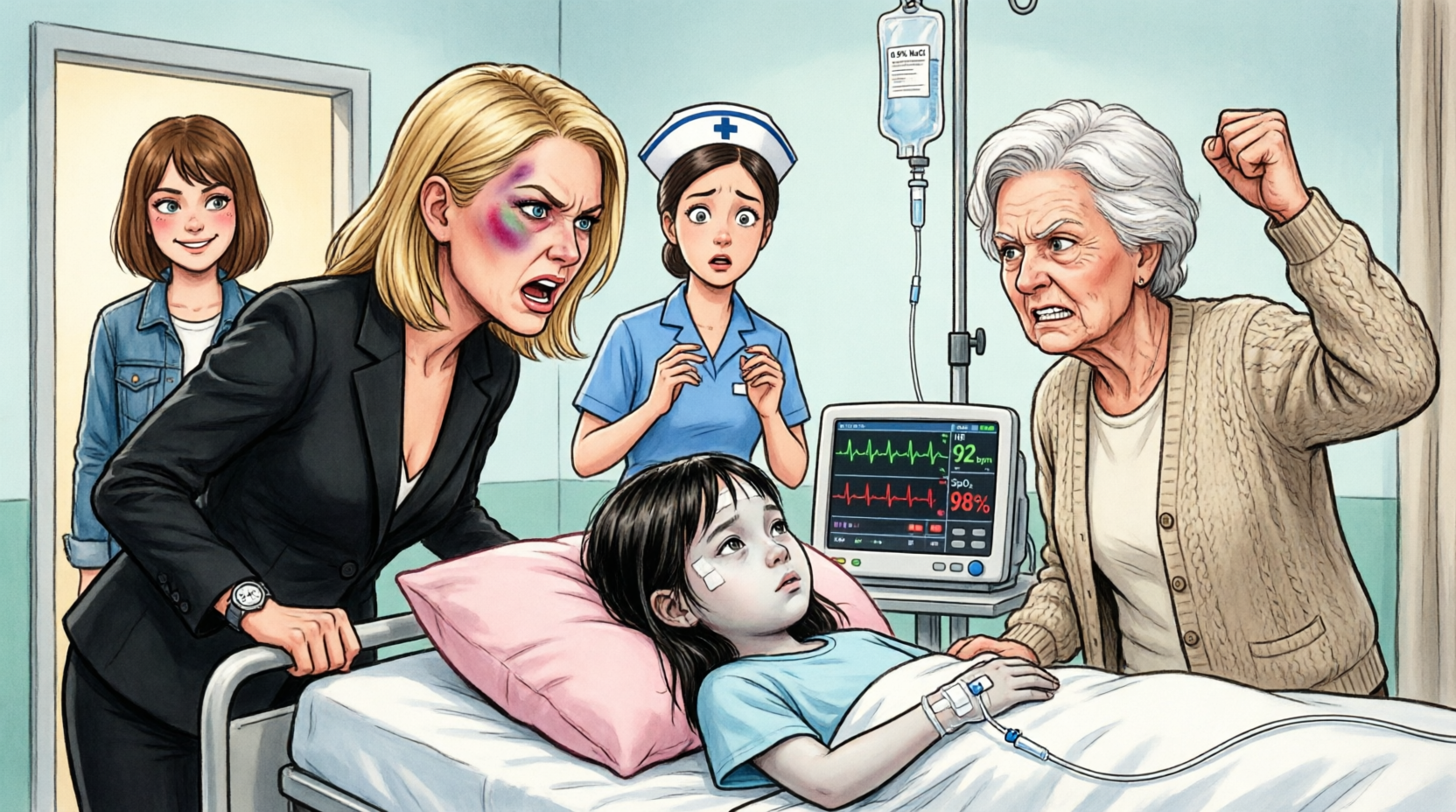
“My daughter Ivy was four years old when this happened. She was asleep in her own home, on her own couch, in the place where she should have been safest. Her insulin pump was not a toy. It was not a symbol of attention. It was not an object in a family argument. It was life-sustaining medical equipment attached to a child’s body.”
My voice cracked, but I continued.
“That night, Ivy woke shaking, sweating, confused, and terrified. She asked me why her aunt said she was not special. She asked me if Grandma was mad. She asked if she was safe. No child should have to ask those questions because an adult decided jealousy mattered more than her life.”
Mallerie stared at the floor.
My mother covered her face.
My father looked at me, and for once, I could not read his expression.
“The harm did not end when Ivy’s blood sugar stabilized,” I said. “It continued in nightmares, fear of medical devices, lost trust, and the knowledge that people who should have protected her made excuses instead. I am asking the court to treat this as what it was: a deliberate act against a vulnerable child. I am also asking that any sentence prioritize Ivy’s safety over family comfort.”
I lowered the paper.
Then I added something I had not written.
“I spent most of my life being told to keep peace in my family. I am done keeping peace with danger.”
Daniel’s hand brushed mine.
The judge sentenced Mallerie according to the plea terms but added stern conditions. Any contact attempt would risk incarceration. Treatment compliance was mandatory. She was barred from possessing or handling another person’s medical equipment. She was ordered to write a letter of apology to Ivy, but it would be delivered only to me and Daniel, and only if Ivy’s therapist someday believed reading it would help her.
I appreciated that.
Ivy did not need apologies handed to her like burdens.
After court, my mother tried to speak.
The bailiff stopped her.
My father did not try.
As Daniel and I walked down the courthouse steps into the harsh summer light, I expected relief.
Instead, I felt empty.
Daniel seemed to understand.
“It’s over legally,” he said.
I nodded. “But not really.”
“No. Not really.”
We picked Ivy up from Ruth’s house. She was in the backyard wearing fairy wings, face sticky with watermelon, completely uninterested in the justice system.
“Mommy!” she shouted. “Daddy! Look, I can fly almost!”
She jumped from the bottom porch step, landed in the grass, and threw both arms up.
Daniel clapped as if she had crossed the sky.
I laughed so hard I cried.
Life did not return to normal after that.
It became something else.
Something quieter in some ways. Louder in others.
Holidays changed. Thanksgiving was at Ruth’s house, where the turkey was dry but nobody yelled. Christmas morning happened in my living room with Daniel arriving before sunrise because Ivy insisted Santa might need both parents to witness the crumbs he left behind. We took pictures in pajamas. Daniel burned cinnamon rolls. Ivy declared them “crispy but brave.”
There were no phone calls from my parents.
No guilt trips before Easter.
No surprise visits.
No Mallerie flopping onto my couch and making comments sharp enough to bleed.
The absence was huge at first, like furniture removed from a room leaving dents in the carpet. Then slowly, the space became usable.
Ivy filled it with drawings.
Therapy helped her name feelings. She began saying things like, “My worry is loud today,” and “I don’t want Aunt Mallerie in my story.” Her therapist, Dr. Keene, helped us explain boundaries without making Ivy feel responsible for adult behavior.
One afternoon, months after the sentencing, Ivy drew a picture of our family.
This time there were three stick figures: Mommy, Daddy, Ivy.
Then she added Ruth, Ms. Paula from daycare, Dr. Monroe, and Carmen the nurse, whom Ivy still remembered as “the soft voice lady.”
The page became crowded with people who had helped.
No Grandma.
No Grandpa.
No Aunt Mallerie.
I asked, carefully, “Do you want to add anyone else?”
Ivy studied the drawing.
“No,” she said. “This is my safe team.”
My safe team.
I hung the picture on the fridge.
Daniel stood looking at it that evening when he came to drop off extra supplies.
“She put me taller than you,” he said.
“You are taller than me.”
“Emotionally too, I think.”
“In your dreams.”
He smiled.
It was happening more often now, that gentle smile. The one from before everything got hard.
We did not rush anything. We did not pretend trauma had magically repaired what exhaustion had broken. But co-parenting dinners became easier. Therapy sessions became honest. Sometimes Daniel stayed after Ivy fell asleep, and we talked at the kitchen table about bills, school, grief, mistakes, and the strange possibility of friendship after divorce.
One cold January night, nearly ten months after the hospital, the power went out during a storm.
Ivy woke crying, frightened by the sudden dark. Her backup medical supplies were secure. Her devices had battery support. We had prepared for this a dozen times because preparedness had become my lullaby.
Still, her fear rose fast.
Daniel was there, snowed in after dinner.
We lit battery lanterns. I checked Ivy calmly. Daniel made shadow puppets on the wall, though his rabbit looked more like a deranged lobster. Ivy laughed despite herself.
Then she asked, “What if something bad happens again?”
I sat beside her on the couch, the same couch where everything had begun.
“Bad things might happen sometimes,” I said, because I no longer believed in comforting lies. “But we have plans. We have safe grown-ups. We have doctors. We have each other. And we listen when something feels wrong.”
She leaned against me. “Even if someone says I’m dramatic?”
“Especially then,” Daniel said.
I looked at him.
He sat on the floor in front of us, lantern light softening his face.
“Your body belongs to you,” he told Ivy. “Your medical things are important. Your feelings are important. If anyone makes you feel unsafe, you tell us. We will believe you.”
Ivy nodded solemnly.
Then she said, “Even if it’s Santa?”
Daniel blinked.
I said, “Santa should also respect boundaries.”
“Good,” Ivy said. “Because he comes in houses.”
Daniel lost the battle and laughed into his hands.
The power came back at midnight, but we stayed in the living room under blankets until Ivy fell asleep between us.
I woke around two to find Daniel still awake, staring at the camera on the bookshelf.
“You okay?” I whispered.
He nodded, then shook his head. “I keep thinking about how close it was.”
“Me too.”
“If you hadn’t checked…”
“I know.”
“If the camera hadn’t recorded…”
“I know.”
He looked at me. “How do you live with that?”
I thought about it.
“The same way we live with her diagnosis,” I said finally. “Not by pretending it isn’t terrifying. By building routines around love.”
Daniel’s eyes softened.
“That sounds like something expensive therapy teaches.”
“It does.”
“Worth it?”
“Mostly.”
He smiled faintly.
Then he reached across the sleeping child between us and took my hand.
Not romantically, not exactly. Not yet. Maybe not ever. But tenderly. As two people holding opposite ends of the same fragile bridge.
Spring came again.
A full year.
The anniversary of the incident approached like weather in my bones. I became irritable without understanding why. I checked Ivy’s supplies too often. I dreamed of hospital monitors. I smelled antiseptic in ordinary places. One night I woke convinced I heard Mallerie laughing in the living room, only to find the house silent and moonlit.
Dr. Keene had warned me anniversaries could do that.
“The body remembers dates even when the mind refuses to circle them on the calendar,” she said.
I hated how right she was.
On the anniversary morning, Ivy woke early and climbed into my bed.
“Mommy?”
“Mm?”
“Can we make pancakes today?”
My eyes opened.
Sunlight touched the edge of the curtains. Birds chattered outside. Ivy’s hair was a tangled halo around her face.
“Pancakes?” I asked.
“Real ones. Not hospital sponge ones.”
A laugh burst out of me, startling us both.
“Yes,” I said. “We can make pancakes.”
Daniel came over with strawberries and a ridiculous bouquet of daisies because Ivy had recently announced that flowers were “plants wearing party clothes.” Ruth joined us. We made pancakes shaped like hearts, stars, and one unfortunate blob Daniel insisted was a unicorn.
Ivy ate three.
After breakfast, she asked to go to the park.
The same park she had run through the evening before Mallerie came over. For a moment, fear tightened my chest. Then Ivy grabbed her kite from the closet, the purple one Daniel had bought her, and I understood something simple and enormous.
The day belonged to her.
Not to the hospital.
Not to Mallerie.
Not to fear.
To Ivy.
We went to the park.
The sky was bright blue, wind strong enough to lift the kite almost immediately. Ivy ran across the grass, laughing, Daniel jogging behind her with unnecessary instructions, Ruth cheering from a bench. I stood beneath a maple tree and watched my daughter fly something purple and wild into the open air.
My phone buzzed.
Unknown number.
My stomach dropped.
I almost ignored it. Then I thought of evidence, court orders, documentation. I stepped away and answered without speaking.
For a second, there was only breathing.
Then my father’s voice said, “It’s me.”
I went cold.
The protective order against my parents was nearing expiration but still active. Any contact was a violation.
“You cannot call me,” I said.
“I know.”
“Then hang up.”
“Please.”
The word stunned me.
My father did not say please. Not like that. Not small.
I looked across the park. Ivy shrieked as the kite dipped. Daniel helped her pull it higher.
“What do you want?” I asked.
There was a long silence.
“Your mother and I separated,” he said.
I closed my eyes.
I had imagined many calls. Accusations. Manipulation. Fake emergencies. I had not imagined that.
“She won’t stop,” he continued. “She still says you exaggerated. She still says Mallerie was targeted. Mallerie is in treatment and… she admitted things. More than what she said in court. Things she did when she was younger. Things we ignored.”
His voice broke on the last word.
I leaned against the tree.
“I ignored them,” he said. “You told us. Daniel told us. Teachers told us. Other parents. We made excuses every time because it was easier than admitting we had failed her. Failed you.”
I said nothing.
“I’m not asking to see Ivy,” he said quickly. “I know I don’t deserve that. I’m not asking you to forgive me either.”
“Then why are you calling?”
“I wanted to say you were right.”
The park sounds faded.
Children laughing. Wind in leaves. Daniel calling, “Run left, bug, left!”
My father inhaled shakily.
“You were right to protect her from us.”
For years, some wounded child inside me had waited for those words.
Now that they were here, they did not heal everything.
They did not rebuild trust.
They did not erase the hospital.
But they entered me quietly, like a key turning in a lock I had forgotten I was holding.
“You’re violating the order,” I said, because truth mattered more than tenderness now.
“I know. I’ll report it myself if I need to. I just… I needed you to know.”
“You should tell the prosecutor,” I said. “Or your therapist. Or whoever is helping you. Not me.”
“I understand.”
Another silence.
Then he said, “Is she okay?”
I watched Ivy leap into the air, one hand gripping the kite string, her whole body bright with life.
“She is healing.”
A sound came through the phone, almost a sob.
“Good,” he whispered. “That’s good.”
I ended the call.
Then I stood under the maple tree and cried.
Daniel saw me and handed the kite string to Ruth before jogging over.
“What happened?”
“My dad called.”
His expression hardened. “What did he say?”
“That he knows I was right.”
Daniel looked past me, processing.
“Are you okay?”
I wiped my face. “I don’t know.”
“Do you want me to call Officer Patel?”
“Yes. Later. We document it.”
He nodded, proud and sad at the same time.
Ivy ran toward us, breathless.
“Mommy, you have to hold it! It’s pulling like a dragon!”
I looked at Daniel.
He smiled gently.
“Go fight the dragon.”
So I did.
I took the string from Ivy’s sticky little hand, and together we held on as the kite tugged hard against the sky.
That evening, after documenting my father’s call, I sat on the porch alone. The house behind me glowed warm. Ivy was asleep. Daniel was washing dishes even though I told him not to. Ruth had gone home with leftover pancakes wrapped in foil.
My phone rested on the table.
No new messages.
No crisis.
Just quiet.
I thought about my father’s words. I thought about whether people could change. I thought about how change did not automatically grant access. A person could become better far away from us. A person could be sorry and still unsafe. A person could tell the truth and still not be entitled to the child they failed to protect.
Maybe one day Ivy would ask about him. Maybe one day, when she was older, with therapists and boundaries and her own voice strong enough to carry the weight, there would be some carefully managed answer.
But not now.
Now she was five.
Now her world needed to be smaller than adult regret and bigger than fear.
Behind me, the door opened.
Daniel stepped onto the porch, drying his hands on a towel.
“I did the dishes,” he said.
“I heard.”
“One pan is soaking.”
“One pan is always soaking when you wash dishes.”
“That pan was emotionally unavailable.”
I smiled.
He leaned against the railing.
“Ruth asked if we’re coming Sunday.”
“For dinner?”
“Yeah.”
I looked at him. “We?”
He suddenly became interested in folding the towel.
“I mean, you and Ivy. I’ll be there too. Obviously. It’s my mother.”
“Obviously.”
He cleared his throat. “She likes having you over.”
“I like being there.”
“Good.”
The porch light hummed softly.
Then he said, “I like having you there too.”
The words sat between us, careful and unforced.
I looked at him, really looked. At the tired eyes that had watched monitors beside mine. At the hands that had held Ivy through nightmares. At the man who had been my husband, then my opponent, then my ally, and now something unnamed but not unwelcome.
“I like being there,” I said again, softer.
He nodded.
No promises. No dramatic reunion. No pretending pain was romantic just because we had survived it together.
Just a door, not closed.
Months passed.
Mallerie completed the first phase of court-ordered treatment. I knew because the prosecutor notified me of compliance updates. She did not contact us. My mother tried twice through relatives, both attempts documented and shut down. My father sent one letter through his attorney, not to me directly. I did not read it for three weeks.
When I finally did, it was brief.
He apologized without asking for anything.
That mattered.
It was not enough.
That mattered too.
I placed the letter in a folder labeled “For Later” and locked it in the cabinet with legal documents, not medical supplies. Ivy did not need to carry it. Neither did I, not every day.
Ivy started kindergarten in the fall.
On the first morning, she wore a purple backpack nearly as big as her body and insisted on sparkly shoes. Her medical plan had been reviewed with the school nurse, her teacher, the principal, and every adult who might be responsible for her care. Daniel and I attended the meeting together. We asked questions. We explained boundaries. We provided written instructions. We did not apologize for taking time.
The school nurse, Mrs. Bell, said, “You two are very organized.”
Daniel said, “Fear made us annoying.”
I said, “Love made us thorough.”
Mrs. Bell smiled. “Thorough is welcome here.”
When we dropped Ivy at her classroom, she hesitated at the door.
“What if I need you?” she asked.
Her teacher, Ms. Anand, knelt nearby but did not intrude.
I crouched in front of Ivy. Daniel crouched beside me.
“Then the grown-ups here know how to help,” I said.
“And we are close,” Daniel added. “Mommy is ten minutes away. I’m fifteen if I break no traffic laws.”
Ivy narrowed her eyes. “You should not break laws.”
“Correct.”
I touched her cheek. “You can do brave things while feeling nervous.”
She took a deep breath.
“Brave means doing it with worry?”
“Sometimes.”
She nodded, then marched into the classroom with the determined dignity of a tiny queen.
I made it to the car before crying.
Daniel handed me a tissue.
“You stock these now?” I asked.
“I have evolved.”
We sat in the car outside the school for ten minutes, neither of us ready to leave.
“She’s okay,” he said finally.
“She’s okay.”
“Are you?”
I watched children stream through the doors, lunchboxes swinging, parents waving, the world doing its ordinary morning miracle.
“I’m getting there.”
He reached across the console and took my hand.
This time, it was a little romantic.
I let it be.
Two years after the hospital, Ivy asked about Mallerie.
We were baking cookies. Flour dusted the counter. Daniel was measuring chocolate chips with suspicious generosity. Ivy had grown taller, her baby softness giving way to long limbs and missing front teeth. Her medical routines had become part of life again, not free of frustration but no longer wrapped in terror.
She rolled dough between her palms and said, “Is Aunt Mallerie still in time-out?”
Daniel went still.
I kept rolling dough.
“Yes,” I said.
“Forever?”
“I don’t know.”
“Did she say sorry?”
I looked at Daniel.
He gave the smallest nod, telling me he trusted me to answer.
“She wrote a letter,” I said. “Daddy and I read it. Dr. Keene read it too.”
“What did it say?”
“That she was sorry she hurt you. That she was wrong. That your diabetes was never your fault. That her jealousy was her responsibility, not yours.”
Ivy pressed a chocolate chip into the dough.
“Can I read it?”
My heart squeezed. “Do you want to?”
She thought about it for a long moment.
“Not today.”
“Okay.”
“Maybe when I’m bigger.”
“Okay.”
She added another chocolate chip.
“Is Grandma sorry?”
I breathed in slowly.
“I don’t know.”
“Is Grandpa?”
“He says he is.”
“Do we believe him?”
Daniel leaned against the counter, listening.
I said, “We believe actions over words. Grandpa has respected the boundary for a long time now. That is an action. It does not mean we have to see him. It means we notice.”
Ivy nodded.
“Can people be sorry and still not come to cookies?”
“Yes.”
“Good,” she said. “Because I want all the cookies.”
Daniel whispered, “Relatable.”
Ivy giggled and threw a chocolate chip at him.
That night, after she slept, Daniel and I read Mallerie’s letter again at the kitchen table.
It had arrived six months earlier through the proper legal channel. The handwriting was uneven. The sentences were simple. There were no excuses. That alone told me treatment had done something.
Dear Ivy,
I hurt you when you were little. I touched something that helped keep you healthy, and I did it because I was angry and jealous. That was wrong. You did not cause it. Your diabetes did not cause it. Your mom did not cause it. I caused it. I am sorry. You never have to forgive me or see me. I hope you are safe and happy. I am working on becoming someone who never hurts people like that again.
Mallerie.
The first time I read it, I felt nothing.
The second time, I felt rage.
The third, sadness.
Now, two years later, I felt the faintest outline of hope that had nothing to do with reunion.
“She sounds different,” Daniel said.
“She does.”
“Do you believe it?”
“I believe she was different when she wrote it. I don’t know what she’ll be ten years from now.”
“That’s fair.”
I folded the letter carefully.
“I don’t hate her every day anymore,” I said.
Daniel looked at me. “That’s good.”
“Sometimes I do.”
“That’s also fair.”
I placed the letter back in its envelope.
“I don’t think forgiveness is a door you open so someone can walk back in,” I said. “Maybe sometimes it’s just putting down whatever they threw at you.”
Daniel was quiet for a while.
Then he said, “Have you put it down?”
I looked toward Ivy’s room.
“Some days.”
He reached for my hand.
“Some days is a lot.”
When Ivy was seven, Daniel moved back in.
Not suddenly. Not because trauma tied a bow around us. It happened after years of showing up, therapy, careful conversations, and one very serious discussion with Ivy in which she asked whether this meant Daddy would now be available for breakfast negotiations.
We did not remarry right away.
We did not know if we would.
But we built something that felt less like returning to the past and more like choosing a new house on the same land after the old one had burned.
The first night he slept under our roof again, I woke at three in the morning and checked the locks.
Then the medical cabinet.
Then Ivy’s room.
Daniel found me in the hallway.
“Hey,” he whispered.
“I’m okay.”
He did not say, “Are you sure?” because he had learned that sometimes okay meant standing upright while fear passed through.
He stood beside me outside Ivy’s door.
She slept peacefully, one arm flung over her stuffed rabbit, her device secure, her face soft in the nightlight glow.
“I still check,” I whispered.
“I know.”
“Maybe I always will.”
“Then we’ll always check.”
That word.
We.
I leaned into him.
In the dark hallway, with our daughter breathing safely a few feet away, I finally let myself believe that love could be rebuilt without denial.
When Ivy was eight, she asked to read Mallerie’s letter.
We sat with Dr. Keene when she did. Ivy read slowly, lips moving over each word. Her brow furrowed. She did not cry.
When she finished, she folded the paper and handed it back.
“What do you think?” Dr. Keene asked.
Ivy looked at me, then at Daniel.
“I think she knows it was her fault.”
“Yes,” I said softly.
“I like that she said I don’t have to forgive her.”
Daniel’s eyes shone.
“What do you want to do with the letter?” Dr. Keene asked.
Ivy considered.
“Keep it in the folder. Not in my room.”
“That sounds good,” I said.
On the drive home, Ivy stared out the window.
Then she said, “I don’t want to see her.”
“Okay,” Daniel said.
“Maybe when I’m a grown-up.”
“Okay,” I said.
“Or maybe never.”
“Also okay.”
She nodded, satisfied.
Then she asked if we could get ice cream.
We could.
We did.
At nine, Ivy began advocating for herself with a fierceness that made me both proud and slightly afraid for every adult who underestimated her.
At a birthday party, a parent she barely knew pointed at her medical device and said, “What’s that little gadget?”
I started to answer from across the picnic table.
Ivy beat me to it.
“It’s private medical equipment,” she said. “You can ask me questions if I say it’s okay, but you can’t point.”
The parent blinked. “Oh. Sorry.”
“Thank you,” Ivy said, then returned to her cupcake.
Daniel leaned toward me and whispered, “She could run a courtroom.”
“She already has.”
That night, Ivy asked if I was proud of her.
“So proud,” I said.
“Because I was polite but bossy?”
“Because you protected your boundary.”
She grinned. “Bossy boundary.”
“Sure.”
She fell asleep smiling.
I stood by her bed for a long time, remembering the child who once asked if she was special because someone cruel had tried to plant doubt in her while she slept.
That seed had not grown.
We had not let it.
When the final no-contact order neared expiration, I received notification that I could request renewal.
Ivy was ten by then.
Old enough to have a voice.
Not old enough to carry adult decisions alone.
Daniel and I discussed it with Dr. Keene first. Then with Ivy.
We sat at the kitchen table on a rainy Thursday evening. Ivy listened carefully, twisting a friendship bracelet around her wrist.
“So the paper that says Aunt Mallerie can’t come near us is ending?” she asked.
“Yes,” I said. “We can ask the court to extend it.”
“Has she tried?”
“No.”
“Has Grandma?”
“Not recently.”
“Has Grandpa?”
“No.”
Ivy looked down.
“Grandpa sends birthday cards through the lawyer,” she said.
“Yes.”
“I like the turtle one.”
“I know.”
“Do I have to see him if the paper ends?”
“No,” Daniel said immediately. “Legal permission is not the same as family permission.”
Ivy nodded.
“Do you want the order renewed?” I asked.
She was quiet so long rain filled the room.
Then she said, “For Aunt Mallerie, yes. For Grandma, yes. For Grandpa… I don’t know.”
My heart twisted.
“Not because I want to see him now,” she added quickly. “But because he follows rules. Maybe rules inside himself, not just court rules.”
Daniel looked at me.
There was wisdom in that, more than I was ready for.
In the end, we renewed against Mallerie and my mother. My father, through his attorney, signed a voluntary agreement not to contact Ivy directly unless invited through me and Daniel, and not to attend any event where she would be present without written permission. It was not trust. It was structure.
A year later, after more therapy and careful thought, Ivy agreed to receive a letter from him.
He wrote about birds.
Not guilt. Not pressure. Not “I miss you.” Not “please forgive me.”
Birds.
He had taken up birdwatching after separating from my mother. He wrote that a cardinal visited his feeder every morning and behaved like it owned the yard. He included a drawing. It was terrible.
Ivy laughed for five minutes.
“He draws like Daddy,” she said.
“Rude,” Daniel muttered.
Ivy wrote back three sentences through the agreed channel.
Dear Grandpa,
Cardinals are pretty. Your drawing is bad. I am doing good.
Ivy.
It was the most Ivy letter imaginable.
That was where it began.
Not reconciliation.
Correspondence.
Monitored. Slow. Uneven. Guided by Ivy’s comfort and nobody else’s hunger.
My mother never changed.
Or if she did, she did it somewhere beyond our knowledge. She sent messages through relatives for years, always some variation of wounded outrage. She was lonely. She was aging. She deserved to know her granddaughter. Families forgive. Mothers make mistakes. I never responded.
At first, silence felt like cruelty.
Then it became hygiene.
Mallerie, I heard indirectly, moved away after completing probation. She became a medical receptionist for a veterinary clinic, which struck me as both ironic and strangely hopeful. She never contacted us. Her apology letter remained in the folder. Ivy never asked for it again.
When Ivy was twelve, she gave a presentation at school about living with Type 1 diabetes.
Parents were invited. Daniel and I sat in the back of the classroom, trying not to look too eager. Ivy stood at the front with slides she had made herself, explaining in clear, confident terms what blood sugar was, what insulin did, and how classmates could be supportive without being weird.
At the end, a boy asked, “Is it scary?”
Ivy thought about it.
“Sometimes,” she said. “But scary things are less scary when people listen and don’t touch stuff that isn’t theirs.”
Several parents chuckled softly.
Daniel covered his mouth.
I stared at our daughter, tall and bright and utterly herself.
She continued, “Also, if someone says you’re making a big deal about your health, you should still make a big deal. It’s your body.”
Her teacher clapped first.
Then everyone did.
I cried, of course.
Daniel had tissues.
He always had tissues now.
That evening, we celebrated with pizza. Ivy rolled her eyes when we told her how proud we were, but she smiled into her soda.
“You guys are embarrassing,” she said.
“That’s our job,” Daniel replied.
“You’re overqualified.”
After dinner, she went to her room to video call a friend, leaving Daniel and me at the kitchen table surrounded by plates and the comfortable mess of ordinary life.
I looked around the room.
The medical cabinet still stood against the wall, though newer, less ominous now, covered on one side with magnets from vacations. The camera remained on the bookshelf, upgraded twice over, no longer a symbol of terror but of vigilance. The couch had been replaced years ago, not because we could erase what happened, but because one spring I realized I wanted a blue one.
On the fridge hung a photo from Ivy’s presentation. In it, she stood beside her slide, chin lifted, eyes clear.
Daniel followed my gaze.
“She’s something,” he said.
“She is.”
He reached across the table for my hand, wedding ring glinting.
We had remarried when Ivy was eleven, in Ruth’s backyard, with Ivy officiating unofficially until the actual officiant gently reclaimed control. We did not use the word destiny. We did not say everything happened for a reason. Some things happen for no good reason at all. Some people hurt children. Some families fail. Some nights split your life cleanly into before and after.
But after is still a place.
You can build there.
A week after Ivy’s presentation, a letter arrived.
Not through an attorney.
Not from my father.
From Mallerie.
The return address was in Oregon.
My hands went cold when I saw her name.
Daniel stood beside me at the kitchen counter.
“She violated the order?” he asked.
I checked the date. The order had expired two months earlier. We had not renewed because Mallerie had remained gone for years and Ivy, after discussion with Dr. Keene, said she did not want court involved anymore unless Mallerie tried direct contact.
“She mailed it to me,” I said. “Not Ivy.”
Daniel’s jaw tightened. “Your call.”
I almost threw it away.
Then I thought of the girl Mallerie had been, the monster she had become for one terrible night, the woman she might or might not be now. I thought of boundaries. I thought of not letting fear make every decision.
I opened it.
Inside was one page.
I read it silently first.
Then aloud to Daniel.
Dear Vanessa,
I know I have no right to write. I am not asking for contact with Ivy. Please do not show her this unless you think it is right, and I understand if the answer is never.
I have been in therapy for years. That is not a request for praise. It is context. I understand now that what I called a joke was cruelty. I understand that jealousy became entitlement because Mom and Dad allowed it and because I chose to keep using it. I understand that I could have killed Ivy. I write that sentence often because I should never be allowed to soften it.
I am sorry I hurt her. I am sorry I hurt you. I am sorry I turned your fear into entertainment. I am sorry I let Mom defend me when I knew the truth. I am sorry I smirked in court. I remember doing it. I hate that version of myself, but hating her does not undo what she did.
I am not asking to be forgiven. I am not asking to come back. I only wanted to tell you that you were right to choose Ivy. I hope she is healthy and happy. I hope you are too.
Mallerie.
By the time I finished, Daniel’s eyes were wet.
Mine were dry.
Not because I felt nothing.
Because what I felt was too deep for tears.
I folded the letter.
“What do you want to do?” Daniel asked.
“Put it in the folder.”
“Tell Ivy?”
“Not today. Maybe not for a long time.”
He nodded.
“Are you okay?”
I looked out the kitchen window at the backyard where Ivy’s old purple kite hung from a hook in the shed, faded now but intact.
“I think so.”
That night, I dreamed of the hospital again.
But the dream changed.
In the old dream, I ran down an endless hallway carrying Ivy while doors slammed shut ahead of me. My mother laughed from somewhere behind the walls. Mallerie whispered from every room. The hallway never ended.
This time, I reached the end.
Carmen opened the door.
Daniel stood inside.
Dr. Monroe checked Ivy’s pulse.
Ruth held a blanket.
Officer Patel stood guard.
And Ivy, older now, maybe twelve, maybe twenty, sat up on the hospital bed and said, “Mom, I’m okay. You can put me down.”
I woke before dawn with tears on my face.
Daniel slept beside me, one hand under his cheek.
The house was quiet.
I got up and walked to Ivy’s room.
She was asleep, sprawled diagonally across her bed, one sock on, one sock missing, surrounded by books and the controlled chaos of adolescence. Her medical device rested secure where it belonged. Her safe team had expanded over the years, but at the center of it, always, was her own voice.
I did not wake her.
I stood there only a moment.
Then I went downstairs and made coffee.
The morning began with the kind of quiet that used to comfort me.
This time, it did.
Not because nothing bad could happen.
Not because the world had become safe.
But because I had learned the difference between peace and silence.
Silence was what my family demanded after harm.
Peace was what we built after truth.
Years ago, when Ivy was four, I stood in a hospital hallway with a burning cheek and a shaking phone, remembering a camera that my sister had forgotten. I thought the proof would be the thing that saved us. In a way, it did. It saved us from lies. It saved us from being cornered inside my parents’ version of events. It saved my daughter’s story from being rewritten as drama, misunderstanding, exaggeration.
But proof was only the beginning.
What saved us afterward was less dramatic.
Changed locks.
Blocked numbers.
Therapy appointments.
Court forms.
Doctor visits.
Pancakes.
Lanterns in a power outage.
A father learning to carry tissues.
A mother learning that being clear was not the same as being cruel.
A child learning that her body mattered, her fear mattered, her voice mattered.
A family, smaller than before, but safer.
At seven that morning, Ivy thundered down the stairs, no longer small enough to sound like a herd of squirrels but somehow still trying.
“Mom,” she called, “did you sign the field trip form?”
“On the counter.”
“Did Dad make coffee or did you?”
“I did.”
“Good. His tastes like bean punishment.”
Daniel’s voice drifted from upstairs. “I heard that.”
“You were meant to,” Ivy shouted back.
I smiled into my mug.
She breezed into the kitchen, taller than my shoulder now, hair in a messy braid, backpack hanging from one arm. She grabbed the form, then paused when she saw me watching her.
“What?”
“Nothing.”
“Mom.”
“I’m just looking at you.”
“That’s weird.”
“I know.”
She rolled her eyes, but she came over and leaned against me for half a second, the adolescent version of a hug.
“I’m fine,” she said, as if answering the question I no longer needed to ask aloud.
I kissed the top of her head.
“I know.”
And I did.
Not because danger had never touched her.
Because it had touched her and failed to define her.
Daniel came downstairs, tying his tie badly. Ivy groaned and fixed it for him with practiced irritation. Sunlight poured through the kitchen windows. The blue couch waited in the living room. The camera blinked softly from the shelf. The medical cabinet stood locked but no longer frightening. Outside, the day opened wide.
For a long time, I believed family was something you endured.
Then I believed family was something you escaped.
Now, watching my daughter scold her father about tie symmetry while he pretended not to know how to fix it, I understood something better.
Family was something you protected.
Family was something you chose with your actions.
Family was not the people who demanded silence after hurting you.
Family was the people who helped you tell the truth, survive it, and make breakfast the next morning.
Ivy grabbed a pancake from the plate I had made without thinking.
She took one bite and pointed it at Daniel.
“See? This is a pancake. Learn from greatness.”
Daniel bowed solemnly. “I remain humbled.”
I laughed.
The sound filled the kitchen, easy and whole.
And for once, nothing in me waited for it to be taken away.
THE END
