NEXT PART — The Name Ruth Left Off the List
By the time I pulled into the short-term garage on Thursday, my brother had sent eleven messages to the family group chat.
The first said he was on his way. The second said he’d parked. The next nine were about where he’d parked, because my father had replied to the second one with, I know where the airport is, Troy.
I found him at baggage claim holding three coffees in a cardboard tray.
“Dad says he’s carrying his own bag,” he told me.
“How much does it weigh?”
“Forty-six pounds.”
“How do you know that?”
“Mom sent me a picture of the scale at Aunt Linda’s.”
We stood there watching the doors. For a minute, neither of us had anything to say. The carousel was still. Above it, a screen showed my parents’ flight in green letters.
“You okay being here?” Troy asked.
“Yeah.”
He looked over at me.
“I’m a little cold,” I said. “And you got me coffee. I’m okay.”
He handed me the one with an M written on the lid. James used to write an M on my coffee when we had people over. He called me Amelia right up until the first time he heard my family call me Mel. After that he’d switch between the two, depending on whether he wanted to make me laugh or get me to tell him what was wrong.
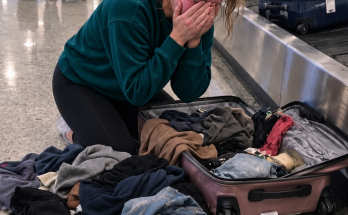
I’d spent a year thinking a place could keep an old version of you. I’d expected to walk into baggage claim and feel like the woman who had stood there with a broken suitcase and a phone full of people telling her to figure it out. Instead, I was standing beside my brother, wondering how long we ought to wait before drinking Dad’s coffee too.
Then Mom came through the doors alone.
She had her purse, her coat, and a paper bag from a bakery Aunt Linda liked. She set the bag down by my feet and went straight into my arms.
“Aunt Linda gave me scones for Ruth,” she said against my shoulder. “Remind me before I go home.”
“Where’s Dad?”
“Ten feet behind me, arguing with a man who offered him a wheelchair.”
Dad came through the doors a moment later, sitting in the wheelchair.
“Man made a very persuasive case,” he said.
Troy crouched, handed him his coffee, and went to get the luggage. Dad let him.
Mom picked up the bakery bag. One side had gone translucent with butter.
“I called Ruth from the plane,” she said. “I wanted to tell her about the scones. She usually picks up by the second ring.”
“She’s probably out.”
“I called again when we landed.”
“Did you leave a message?”
“Yes. Then I remembered how many times she must have called me that night.”
I put my coffee down.
I’d been in the habit of leaving my phone face down when I was out with somebody. James and I started doing it years ago because I used to interrupt him in the middle of a sentence to answer somebody asking what time dinner was on Sunday. My phone was face down on the ledge behind me.
There were two missed calls from Ruth.
The first had come while I was looking for a parking space. The second, three minutes before Mom walked through the doors. There was a voicemail.
I played it, holding the phone between Mom and me.
“Amelia, it’s Ruth. I need you to come over when you’ve got a minute. You can finish whatever you’re doing. I’m perfectly all right. I just need—”
She stopped.
I heard something scrape against the floor.
Then she hung up.
I called her. It rang twice.
“Hello, dear.”
“Ruth, where are you?”
“In my kitchen.”
“Did you fall?”
“I’m at the table. I’ve got tea.”
“Okay. I’m coming over.”
“Bring your mother. I heard something about scones.”
She sounded so thoroughly herself that my shoulders dropped. Then she said, “Would you ask your brother to come too? If he’s free.”
Troy was lifting Dad’s suitcase off the carousel. He saw me looking at him and set it down.
“He’s free,” I said.
There were four cardboard boxes in Ruth’s living room.
The biggest one said KITCHEN in black marker. It held three photo albums and the ceramic duck that usually sat on her windowsill. A smaller box said BOOKS and contained most of her good dishes.
“What on earth are you doing?” I asked.
“Apparently, I’m packing badly.”
She was sitting at the table with one slipper on. The other foot was bare and swollen around the ankle.
I looked at it. She looked at me looking at it.
“I called the doctor before I called you,” she said. “I have an appointment in the morning. And before any of you gets an idea, I got the slipper off on my own.”
Dad took the chair across from her. “How’d you do it?”
“Caught my toe on the step bringing in the recycling.”
“That step’s been loose since July,” I said.
“Oh, I know. I use it every day.”
Mom opened the bag from the bakery. She found plates in the cupboard and put a scone in front of everyone. I’d grown up watching her make tea during arguments, after funerals, and once when a boy broke up with me on my birthday. For years I’d thought she did it because she couldn’t stand to sit still. Now I watched her put a plate near Ruth’s good hand, close enough that Ruth wouldn’t have to lean to reach it.
“Can we talk about the boxes?” Troy asked.
Ruth pulled an envelope out from under her saucer and handed it to him. He read the first page, turned it over, then read it again.
“You’re selling the house?”
“I was going to.”
“Were you going to tell us?” I asked.
“I am telling you. You’re here, and I’m telling you.”
I felt the answer I wanted to give rise right into my throat. Something about all the things she knew about my life, all the times she’d shown up at my door without waiting to be asked. Something about how I thought I’d earned the right to know.
I took a bite of my scone. It was dry around the edges. I chewed for a while.
“Where were you planning to go?” I asked.
“Somewhere with no stairs and nobody who knows how I take my tea.”
Mom set the kettle down.
“Both of those things sounded lovely six weeks ago,” Ruth said. “Today I fell on a step I’ve been meaning to fix since July, and I sat down on my kitchen floor and thought about how long it would take somebody to find me. Then I got up, made tea, and called you twice because I still couldn’t bring myself to say it the first time.”
“Say what?” I asked.
Ruth looked at the boxes in the living room.
“I don’t want to move far away. I think I was trying to do it before anybody saw me needing help.”
Dad rested both hands on the handle of his cane.
“How far away were you going?”
“Eugene.”
He thought about it. “That’s far enough to make me complain about the drive every time.”
“You complain about the drive to the grocery store, Frank.”
“I get there, though.”
Ruth laughed. Then she picked at the edge of the scone until a small pile of crumbs had gathered on her plate.
“James knew where my spare key was,” she said. “Under the blue pot. I moved it after he died. I meant to tell you where I’d put it, Amelia, and every time I thought about telling you, it felt like I was giving you another thing to remember.”
“Where is it now?”
“In the flour tin.”
Mom turned and looked at the counter. “The flour tin?”
“I buy bread, Carol. There hasn’t been flour in that tin since Obama.”
For a few minutes, we talked about ordinary things. Troy would look at the step in daylight. Mom offered to drive Ruth to her appointment. Dad said he knew somebody who had moved into a ground-floor apartment a mile away and could ask what it was like. Ruth listened to each offer, accepted two of them, and told my father she’d make her own inquiries when she felt like it.
Then she asked us to open the little drawer under the wall phone.
“The address book in there,” she said. “The red one.”
I took it to her. A rubber band held it shut. Some of the pages had gone soft at the corners. Inside the front cover, somebody had written a phone number in purple ink and drawn a flower beside it.
“Who’s that?” I asked.
“My daughter.”
I waited for a correction. A goddaughter, maybe. A daughter-in-law whose name had never come up.
Ruth took the book from me and smoothed the first page with her thumb.
“Her name is Evelyn.”
The kettle clicked. Across the table, Troy put his coffee down very carefully.
“How old is she?” Mom asked.
“Fifty-six in February. She was born during an ice storm. The nurse said nobody would be going anywhere that night, and I remember thinking that suited me fine. I wanted to keep looking at her.”
Ruth smiled at something only she could see.
“She hasn’t been inside this house in eighteen years.”
I thought about the boxes in the living room. The photo albums in the one marked kitchen. I’d carried groceries into this house, brought over Christmas dinner, and once sat on the bathroom floor with Ruth while we tried to figure out how to turn off the water under her sink. I knew the name of the woman who did her hair. I knew how old she’d been when she first ate a mango. I had never seen a picture of Evelyn.
“Does she know you’re moving?” I asked.
“She doesn’t even know I still live here, as far as I can tell.”
“Have you tried to call her?”
“Once. A long time ago. I got her answering machine and left a message.”
“What did you say?”
“I told her she could call me when she was ready to be reasonable.”
Mom’s eyes went to the table.
Ruth noticed. “Yes, Carol. I’ve had a lot of time to think about the wording.”
Nobody laughed this time.
Mom and Dad went home after supper. Troy put the boxes against the living room wall so Ruth could get around them and took a picture of the front step before he left. I stayed behind to wash the plates.
Ruth had a radio above the sink. James fixed its antenna with a paper clip one summer. It still picked up exactly one station: a man who played old standards and sometimes forgot to turn off his microphone before he coughed.
I switched it on. Ruth called to me from the table.
“You can ask.”
I dried my hands on the towel. “What happened between you?”
“Evelyn was leaving her husband. She called me from a grocery store parking lot on a Sunday. She had her daughter with her and a duffel bag. She asked if she could come here for a few days.”
Ruth looked down at her one slipper.
“I told her to go home and talk to him. I’d known him since he was nineteen. He fixed my car twice. He brought me a ham when my husband died. I spent a lot of time that afternoon telling Evelyn what a good man she’d married.”
The radio played softly behind us. Ruth picked up her teacup, found it empty, and set it down again.
“She asked if she could speak to her old bedroom.”
“What?”
“That was how she put it. ‘Could I speak to my old bedroom, Mom? Maybe it remembers me.’”
Ruth tried to say the next thing and couldn’t. I went back to the stove and brought the kettle to the table. I poured her the tea. When I sat down, she was looking at the red address book again.
“I knew as soon as she said it,” Ruth said. “I knew how badly I’d let her down. And I told her she was being dramatic. I wanted her to take it back so I could go on believing I’d done the right thing.”
I remembered looking out at the traffic beyond baggage claim after my family told me to take an Uber. How quickly I’d typed No problem. How I’d sat there afterward, staring at the words, wishing I’d left the message unanswered so at least they wouldn’t have that little scrap of permission.
“What did Evelyn do?” I asked.
“Her friend took them in. She told me that much in a letter. I found out later that she moved to Spokane. I have a granddaughter named Sophie who was eight the last time I saw her. She could have children by now. I wouldn’t know their names.”
Ruth put her hand flat on top of the book.
“Did James know?”
“Some of it. He saw a photograph one day when he was helping me look for the warranty for my fridge. He asked who the little girl was. I told him. A week later, he brought over a pack of envelopes.”
“What did you do with them?”
“I put them in the drawer and told him I wasn’t much for writing letters.”
I could picture him buying those envelopes. He’d have stood in the stationery aisle debating whether to get the ones you had to lick. He’d have come over with some ordinary excuse about buying too many and let Ruth decide what to do with the extra.
“Every time he came over after that,” Ruth said, “I thought he might ask if I’d written to her. He never did. Drove me crazy.”
I laughed. So did she, a little.
Then she pulled the drawer open and took out a pack of envelopes with the price sticker still on it.
“Do you suppose we could start with Sophie?” she asked.
“Why Sophie?”
“Because I know where to find her.”
Three months earlier, Ruth had seen a photograph in a community newsletter from Spokane. It was a picture of volunteers standing in front of a shelf full of children’s coats. The woman at the end wore a mustard-colored sweater and had one hand up, caught in the middle of pushing her hair back. Her name was in the caption.
Ruth had clipped out the picture and folded it into her address book.
I unfolded it. Sophie had Ruth’s forehead and her habit of turning her feet slightly inward when she stood. I could see why Ruth had known her.
“What do you want to say to her?” I asked.
“I wanted to ask her for her mother’s number.”
Ruth reached for the clipping. We sat there looking at the woman in the mustard sweater.
“She was in that car too,” Ruth said.
“Yes.”
“I always leave her out when I tell it.”
Ruth got up, steadied herself on the back of her chair, and took a pad of paper from the counter. It had a picture of a smiling tomato printed at the top. She stared at that tomato for so long I went and found a plain sheet in the drawer.
I set it in front of her and handed her a pen.
Ruth wrote six lines, crossed out four of them, and started again. I found a clean dish to dry. By the time I’d dried it twice, she asked me to read what she’d written.
Dear Sophie,
I don’t know what you remember about the day your mother asked to come here. I remember that you were in the car and that I could have made up a bed for each of you before dark. I’m sorry I sent you both away. If you ever want to write back, I’d like to hear from you. You can decide whether or not to tell your mother I wrote.
Love,
Grandma Ruth
“I don’t know about ‘Grandma,’” she said. “I’m a woman she met a few times before she was old enough to stay home by herself.”
“Did she call you Grandma when she was eight?”
“She called me Roo. She couldn’t say Ruth without spitting.”
I slid the paper back across the table. Ruth crossed out the last line and wrote, Ruth (Roo, when you were little).
She added her phone number. Then she read the letter aloud to herself, quietly enough that I could only hear every other word.
“Would you help me mail it in the morning?”
“Your mom’s taking me to the doctor. I’ll ask her to stop at the post office.” She folded the letter into thirds. “I think I’d like to put it in the slot myself.”
For twelve days, there was no answer.
I know it was twelve because Ruth told me she wasn’t counting on day four, day seven, and day eleven.
Her ankle improved. Troy fixed the step. Mom took her to see a ground-floor apartment and called me afterward to report that Ruth had opened every cupboard, run the shower, and asked a resident in the lobby what happened when something broke. Ruth eventually decided to stay in her house for the winter. One Sunday afternoon, we unpacked the boxes. I put the dishes back where she wanted them, and she put one of the photo albums on the coffee table.
The first picture showed an eight-year-old with a cardboard crown sitting beside a woman who was holding a birthday cake. The cake listed badly to one side. The woman had flour on her elbow.
“Evelyn made that,” Ruth said. “She’s laughing because somebody asked her to hold it straight. That cake spent the whole party sliding into the corner of its box.”
We went through another ten pages. Evelyn at seventeen, sitting on the hood of a car. Evelyn on the day Sophie came home from the hospital, looking so tired she’d forgotten to smile. Sophie at three, wearing one of Ruth’s good shoes and carrying the other by its heel.
I realized I had never asked Ruth what she’d been like as a mother. All I knew was what she’d done that Sunday. There were whole years in those photographs, and there was still that Sunday. I sat beside her while she turned the pages.
On the twelfth evening, I was in my kitchen trying to get a splinter out of my thumb when my phone rang.
“Amelia?” Ruth said.
“Yes.”
“I need you to come over.”
My heart went straight to her ankle. “Are you hurt?”
“No. I’m sitting down. I’m perfectly all right.” She paused. “That’s what I said last time, isn’t it? All right. I’m frightened, and I could use some company.”
I wrapped my thumb in a paper towel, put on my shoes, and walked next door.
Ruth was at the kitchen table. There was a glass of water on one side of her phone and the red address book on the other.
“She texted,” Ruth said.
“Sophie?”
Ruth nodded. She turned the phone so I could see it. The message had come in at 6:42. I looked at the clock over the sink. It was 6:49.
Hi, Roo. I remember the parking lot. I remember Mom going into the store and buying me a pack of gum because she’d promised me one before she made the call. I kept waiting for her to tell me we were going to your house.
Ruth watched me read.
The message went on.
I remember the paper crown, too. I wore it to bed. Mom let me. I still have the picture.
I showed her your letter. I asked first if she wanted to see it. She took it upstairs and read it by herself. She came back down and asked me to tell you something she couldn’t manage to type. I’m going to put it the way she said it.
There was a second message. Only two sentences.
I’m coming to Portland next Thursday. If I ask you to pick me up, will you come?
Ruth had already typed an answer in the little box at the bottom of the screen. It was a whole paragraph about how happy she was, how sorry she was, how many times she’d thought about calling, how welcome Evelyn would be. She had written three sentences about the state of the guest room.
I waited while she read it.
Then she held down the backspace key until the box was empty.
Yes. What time?
She pressed send.
I moved to get the kettle, but Ruth put her hand on my sleeve.
“Could you stay here while I wait?”
I sat back down. Somewhere in the house, a clock ticked loudly enough for me to wonder how I’d never heard it before.
Three dots appeared on the screen. They disappeared. Then they came back.
Five. Just me this time.
Ruth read the message twice. Then she set her phone down and asked me to show her where to park.