The house learned to be quiet before I did. For three days after Harold died, it held its breath. The refrigerator hummed at a lower pitch. The floorboards stopped their usual creaking complaints. Even the wind seemed to move around the roof rather than over it, as if afraid to disturb what remained. I walked through rooms that still held the shape of him. His coffee cup sat on the counter where he’d left it that last morning, a brown ring marking the bottom. His slippers waited by the bed, one slightly more worn than the other from the way he’d dragged his left foot after the stroke five years earlier. His reading glasses rested on the nightstand beside a book about World War II aviation he’d been reading for six months, moving through it slowly, savoring each chapter like a piece of candy he didn’t want to finish.
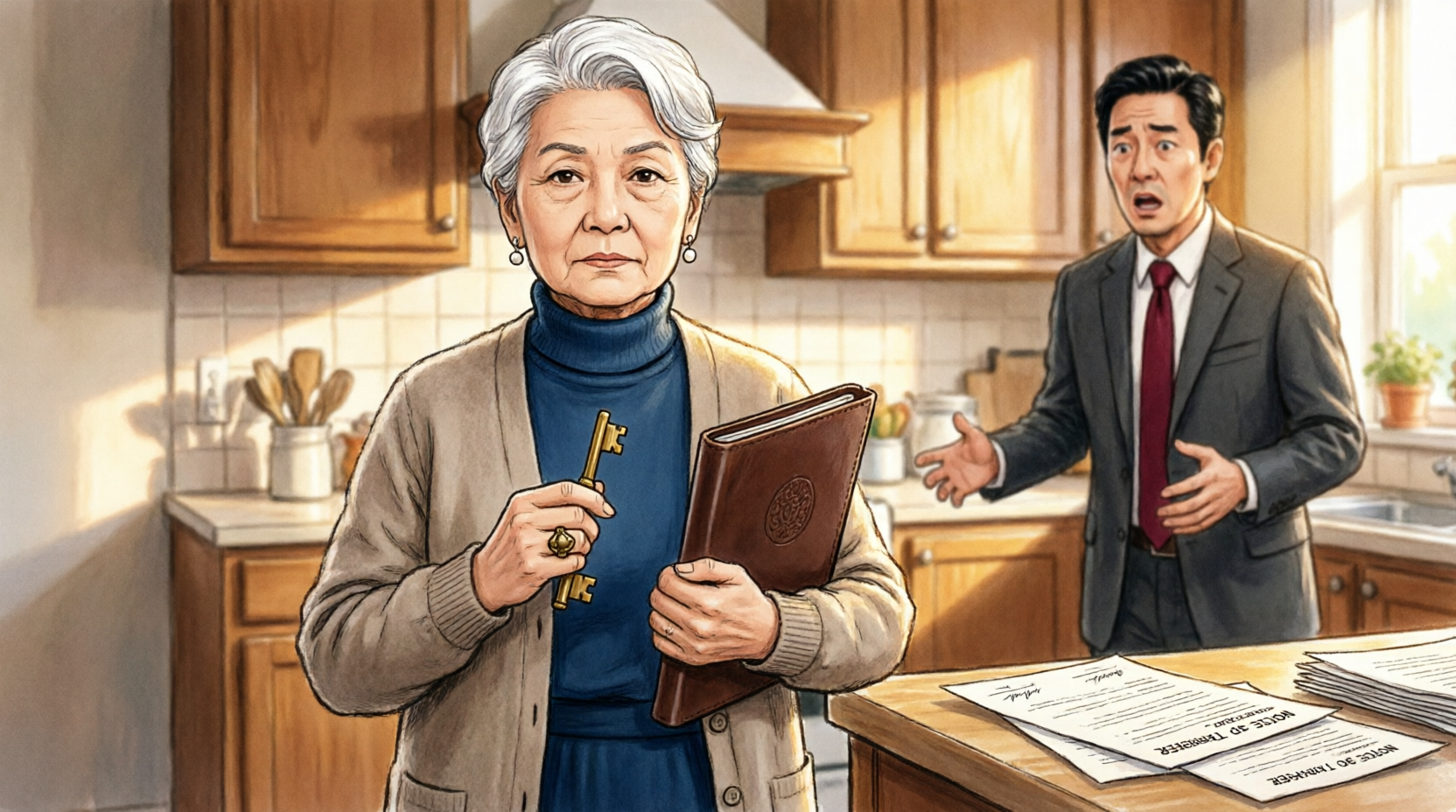
I didn’t cry those first three days. I moved through the house like a caretaker, watering his roses, collecting his mail, setting a place at the table out of habit before remembering there was no one to set it for. Daniel came on the fourth day. He brought Renee and the children, and they filled the rooms with a noise that felt like violence. “Mom, you shouldn’t live alone,” he said, finding me in the kitchen where I was scrubbing the same spot on the counter for the third time. The children ran through the house, their footsteps heavy on the stairs. My granddaughter, Emma, was twelve then, all sharp elbows and uncertain glances. My grandson, Jake, was fourteen, glued to his phone, thumb scrolling in a rhythm that never changed.
“You have us,” Daniel continued, his voice taking on that tone he’d developed as a teenager when he wanted something. Reasonable. Patient. As if he were explaining something simple to someone who wasn’t keeping up. “We have room. The guest room is all set up.” Renee appeared in the doorway, holding a casserole dish wrapped in aluminum foil. She wore a cream-colored dress that probably cost more than my monthly grocery budget, and her hair was styled in that careful way that took effort but was meant to look effortless. “We’d love to have you,” she said, though her eyes were already cataloging what needed to be done with the house, what could be sold, what should be thrown away. “Just for a little while. Until you’re back on your feet.” *For a little while.* That phrase did so much work. It made the decision sound temporary. It made the sacrifice sound practical. It made my grief sound like something the family could manage if I would just cooperate.
I looked past them, through the kitchen window, to the porch where Harold and I had sat every morning for thirty-four years. He would drink his tea. I would drink my coffee. We didn’t always talk. Sometimes we just watched the sun climb over the neighbor’s roof and listened to the birds argue in the oak tree.
“How long is a little while?” I asked.
Daniel exchanged a glance with Renee. It was quick, practiced, the kind of look that suggested they’d discussed this before.
“However long you need,” he said. “A few months. Six, maybe. Until you feel like yourself again.”
I didn’t feel like myself. I felt like a ghost haunting my own life. But I also knew, with a clarity that surprised me, that this house would become a museum if I stayed. Every room would hold a memory. Every corner would keep a piece of him. And eventually, I would suffocate under the weight of all that love.
So I said yes.
***
Selling the house took three weeks. Daniel handled the paperwork. Renee hired a real estate agent who specialized in “downsizing transitions.” The phrase made me sound like luggage being repacked for a different destination.
I packed slowly, methodically. I kept Harold’s clothes at first, folding his shirts into boxes, telling myself I’d donate them eventually. I kept his books, his tools, the bent spoon he’d used for coffee since our first year of marriage.
But Daniel and Renee came through with gentle suggestions.
“Mom, do you really need all those cookbooks? You can get new ones if you want them.”
“That toolbox is so old. We can get you a new one. Lighter. Easier to handle.”
“The kids need the space in the garage for their bikes.”
Each suggestion was reasonable. Each request was framed as concern. And slowly, piece by piece, I gave away the evidence that I had been someone’s wife, someone’s partner, someone’s equal.
The yellow kitchen went first. I sold it to a young couple who fell in love with the “character” of the chipped tiles and the window that stuck in summer. I watched them measure for new cabinets, their hands touching as they pointed out where things could go, and I felt a sharp, sudden grief for all the mornings Harold and I had spent in that room, not planning renovations, just being.
The rosebushes went next. I gave them to my neighbor, Mrs. Chen, who had watched Harold trim them badly for years and never said a word. She cried when I handed her the pruning shears.
“He loved those bushes,” she said.
“He loved the idea of them,” I corrected. “He loved that they were ours.”
The porch was the hardest. I sat there the night before we left, wrapped in Harold’s old cardigan, watching the sun set over the same view we’d watched for thirty-four years. I tried to memorize the way the light hit the oak tree, the way the shadows stretched across the lawn, the way the evening air smelled like cut grass and possibility.
I didn’t say goodbye out loud. I just sat there until the stars came out, until the house behind me went dark, until I could no longer pretend that leaving was temporary.
***
Daniel’s house in Scottsdale was everything our house wasn’t. New. Clean. Careful.
The floors were polished concrete that echoed every footstep. The walls were white, the cabinets white, the appliances stainless steel that showed every fingerprint. A covered pool sat in the backyard, chlorinated and unused, surrounded by a patio that looked like it had never hosted a barbecue.
Three garage doors lined the front of the house, each one holding a vehicle I couldn’t name. The refrigerator was full of almond milk, string cheese, protein bars, and routines that had no place for me.
“This is your room,” Daniel said, leading me down a hallway that smelled like lemon cleaner and new carpet.
Renee stood in the doorway, arms crossed, watching as I set my suitcase on the bed.
“We call it the guest room,” she said, correcting me before I’d even spoken. “It photographs better that way for the real estate listings, you understand. Staging is important.”
I understood that I was not meant to feel at home here. I was meant to be grateful for a temporary space in someone else’s life.
The room was decorated in shades of beige and gray. A generic landscape painting hung above the bed. The closet held wire hangers and empty space. The bathroom attached to it had towels that matched, folded into perfect thirds, and a soap dispenser that probably cost more than I used to spend on groceries in a week.
“It’s lovely,” I said, because what else was there to say?
Daniel hugged me then, a quick, awkward embrace that smelled like his cologne and his discomfort. “We’re glad you’re here, Mom. Really. It’ll be good for all of us.”
Renee smiled, but it didn’t reach her eyes. “Dinner’s at six. We eat early so the kids can do homework.”
And just like that, I had a schedule. A role. A place that was not quite a room and not quite a home.
I unpacked my suitcase slowly, folding my clothes into drawers that felt too large, hanging my dresses in a closet that smelled like nothing at all. I kept Harold’s bent spoon in my purse, a small weight against my hip, a reminder that I had been someone once, that I had belonged somewhere, that I had been loved in a way that didn’t require staging or photography or justification.
That first night, I lay in the guest room bed and listened to the house settle around me. The air conditioning hummed. The refrigerator clicked on and off. Somewhere down the hall, Daniel and Renee spoke in low voices, their words indistinct but their rhythm familiar—the rhythm of a couple negotiating a life together.
I thought about Harold. I thought about the way he used to snore, a soft, rhythmic sound that had annoyed me for years until suddenly it was gone. I thought about the way he’d reach for my hand in his sleep, even after forty-seven years, as if his body needed the confirmation that I was still there.
I cried then, quietly, into the pillow that smelled like fabric softener and strangers. I cried for Harold. I cried for the house I’d sold. I cried for the life I’d lost.
But mostly, I cried because I knew, with a certainty that settled in my bones like winter cold, that I was no longer the main character in my own story.
I was the guest. And guests, eventually, are expected to leave.
—
PART 2: THE GUEST ROOM
The first week was a study in invisibility.
I learned the rhythms of the house quickly, the way I’d learned the rhythms of every new job, every new school, every new situation life had thrown at me. Adaptability had been my survival skill for seventy-one years. It would serve me now.
Renee woke at 5:30 a.m. I heard her shower, heard the blow dryer, heard the careful application of makeup that took longer than I would have expected. By 6:15, she was in the kitchen, preparing breakfast with the efficiency of someone who’d rehearsed this routine a thousand times.
Daniel woke at 6:30. He moved through the house like a ghost, grabbing coffee, kissing Renee’s cheek, checking his phone. By 7:00, he was gone, off to whatever job kept him busy enough to avoid being home.
The children emerged at 7:15, zombies in designer clothes, shoveling cereal into their mouths while scrolling through phones they weren’t supposed to have at the table. By 7:45, they were gone too, off to schools that cost more per year than I’d spent on my entire education.
And me? I existed in the spaces between.
I learned which pan Renee preferred for eggs (non-stick, heated to medium, never high). I learned which mug Daniel wanted left clean beside the coffee maker (the blue one, never the red one, and definitely not the one with the chip). I learned that Emma took piano lessons on Tuesdays and Thursdays, that Jake had soccer practice on Mondays and Wednesdays, that both children needed to be picked up at 3:15 sharp because Renee had “commitments” until five.
I learned not to leave my crossword book on the counter. Not to rearrange the towels in the bathroom. Not to open the pantry without asking. Not to exist too loudly in a house that valued quiet efficiency.
“I’ll make lunch,” I offered on the third day, standing in the kitchen while Renee assembled salads with the precision of a surgeon.
She looked up, surprised, as if the offer itself was unexpected. “Oh, that’s okay. I’ve got it.”
“I don’t mind. I used to make lunch for Daniel every day when he was in school.”
A flicker of something crossed her face. Discomfort? Resentment? I couldn’t tell.
“Daniel likes his lunch a certain way,” she said finally. “It’s easier if I just do it.”
Translation: *I don’t trust you to do it right.*
I nodded and stepped back, retreating to the corner of the kitchen where I wouldn’t be in the way.
***
The slights were small at first. So small I could doubt them, dismiss them, tell myself I was being sensitive.
A brunch invitation that didn’t include me, left on the counter with a note: *Gone to brunch with the girls! Back later!* No explanation. No apology. No “Do you need anything while we’re out?”
Just a sticky note and an empty kitchen.
A family photo taken in the backyard, everyone arranged by the pool, smiling at a photographer Renee had hired. I found out about it later when Jake posted it on social media, captioned: *Family time.*
I wasn’t in it.
When I asked, casually, over dinner, Renee waved a hand. “Oh, we just grabbed a quick one. We’ll get another when you’re feeling more up to it.”
*When you’re feeling more up to it.* As if my absence was about grief, not exclusion.
Conversations that stopped when I entered the kitchen. I’d hear the murmur of voices, Daniel and Renee talking about something, and then silence when I appeared in the doorway.
“What were you discussing?” I’d ask.
“Nothing important,” Renee would say, turning back to whatever she was doing. “Just… stuff.”
*Stuff.* The word that meant everything and nothing. The word that meant: *This doesn’t concern you.*
***
Then came the afternoon I heard Renee’s voice through the bedroom door.
I was walking down the hallway, heading to the bathroom, when I heard her speaking. Not loudly, not angrily, but with a casual cruelty that stopped me in my tracks.
“She eats our food, uses our utilities, and contributes what exactly?”
The words were clear. Distinct. Unmistakable.
I stood frozen in the hallway, my hand still on the bathroom doorknob, waiting for Daniel to respond. Waiting for him to say: *That’s my mother. She’s grieving. She’s family.*
Waiting for the man I’d raised, whose fevers I’d sat through, whose heartbreaks I’d soothed, whose college tuition I’d helped pay for by working double shifts at the diner, to defend me.
There was silence. Then Daniel’s voice, low and uncertain. “She’s just… she’s adjusting.”
“Adjusting how long?” Renee’s voice was sharp now. “It’s been two months, Daniel. Two months of her hovering around, making comments about how we raise the kids, rearranging the kitchen ‘for efficiency.’ I can’t live like this.”
“She doesn’t have anywhere else to go.”
“That’s not our problem forever.”
I should have walked away then. I should have gone back to my room, packed my bags, found a senior living community, done anything but stand in that hallway and listen to my own erasure.
But I didn’t move. I stood there, my hand still on the doorknob, my heart pounding so hard I thought they might hear it through the walls.
And Daniel said nothing.
Not “She’s my mother.” Not “We’ll figure it out.” Not “Give her time.”
Nothing.
Just silence.
I waited another moment, hoping, praying, that he would find his voice, find his backbone, find the son I knew he used to be.
But the silence stretched on, and finally, quietly, I walked to the bathroom, closed the door, and turned on the faucet so they wouldn’t hear me cry.
***
That night, I lay in the guest room bed and thought about Harold. I thought about the way he’d stood up for me, not in grand gestures, but in small, consistent ways. The way he’d hand me the heavier grocery bags without being asked. The way he’d position himself between me and the contractor who talked over me. The way he’d leave notes on the counter that said *You’re enough* in his messy block handwriting.
He’d never made speeches about my worth. He’d just lived it beside me, every day, for forty-seven years.
And now I was living in a house where my worth was measured by my utility, where my presence was tolerated but not welcomed, where I was expected to be grateful for the privilege of making myself small.
I reached into my purse, which sat on the nightstand, and pulled out Harold’s bent spoon. I held it in my palm, feeling the weight of it, the familiar curve where his fingers had worn the metal smooth.
“I don’t know what to do,” I whispered to the empty room.
The spoon didn’t answer. It never had. Harold had never been one for giving advice. He’d just been there, steady and sure, a constant in a world that changed too fast.
Now he was gone, and I was alone, and the only thing I had left was a bent spoon and the quiet certainty that I deserved better than this.
But deserving better and having the power to change it were two different things.
I was seventy-one years old. I had no income beyond Social Security. I had no job skills that anyone wanted. I had no savings to speak of—most of what Harold and I had saved had gone to Daniel’s college, to his wedding, to the down payment on this house I was now living in as a guest.
I had nothing.
Except, perhaps, the stubborn refusal to believe that this was how my story ended.
I placed the spoon back in my purse and turned off the light. Tomorrow, I told myself, I would figure it out. Tomorrow, I would find a way to be more than a guest in someone else’s life.
Tomorrow, I would remember who I was before grief taught me to shrink.
But tomorrow, when it came, brought nothing new. Just another day of folding towels, of driving children, of making myself useful in a house that would never be home.
I didn’t know then that luck was already on its way to me. That it was wearing dirty shoes, just like Harold used to say. That it was sitting in a gas station lottery machine, waiting for me to walk through the door and change everything.
I didn’t know that my life was about to split in two, that everything before this moment would become the “before,” and everything after would become the “after.”
All I knew was that I was tired. So tired. And that for the first time in my life, I didn’t know how to go on.
—
PART 3: THE TICKET
February in Scottsdale was a strange thing. Warm enough to wear short sleeves during the day, cold enough to need a jacket at night. The desert bloomed in unexpected places, purple and orange flowers pushing through cracks in the pavement, stubborn life insisting on itself despite the odds.
I had a Medicare appointment on the fifteenth. Dr. Martinez wanted to check my blood pressure, review my medications, make sure I was “adjusting well to life changes.” The phrase was kind, clinical, meaningless.
Daniel offered to drive me. I declined. I needed the space, the time alone in the car, the chance to think without someone else’s expectations pressing against me.
The doctor’s office was in a strip mall three miles from the house. I parked, walked inside, sat through the appointment, nodded when I was supposed to nod, answered questions with the answers they wanted to hear.
*Yes, I’m sleeping well.* (Lie.)
*Yes, I’m eating regularly.* (Mostly.)
*Yes, I have support at home.* (If you counted being tolerated as support.)
Dr. Martinez wrote something on her clipboard, smiled the smile of someone who cared but had twenty more patients to see that day, and told me I was doing “remarkably well.”
I left the office feeling like a fraud. Remarkably well? I was surviving. There was a difference.
The gas station was on the way home. I needed milk, bread, maybe a magazine to pretend I was reading in the guest room instead of just lying there, staring at the ceiling.
I pulled into the lot, parked near the entrance, and walked inside.
The clerk was a young man with tired eyes and a name tag that read *Miguel*. He smelled like cigarette smoke and cinnamon gum, an odd combination that shouldn’t have worked but somehow did. The floor mat near the register was curled at one corner, and a man in a baseball cap was arguing with the pump outside because his receipt wouldn’t print.
Everything about the place was ordinary. Tired. Real.
I bought the milk. I bought the bread. I picked up a magazine I wouldn’t read.
And then I saw the lottery display.
It sat by the register, a rainbow of scratch-off tickets promising millions for the price of a cup of coffee. I’d never bought one before. Harold and I had talked about it sometimes, laughing at the odds, at the people who spent their grocery money on dreams.
“Luck wears dirty shoes,” Harold used to say. “It doesn’t show up in clean places.”
I don’t know what made me do it. Maybe it was the exhaustion, the bone-deep tiredness of being tolerated instead of loved. Maybe it was the memory of Harold’s voice, still so clear in my head. Maybe it was just the stupid, stubborn hope that refused to die, even when logic said it should.
I picked a ticket. Five dollars. The cheapest one. The one with the worst odds.
“Good luck,” Miguel said, scanning it without looking up.
I didn’t feel lucky. I felt foolish. But I tucked the ticket into my purse anyway, next to Harold’s bent spoon, and drove home.
***
The ticket stayed in my purse for four days.
I forgot about it, mostly. Life in the guest room continued its careful rhythm. I drove Emma to piano. I picked up Jake from soccer. I folded towels that weren’t mine and ate meals that tasted like obligation.
On Monday morning, the house was empty. Daniel had left early for a meeting. Renee had taken the children to school. I was alone, sitting at the kitchen island with a cup of coffee that had gone lukewarm.
I was thinking about nothing and everything. About Harold. About the house I’d sold. About the way Renee’s voice had sounded when she asked what I contributed. About the silence that had followed.
My purse sat on the counter beside me. It had fallen open, spilling its contents: keys, tissues, the bent spoon, a receipt from the gas station, and the lottery ticket.
I picked it up without thinking. Without hope. Just something to do with my hands.
I scratched off the first panel. Nothing.
The second. Nothing.
The third. A number appeared. 7.
I checked the winning numbers printed at the top of the ticket. 7 was one of them.
My heart did a strange little stutter. Coincidence. It meant nothing. Millions of people won small prizes every day. Five dollars. Ten dollars. Enough for a cup of coffee and the false hope that maybe, just maybe, luck was real.
I scratched off the fourth panel. 23.
Another match.
My hands started to shake. I set the coffee cup down before I spilled it.
Fifth panel. 41.
Sixth panel. 12.
Seventh panel. 56.
I was matching every number. Every single one. My breath came faster. This wasn’t a small prize. This was…
I checked the ticket again. Read the fine print. The prize structure. The odds.
And then I saw it. The final number. The one that would determine whether this was a story I told at family gatherings or a story that changed everything.
I scratched off the last panel slowly, carefully, as if the speed of my hand could influence the outcome.
89.
I stared at it. At the number. At the ticket. At the winning numbers printed at the top.
I matched them again. One by one. 7. 23. 41. 12. 56. 89.
All six.
I checked the prize amount. Read it once. Twice. Three times.
$89 million.
The numbers didn’t make sense. They floated on the page, refusing to settle into meaning. Eighty-nine million dollars. More money than Harold and I had made in our entire lives combined. More money than I could imagine spending. More money than…
I sat very still at the kitchen island. The refrigerator hummed behind me. The clock on the wall ticked. The house was quiet, empty, waiting.
I didn’t scream. I didn’t cry. I didn’t run through the house laughing like people did on television.
I folded the ticket carefully, precisely, and slid it into my Bible, between Psalms and the church bulletin Harold had saved from his funeral.
Then I washed my coffee cup. Dried it. Put it away.
Money doesn’t always make you louder. Sometimes it makes you careful. Sometimes it gives you the one thing nobody can take back.
Options.
***
I spent the rest of the day in the guest room, sitting on the bed, thinking.
What would Harold say? He’d tell me to be smart. To be careful. To not let the money change who I was.
But who was I? That was the question, wasn’t it? I wasn’t Harold’s wife anymore. I wasn’t the owner of the yellow house with the rosebushes. I wasn’t even the main character in my own life.
I was a guest. A burden. A problem to be managed.
And now I was a woman with eighty-nine million dollars.
The irony wasn’t lost on me.
I thought about telling Daniel. I imagined his face, the way his eyes would widen, the way he’d suddenly find time in his busy schedule to talk to me, to ask how I was doing, to make sure I was comfortable.
I thought about Renee. The way her voice would soften, the way she’d suddenly remember that I was family, that I belonged, that I was important.
I thought about the children. The way they’d look at me differently, the way I’d become interesting for the first time since I’d moved in.
And I knew, with a clarity that surprised me, that I couldn’t tell them. Not yet. Maybe not ever.
Because if I told them now, the money would become the thing that defined me. I’d go from being a burden to being an ATM. From being tolerated to being used.
And I was tired of being used.
So I made a decision. A quiet one. A careful one.
I would claim the money. I would protect it. I would use it to build a life that was mine, not a life that depended on someone else’s generosity.
But I wouldn’t tell them. Not until I was ready. Not until I had the power to walk away.
Harold used to say that money didn’t change who you were. It just revealed who you’d been all along.
I was about to find out who my family really was.
But first, I needed help. I needed someone who understood money, who understood the law, who understood how to protect what was mine.
I thought about Patricia Holloway. She’d been Harold’s attorney for years. Sharp-eyed. Calm. The kind of woman who made panic feel unnecessary.
I’d call her tomorrow. For now, I just needed to survive the rest of the day. To fold the towels. To drive the children. To smile when I was spoken to.
To pretend that my life hadn’t just split in two.
I took the Bible from under my pillow, opened it to Psalms, and ran my fingers over the folded lottery ticket.
“Help me be smart,” I whispered. “Help me be strong. Help me remember who I am.”
The Bible didn’t answer. It never had. But holding it, feeling the weight of it in my hands, I felt a little less alone.
Tomorrow, I’d call Patricia. Tomorrow, I’d start building my escape.
Tomorrow, I’d stop being a guest and start being myself again.
But tonight, I was just a woman with a secret and a heart full of grief, sitting in a room that wasn’t hers, waiting for a life that hadn’t started yet.