Former Vice President Mike Pence Named President of Heritage Foundation, Vows to Restore “Reagan-Era Roots”
Former Vice President Mike Pence has been officially named the new president of the Heritage Foundation, one of the most influential and enduring conservative think tanks in the United States. The appointment, confirmed during a closed-door meeting of the organization’s board of trustees in Washington, D.C., marks a pivotal moment for both Pence’s post-vice-presidential trajectory and the strategic direction of the American conservative movement. In his introductory address, Pence pledged to steer the foundation back to its “Reagan-era roots,” emphasizing a renewed commitment to principled, policy-driven conservatism centered on limited government, national strength, economic freedom, and traditional values.
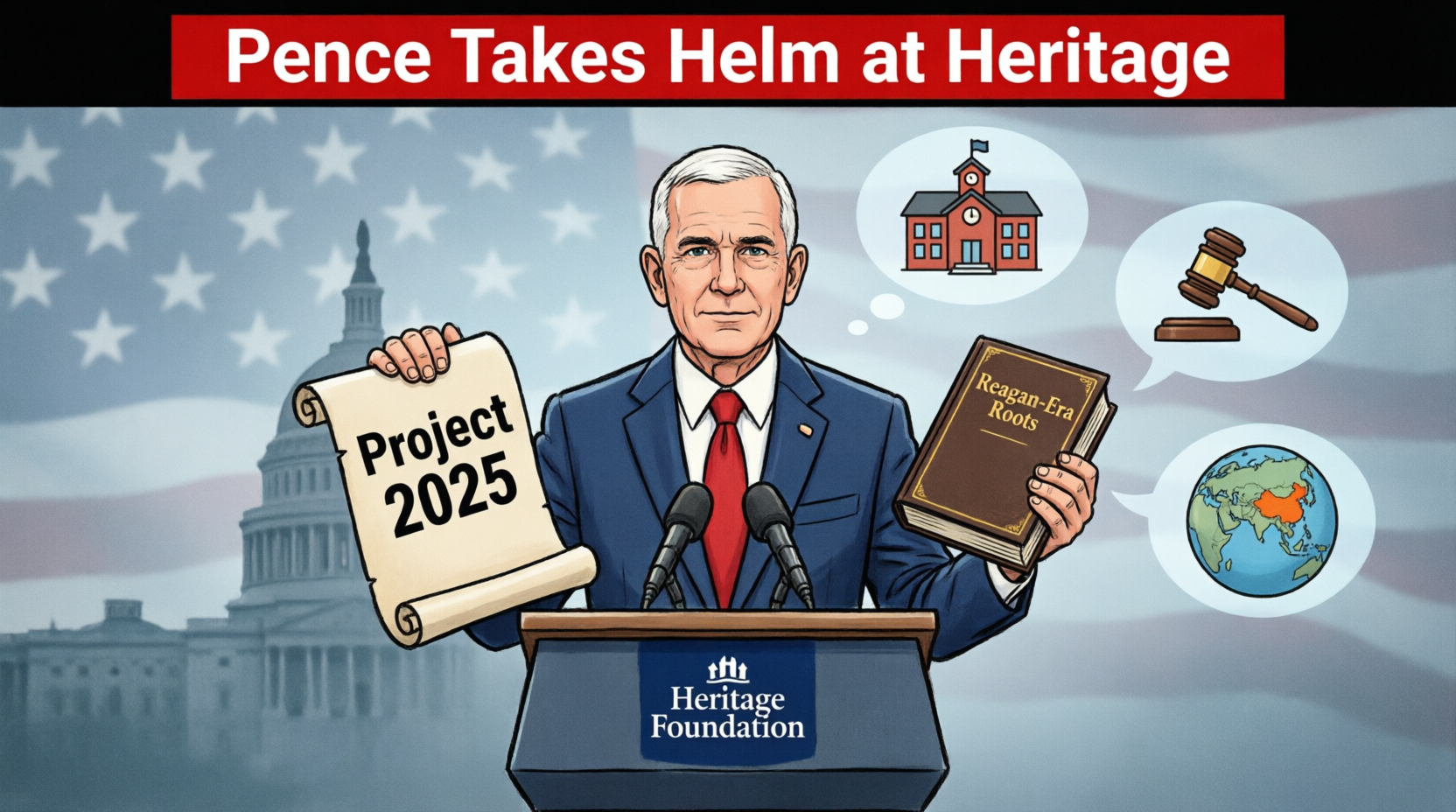
The move represents a significant recalibration for the Heritage Foundation, which has historically served as an intellectual and policy incubator for Republican administrations dating back to the 1980s. Insiders familiar with the transition indicate that Pence intends to leverage the organization’s comprehensive “Project 2025” agenda as a foundational blueprint for future Republican governance, regardless of which candidate ultimately secures the presidential nomination in 2028. Project 2025, a sprawling policy initiative developed by Heritage and allied conservative groups, outlines detailed proposals for executive action, regulatory reform, and federal personnel staffing designed to rapidly implement conservative priorities upon a Republican return to the White House. Heritage’s senior leadership has publicly endorsed Pence’s vision, noting that his decades of congressional and executive experience position him to prioritize long-term ideological strategy over the short-term political controversies that have dominated recent conservative discourse.
In his remarks to foundation staff, major donors, and policy fellows, Pence placed heavy emphasis on what he described as “winning the war of ideas.” He argued that sustainable conservative progress requires intellectual rigor, civic engagement, and a clear articulation of principles that resonate beyond partisan echo chambers. Notably, Pence deliberately avoided direct references to former President Donald Trump, a choice widely interpreted by political analysts as an effort to reframe the conservative agenda around institutional policy development rather than personality-driven politics. “The future of this movement does not rest on headlines or heated rhetoric,” Pence stated, according to those familiar with the speech. “It rests on the hard work of crafting solutions, training leaders, and reminding Americans of the timeless values that have made this nation exceptional.”
The announcement has elicited a sharply divided response across the Republican Party. Allies of Trump have expressed skepticism, with several prominent conservative media personalities and grassroots organizers questioning whether Heritage’s institutional, policy-first approach aligns with the populist momentum that has reshaped the GOP in recent election cycles. Conversely, establishment Republicans, traditional conservative intellectuals, and policy-focused lawmakers have welcomed the appointment, praising Pence’s steady leadership style, extensive legislative background, and ability to bridge ideological factions within the party. Several former congressional advisors noted that Pence’s record on fiscal discipline, national security, and social conservatism makes him a natural fit to helm an organization that has historically shaped Republican platforms for over four decades.
According to sources close to the transition team, Pence’s policy agenda at Heritage will center on three core pillars: advancing stricter abortion regulations in the post-Dobbs legal landscape, expanding school choice initiatives through federal incentives and state-level education savings accounts, and adopting a more assertive strategic posture toward China. On economic and foreign policy, Pence is expected to push for supply chain decoupling, heightened scrutiny of Chinese technology investments, and a renewed emphasis on human rights diplomacy. Domestically, his team plans to explore legislative pathways for parental rights in education and work with state policymakers to refine regulatory frameworks that align with conservative governance models.
As his first major initiative, Pence will launch a new “Faith & Freedom” lecture series, designed to spotlight emerging Republican leaders, policy experts, and cultural commentators who align with the foundation’s vision. The program, expected to debut in early 2027, will feature monthly events at Heritage’s headquarters and select university campuses, with recordings distributed through conservative media networks and digital platforms. Organizers say the series aims to cultivate the next generation of conservative voices while reinforcing the intersection of civic duty, moral clarity, and policy innovation.
Political observers note that Pence’s leadership at Heritage could also serve as a strategic platform for a potential 2028 presidential campaign. By anchoring himself in policy development and intellectual infrastructure, Pence may be positioning himself as a unifying alternative within a party still navigating the tension between populist and traditional conservative factions. Whether viewed as a policy architect, a party consolidator, or a long-game political strategist, Pence’s tenure at the Heritage Foundation is poised to shape the conservative agenda for years to come. As the 2028 election cycle gradually takes shape, all eyes will be on how effectively the former vice president can translate intellectual capital into political momentum—and whether the “Reagan-era roots” he promises to restore will resonate with a rapidly evolving American electorate.