Part 2
—Why? —I asked. Moses closed his eyes for a brief moment. —Because your children didn’t inherit a prize, Mrs. Teresa. They inherited a test. I didn’t understand. The glass building had a private conference room on the sixth floor. Through the window, you could see San José glistening with rain, its low-slung roofs, the rolling green mountains in the distance, and a sky that felt completely different from the heavy air of Miami.
Moses offered me coffee. It wasn’t from a machine. He prepared it using a traditional wooden pour-over stand with a cloth filter bag. The dark liquid dripped down slowly, rich and fragrant. That deep aroma instantly brought back memories of my early mornings with Robert, back when I would boil fresh coffee with cinnamon to stay awake while he coughed through the night. —Robert told me you never took your coffee without sugar —Moses said softly. My throat tightened. —Robert remembered the small things. —That’s exactly why he left you one.
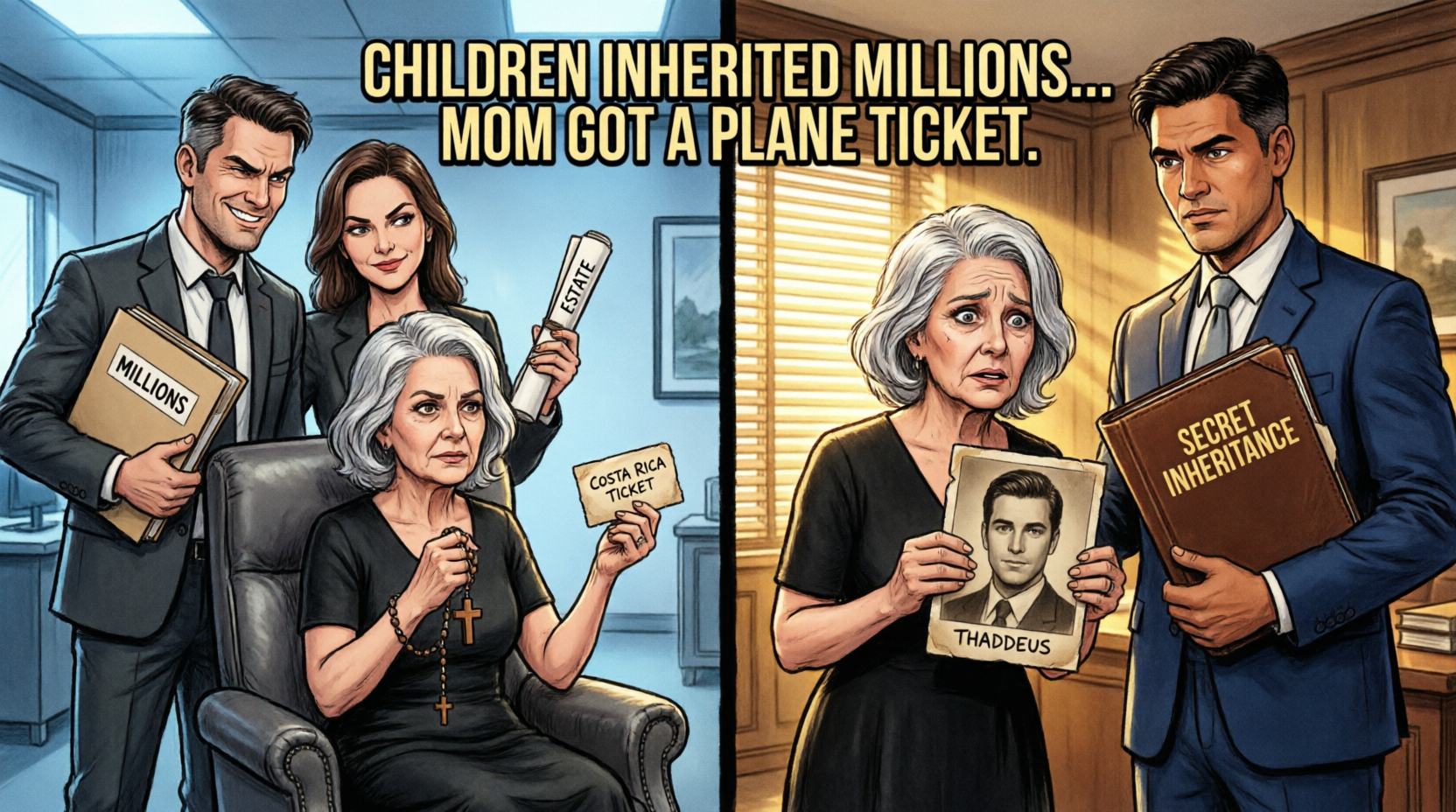
He gestured toward the envelope that had held my plane ticket. —That was the key.
He opened the thick folder. Inside were notarized copies, birth registries, photographs, banking records, property deeds, and a sealed letter with my name written in Robert’s unmistakable handwriting. I didn’t touch it right away. I was terrified that opening it would make me shatter all over again.
—Thaddeus Monteverde was Robert’s brother —Moses explained—. Half-brother, though they grew up as close as twins. Their father had two separate families. One in Florida. One here.
I stared at the photograph. The two young men smiled faintly, standing in front of a wooden house with coffee plantations stretching behind them. —Robert never told me.
—Because he was ashamed of the scandal surrounding their father’s choices, not his brother. When their father passed away, the American side of the family tried to completely erase Thaddeus. Robert was the only one who went looking for him.
Moses slid a sheet of paper toward me. —Thaddeus never married or had children. He built a highly successful coffee export business here, bought land, and built a historic home in Barrio Amón. When he fell terminally ill, he left everything to Robert under one strict condition: that none of it would ever fall into the hands of people who treated family like a prize to be looted.
I felt a sudden chill. —My children.
Moses didn’t answer. He didn’t have to. Rebecca and Diego had treated the will like a menu at an expensive restaurant. They had greedily counted up estates, cars, and luxury apartments. Not a single soul had asked about Robert’s years confined to a medical bed. Nobody had asked about me.
—Robert thought about bringing you here sooner —Moses continued—, but you refused to leave his side while he was weak. So, he structured two separate successions. The visible one, in Miami. And this one.
—What exactly is this?
Moses opened a second folder. On the very first page, a bold heading read: The Monteverde-Navarro Trust. Beneath it was my name. Sole Beneficiary: Teresa Morales Navarro.
I stared at those words until they became a total blur. —I don’t follow.
—There is a sprawling coffee plantation in the mountains of Naranjo. A historic residence in Barrio Amón. Controlling shares in a specialized boutique export company. Bank accounts with more than enough capital to maintain everything permanently without ever selling a single asset. And a legally registered non-profit foundation dedicated to supporting older women who have been abandoned by their families.
I pressed my hand to my chest. —A foundation?
—Robert named you President for Life.
I let out a broken, hollow laugh. —I barely finished high school.
—Robert said you successfully managed a household, a chronic illness, and an ungrateful family for forty-six years. He said that was a thousand times harder than running any corporate office.
That was when I finally wept. Not gracefully. Not quietly. I sobbed with my face buried in my hands, the way older women cry when they no longer have to pretend to be strong just so everyone else can sleep peacefully at night.
Moses waited patiently. When I finally caught my breath, he gently pushed the letter toward me. —He requested that you read this here.
I tore the envelope open with trembling fingers. Robert’s handwriting was shaky, but completely recognizable.
“Tere: If you are reading this, it means our children did exactly what I feared they would do. They mocked the envelope. They thought I was casting you out with nothing. Forgive me for letting that moment hurt you. I needed you to come down here without triggering a single shred of suspicion from them. Anything I left you in Miami, they would have tied up in aggressive legal battles to strip away from you. What I left you here is ironclad and completely protected.”
I clutched the paper tight.
“Thaddeus was my brother. The only one who taught me that blood means absolutely nothing if there is no loyalty. You were my loyalty, Tere. You were my sanctuary when my own body stopped obeying me. I am not leaving you a fortune just so you can rest. I am leaving you a place where no one will ever look at you like an inconvenience or a burden.”
My mouth trembled as I read on.
“If you want to go back to Florida, go back. If you want to stay, stay. But never return to ask them for permission again. You have already paid far too high a price just for loving them.”
The very last line was almost illegible, smudged by time.
“Do not judge what seems small. That plane ticket was your door.”
I folded the letter tightly against my chest. For the first time since the funeral, I didn’t feel like Robert was buried six feet under the ground. I felt him sitting right beside me—stubborn, quiet, doing things entirely his own way. Late, but keeping me safe.
—There is one more thing —Moses said. I lifted my gaze. —There is always one more thing when a dead man leaves legal folders behind.
The attorney offered a faint smile. —Your children called my associates this morning.
My heart sank. —How did they find out?
—They don’t know where you are. But they have already contacted the listing notary in Miami. Apparently, they discovered massive tax liabilities and structural debt attached to one of the commercial properties.
—Debt?
Moses adjusted his glasses. —Robert didn’t leave them garbage. He left them exactly what they spent years demanding: properties, luxury cars, and heavy commercial accounts. But he also left them the attached obligations—back taxes, outstanding mortgages, and a strict penalizing clause. If they attempt to contest his private international assets or file claims against any property outside the United States, they legally forfeit the inheritance rights to several of their core American assets.
I froze. It wasn’t an act of petty revenge. It was a mirror.
My children had rushed blindly toward wealth without ever reading the fine print. Just like they always rushed to my house whenever they needed a free meal, money, or favors, only to vanish before lifting a finger to wash a single plate.
—Robert did that? —Robert gave them every opportunity to behave with basic human dignity. They chose not to.
That night, I slept in the beautiful historic house in Barrio Amón. It featured gleaming hardwood floors, high ceilings, and a wrap-around balcony where the rain sounded entirely different. Not like a storm. Like company.
On the walls hung old photographs of Thaddeus: young amidst the coffee fields, older beside heavy burlap sacks of grain, smiling warmly with his workers, cradling a stray dog.
In the kitchen, I found a traditional breakfast spread of gallo pinto, sweet plantains, and a handwritten note from a local housekeeper named Maritza: “Welcome, Mrs. Teresa. This house has been waiting for you for years.”
I sat down at the table completely alone. I took a bite. And I cried again, but much less this time.
The next day, Moses drove me up to the plantation. The road wound higher and higher into a vibrant, lush green scenery that I didn’t even know how to name. There were vast coffee fields, low-hanging mist, red-roofed cottages, and locals waving politely from their motorbikes—women sweeping their front porches as if the morning itself needed to start completely clean. Back in Florida, I had spent years staring at stark hospital walls, pharmacies, medical bills, and Robert’s exhausted face.
Up here, the air smelled beautifully of rich, living earth.
The estate was named Dos Hermanos—Two Brothers. The moment I saw the wooden sign, the old photograph clicked perfectly into place.
A woman in her late sixties stepped out of the main house to greet me. Maritza. She pulled me into a warm embrace as if we were old friends. —Mr. Robert spoke of you constantly. —He did? Up here? —Every single time he called the administrative office. He would tell us, “When Tere finally arrives, do not treat her like a guest. You treat her as the rightful owner.”
Owner. That word felt far too big for me.
We walked through the beautiful villa. There was a wide veranda lined with rocking chairs, a long dining table, vibrant red flowers blooming in planters, and a master bedroom prepared with a crisp white quilt. Resting on the nightstand was another photograph.
Robert, his hair completely silver, sitting right next to Thaddeus. The date on the back was from fifteen years ago.
I remembered that exact weekend. I had stayed home to watch my grandkids because Rebecca had an “urgent, unavoidable” trip to Cancun. Robert had told me he was traveling to see a medical specialist in Atlanta.
It stung a little. Not because of the trip itself. But because of the secrecy.
—Why didn’t he just bring me with him? —I asked quietly, staring at the frame.
Moses looked out over the vast green hills. —Because your children were already monitoring your bank statements and assets. Robert was terrified that if they found out about the Costa Rican holdings, they would pressure you to liquidate them. He was also terrified that you would refuse to leave the country while he was sick.
He was entirely right. I would have never left his side.
By mid-afternoon, my cell phone began to buzz relentlessly. Diego. I watched it vibrate until it went to voicemail. Then Rebecca. Then Elvira. Then a cascade of text messages.
“Mom, where are you?” “We need to talk about what Dad did with the estates.” “That ticket wasn’t an invitation for you to just vanish without telling us.” “There are major legal issues here.”
I actually laughed. Legal. What a beautiful word children love to deploy the exact second they discover the mother they spent a decade ignoring still holds the rights to a piece of paper. I didn’t reply.
That evening, sitting out on the wide veranda of the estate, Moses walked me through everything with immense patience. I needed to sign the formal acceptance forms, register my legal status before a Costa Rican notary, and decide whether I wanted to directly manage the operations or delegate the day-to-day work. He spoke of the National Registry, powers of attorney, offshore banking accounts—steps that sounded incredibly intimidating to me.
—I don’t know if I’m capable of doing all this —I confessed.
Maritza, who was pouring fresh coffee, set the glass carafe down firmly on the table. —Mrs. Teresa, you were capable of physically lifting Mr. Robert out of his bed when his own legs couldn’t support his weight. Trust me, this is just paperwork.
I smiled through my tears.
Three days later, my children caught a flight and arrived in San José.
I don’t know how they tracked down the address. Perhaps through the cross-reference of the notary records. Or perhaps because money turns selfish people into elite detectives. They showed up at the historic house in Barrio Amón, sweaty, irritated, and dressed in sharp business suits as if they were stepping into a corporate boardroom to close a merger.
Rebecca marched right into the living room without even greeting me. —Mom, what on earth do you think you’re doing?
I was sitting comfortably by the large window, sipping my coffee from a blue ceramic mug. —I’m having breakfast.
Diego looked around the grand room, his eyes assessing the architecture. —Did Dad own this estate? —No —I replied—. It belonged to Thaddeus. —Who the hell is Thaddeus?
Moses stepped out of the private study, carrying his briefcase. —Good morning. Let me remind you that this is private property.
Elvira let out a dry, dismissive laugh. —Oh, please. We’re family.
I stood up slowly from my chair. —How fascinating. You were family at the notary office too, right when you smirked at my plane ticket.
Rebecca clenched her jaw. —Mom, don’t be dramatic. It was a joke. —It wasn’t a joke, Rebecca. It was relief.
Diego rapped his knuckles hard against the wooden table. —Dad couldn’t legally hide international assets from us. This whole thing is going to be audited and contested.
Moses opened his folder, pulling out a page. —You are entirely welcome to contest it. But the moment you legally challenge the Costa Rican disposition, the immediate forfeiture clause is triggered against your core Florida assets. I strongly suggest you read the text before making threats.
Diego went pale. Elvira snatched the paper right out of his hands. Rebecca stared at me as if I were a master manipulator who had orchestrated the entire trap.
—Did you know about this? —she demanded. —No. —Then sign a waiver and renounce it.
The word pierced right through me. She didn’t ask. She ordered.
Just like when she used to drop her kids off at my house without ever asking if I had the strength to watch them. Just like when Diego would ask to “borrow” money, knowing damn well he would never pay back a single dime. Just like when Elvira would tell me that a senior citizen my age had no business dressing up or buying nice things.
Renounce it. Renounce your peace. Renounce your name. Renounce your escape. Renounce the absolute last token of love your husband left behind to save you.
I felt a surge of fear. Deep, physical fear. Fear doesn’t magically vanish just because you have money or legal documents. It lingers in the body, conditioned by decades of submissive obedience. But then, I felt the texture of Robert’s letter tucked safely in my dress pocket.
“You have already paid far too high a price just for loving them.”
—No —I said.
Rebecca blinked, stunned. —What? —I am not renouncing a single thing.
Diego exhaled sharply through his nose, his voice dripping with condescension. —Mom, you’re being manipulated by these foreign lawyers. —No, son. For the very first time in my life, I am being fully informed.
He took an aggressive step toward me. Moses instantly moved to intervene, but he didn’t even need to. Maritza appeared at the kitchen doorway flanked by two large, imposing plantation workers. They didn’t say a word. They just stood there, solid as oak trees.
Diego lowered his voice, trying to cut me with his words. —You’re going to end up completely alone.
I looked at him. I looked at the boy I used to nurse through high fevers. The young man whose college textbooks I had sewn late into the night to afford. The man who hadn’t shed a single tear for his father because he was too busy calculating the resale value of luxury cars.
—You people already left me completely alone a long time ago —I answered calmly—. The only difference is that now, I hold the keys.
Rebecca’s eyes welled with tears. In the past, her crying would have made me bend over backward to fix whatever was wrong. This time, I saw her tears for exactly what they were. They weren’t tears of grief or love. They were tears of loss.
But she wasn’t losing her mother. She was losing her access.
They stormed out that very afternoon, shouting about international lawsuits, embassies, corporate litigation, and every empty threat people deploy when they lack a shred of moral right but possess enough money to cause noise.
I stood out on the balcony, watching the rain pour down over the streets of San José. Moses quietly asked me if I wanted to return to Miami for a few days to pack up my things.
I thought about my empty house in Florida. The dining table where that plane ticket had felt like a cruel humiliation. I thought about my lifelong neighbors, the local bakery on the corner, the familiar evening sounds, and the fresh ingredients I used to buy for Robert at the local market. I thought about everything that had defined my old life.
Then I thought about the Dos Hermanos estate. About Maritza. About the vulnerable older women the new foundation could shelter and protect. I thought about Robert, writing with a failing, exhausted hand, explicitly stating that he hadn’t left me a fortune to make me disappear—but to ensure I was finally seen.
—Yes, I am going to return —I told him—. But I am not staying there.
I flew back to Florida a month later. I didn’t step foot near my children’s homes.
I went straight to Robert’s grave, carrying a beautiful, vibrant bouquet of seasonal flowers, because even the dead deserve a beautiful surprise now and then. I knelt down on the grass, pressing his letter against my chest.
—You brilliant, stubborn man —I whispered into the breeze—. You made me weep in an office full of vultures. But thank you.
I didn’t sell the modest house where I had spent years nursing him. I repaired the roof, touched up the paint, and left the keys with a trusted, lifelong neighbor. In the kitchen, right on the center of the table, I hung a beautifully framed copy of that one-way plane ticket. Not to remember the humiliation—but to permanently remember the door.
Six months later, the Teresa Morales Foundation opened its very first sanctuary home right on the plantation grounds. The initial intake brought in three older American women and two Costa Rican women—all of them deeply exhausted from a lifetime of asking for permission to simply exist. One had been heartlessly left behind by her adult children at a hospital ward in Boston. Another arrived from Cartago, entirely quiet, clutching a plastic suitcase with hands raw from a lifetime of hard labor and heavy prayers.
I welcomed them all with fresh pour-over coffee, warm bread, and a home-cooked meal.
I didn’t know the first thing about running a non-profit foundation. But I learned. Just like I had learned how to administer complex medical injections. Just like I had learned how to decipher confusing medical bills. Just like I had learned how to sleep sitting up in a hospital chair. Just like I had learned—far too late in life, but I learned—never to confuse sacrifice with love.
My children sent formal legal letters. Then corporate demands. Then, finally, total silence.
The silence was the only decent thing they ever gave me.
Did it hurt? Of course it did. A mother does not tear her own children out of her heart without bleeding. But a mother can also firmly lock the front door when her children only ever walk in to hollow out her home.
One quiet afternoon, sitting out on the veranda at Dos Hermanos, I watched the white mist roll gently over the green coffee fields. Maritza was softly singing a tune from the kitchen. One of our residents was watering the garden beds. Another was laughing over the phone with a granddaughter who had finally reached out to look for her with love.
I pulled out the old, yellowed photograph of young Robert and Thaddeus. The two young men stared into the camera, entirely unaware of how much of their lives they would have to hide away from the world.
—I found it, Robert —I whispered into the quiet air—. I found the small thing.
The folded ticket. The envelope. The long flight. The smirks. The door.
And I finally understood that my children had smiled that day because they genuinely believed they were casting me out of the family. They had no idea that Robert, even from beyond the grave, was unlocking my cage.
He left me a one-way ticket. Because he knew that after so many decades of living entirely for others, I desperately needed to learn one fundamental truth:
Not every return leads you back to a home. Sometimes, home begins at the exact place where nobody can ever order you to go back.