By the time I reached the hospital in downtown Nashville, the doctors were whispering words like brain swelling and concussion. But the part that still keeps me awake at night wasn’t the blood or the bruises. It was what my son whispered when I held his hand:
“Daddy… Grandpa said you weren’t coming.”
They thought I was just another suburban father stuck in traffic across town.
They had no idea who I really was.
The first thing I noticed inside Vanderbilt Medical Center wasn’t the chaos. It was the lights. Harsh fluorescent bulbs buzzing overhead like angry hornets while I sat frozen in the emergency waiting room, my hands clenched so tightly my knuckles turned ghost white. Somewhere nearby, a vending machine slammed out a soda can. A baby cried down the hall. Nurses rushed past me carrying clipboards and exhaustion.
And my phone wouldn’t stop vibrating.
Christine.
My wife had called eight times. Eight.
But she hadn’t shown up to the hospital.
According to our elderly neighbor, Mrs. Patterson, Christine was still at her father’s house in Brentwood while my son wandered bleeding down the sidewalk with one shoe missing and blood dripping from his ear.
The doctors told me Jake had a moderate concussion. Maybe worse. They were still running scans. I heard every word, but none of it felt real. My life was supposed to be ordinary—soccer practice, burnt pancakes on Saturday mornings, stepping on Lego bricks in the dark. Not this. Not my little boy lying behind a curtain with half his face swollen purple.
Then the doctor finally approached me.
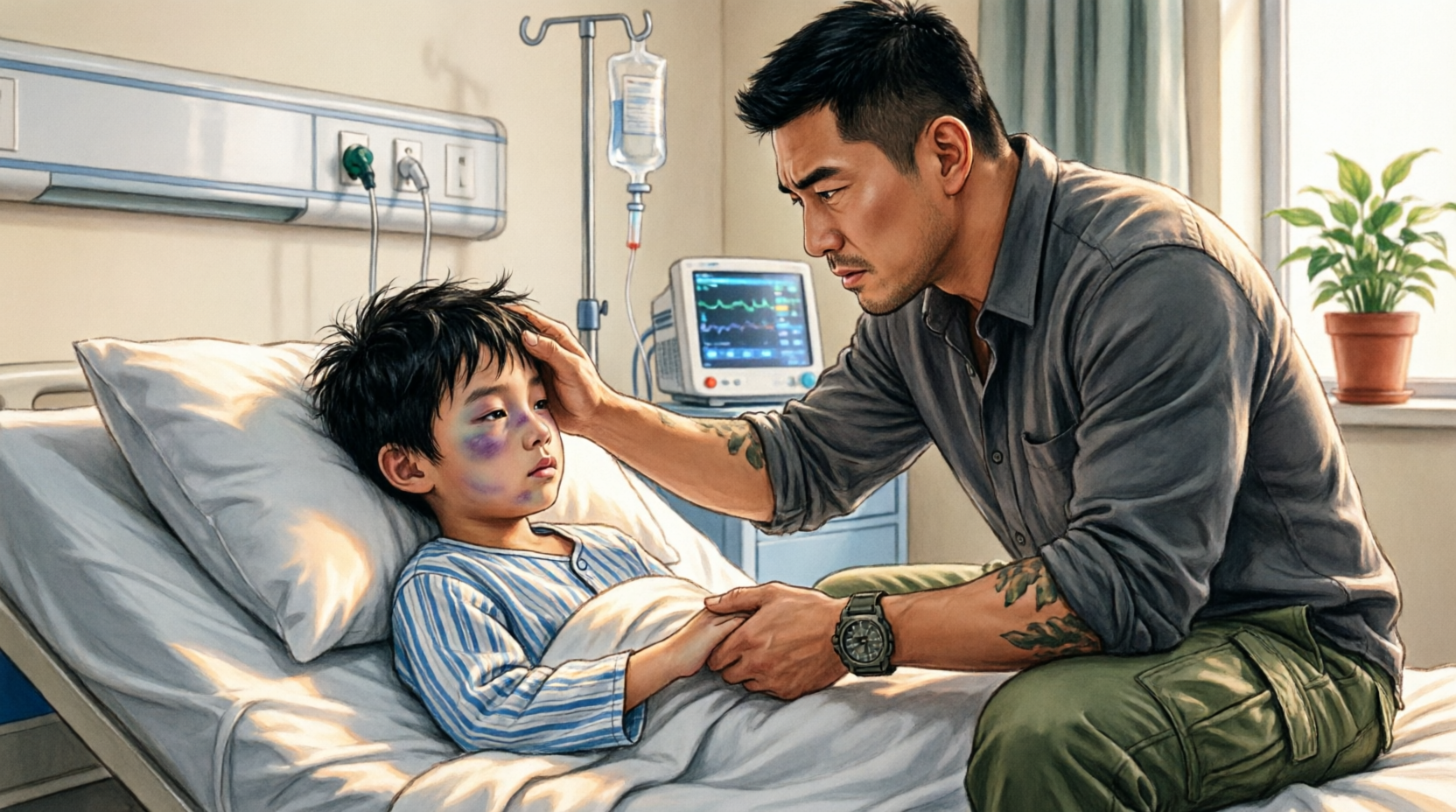
“Mr. Carter?” she asked gently. “He’s awake. He keeps asking for you.”
I followed her through a maze of pale hallways that smelled like bleach and stale coffee. Every step felt heavier than the last. When I reached Jake’s room, my chest nearly collapsed.
He looked so small in that hospital bed.
The right side of his face was badly swollen, bruises spreading beneath his skin like dark storm clouds. His hair was matted against his forehead. Tiny cuts streaked his cheek.
Then he looked at me.
“Dad…”
His voice cracked me wide open.
I grabbed his hand carefully. “I’m here, buddy. I’ve got you.”
His fingers trembled around mine. Tears welled in his eyes.
“I tried to run,” he whispered.
My throat tightened. “You don’t have to talk right now.”
But terrified children always talk. Silence scares them more.
“Grandpa got mad,” Jake said shakily. “He said you think you’re too good for this family.”
I felt something cold slide through my veins.
“He was yelling… then Uncle Brian grabbed my arms. Uncle Scott held my legs.”
The room suddenly felt too small.
Jake swallowed hard before whispering the words that changed everything.
“Grandpa slammed my head on the driveway.”
For a second, I couldn’t breathe.
I had seen violence before. Real violence. I’d spent years around men capable of horrors most people couldn’t imagine. I’d learned how to stay calm while bullets tore through walls and grown men screamed for mercy.
But hearing my son describe three adults pinning him to concrete while his grandfather laughed?
That awakened something monstrous inside me.
Jake’s lip trembled again. “Grandpa said… ‘Your daddy’s not here to protect you.’”
I kissed his forehead gently, avoiding the bruises. Then I walked out into the hallway before he could see the rage spreading across my face.
The doctor started saying something behind me, but I barely heard her. My hands were already reaching for my phone.
I didn’t call the police.
Police write reports. Police hold press conferences. Police ask questions while monsters sleep comfortably in their own beds.
No… I made a different call. One encrypted number I hadn’t touched in years.
The voice on the other end answered immediately.
“I need a cleanup team,” I said quietly.
There was a long silence. Then:
“Who’s the target?”
I looked through the hospital window at my battered son lying in that bed.
And for the first time in a very long time… I gave an order that would change everything…
The fluorescent lights inside Vanderbilt Medical Center buzzed like restless insects, casting a cold glow over every anxious face waiting for news that would either save or destroy their world tonight.
I sat in that plastic chair with my hands clenched so tightly that my knuckles turned pale, watching strangers walk past while my entire life quietly bled behind a hospital curtain somewhere down the hall.
My eight-year-old son, Jake, was inside those walls after being beaten nearly to death in his grandfather’s driveway while three grown men held him down and laughed like it was entertainment.
The doctors spoke in careful tones about concussion levels and possible brain swelling, but none of their medical language could translate the storm forming inside my chest.
I had lived a life that trained me to stay calm under pressure, yet nothing in that training prepared me for hearing my child whisper that his own family had turned into something unrecognizable.
Christine, my wife, called me eight times that night, but she never once came to the hospital, and that silence began to feel heavier than the screams I could not hear.
An elderly neighbor later told me she saw Jake walking alone down the sidewalk, missing one shoe, blood dripping from his ear, while no adult bothered to stop him.
Every second of that story carved something deeper into me, because it meant my son had been discarded in plain sight while adults chose indifference over responsibility.
When the doctor finally said Jake was awake, I stood up so fast the chair scraped the floor, and I followed her through endless hallways that smelled like bleach and exhaustion.
Each step toward his room felt like walking deeper into a version of reality I had never agreed to enter, where childhood innocence was replaced by hospital monitors and bruises.
When I saw him lying there, his small body swallowed by white sheets, something inside me fractured in a way I will never be able to repair or forget.
Half his face was swollen purple, his hair stuck to his forehead, and his eyes searched for mine like he was afraid I might disappear if he blinked too long.
“Dad,” he whispered, and that single word carried more pain than anything I had ever heard in my entire life.
I took his hand gently, careful not to touch the bruises, and told him I was there, even though part of me felt like I had arrived too late to matter.
He tried to speak through cracked lips, telling me he had tried to run, but his voice broke as if even the memory of it hurt too much to carry.
I told him he didn’t need to explain anything, but children always try to explain pain, as if understanding it might somehow make it less real or less unfair.
Then he said the words that changed the shape of my entire world, telling me his grandfather had been angry and said I thought I was too good for the family.
His fingers trembled harder as he described how his uncles held his arms and legs, pinning him down while he begged them to stop with a voice no child should ever use.
The room felt smaller with every sentence he spoke, as if the walls were closing in to trap both of us inside a moment that should have never existed.
And then he whispered it, the part that still wakes me at night, that his grandfather slammed his head into the driveway while laughing and saying I would not come to save him.
For a moment, I could not breathe, because my mind refused to accept that adults I had once trusted could turn into something so cruel, so casually destructive.
I had seen violence before in places where survival was uncertain, but nothing prepared me for hearing it described by my own child in a hospital bed.
I kissed his forehead gently, avoiding the bruises, and stepped out into the hallway because I knew if I stayed one more second, I would shatter in front of him.
The doctor tried to speak to me as I left, but her voice blurred into the background as something colder and sharper began forming in the silence inside my head.
I didn’t call the police first, because part of me already understood that official procedures would not move at the speed of what had just been done to my son.
Instead, I called a number I had not used in years, one that existed in a past I thought I had buried under normal life and family routines.
When the voice on the other end answered, I asked for a cleanup team, and the silence that followed felt heavier than any confirmation I could have received.
I looked back through the hospital glass at my son lying alone in that bed, and I understood that everything I believed about distance and safety had already collapsed.
Somewhere across town, in a house in Brentwood, three grown men were sitting comfortably, drinking whiskey, laughing about something they believed would never come back to them.
They had no idea that the story they thought ended in that driveway was only the beginning of something far larger, something they would eventually realize they could not control.
When a detective later examined Jake’s injuries, he asked me what I did for a living, and I said nothing, because answers were no longer safe in that moment.
The question itself revealed everything about how the world works, how people assume they understand danger only when it wears the right uniform or speaks the right language.
My son’s breathing was steady but fragile, each monitor beep reminding me that survival is not the same thing as healing, and healing is not the same thing as justice.
I stayed by his bedside through the night, watching machines count his life in numbers while I counted the consequences forming quietly in places no hospital could measure.
Every time he stirred, I leaned closer, afraid he would forget I was there, because abandonment had already been taught to him by people who should have protected him.
The next morning, sunlight entered the room like something indifferent, and I realized the world outside the hospital continued as if nothing had been broken the night before.
That realization angered me more than anything else, because it meant suffering is often invisible to everyone except the people forced to live inside it.
Christine finally arrived hours later, but her presence felt distant, as if she had stepped into a situation she could not fully recognize or explain to herself.
I did not shout at her, because anger felt too small for what had already happened, and silence between us carried more truth than any argument could.
Jake woke again briefly, asking for water, and when he saw both of us, he seemed unsure whether safety could exist in the same room as the people who failed him.
That uncertainty is what broke me the most, because no child should ever have to question whether their parents are the safest thing in the world.
Later, I walked the hospital corridors alone, replaying every detail of what he said, trying to understand how cruelty can exist so casually inside familiar family structures.
The detective returned, observing me carefully, as if trying to match the injured child in the bed with the man standing beside him in silence.
He asked again what I did, and I still refused to answer, because some identities only matter when the wrong people learn them too early.