At exactly 5:12 a.m. on Thanksgiving morning, my phone buzzed across the kitchen counter so hard it almost tipped into the sink. The house smelled like old grease, stale coffee, and the kind of heat that never quite reached the corners. Outside, frost had turned the windows silver. Inside, my family had already decided where I belonged.
I was seven months pregnant, wearing Daniel’s oversized Marine sweatshirt, and holding a mug of coffee that had gone cold while everyone else moved around me like I was furniture. The message was from Chloe, my younger sister. No good morning. No “how are you feeling?” No acknowledgment that I had cried myself sick the night before because it was my first Thanksgiving without my husband. Just instructions.
“Mom and Dad need the upstairs bedrooms,” she said when I called her back. “Move your things into the garage tonight. Ryan needs a private workspace while we’re staying here.”
I remember looking at the kitchen sink because there was a crack in one white mug and a line of brown coffee had dried inside it.
I focused on that crack because it felt safer than focusing on her words.
“The garage?” I asked. “It’s below freezing.”
My mother stood by the stove stirring cream into her coffee.
My father sat at the table with the newspaper spread in front of him, not reading it anymore, just hiding behind it.
Chloe arrived a few minutes later in silk pajamas, holding her little dog like the dog had more right to warmth than I did.
Ryan came after her, one hand around a phone, the other already gesturing toward the garage as if he were discussing office square footage with a contractor.
“It’s temporary,” Chloe said. “Ryan has calls today.”
Ryan gave a small laugh.
“And honestly,” he said, “the constant mourning around here gets exhausting.”
I felt the baby shift inside me.
Not kick exactly.
More like a slow turn, as if even he knew the room had gone wrong.
Daniel Carter had been gone nine months.
Nine months since two Marines came to my door and I knew before either of them spoke.
Nine months since the folded flag.
Nine months since the funeral where my father cried into Daniel’s shoulder patches and told everyone that my husband had been the finest man he ever knew.
Daniel had bought that house after his second deployment.
He said my parents needed stability.
He said family meant stepping in before someone had to beg.
He paid off one hospital bill after my mother’s procedure.
He covered another after my father’s emergency visit.
He paid Chloe’s law school tuition when she stood in our driveway at midnight, shaking and swearing she would never forget it.
Daniel helped everyone.
He fixed the porch railing.
He replaced the furnace filter.
He kept a small American flag near the mailbox because he said a man who had been dragged through enough sand and heat overseas deserved to come home to something steady.
And now, less than a year after he was buried, the people he had carried were telling his pregnant widow to sleep beside gasoline cans.
“You heard your sister,” my father said from behind the newspaper. “Stop acting like you deserve special treatment.”
There are moments when anger comes hot.
This was not one of them.
This came cold.
I pictured the coffee mug leaving my hand.
I pictured it breaking against the cabinet near Ryan’s head.
I pictured Chloe finally dropping that polished little expression she wore whenever she wanted something and had convinced herself that wanting it made her right.
But I did not throw anything.
I had learned restraint the hard way.
Grief teaches you how to stay still when every nerve in your body wants to move.
My mother finally looked at me.
“Just make sure your things aren’t scattered around,” she said. “Ryan keeps the Mercedes in there.”
Ryan laughed.
That sound did something to me.
Not because it was cruel.
Because it was casual.
Cruelty hurts worse when it doesn’t even have to gather energy.
The kitchen froze for one strange second.
The spoon stopped moving in my mother’s cup.
My father’s newspaper sagged against his knees.
Chloe’s dog blinked at me from her arm.
Outside, a truck coughed awake somewhere down the block, and in that little suburban kitchen, nobody looked ashamed enough to save me.
Nobody moved.
So I moved.
I went upstairs and packed only what mattered.
Three coats.
Two pairs of maternity jeans.
My laptop.
Daniel’s dog tags.
His field notebook.
The notebook was worn soft at the corners, the green cover bent and darkened where his thumb used to hold it open.
Inside were sketches, signal diagrams, failure notes, and short lines of Daniel’s handwriting that looked calm even when the ideas were complicated.
ORION, he had written on the inside cover.
IF I DON’T FINISH IT, SHE WILL.
He had written that before his last deployment.
I found it after the funeral when the house was so full of casseroles and sympathy cards that I could barely breathe.
I did not understand all of it at first.
Daniel had been brilliant in a way he never bragged about.
He could sit at the kitchen table with a screwdriver, a radio, a legal pad, and a half-empty cup of coffee and disappear into a problem for hours.
Project Orion was his private obsession.
A military communications shield.
A system meant to protect signal integrity during emergency extraction missions, when dropped communication could turn seconds into casualties.
Daniel had come home once with a silence around him that did not leave for weeks.
He never told me every detail.
He only said, “If the line had held, they might have gotten out sooner.”
After he died, I started reading his notes because it was the only way I knew how to keep sitting beside him.
Then I started understanding them.
Then I started correcting pieces.
Then I built what he had never gotten time to finish.
By 5:48 a.m. that Thanksgiving morning, I had taken photos of the upstairs room they were making me leave.
I photographed the closet.
The empty dresser.
The hallway.
The garage cot.
I was not planning revenge.
I was documenting facts.
Facts had become a language my family could not twist.
The garage smelled like mildew, gasoline, and damp concrete.
Ryan’s golf clubs leaned against a stack of storage bins.
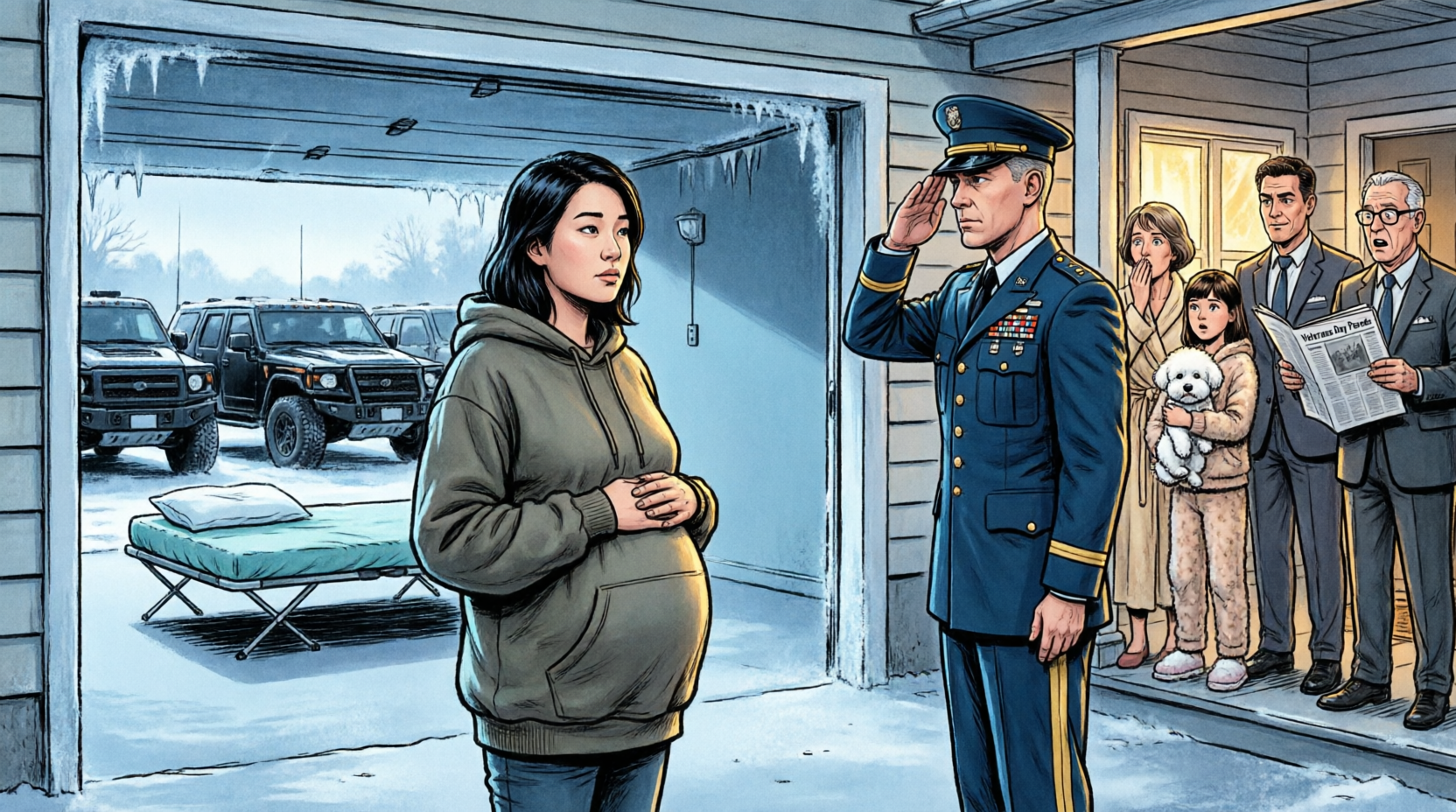
His Mercedes sat polished and warm-looking under a cover, while a folding cot had been set up beside the wall like a punishment someone wanted to call practical.
There was one thin blanket.
No heater.
No bathroom.
No place for a pregnant woman to sleep.
I lowered myself onto the cot carefully.
The canvas creaked under my weight.
For one sharp second, I wanted Daniel so badly my throat closed.
He would have looked at that cot and gone still.
Not loud.
Not theatrical.
Still.
Daniel’s silence was never empty.
It was the moment before he acted.
I put both hands on my stomach.
The baby kicked.
Hard.
“Your dad always had dramatic timing,” I whispered.
Then my encrypted phone vibrated.
I wiped my face with the sleeve of Daniel’s sweatshirt and looked down.
TRANSFER CONFIRMED.
PROJECT ORION APPROVED.
DEFENSE CONTRACT EXECUTED.
TRANSPORT ETA: 0800.
WELCOME TO STRATIX DEFENSE SYSTEMS, MRS. CARTER.
The words blurred before I could read them twice.
Not because I did not expect them.
Because expectation and arrival are not the same thing.
For months, while my family thought I was a broken widow taking up space, I had been moving through technical reviews, encrypted calls, compliance questionnaires, prototype simulations, and document revisions after midnight.
I had submitted the final technical packet at 1:43 a.m. the previous Friday.
Two days before Thanksgiving, Stratix Defense Systems executed the purchase agreement.
The first transfer landed that morning.
The executive appointment was effective immediately.
Chief Technology Officer.
Before my thirty-third birthday.
I sat in that freezing garage and stared at the screen while Ryan’s Mercedes rested ten feet away under a soft cover.
My family knew nothing.
Not because I hid it from them with some elaborate plan.
Because they never asked.
They asked whether I had ordered groceries.
They asked whether I could move my laundry out of the dryer.
They asked whether I could be less depressing around guests.
They did not ask what I worked on after midnight.
They did not ask why Daniel’s old notebooks were spread around me.
They did not ask why my laptop camera was covered, why my calls were encrypted, or why I sometimes closed a file the moment someone came into the room.
To them, I was simply the pregnant widow occupying a room they wanted for someone else.
They thought silence meant dependence.
Sometimes silence is just paperwork moving faster than gossip.
At 7:58 a.m., the concrete under my feet began to tremble.
At first, I thought it was the garage door motor.
Then I realized the vibration came from outside.
Engines.
Several of them.
Heavy.
Controlled.
The kind of sound you feel in your ribs before you fully hear it.
I stood slowly and pressed the garage door opener.
Cold daylight spilled over the concrete.
The first matte-black military SUV turned into the driveway.
Then the second.
Then the third.
Their tires crushed frost along the pavement.
Their headlights swept across the garage, over Ryan’s covered Mercedes, over the folding cot, over the thin blanket, over my duffel bag, and finally over me.
The front door opened so fast it slammed against the wall.
My mother stepped onto the porch in her robe.
Chloe rushed out behind her with the dog still in her arms.
Ryan stopped halfway down the steps.
My father stood in the doorway holding the newspaper like he had forgotten what hands were for.
The door of the first SUV opened.
Colonel Nathan Hayes stepped out in full formal uniform.
Behind him came four men from Daniel’s former special operations team.
I knew two of their faces from photos.
I knew one from the funeral.
I knew all of them by the way they moved.
Focused.
Silent.
Professional.
Colonel Hayes walked past my family without a glance.
He came straight to the open garage.
Then he stopped in front of me and raised his hand in a formal salute.
“Mrs. Carter,” he said. “Department authorization was approved at 0600 hours.”
The air changed.
I cannot explain it any other way.
My mother’s face tightened.
Chloe stopped clutching the dog and started clutching it.
Ryan looked from the vehicles to the colonel to me, and his confidence began to leak out of him.
My father lowered the newspaper.
The four of them looked into the garage properly for the first time.
They saw the cot.
They saw the thin blanket.
They saw the storage bins.
They saw Daniel’s dog tags against my chest.
They saw my hand on my stomach.
And for the first time since Daniel died, my family looked at me as if I might be someone they did not understand.
Colonel Hayes reached back into the SUV and removed a black folder stamped with an official seal.
Chloe’s voice cracked.
“What did you do?”
The colonel did not acknowledge her.
He opened the folder, checked the top page against a tablet, and turned it toward me.
“Mrs. Carter,” he said, “before transport, we need your signature on the residence authorization and executive security acknowledgment.”
Ryan gave a short, ugly laugh.
It died almost immediately.
“Executive security?” Chloe said. “For her?”
That was when one of Daniel’s former teammates stepped forward carrying a sealed evidence bag.
Inside it was Daniel’s field notebook.
For one second, I could not breathe.
I had packed that notebook myself, but the sight of it protected under clear plastic made it look less like a relic and more like testimony.
The teammate held it carefully, almost respectfully.
Colonel Hayes looked at the porch, then at me.
“Your husband filed supplemental beneficiary instructions before his final deployment,” he said. “They were attached to the Orion research chain. Execution of the contract triggered them.”
My father sat down hard on the porch step.
The newspaper slid from his hand and opened across the frosted boards.
My mother whispered, “Daniel did what?”
I looked at her then.
Really looked.
This was the woman who had eaten the soups he brought after her appointments.
This was the man who had let Daniel pay bills he pretended not to have.
This was the sister who had used Daniel’s money to become the kind of person who could look down on his widow.
And this was Ryan, standing near the Mercedes they had protected more carefully than my unborn child.
The colonel handed me a pen.
My fingers shook when I took it.
Not from fear.
From the weight of being witnessed.
That is what humiliation steals first.
Not comfort.
Witness.
It convinces you that what happened to you does not count unless someone important sees it.
That morning, everyone saw.
I signed the residence authorization first.
Then the executive security acknowledgment.
Then a transfer intake form confirming immediate relocation to a protected corporate residence arranged through Stratix.
The words were dry.
The consequences were not.
My mother stepped down one porch step.
“Honey,” she said, softening her voice so quickly it almost made me laugh. “We didn’t know.”
I capped the pen.
“You didn’t ask.”
Chloe’s eyes filled with tears, but they were not the right kind.
They were panic tears.
“You could have told us,” she said.
I looked past her to the garage.
The cot was still there.
The blanket was still folded at one corner.
The concrete still held the cold.
“I did tell you I was pregnant,” I said. “I told you the garage was freezing. That should have been enough.”
Ryan ran a hand through his hair.
“Look, this got blown out of proportion,” he said. “Nobody meant anything by it.”
One of Daniel’s old teammates turned his head slightly.
That was all.
Ryan stopped talking.
Colonel Hayes closed the folder and handed it to one of the uniformed personnel behind him.
“Ma’am,” he said to me, “your transport is ready when you are.”
I looked back into the garage.
There was not much to take.
The laptop.
The duffel.
Daniel’s dog tags were already around my neck.
The field notebook would come with me under proper chain of custody.
For a moment, my mother seemed to understand that I was really leaving.
Her face crumpled.
“Please,” she said. “It’s Thanksgiving.”
That nearly got me.
Not because the plea was fair.
Because some part of me still wanted a mother badly enough to be hurt by the shape of one.
I remembered Daniel carrying grocery bags up that same porch.
I remembered him fixing the mailbox after a delivery truck clipped it.
I remembered my father clapping him on the back and calling him son.
I remembered Chloe hugging me after her law school graduation and saying, “I owe you both everything.”
Memory can be cruel because it preserves the version of people who might have loved you better.
I picked up my duffel.
“No,” I said. “It’s Thursday.”
The sentence was not dramatic.
It did not need to be.
Colonel Hayes offered his arm as I stepped from the garage toward the driveway.
I took it because the pavement was slick and because Daniel would have wanted me to accept help when it was offered with respect.
My family stood there, four people in a line, watching the unwanted burden walk past them into a future they had not been invited to share.
Chloe whispered, “Where are you going?”
I turned once.
“To the house Daniel made sure I’d have,” I said. “And to the job he knew I could do.”
The ride was quiet.
One of the men in the second row passed me a bottle of water without making a fuss about it.
Another adjusted the heat vent so it reached my hands.
Small kindnesses can undo you faster than apologies.
At the protected residence, there was a bedroom already warmed, a medical appointment scheduled through the hospital intake desk for that afternoon, and a temporary office with two monitors waiting on a plain wooden desk.
No marble.
No mansion fantasy.
Just safety.
Heat.
A lock that belonged to me.
A place where nobody asked me to make myself smaller for a man who needed quiet.
At 3:27 p.m., I received the first text from my mother.
It said, We need to talk.
At 3:31, Chloe texted.
I’m sorry. Ryan pushed too hard.
At 3:44, my father wrote, We made a mistake.
I did not answer any of them that day.
I sat at the desk, opened Daniel’s notebook, and placed his dog tags beside my laptop.
The baby kicked again.
This time, I smiled.
Not because everything was healed.
It was not.
Healing is not a convoy or a contract or a folder stamped with a seal.
Healing is what starts after the door closes behind the people who only loved you when you were useful.
In the weeks that followed, my parents called often.
Chloe sent long messages.
Ryan sent none, which was the smartest thing he had done all year.
I arranged for my parents to receive information through a third party about where they could apply for assistance, because I was not cruel enough to enjoy their fear.
But I did not move back.
I did not pay Chloe’s expenses.
I did not apologize for succeeding quietly.
I did not pretend the garage had been a misunderstanding.
Because it had not been.
It was a verdict.
They had looked at a pregnant widow in her husband’s sweatshirt and decided warmth was negotiable.
They had looked at Ryan’s car and decided it deserved shelter.
They had looked at me and seen a burden.
Less than twelve hours later, the driveway filled with military SUVs, a colonel called me by name, and the truth arrived with engines loud enough to shake the concrete.
The woman they forced into the freezing garage was not helpless.
She was not dependent.
She was not waiting to be rescued by people who had already shown her who they were.
She was Daniel Carter’s wife.
She was the mother of his child.
She was the engineer who finished Project Orion.
And when she finally left that garage, she did not leave empty-handed.
She left with her dignity, her future, and every consequence they had earned.