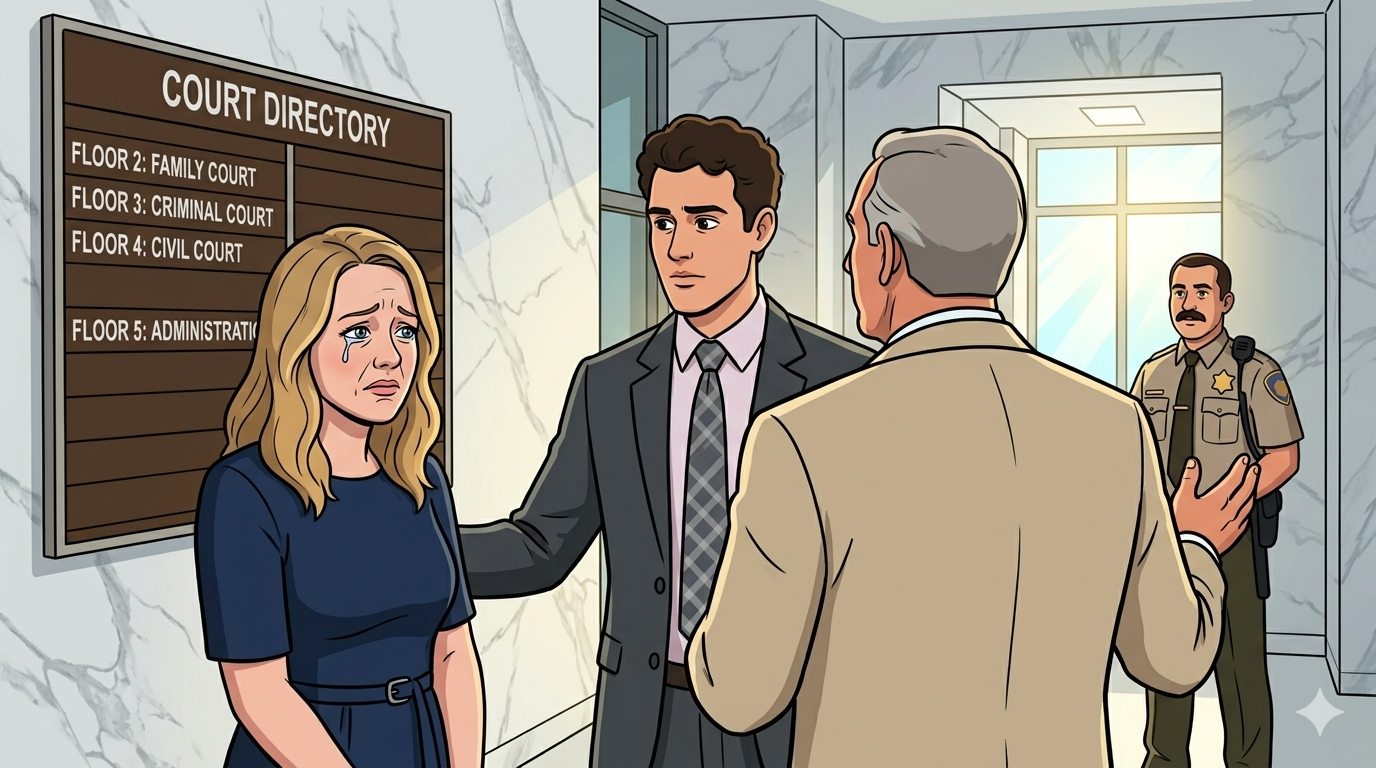
That morning I took a crowded city bus to my own divorce hearing, and one small act of kindness toward a stranger turned into the thing that changed everything
I woke up knowing my marriage was over.
Not because of a big fight.
Because of a quiet manila envelope from the courthouse sitting on my kitchen table in our little place near Chicago.
Inside: the date, the time, the room where a judge would end what I had spent years building.
My husband didn’t even bother to call.
He just texted.
“You got the letter. Be there. Don’t make things complicated.”
No “hi.” No “how are you.”
Just instructions, like I was staff.
This is the same man I once shared cheap takeout with on the floor of our first apartment. The one I stayed up sewing clothes for, so he could afford his law books. The one whose first office outfit I patched and pressed by hand.
Now he’s a rising attorney downtown. Expensive suits. Big clients. New car.
And suddenly I’m “not on his level” anymore.
He made it very clear:
He would walk into that courthouse with his colleague.
I would walk in alone.
And if I dared to argue about anything, he’d “make sure I left with nothing.”
The part that stung the most?
He meant it.
I didn’t have a car that morning. The one we shared was already gone with him. My access to our money had magically “stopped working.”
So I put on the best dress I had that still fit, wrapped a faded scarf around my neck, and walked to the bus stop.
On the way, I heard my neighbors whisper.
“Isn’t that her? The lawyer’s wife?”
“She’s going to court, I heard.”
“Poor thing… he’s doing well, and she’s taking the bus.”
I wanted to turn around and tell them everything.
How I’d worked extra hours, how I’d skipped little things for myself so he could look good at work.
Instead, I kept walking.
By the time the city bus finally wheezed up, my heart was pounding harder than the engine.
It was packed.
Sweat, perfume, old cigarette smell, winter air sneaking in through cracked windows. I squeezed into the aisle, hanging onto a metal bar, feeling like a complete cliché: the abandoned wife on public transit, on her way to get tossed aside.
Then the bus jerked to a stop near downtown.
The driver yelled for people to move back.
An elderly man tried to climb on.
He was too thin for his shirt. His hands shook as he reached for the rail. He got one foot on the bus, and before he could pull himself up properly, the driver lurched forward again.
I watched his body pitch backward toward the open steps.
Someone shouted, but no one moved.
I did.
I pushed past backpacks and headphones and grabbed his arm just in time. His whole weight fell into me. My shoulder screamed, but I held on.
“Careful, sir,” I breathed, trying to steady him. “I’ve got you.”
When he finally sat down in the front, I realized there was something different about him.
Not his clothes—they were simple, worn.
It was his eyes. Clear. Calm. Like he’d seen a lot and nothing surprised him anymore.
He thanked me the way older men from another generation do, with too many “thank yous” and a little nod that felt bigger than words.
“Where are you headed all dressed up on a bus like this, dear?” he asked, voice soft, like he actually cared about the answer.
I thought about lying.
Instead, I swallowed and told the truth.
“To the courthouse,” I said quietly. “Family division. Today’s my first hearing.”
His gaze sharpened, but he didn’t rush me.
“My husband…” My throat tightened. “He doesn’t want to be married to me anymore. He has a good job now. Nice friends. I embarrass him.”
I waited for the usual pity. Or curiosity. Or the little shrug people give when they secretly think you must have done something wrong.
Instead, this stranger on the bus said, very simply:
“Then he doesn’t understand value. People who throw away something good because they’re blinded by something shiny usually realize it too late.”
We talked in low voices until the driver yelled out our stop.
It turned out we were getting off at the same place.
“That big building up there?” he said, nodding toward the entrance with the flags. “I know it well. Let me walk in with you. Consider it my way of saying thank you.”
So I walked into my divorce hearing next to an old man I’d just met on a Chicago bus.
We sat together in the hallway outside the courtroom. My hands wouldn’t stop shaking. He kept his voice steady, telling me to breathe, telling me not to let my husband see me break.
And then I heard it.
The familiar sound of expensive shoes on tile.
My husband stepped into view in his tailored suit, his colleague a step behind him. Same confident walk. Same cologne. Same face that used to look at me like I was his whole world.
He looked right past the man sitting next to me, then down at my dress, my bag, my tired face.
“You really took the bus,” he said, almost laughing. “Perfect.”
He spoke loudly, so everyone around us could hear.
He talked about me like I was some outdated accessory he was finally throwing away.
He pushed a thick stack of papers at me, telling me to accept that I’d be leaving this marriage with “just your clothes and your memories.”
When I refused, right there in the hallway, his face changed.
He leaned in too close and started saying things he never would have said in front of our friends. Harsh things. Small things. The kind of words meant to make you feel like you’re nothing.
And that was when the elderly man beside me slowly stood up.
He planted his cane on the floor, lifted his head, and looked my husband straight in the eye with a calm that made the whole corridor go strangely quiet.
“Son,” he said, voice low but carrying, “are you sure you want to talk to your wife like that in public?”
In that second, something in the air shifted.
My husband frowned, like he was about to tell this “nobody” to mind his own business
PART 2
My husband opened his mouth, ready to dismiss the old man beside me like he was nothing. I could see it—the same arrogance he used in court, the same tone he used on waiters, on me. But before he could speak, his colleague suddenly stiffened. Her eyes locked onto the man next to me, and all the color drained from her face.
“Sir…?” she whispered.
The old man didn’t raise his voice. He simply reached into his coat and pulled out a worn leather card holder. When he flipped it open, even I leaned in slightly. My husband’s expression shifted first—from annoyance… to confusion… to something dangerously close to fear.
The hallway went quiet in a way I had never felt before.
“Retired Judge Harold Whitmore,” the colleague said under her breath, almost like a warning.
My husband blinked. “That’s… not possible,” he muttered, but his voice had already lost its edge.
The old man—Judge Whitmore—tilted his head slightly. “I still sit in on select advisory panels,” he said calmly. “And I still care very much about how the law is practiced… especially in family court.”
Then he looked at me, not with pity—but with something steadier. Respect.
My husband tried to recover, straightening his tie, forcing a smile that didn’t quite land. “Well,” he said, voice tight, “this is a private matter.”
“Nothing about intimidation in a courthouse hallway is private,” Judge Whitmore replied.
For the first time in years, I saw my husband hesitate.
He glanced at the papers in his hand—the ones meant to strip me down to nothing—and suddenly they didn’t look so powerful anymore.
And neither did he.
Inside the courtroom, everything felt different.
I sat a little straighter. My hands still trembled, but not from fear—something else had taken its place. The judge assigned to our case greeted Judge Whitmore with visible respect. A quiet exchange passed between them, nothing dramatic… but enough.
When my husband’s lawyer began presenting their version of the story, something changed in the rhythm.
They were no longer speaking like I was invisible.
They were careful now.
Measured.
Almost… cautious.
When it was my turn, I stood up.
My voice shook at first, but I didn’t stop. I talked about the years. The sacrifices. The nights I stayed awake sewing, working, supporting a future that only one of us seemed to benefit from in the end.
I didn’t beg.
I didn’t cry.
I simply told the truth.
And for the first time, people actually listened.
PART 3
By the time the hearing ended, I didn’t recognize the man standing across from me anymore.
Not because he had changed.
But because I finally saw him clearly.
The judge requested a full financial review. Temporary orders were issued—ones that ensured I would not be left with “just my clothes and my memories.” The assets he tried to hide suddenly mattered. The accounts I had been locked out of were now part of the record.
And my husband?
He avoided my eyes.
Outside the courtroom, he tried one last time.
“This isn’t over,” he said, low and sharp, like he was trying to reclaim control.
But the words felt hollow now.
I adjusted my scarf, the same faded one I had almost been ashamed of that morning, and looked at him steadily.
“No,” I said. “It’s just finally fair.”
For the first time, he didn’t have a response.
Judge Whitmore walked beside me down the courthouse steps, his pace slow but steady.
“You did well in there,” he said.
I let out a breath I felt like I had been holding for years. “I almost didn’t make it this morning,” I admitted. “If I hadn’t taken that bus…”
He smiled faintly. “Life has a way of testing people right before it changes for them.”
At the bottom of the steps, he paused.
“So do small acts of courage.”
I watched him walk away, just another quiet figure in the crowd.
But nothing about this day was small.
That morning, I thought I was walking into a room where my life would be reduced to nothing.
Instead, I walked out with something I hadn’t realized I’d lost—
my voice, my dignity, and the undeniable proof that I was never as powerless as he needed me to believe.
And all it took… was refusing to let go of someone who was about to fall.
The Dog Who Stopped the Wedding. The Truth That Waited Outside the Church Door.,013
Eliza would later remember that the first sign something was wrong was not the sound of the door.
It was the way the air changed.
Moments before, the church had been wrapped in a soft, sacred stillness. Sunlight poured through stained glass, scattering gentle colors across the aisle. Guests smiled through tears. The priest held his book open, ready to bless a union that had taken years to build.
Eliza stood at the altar in her white lace gown, fingers trembling slightly in Matteo’s hands. Her heart was full, nervous, happy — everything a bride should feel.
And then the heavy wooden door creaked open.
The sound cut through the church like a blade.
Heads turned.
A dog stood in the doorway.
For a second, no one reacted. It felt unreal, like a mistake in reality. The dog stepped inside slowly, deliberately, its paws echoing against the stone floor.
Its eyes scanned the room.
Locked onto Eliza.
And didn’t look away.
A whisper moved through the guests like wind through leaves.
Before anyone could stop it, the dog trotted down the aisle straight toward the altar.
Straight toward her.
It stopped in front of Eliza, breathing fast, staring up with a look she had never seen before — panic, urgency, something frighteningly human.
Then it began spinning around her, paws brushing her gown, trembling, letting out a low, aching sound that was not a bark.
It was a plea.
Eliza’s heart slammed in her chest.
She knew this dog.
“Sherlock…” she whispered.
Sherlock belonged to her neighbor, Mr. Hargrove. A quiet retired man who lived alone in the small house next to hers. Sherlock was calm, intelligent, loyal. He had never behaved wildly in his life.
But today, Sherlock looked terrified.
The priest lowered his book. Matteo frowned in confusion. Guests leaned forward in their seats, unable to look away.
Sherlock suddenly ran toward the church door.
Stopped.
Turned back to Eliza.
Whined again.
Took a few steps toward the exit.
Stopped.
Looked at her.
Waiting.
He wanted her to follow.
A heavy silence filled the church. Eliza felt something twist deep inside her — a cold, inexplicable dread.
Why would Sherlock be here?
Why today?
Why her?
He whined again, scratching lightly at the floor as if time were running out.
And in that moment, something inside her whispered with absolute certainty:
You have to go.
She released Matteo’s hands.
“I’m sorry,” she said, barely aware of her own voice.
Then she lifted her dress and walked down the aisle toward the dog.
Gasps followed her. Matteo called her name. The priest said something she didn’t hear.
Sherlock bolted the moment she stepped outside.
She ran after him.
The sunlight outside felt too bright, too sharp. Sherlock ran ahead, looking back repeatedly to make sure she followed.
They didn’t go toward the street.
They went toward the narrow path between her house and Mr. Hargrove’s.
Her stomach tightened.
The gate to his yard was open.
It was never open.
Sherlock ran inside, barking now — loud, frantic, nothing like the sounds he made in the church.
“Eliza!” Matteo’s voice echoed behind her, distant. Guests were spilling out of the church.
She didn’t stop.
She followed Sherlock to the front door.
It was slightly open.
A chill ran up her spine.
“Mr. Hargrove?” she called.
No answer.
Sherlock pushed inside.
Eliza stepped into the dim house, the air stale and heavy.
And then she smelled it.
Gas.
Her heart dropped into her stomach.
She rushed into the kitchen.
Mr. Hargrove lay on the floor.
Unmoving.
The stove knobs were all turned on.
Sherlock barked wildly beside him.
“Oh my God!” Eliza rushed to the window and threw it open. Fresh air rushed in. She fumbled for her phone, calling emergency services with shaking fingers.
Guests began crowding at the doorway. Someone pulled Mr. Hargrove toward the living room. Someone else turned off the stove.
Paramedics arrived quickly.
They carried him out on a stretcher, oxygen mask over his face.
He was still alive.
Barely.
Sherlock refused to leave his side.
Eliza stood outside, shaking, her wedding dress streaked with dust and tears she didn’t remember crying.
Everyone praised the dog.
“If Sherlock hadn’t come—”
“He saved his life!”
“What an incredible animal!”
Eliza nodded numbly.
But something didn’t feel right.
Mr. Hargrove was old, but he was careful. Meticulous. He never forgot anything. He once walked back home three blocks because he thought he might have left a window open.
And yet…
All four stove knobs were turned on.
Not one.
All.
A hand touched her shoulder.
Matteo.
His expression was strange. Pale. Tight.
“Are you okay?” he asked.
She nodded slowly.
But her eyes drifted past him.
To Sherlock.
The dog wasn’t looking at Mr. Hargrove.
He was looking at Matteo.
Low growl vibrating in his chest.
And that was when Eliza felt the second twist of dread.
Sherlock had known Matteo for two years.
He had never growled at him.
Not once.
That night, after the chaos, after the wedding had been postponed, after Mr. Hargrove was stabilized at the hospital, Eliza sat alone in her living room replaying everything.
Sherlock’s eyes in the church.
The urgency.
The gas.
The growl.
She couldn’t sleep.
Around midnight, her phone rang.
It was the hospital.
Mr. Hargrove was awake.
And asking for her.
He looked weak, pale, tubes running from his arms. Sherlock lay beside the bed, head resting gently on the blanket.
When Eliza stepped inside, Mr. Hargrove’s eyes filled with relief.
“You came,” he rasped.
“Of course. What happened?”
He swallowed.
“I didn’t turn the stove on.”
Her heart thudded.
“I know.”
He looked toward the door, making sure no one else was there.
Then he whispered words that froze her blood.
“Someone was in my house.”
Eliza’s breath caught.
“I came back from my walk. Sherlock was growling at the kitchen. I thought maybe a raccoon got in. Then I smelled gas. I tried to turn the knobs off…”
He coughed weakly.
“And someone hit me from behind.”
Her world tilted.
“Did you see who it was?”
He shook his head slightly.
“But Sherlock saw.”
Sherlock lifted his head, staring at her.
Not soft.
Not friendly.
Intense.
Warning.
Mr. Hargrove grabbed her wrist with surprising strength.
“Sherlock came to get you for a reason.”
A cold understanding began forming in Eliza’s mind.
She whispered, “Matteo was the last person to leave my house this morning.”
Mr. Hargrove’s eyes widened slightly.
“He came by?”
“He said he forgot his watch.”
Sherlock began growling softly.
Eliza felt her pulse roar in her ears.
Something she had ignored for months surfaced — little moments she brushed aside.
Matteo’s sudden anger when she talked about Mr. Hargrove.
His insistence that she sell the house after marriage.
His comment two weeks ago: “Old people living alone are accidents waiting to happen.”
Her stomach churned.
She stood up slowly.
“I have to go.”
She didn’t go home.
She went back to the church.
Matteo was there, speaking to guests, trying to calm everyone, playing the concerned groom.
He smiled when he saw her.
Too quickly.
“Is he okay?”
Eliza stared at him.
Sherlock’s growl echoed in her memory.
She walked closer.
“Why did you go to my house this morning?”
He blinked. “I told you — my watch.”
“Why did you go to Mr. Hargrove’s house?”
His smile faded slightly.
“I didn’t.”
She held his gaze.
“You did.”
A pause.
A flicker in his eyes.
A crack.
And then she saw it.
The truth.
Not confusion.
Fear.
Matteo took a small step back.
“Eliza—”
She stepped away from him as if he were a stranger.
“Sherlock knew,” she whispered.
And Matteo’s face changed.
Not into guilt.
Into something worse.
Calculation.
He looked toward the crowd.
Toward the exits.
And then he ran.
Guests screamed.
Someone tried to grab him but he shoved past.
Eliza didn’t move.
She watched the man she was about to marry sprint away from the church.
And she finally understood.
Sherlock hadn’t stopped the wedding to save Mr. Hargrove.
He had stopped it to save her.