The Architecture of a Shield
Chapter 1: The Carnival’s Shadow
I never imagined a crisp Tuesday evening in late October would be the precise moment my entire universe fractured.
The annual fall carnival at Maplewood Elementary was usually the highlight of my seven-year-old daughter’s month. Lily lived for these chaotic evenings—the dizzying scent of spun sugar, the neon glow of the ring-toss games, the shrieks of her classmates echoing across the blacktop. But that night, the vibrant atmosphere felt strangely muted. We had only been there for twenty minutes when Lily anchored her small hands onto the sleeve of my denim jacket.
She stared at the asphalt, her voice barely a breath against the ambient noise. “Dad? Can we just go home, please?”
I frowned, crouching slightly to meet her eye level. Her face, usually flushed with autumn air and excitement, was completely drained of color. “Are you feeling sick, kiddo?” I asked, checking her forehead for a fever. Her skin was cool, but she was trembling.
“I’m just tired,” she murmured, refusing to look toward the brightly lit school gymnasium.
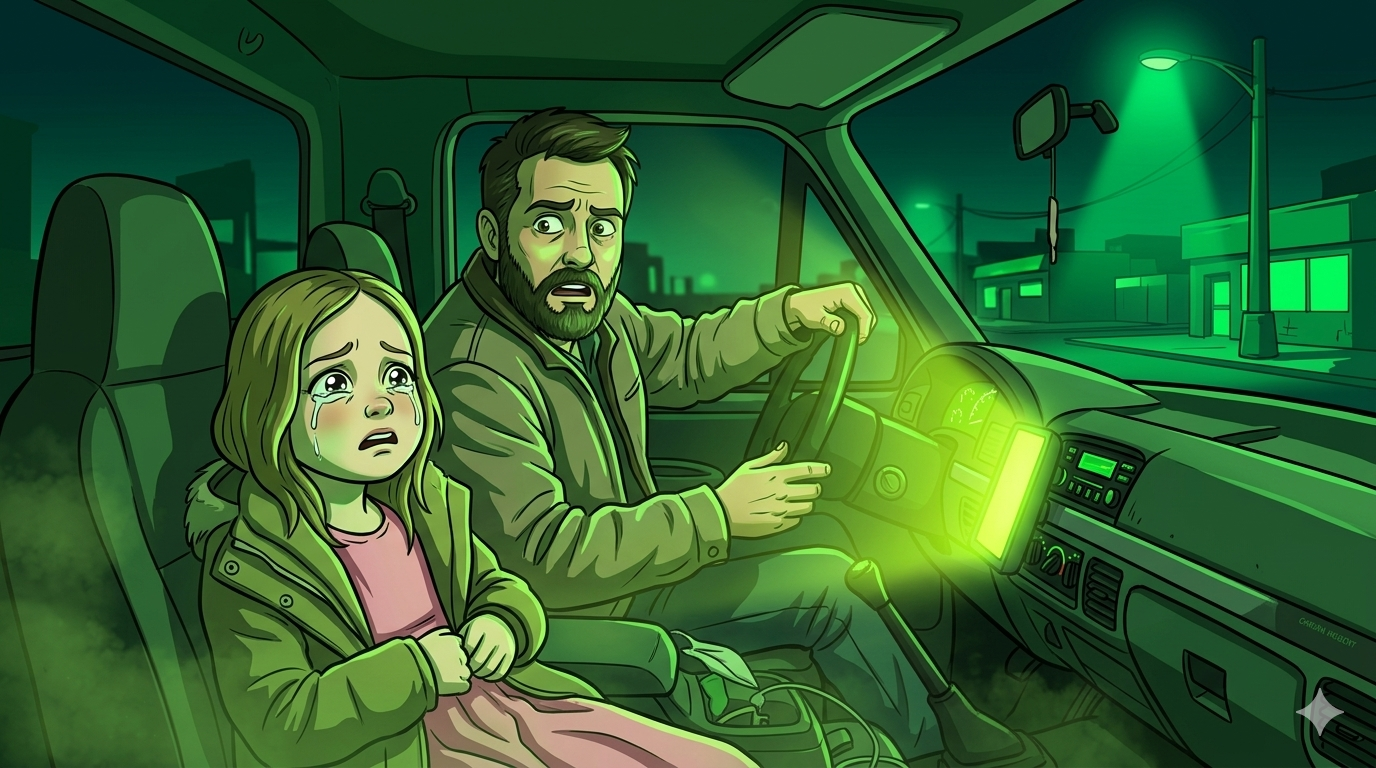
The parking lot was still heavily congested when we reached my truck. Lily scrambled into the passenger seat, pulling her knees to her chest. I slid behind the wheel, the heavy door shutting out the carnival music. I reached for the ignition, but her tiny, terrified voice paralyzed my hand.
“Dad,” she whispered, her eyes darting nervously toward the school building. “I need to show you something. But please… please don’t get mad.”
A cold, heavy dread instantly coiled in the pit of my stomach. “Sweetheart,” I said, unbuckling my seatbelt and turning to face her completely. “I could never be mad at you. Never. What is it?”
She hesitated, her breathing shallow. She peered out the window, scanning the dimly lit rows of cars to ensure we were entirely alone. Then, with shaking fingers, she slowly lifted the hem of her knitted sweater.
The air violently left my lungs.
Bruises. A horrifying canvas of dark purple, sickly yellow, and mottled black spread across her fragile ribcage. They looked like violent fingerprints painted onto her skin. Some were fading, while others were sickeningly fresh.
My vision blurred. A roaring sound filled my ears. I gripped the leather steering wheel so aggressively my knuckles turned entirely white, desperate to ground myself before my rage terrified her further.
“Lily,” I managed to say, forcing my voice into a low, steady cadence that disguised the absolute panic shredding my insides. “Who did this to you?”
She swallowed hard, a single tear cutting a path down her pale cheek.
“Mr. Harrison,” she whimpered. “The principal.”
The name struck me like a physical blow. Jason Harrison. The beloved educator. The man who handed out awards at assemblies.
“But Dad, you can’t tell anyone yet!” Lily pleaded, panic surging in her voice. “He said if I told, something terrible would happen to us. He said no one would ever believe me because he’s the principal, and I’m just a kid.”
Every primal, protective instinct in my DNA screamed at me to kick my truck door open, march straight back into that gymnasium, and tear the man apart in front of the entire community. But the sheer, paralyzing terror in my daughter’s eyes acted as a chain around my ankles. I couldn’t be a monster to fight a monster. I had to be an architect. I had to be smart.
“Lily, look right at me,” I commanded softly. She lifted her watery eyes. “You did exactly the right thing by telling me. I am so incredibly proud of you. And I promise you, we are going to handle this. But first, we need to go see a doctor to make sure you’re okay.”
She shrank back against the seat. “I don’t want people to know. Everyone loves Mr. Harrison. The teachers, the other parents… they’ll think I’m lying.”
I reached across the console, enveloping her small, trembling hands in mine. “Baby, you are the bravest person I have ever known. And I believe you. That is the only thing that matters.”
I put the truck in gear and drove away from the school. But as I watched the illuminated Maplewood Elementary sign fade in my rearview mirror, I realized the hardest part wasn’t going to be confronting the man who hurt her. It was going to be fighting the massive, impenetrable fortress of a community that protected him.
Chapter 2: The Wall of Authority
The twenty-minute drive to Vancouver Children’s Hospital felt like wading through wet cement. My wife, Rachel, was three hundred miles away visiting her sister in Kelowna. A selfish, protective part of my brain was mildly relieved she wasn’t in the passenger seat. I barely possessed the bandwidth to keep my own composure; if Rachel had seen those marks on our child, the raw devastation would have unraveled us both.
The emergency room was a sensory overload of harsh fluorescent lighting and the sharp smell of antiseptic. We were assigned to Dr. Sarah Chen, an attending physician whose demeanor was a perfect blend of gentle empathy and clinical precision. She meticulously documented the injuries, taking specialized photographs under glaring lights. With every quiet, careful question she asked Lily, Dr. Chen’s jaw set a fraction tighter.
Once the examination concluded and a nurse offered Lily a warm blanket and a tablet to watch cartoons, Dr. Chen pulled me into the sterile hallway.
“Mr. Sutherland,” she began, her voice dropping to a grave whisper. “These specific injuries are entirely consistent with repeated, deliberate physical harm. The varying stages of healing in the contusions suggest a pattern spanning at least two to three weeks. By law, I am immediately required to report this to Child Protective Services and the local police precinct.”
“Good,” I replied, the word tasting like ash in my mouth. “Make the call. Because the man who did this is the principal of her elementary school.”
Dr. Chen’s professional mask slipped for a microsecond. Her dark eyes clouded with a weary, knowing resignation. “Then this nightmare just became infinitely more complicated. Predators in positions of high authority are incredibly dangerous, Mr. Sutherland. They are frequently insulated by the very systems designed to protect our children.”
She wasn’t being cynical; she was being prophetic.
An hour later, Officer Martinez arrived in the examination room. He was a younger cop, initially sympathetic and patient as he took Lily’s halting, tearful statement. But the precise moment I uttered Jason Harrison’s name, the atmospheric pressure in the room shifted. A flicker of profound doubt crossed the officer’s face.
Officer Martinez slowly lowered his notepad. “Jason Harrison? The principal at Maplewood?”
“Yes,” I snapped, sensing the incoming defense.
Martinez sighed, shifting his weight. “Mr. Sutherland, I’ve known Jason for fifteen years. He’s been the principal there for over a decade. He launched the district’s after-school mentorship program. He coaches the community youth soccer league. His own children attend that school.”
“I do not care if the man has won a Nobel Peace Prize,” I interrupted, my voice trembling with suppressed rage. “Look at my daughter. She is seven years old, and she is terrified to step foot in a classroom.”
“I am not saying I don’t believe your daughter, sir,” Martinez backpedaled, holding up a defensive hand. “I am simply advising caution regarding accusations of this magnitude. Jason Harrison is a well-respected member of this community.”
A well-respected member of this community.
That phrase branded itself into my cerebral cortex. It was the ultimate shield. It was the unspoken code that meant a child’s pain was secondary to a powerful man’s reputation.
Officer Martinez finalized his report and departed, leaving behind a hollow promise to “look into it.” Dr. Chen provided a list of specialized child psychologists and strictly advised keeping Lily out of school until the investigation formally concluded.
We didn’t arrive back at our dark house until well past midnight. I carried my exhausted daughter to her bedroom, tucking her under her favorite quilt. Just as I turned toward the door, her small hand shot out from the dark, grabbing my wrist.
“Dad?” she whispered, her voice laced with the fear that the police officer had planted. “You really believe me, right?”
I knelt beside her bed, kissing her forehead. “Every single word, sweetheart. I would burn the world down before I doubted you.”
I retreated to the kitchen, the silence of the house pressing against my eardrums. I dialed Rachel. She answered on the first ring. When I relayed the horrific events of the evening, the sound of her breaking down over the cellular connection nearly brought me to my knees.
“I am leaving right now,” Rachel sobbed, the sound of keys jingling in the background. “I will be home in four hours.”
I spent those four agonizing hours sitting alone at the kitchen island, staring blankly at the duplicate photographs Dr. Chen had provided. My beautiful, innocent girl, marked by a predator cloaked in community trust.
I am a senior software engineer. My entire professional existence revolves around diagnosing systemic failures, bypassing corrupted firewalls, and utilizing raw data to solve complex problems. So, as the clock struck 2:00 AM, I wiped my eyes, opened my laptop, and went to war.
A standard search query of Jason Harrison yielded dozens of glowing PR articles. Ribbon-cutting ceremonies. Charity galas. Smiling photos surrounded by oblivious children. But deep on the seventh page of search results, buried in an archived local parenting forum, I found a thread that made the blood in my veins run ice cold.
It was an anonymous post dated eight months prior: Has anyone else noticed that Mr. Harrison seems to spend an unusual amount of one-on-one time with specific students? My daughter says he frequently pulls kids into his office during recess and closes the blinds. Is this normal protocol?
The replies were aggressively dismissive. Other parents had attacked the original poster, accusing them of paranoia and vehemently defending Harrison’s pristine reputation.
I dug deeper, bypassing standard search engines to access public district complaint logs. I found a redacted file from three years ago. A parent had filed a formal grievance regarding “inappropriate and aggressive physical contact” involving Harrison. The district had conducted an internal review, deemed the complaint “unfounded,” and buried it. The parent had quietly transferred their child to a different district.
When Rachel finally burst through the front door at 4:00 AM, I had filled an entire spiral notebook with a timeline of systemic negligence. Rachel didn’t speak to me; she ran straight into Lily’s room and remained there for an hour.
When my wife finally emerged, her eyes were bloodshot, but her jaw was locked in a terrifying display of maternal fury. Rachel was a seasoned medical office manager; she navigated aggressive bureaucracy and massive egos for a living.
“What are we going to do, Marcus?” she asked, her voice dangerously calm.
“We are going to dismantle his life,” I replied, closing my laptop. “But the police aren’t going to help us. We have to find the cracks in his armor ourselves.”
Chapter 3: The Engineer’s Arsenal
The next morning, the systemic wall I had anticipated materialized exactly as expected. Officer Martinez called just after 9:00 AM.
“Mr. Sutherland, I spoke with Principal Harrison this morning,” the officer began, his tone maddeningly even. “He completely denies all allegations. He stated that Lily is a sweet girl, but noted she has been exhibiting behavioral issues recently—acting out, refusing to follow basic directions. He suggested the bruising is likely the result of rough play on the playground, and that she may have fabricated this narrative to avoid disciplinary action.”
My blood pressure spiked so violently I saw black spots dancing in my vision. “Are you out of your mind? You saw the medical photographs! A pediatrician confirmed the pattern of trauma. My daughter does not lie!”
“I understand your frustration,” Martinez sighed. “But we must objectively evaluate all possibilities. The school district has initiated its own internal investigation. In the interim, Mr. Harrison will remain in his position. There is simply no concrete evidence directly linking him to the injuries.”
“What about the statement of a seven-year-old victim?” I demanded.
“Without corroborating adult witnesses or video evidence, the prosecutor’s office will not move forward with charges against a man with his standing,” Martinez replied flatly.
I terminated the call before I hurled my phone through the drywall.
Rachel and I sat at the kitchen table, formulating a strategy. If the authorities demanded corroboration, we would hand-deliver it to them.
I began meticulously reaching out to other Maplewood parents under the guise of casual concern. Hey, how is your kid adjusting to the new semester? Any weird issues popping up?
Most parents blindly parroted the district’s PR lines, praising the school’s leadership. But three specific conversations shattered my heart.
A mother named Jennifer admitted her son had suddenly developed crippling anxiety. “He used to love school,” she whispered over the phone. “Now, he throws up every morning. When I ask him why, he just cries and says he is terrified of the principal’s office.”
A father named David reluctantly confessed his daughter had begun wetting the bed again—a regression she hadn’t experienced since preschool. She was having violent nightmares but refused to speak about them.
And a mother named Patricia broke down in tears, revealing her daughter had innocently asked if it was normal for teachers to give “special hugs that leave marks.”
I documented every date, every symptom, every terrified whisper. But hearsay wouldn’t secure an arrest warrant. I needed irrefutable, digital proof.
I did something that evening that severely crossed the boundary of federal cyber laws, but morality had long since eclipsed legality. I targeted the school’s security camera network.
As a software engineer, I knew that municipal school districts were notoriously underfunded, utilizing ancient, unpatched security systems with default administrative passwords. It took me less than forty-five minutes to bypass their firewall from my living room sofa.
I gained unrestricted access to three weeks of archived, high-definition hallway footage. I systematically scrubbed through hundreds of hours of video, isolating the camera positioned directly outside the main administrative office.
At 2:00 AM, my screen illuminated a truth so sickening I had to sprint to the kitchen sink to vomit.
I found highly disturbing behavioral patterns. Footage of Jason Harrison stepping out of his office, scanning the empty hallway, and pulling a vulnerable student inside before deliberately twisting the blinds shut. I watched children enter his office looking normal, only to emerge twenty minutes later exhibiting classic trauma responses—shoulders aggressively hunched, arms crossed defensively over their chests, staring blankly at the linoleum floor.
And then, I found the footage from exactly two weeks ago.
The timestamp read 10:14 AM. I watched my beautiful Lily skip down the hallway, clutching a hall pass. She entered the main office with a bright smile. Exactly seventeen minutes later, the heavy oak door opened. Lily walked out. Her posture was incredibly stiff, her head bowed, her small hands frantically wiping away tears.
I sat in the dark, my face wet with my own tears, and burned the raw video files onto four separate encrypted USB drives. I possessed the digital smoking gun. But to truly bury him, I needed an insider to verify the timeline. I needed someone inside the castle walls to open the gates.
Chapter 4: The Whistleblower
I needed an adult witness who possessed intimate knowledge of the school’s daily rhythms. I recalled Lily frequently talking about her homeroom teacher, Mrs. Patterson. She was a veteran educator who had spent twenty years navigating the political minefield of Maplewood Elementary. If anyone recognized the predator hiding in plain sight, it was her.
During my lunch hour, I drove to the school campus. The receptionist aggressively attempted to block my entry, citing protocol, but I bypassed her desk and walked directly to the third-grade wing.
Mrs. Patterson was erasing a chalkboard in her empty classroom when I stepped through the door. She was a woman in her late fifties, her face etched with the kind of exhaustion unique to public school teachers.
The moment she saw me, her posture went rigid. “Mr. Sutherland,” she said, her voice shaking slightly. “I have heard the rumors circulating the staff room. I must assure you, Mr. Harrison has always maintained professional—”
“Please,” I interrupted softly, closing the heavy classroom door behind me. “I am not here to threaten you, Mrs. Patterson. I am here as a father fighting for his daughter’s life. And I know there are other children in this building who desperately need protecting.”
I pulled out my phone, bypassed the lock screen, and placed the horrifying medical photographs of Lily’s bruised ribs onto her desk.
Mrs. Patterson looked down. All the color instantly drained from her face. She dropped the chalkboard eraser; it hit the tile floor with a dull thud. She covered her mouth with a trembling hand, tears immediately pooling in her eyes.
“How long have you suspected?” I asked gently, leaning against the doorframe.
The silence stretched for a brutal eternity. Finally, she collapsed into her desk chair, burying her face in her hands.
“Three years,” she wept, the confession tearing out of her throat. “God forgive me… I have known for three years.”
She detailed the subtle, agonizing signs. The dramatic behavioral shifts in bright students. A previously outgoing child who suddenly suffered panic attacks whenever asked to deliver paperwork to the main office.
“Why didn’t you go to the authorities?” I asked, suppressing my anger to maintain her trust.
“I tried,” she sobbed, looking up at me with haunted eyes. “Two years ago, I brought my concerns to the vice principal. I was immediately pulled into a closed-door meeting. I was told I was being hysterical and overly sensitive to ‘unconventional mentorship methods.’ The unwritten rule was crystal clear: stay quiet, or your career is over.”
She explained the deep, corrupted web protecting Harrison. “He brings in massive municipal grants through his local country club connections. The district superintendent is his brother-in-law. The chairman of the school board has a wife who works as Harrison’s private secretary. Anyone who dared question his authority suddenly found themselves permanently transferred to the worst-performing schools in the county. I am three years away from my pension, Mr. Sutherland. I was a coward. I put my head down.”
“You are talking to me right now,” I reminded her. “That takes courage.”
She wiped her eyes, her expression hardening into a fierce resolve. “I saw Lily the day he hurt her. She came back to my classroom after recess. She had this vacant, terrified look in her eyes—a look I have seen on too many children in this building. I realized I could not stay silent anymore, even if it costs me my retirement.”
“Will you provide a formal, written statement?” I asked.
“Yes,” she nodded firmly. “But you need to understand the magnitude of the beast you are hunting, Mr. Sutherland. This isn’t just about destroying one man. You have to destroy the entire system that insulated him.”
I left the school with Mrs. Patterson’s devastating written testimony secured in my jacket pocket.
Rachel and I spent the weekend compiling the ultimate dossier. We realized that utilizing official, bureaucratic channels was a death sentence for the truth. The police were apathetic, and the district was actively circling the wagons. We had to force a public reckoning.
The monthly, open-forum school board meeting was scheduled for Tuesday evening. We consulted a trusted attorney to ensure we skirted defamation laws. “Stick exclusively to the documented facts,” he advised. “Do not make emotional accusations. Let the evidence act as the executioner.”
Tuesday night arrived. We pulled into the municipal building parking lot. My stomach churned with a nauseating mix of fear and adrenaline. We walked through the double doors into the packed chamber, carrying the heavy binders of truth, preparing to look the monster directly in the eye.
Chapter 5: The Reckoning
The municipal chamber was suffocatingly hot and packed to absolute capacity. Whispers had permeated the community network; everyone sensed a storm was brewing. I recognized the faces of Maplewood parents, anxious teachers, and rigid district administrators.
And there, seated prominently in the front row, wearing an immaculate tailored suit and an expression of untouchable arrogance, was Jason Harrison.
When the chairman finally opened the floor for public comment, Rachel gave my hand a brief, agonizing squeeze. I stood up, my legs feeling like lead, and walked to the wooden podium facing the elevated semi-circle of board members.
“State your name and your business for the record,” the chairman droned.
I adjusted the microphone. “My name is Marcus Sutherland. Three weeks ago, my seven-year-old daughter disclosed to me that she had been repeatedly, physically harmed by the principal of her school, Jason Harrison.”
The chamber erupted. Gasps echoed off the high ceilings. A woman in the third row let out a muffled shriek. Dozens of conversations ignited simultaneously.
The chairman slammed his wooden gavel against the sound block. “Order! Mr. Sutherland, those are severe, slanderous accusations!”
“They are undeniable facts,” I countered, my voice cutting through the chaos, refusing to be silenced. “Which is precisely why I am not making them without proof.”
I dramatically hoisted the thick black binder into the air.
“I possess authenticated medical documentation detailing the brutal injuries inflicted upon my child. I possess internal security camera footage exposing Mr. Harrison’s suspicious, isolated interactions with vulnerable students behind closed blinds. I possess a signed, formal statement from a twenty-year veteran educator at Maplewood confirming a multi-year pattern of predatory behavior. And I possess documented accounts from multiple parents whose children are currently exhibiting severe trauma responses.”
The district superintendent—Harrison’s brother-in-law—bolted out of his leather chair. He was a massive, intimidating man, his face flushed with panicked rage. “This is highly irregular and completely inappropriate! The district is conducting a private internal review! Broadcasting these baseless claims publicly compromises the integrity of our investigation!”
I leaned into the microphone, my eyes locked on the superintendent. “Your ‘internal investigation’ allowed a known predator to continue accessing children while my daughter shakes in her sleep. Your ‘investigation’ is identical to the one you buried three years ago to protect your brother-in-law!”
The crowd gasped again. The air was entirely sucked out of the room. I saw Jason Harrison’s smug, untouchable facade finally crack. A bead of sweat traced a path down his temple.
“I brought this evidence to the local police, and I was told his reputation made him untouchable,” I continued, my voice trembling with raw, unfiltered emotion. “I brought this to the district, and I was told to wait quietly in the dark. So tonight, I am bringing it to the public. Because this community deserves to know the exact nature of the monster you have been protecting.”
I marched forward and slammed duplicate copies of the dossier onto the table directly in front of the board members.
The superintendent desperately attempted to adjourn the meeting, but the dam had already broken.
Jennifer, the mother from my phone calls, stood up, tears streaming down her face, screaming about her son’s daily panic attacks. Patricia stood up next, shouting about her daughter’s nightmares. Then David. Then a mother I had never even met.
One by one, parents who had been brainwashed by the system, who had dismissed their own children’s pain in deference to authority, rose in a wave of furious realization.
Jason Harrison jumped to his feet, holding his hands up in a pathetic gesture of defense. “These allegations are an orchestrated witch hunt! I have dedicated my entire life to these children! This is a coordinated attack by a disgruntled father whose child is a disciplinary nightmare!”
I turned slowly, facing the man who had painted bruises onto my daughter’s ribs. My voice dropped to a deadly, quiet register that somehow carried to the very back row.
“My daughter is seven years old. Do not ever attempt to blame your unthinkable sickness on her innocence.”
The meeting devolved into a three-hour riot of demands, tears, and furious parents. By midnight, the terrified school board had absolutely no choice. Trapped by the glaring light of public scrutiny, they formally placed Jason Harrison on unpaid administrative leave and authorized an immediate, independent external investigation.
But the true victory materialized exactly forty-eight hours later.
Officer Martinez called me on Thursday morning. His tone was entirely different—subdued, respectful, laced with a heavy dose of professional shame.
“Mr. Sutherland,” he sighed heavily. “I am calling to inform you that the prosecutor’s office has formally reopened the criminal investigation. Following the board meeting, four more families walked into the precinct to file reports. We executed a search warrant on Mr. Harrison’s office and his personal residence at dawn.”
“What did you find?” I asked, my grip tightening on the phone.
“Enough,” Martinez replied grimly.
Chapter 6: The Light After the Fall
The digital forensics unit uncovered a horrifying reality on Jason Harrison’s encrypted personal computer. They found deeply disturbing digital files, meticulous notes cataloging vulnerable students—children from single-parent households, children with learning disabilities, children who were statistically less likely to be believed if they ever found the courage to speak up.
Jason Harrison was arrested in his driveway on a rainy Wednesday morning, paraded in handcuffs past the local news vans that had flooded his quiet, manicured street.
The scope of his betrayal was catastrophic. As the media coverage exploded, more victims stepped out of the shadows. Children who had transferred out of the district. Teenagers currently in high school who had suffered in silence when Harrison first assumed power twelve years ago. The horrifying tally eventually reached seventeen confirmed victims.
The criminal trial commenced six grueling months later. Rachel and I attended every single day, sitting as a united front in the gallery, though we aggressively shielded Lily from the courtroom. She provided her harrowing testimony via a pre-recorded video link from the safety of a specialized trauma center.
The high-priced defense attorneys utilized every vile tactic imaginable. They attempted to assassinate the credibility of traumatized children. They argued mass community hysteria. They aggressively challenged the legality of the security footage I had extracted.
But the sheer weight of the truth crushed their legal acrobatics. The medical documentation, the illicit digital evidence, Mrs. Patterson’s damning insider testimony—it was an avalanche they could not outrun.
Jason Harrison was convicted on sixteen felony counts. The presiding judge, staring down at him with undisguised disgust, sentenced him to twenty-three years in a federal penitentiary.
The systemic fallout was swift and merciless. The superintendent was forced into a humiliating public resignation. The school board chairman stepped down in disgrace. Three senior administrators who had buried prior complaints were permanently stripped of their educational licenses.
But the legal victories were merely the preamble to the actual battle: fighting for our daughter’s soul.
Lily began intensive therapy with Dr. Michelle Thompson, a specialist in severe childhood trauma. The first year was an agonizing gauntlet. Lily suffered violent night terrors. She was deeply terrified of any male authority figure. There were days when the light inside her seemed permanently extinguished.
But healing is not linear; it is a slow, stubborn ascent.
Week by week, month by month, I watched my vibrant little girl piece herself back together. She started painting. She joined a new school’s art club. The shadows beneath her eyes slowly faded, replaced by the spark of childhood she had been robbed of.
One evening, nearly a year later, she sat beside me on the back porch. The sun was setting, casting a warm, golden glow over the yard. She was eight years old now, her baby face beginning to mature.
“Dad?” she asked quietly, her eyes tracking a firefly in the dusk.
“Yes, my brave girl?”
“I learned something in therapy,” she said, leaning her head against my shoulder. “I learned that speaking up is really, really scary. But staying quiet forever is much scarier. Because even when people don’t believe you at first, the truth is always still the truth.”
Tears stung my eyes. I pulled her into a tight embrace. “You are absolutely right. And because you were so incredibly brave, you made sure he can never hurt another child again.”
“I wasn’t brave at first,” she corrected me softly. “I was just scared.”
“Bravery doesn’t mean you aren’t terrified, Lily. Bravery means you are terrified, but you do the right thing anyway.”
Rachel and I channeled our fury into advocacy. We traveled the province, speaking to parent-teacher organizations, demanding the implementation of ironclad mandatory reporting laws and severe penalties for administrators who prioritize institutional reputation over child safety. Mrs. Patterson, who did not lose her pension, joined us, utilizing her story to train educators to recognize the subtle, silent screams of abused children.
I keep a specific letter folded in the top drawer of my desk. It arrived months after the trial, written by a high school senior who had been one of Harrison’s earliest victims.
Thank you for believing your daughter, the letter read. Because you fought like hell for Lily, my parents finally believed me, too. You saved us.
If you are a parent reading this, let my family’s nightmare serve as your absolute blueprint.
When your child comes to you with an impossible truth, believe them immediately. Predators do not skulk in dark alleys; they wear tailored suits, they coach your local soccer teams, and they build fortresses of community trust specifically designed to shield their darkness. Never allow a title or a pristine reputation to blind you to the reality of a monster’s actions.
If the system designed to protect you fails, you do not bow your head and wait. You gather your evidence. You find your allies. You scream until the deaf are forced to hear you.
Lily’s laughter is currently echoing from the living room, where she is aggressively beating Rachel at a board game. It is a sound I will never, ever take for granted again. We survived the absolute worst of human nature, and we emerged unbroken.
We learned that when the entire world is engineered to protect the powerful, the unconditional, ferocious love of a parent is the only force capable of burning the corrupt system to the ground.
If you found this story impactful, please like and share this post to help raise awareness. Believing our children is the first step in protecting them.
