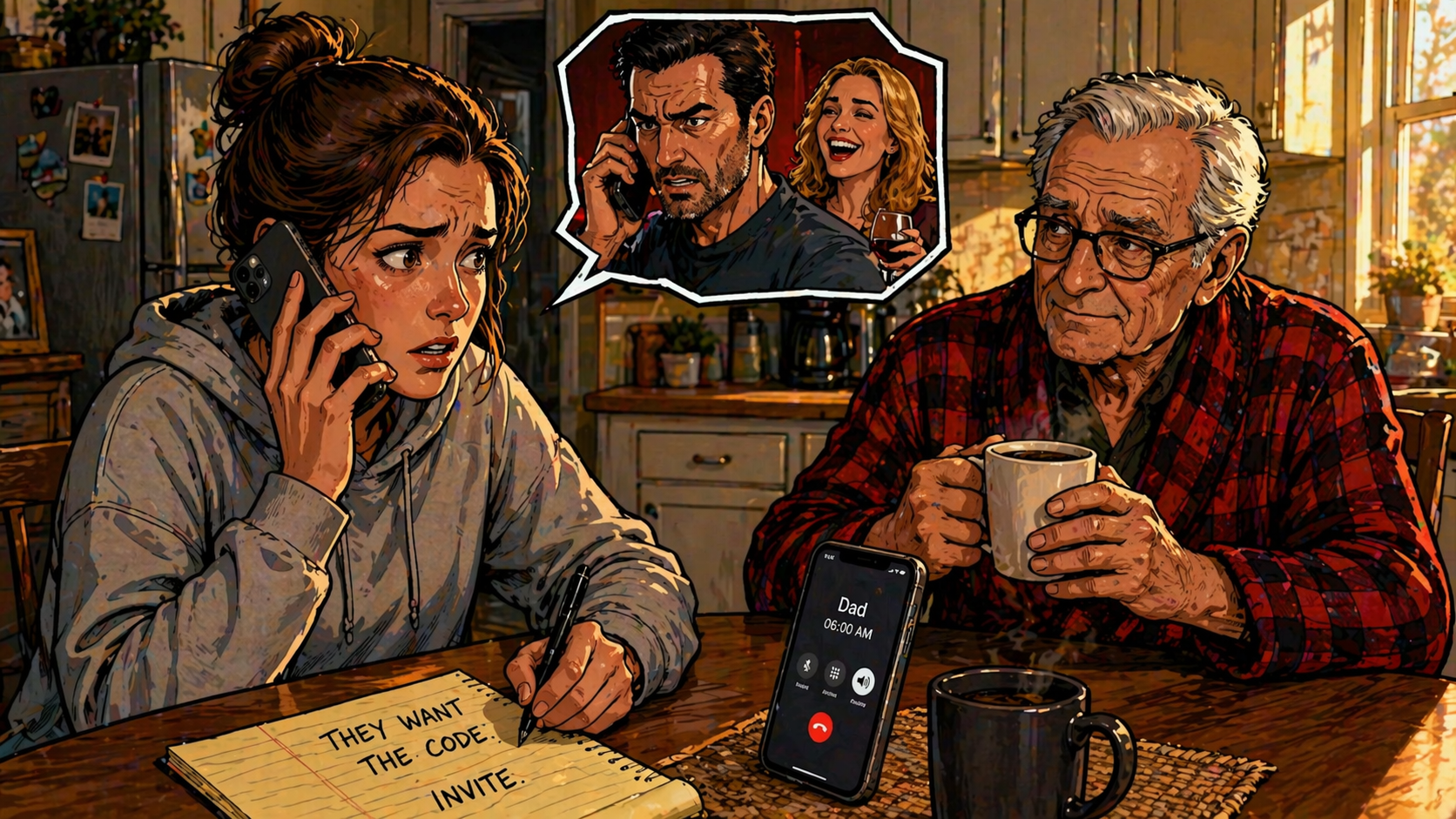
That sentence sat there between us like a lit match.
I had been to the Cedar Hill house maybe six times in my adult life. Big old place outside Astoria, cedar siding gone silver with age, wraparound porch, windows that rattled when the wind came off the water. Grandma used to call it “the stubborn house” because it needed something fixed every season and refused to die anyway. As a kid, I thought it was haunted. As an adult, I mostly thought it smelled like mothballs and old books.
“Who else knows about the safe?” Miller asked.
Grandpa answered without hesitation. “Me. My late wife. Marcus.”
“And Erica?”
“No.”
That hit harder than I expected.
Not because I wanted the money. Because I suddenly saw, with awful clarity, how this whole family had been built: secrets handed sideways between adults while I stood in the doorway carrying grocery bags and guilt.
Miller’s phone buzzed. He checked the screen and swore under his breath.
“What?”
“Search team is at Marcus’s house,” he said. “He and Deborah beat them there. Computer tower’s gone. External drives missing. Filing cabinet dumped.”
“So they knew exactly what to grab,” I said.
“Yes.”
Another buzz. He read the next message and went still.
“What now?” Grandpa asked.
Miller looked at him. “The hidden ledger you mentioned?”
Grandpa’s face turned the color of old paper.
“It’s not in the safe anymore.”
The room tilted for a second.
“How do you know?” I asked.
“Because,” he said slowly, “I checked it yesterday.”
“Then somebody got there last night.”
He nodded once.
Miller stood. “We’re going to Cedar Hill now.”
I stood too. “I’m coming.”
“No,” both men said at once.
I folded my arms. “My father already used me as bait once today. If he thinks I still have access, I’m part of this whether you like it or not.”
Miller looked annoyed. Grandpa looked tired. Neither looked surprised.
That annoyed me more than if they’d argued.
“I know that house,” I said. “I know where Grandma hid spare keys, where the porch boards dip, which pantry shelf sticks in the winter. And if Marcus took that ledger, he’s either trying to finish the sale or destroy whatever’s in it.”
Miller held my gaze for a long second.
“Stay where I can see you,” he said finally.
We stepped out into the hallway. Phones rang somewhere beyond the bullpen. A copier whined. Someone laughed too loud at a joke that wasn’t funny enough. Normal office sounds. Meanwhile my family was detonating.
Grandpa paused near the exit and put a hand on my arm.
“There’s something else,” he said.
I waited.
He swallowed. “If the ledger is gone, Marcus may not need my death to take the first piece. He may only need it to take the second.”
“What second piece?”
His eyes met mine, and for the first time that morning I saw fear there.
“Your grandmother’s codicil,” he said. “The one that changes everything.”
Then he pushed through the glass doors into the bright, cold morning, and I followed him out wondering what in God’s name my dead grandmother had left behind that could scare a living man that much.
Part 4
Cedar Hill always looked like the kind of house that knew too much.
The driveway was long and curved through wet pines, and the morning fog still clung low to the ground in strips like torn gauze. By the time we pulled up, the sun had climbed high enough to silver the top edges of the trees but not warm anything. The house itself sat on the rise above the river—three stories, broad porch, green shutters, white trim gone soft with age. When I was little, I thought rich people lived in houses like that. Later I learned rich people usually sold houses like that before the roof started talking back.
Two patrol cars were already there. One deputy stood near the front steps with a thermos. Another was photographing muddy prints under the east window.
The moment I got out of Miller’s sedan, I smelled wet cedar, cold dirt, and the faint iron scent of the river. My sneakers sank a little into the softened gravel. The porch wind chime Grandma hated was still hanging by the front door, knocking out one dull metal note every few seconds.
Grandpa took one look at the window and swore softly.
The latch had been pried.
Inside, the house held its usual mix of lemon oil, old paper, and fireplace ash, but the air was wrong. Disturbed. Open drawers have a smell. So do emptied rooms. It’s not just dust. It’s the absence of whatever used to hold the space down.
The front hall rug had been shoved crooked. The umbrella stand lay on its side. Someone had tracked mud over the runner and into the library.
“Small team,” Miller murmured, looking around. “Fast. Targeted.”
That was the thing that made my skin crawl. A sloppy burglar flips mattresses and dumps jewelry boxes. This wasn’t sloppy. Whoever came here knew exactly which rooms mattered.
I followed Grandpa into the library. Floor-to-ceiling shelves. Brick fireplace. The leather chair where he used to fall asleep with history books open on his chest. One of the brass reading lamps had been knocked sideways. The oil portrait of some Carter ancestor with terrible sideburns stared down from the wall like he disapproved of all of us equally.
Grandpa crossed to the built-in cabinet under the west window.
Empty.
Not just empty. Cleared.
The little false back that used to sit behind a row of hardback atlases had been removed entirely. I could tell because the wood around it was lighter than the surrounding paneling, protected from the sun all these years.
“Damn it,” he said.
Miller stepped closer. “That’s where the safe was?”
Grandpa nodded once.
“Any chance Marcus didn’t know the combination?”
“He didn’t need it if he took the whole box.”
I moved toward the desk by the fireplace, mostly because standing still made me want to scream. Papers were strewn over the blotter—property tax notices, a hardware store receipt, an envelope from Columbia Crest. Somebody had opened drawers and rifled through folders but left anything that didn’t look immediately valuable.
I opened the center drawer.
Inside were index cards, rubber bands, a dried-up fountain pen, and one folded note in Grandma’s handwriting.
Not to be melodramatic, but my heart did a weird little stop-and-drop in my chest. I knew her handwriting anywhere. Tight and slanted, like every word was trying to catch the next train.
I opened the note.
Archie—
If he starts charming, he’s already stealing.
Don’t wait for proof this time.
I stared at it until the words blurred.
“Erica?” Grandpa asked.
I handed it over.
He read it, then gave the smallest, saddest laugh I’d ever heard. “Rose always did get to the point faster than I could.”
There was more in the drawer. A yellowed recipe card. Old stamps. A brass key with blue tape wrapped around the head. On the tape, in Grandma’s handwriting again, one word: greenhouse.
“Was there a greenhouse?” I asked.
“Collapsed fifteen years ago,” Grandpa said, but I could already hear the shift in his voice. Memory waking up. “There was a potting shed behind it.”
We went out through the back mudroom, boots squeaking over warped linoleum. The backyard sloped toward a tangle of blackberry bramble and old hydrangeas gone bare for the season. At the property line sat the remains of the greenhouse—more rusted frame than building now—and beside it, half-hidden under ivy, a narrow cedar shed with one cracked window.
The door was locked.
I slid the brass key in.
It turned.
Inside, it smelled like damp soil, mouse droppings, and ancient fertilizer. Shelves lined the walls, cluttered with terracotta pots, twine, busted seed trays, and coffee cans full of screws. Light came through the dirty window in greenish patches. Dust floated in it like slow snow.
“Look for recent disturbance,” Miller said.
That, finally, was a language I spoke.
The left side was untouched—thick dust, cobwebs, one dead moth caught in a spiderweb near the eaves. The right side wasn’t. A stack of broken clay pots had been moved and badly put back. One shelf sat slightly forward from the bracket lines in the wall. I crouched and ran my fingers under it.
Fresh scrape marks.
I pulled.
The shelf lifted free.
Behind it was a narrow cavity with a metal lockbox inside.
Not the missing library safe. A different box. Older. Green paint chipped at the corners.
Grandpa sucked in a breath.
I turned. “You knew about this one?”
“Rose’s emergency box,” he said. “I thought she emptied it after the flood year.”
He knelt beside me slower than he used to, but his hands were steady when he opened it.
Inside: a packet wrapped in waxed paper, two cassette tapes in clear plastic cases, a slim ledger book with a cracked red spine, and a sealed envelope addressed in Grandma’s handwriting.
For Erica.
My name looked so strange there I didn’t touch it at first.
Miller took a photo of everything before letting us lift it out. The ledger smelled like mildew and old ink. The envelope was dry and crisp. On the cassettes, Grandma had labeled one MARCUS and one IF NEEDED.
I stared at those words until the cold sank through my jeans.
Then Miller’s phone rang again.
He listened for ten seconds, face tightening, and hung up.
“What?” I asked.
“That broker your father mentioned? We found her. She says the noon sale wasn’t for this house.”
I frowned. “Then what was it for?”
Miller looked at Grandpa. “The waterfront parcel in Warrenton. Forty-two acres. Developer money already on the table.”
Grandpa shut his eyes.
I turned to him. “How much?”
He opened them again. “With the mineral lease, timber rights, and the marina easement?”
He swallowed.
“North of six million.”
For a second all I could hear was wind moving through the pines.
The house. The bank. The fake death. Those were distractions. Big, loud distractions. My father hadn’t been clawing at the family silver.
He had been trying to swallow the whole table.
And just as that settled over me, my phone buzzed in my coat pocket with an unknown number.
I answered.
A cheerful woman’s voice said, “Hi, is this Erica Carter? This is Natalie from Coastline Memorial. We’re calling because your mother left instructions to release a personal effects envelope to you after your grandfather’s cremation authorization was signed.”
I stared at the trees, suddenly unable to feel my hands.
“My grandfather’s what?”
The woman went quiet.
Then she said, much more carefully, “Ms. Carter… are you telling me Archibald Carter is not deceased?”
I looked at Grandpa. At Miller. At the envelope with my name on it.
And in that exact moment I knew two things at once: my parents had already gotten much farther than we thought, and somewhere out there, they had left another trap behind with my name already attached to it.
Part 5
Coastline Memorial sat on the edge of town between a dental office and a pet cremation service, which felt bleak even for Oregon.
The building was low and beige, with fake stone around the entrance and a sad row of junipers out front trimmed into shapes that didn’t fool anybody. Inside, everything was aggressively calm. Beige carpet. Beige chairs. Beige walls. Air freshener trying hard to cover floral chemicals and something faintly medicinal underneath. Soft piano music leaked from hidden speakers, the kind designed to make grieving people less likely to yell.
I wanted to yell anyway.
The funeral director, Natalie, met us in the lobby with both hands clasped in front of her and the expression of a woman mentally reviewing her licensing obligations.
She was maybe forty, trim, professional, pearls at her throat, cardigan buttoned all the way up. Her mascara was immaculate. I distrusted that immediately.
“Mr. Carter,” she said to Grandpa after the first stunned introduction, “I am so sorry for the confusion.”
“That makes one of us,” he said.
She flinched and led us into a side office.
On her desk sat a cream-colored file folder with a gold sticker. ARCHIBALD J. CARTER.
My stomach clenched so hard I tasted copper.
Natalie opened the folder carefully, as if good manners might make the contents less grotesque. Inside were forms. Printed authorizations. A prefilled death certificate worksheet. A cremation consent packet with my mother’s name typed as informant. A release form requesting “expedited transfer of personal effects and document envelope to granddaughter Erica Carter.”
“That was the envelope you called about?” I asked.
Natalie nodded. “We were told there was a sentimental letter and some executor materials meant for family.”
Detective Miller held out his hand. She gave him the packet.
He flipped through quickly. “Who submitted these?”
“A woman identifying herself as Deborah Carter yesterday afternoon. Then a man called from the same number this morning to ask whether the death certificate filing could be fast-tracked for real estate purposes.”
My father. Of course.
The room felt both too warm and too cold. I stared at the cream folder and imagined my mother sitting in this office, probably crossing her legs elegantly while she arranged my grandfather’s disposal before he was dead. She would have complimented the wallpaper. She loved being cruel in well-decorated places.
“There’s more,” Natalie said quietly. “The envelope was left in locker three, per your mother’s instructions.”
“Why a locker?” Miller asked.
“She said there could be family conflict.”
That got the kind of laugh out of me that sounds wrong even while it’s leaving your mouth.
Locker three was in a small secured room behind the office. Metal compartments, brushed steel fronts, individual keys. Natalie opened it with a master key and stepped back.
Inside sat a white document envelope, thick enough to hold more than one paper.
Miller photographed it before handing it to me.
The paper was cool and expensive under my fingers. My name was written across the front in block letters I didn’t recognize.
I opened it.
Inside were copies of a limited power of attorney naming me temporary estate representative, a typed note instructing me to “bring all original property packets to title for immediate liquidation,” and, folded beneath that, a photocopy of my driver’s license.
My blood ran cold.
The copy was old. From when my address was different.
There were also sample signatures.
Mine.
Practice sheets. Ten or twelve versions of my name, traced and retraced until the handwriting looked almost right.
I put everything down very carefully because my hands had started to shake.
“He was going to frame me,” I said.
Nobody answered because nobody needed to.
The whole outline snapped into place with sickening clarity. My father announces Grandpa dead. I panic, cooperate, hand over documents. Meanwhile forged POA papers bearing my name carry the sale through. If something gets challenged later, who looks easiest to blame? The daughter with access. The anxious one. The one who handles forms for a living. The one everybody already assumes is obedient and soft.
“Can I see that?” Miller asked.
I gave him the papers.
Grandpa had gone so still he looked carved.
“Archibald,” Miller said, “did Erica ever sign anything estate-related?”
“No.”
“Ever give Marcus copies of her license?”
I thought about it. School forms. A storage rental years ago. A car insurance issue he said needed “family household documentation.” Little things. Always little things.
“Oh my God,” I whispered. “He’s been collecting my paperwork for years.”
Miller nodded grimly. “That’s how these guys work. They build a costume out of your life.”
Natalie made a small, horrified sound and immediately apologized for making it.
We took the packet back into the office. Miller bagged the contents for evidence. Grandpa sat down in one of the beige chairs like his legs had stopped taking orders.
I had just started to understand how angry I was when my own phone rang.
Deborah.
For a second, I thought about declining it. Then I answered and put it on speaker.
Her voice came through in a rush. Not elegant now. Not amused. Breathless. Raw.
“Marcus left me.”
Nobody spoke.
“We were supposed to go home together,” she said. “He took the truck, took the drives, and left me at the marina.”
Miller held out a finger—keep her talking.
“Why are you calling me?” I asked.
“Because he’s not stopping,” she snapped. “Don’t act like you’re above this, Erica. If he goes down, he’ll take everybody with him.”
“Everybody?”
A pause.
Then, quieter: “He has your Social Security number, your old tax returns, scans of your signature, everything. He said if the title company got nervous, he’d push the transfer through under your authority and let you eat the fallout.”
The fluorescent lights in the funeral office hummed overhead.
“What do you want?” I asked.
“A deal.”
I almost laughed.
“With who?”
“With you,” she said. “I tell you where he’s going next, you tell Detective Boy Scout I cooperated.”
Miller’s mouth flattened, but he didn’t interrupt.
I looked at Grandpa. He was staring at the opposite wall, jaw clenched hard enough to show muscle.
“Talk,” I said.
“He’s going to the old marina shed in Warrenton first,” Deborah said. “He hid something there. I don’t know what. Then he plans to meet someone named Henry before the bank appointment tomorrow.”
Grandpa’s head snapped up.
“Henry who?” Miller asked.
“Voss, I think. The lawyer.”
Grandpa went pale.
“The estate attorney?” I said.
He nodded once.
Deborah kept talking, faster now, like if she slowed down she might hear herself. “Marcus said the old man trusted him too much and Henry liked fees more than rules. That’s all I know. I swear.”
I believed exactly half of that, which was still more than I wanted to believe from my mother.
“Stay where you are,” Miller said. “An officer will pick you up.”
She laughed bitterly. “Sure. Because men always do what they say.”
The line clicked dead.
For a long second nobody moved.
Then Grandpa stood up.
“Henry drafted Rose’s codicil,” he said. “If Marcus has Henry, then this isn’t just theft.”
He looked at me, and the grief in his face had turned into something harder. Something with edges.
“This is about changing the story before it reaches paper.”
Miller grabbed his coat. “We go to the marina now.”
I followed them out past the beige chairs, the fake peace lilies, and the lobby table stacked with brochures about closure. Outside, the air felt sharp enough to cut.
In the parking lot, I checked my email out of instinct more than logic.
There, sitting unread at the top of my inbox, timestamped 7:02 a.m., was a message from Columbia Crest Private Bank.
Subject: Confirmation Received, Ms. Carter
I opened it.
Thank you for your submission. Your request for successor access review and emergency estate liquidation has been queued for processing at 9:00 a.m. tomorrow.
Attached please find the provisional authorization packet bearing your e-signature.
My mouth went dry.
Because I hadn’t signed a thing.
And if the bank believed I had, then by tomorrow morning my father wouldn’t just be stealing from the dead.
He’d be wearing my name while he did it.
Part 6
The marina in Warrenton was the kind of place that looked abandoned even when people were there.
Salt had eaten half the paint off the signs. The docks groaned under the tide. Seagulls screamed like they were personally offended by the weather. Even on a clear day, everything seemed damp—the ropes, the pilings, the warped boards, the air itself. That afternoon the sky was low and white and the river smelled like diesel, fish scales, and cold metal.
Miller parked two lots over from the bait shack and told me, for the third time, to stay in the car if things went sideways.
I nodded, which should have warned him I wasn’t planning to listen.
From where we sat, I could see the old shed Deborah mentioned. Tin roof. Faded blue paint. One sliding door half off its track. A gull perched on top like it owned the place. If I squinted, I could make out a rusted sign: HARBOR STORAGE A.
Grandpa stayed in the back seat, hat pulled low, face set. He had insisted on coming. Miller hated it. I understood both of them.
“What exactly are we looking for?” I asked quietly.
“Best case?” Miller said. “Original documents. Backup drives. Anything linking Marcus to the forged submissions.”
“Worst case?”
He looked at the shed. “An attorney who decided greed was less embarrassing than prison.”
That sat with me.
Henry Voss had done my grandmother’s estate paperwork after she died. I remembered cuff links, expensive shoes, breath that smelled like coffee and mint. The kind of man who used the phrase in due course while billing you four hundred dollars an hour. He had once patted my shoulder and told me I had “a very compliant energy,” which at nineteen I thought was a compliment and at twenty-nine wanted to set on fire.
A dark SUV rolled into the lot ten minutes later.
Nobody got out right away.
Rain started in that fine coastal way that feels like mist until your coat is soaked through. Droplets pearled on the windshield. Miller murmured into his radio.
The passenger door of the SUV opened.
Deborah stepped out first.
I sat up straighter. “What the hell?”
She was wearing the same camel coat from earlier, but now one heel was broken and her hair had gone limp from the damp. She looked furious, which on her made-up face almost passed for young.
Then Marcus got out from the driver’s side.
He hadn’t left her. Not really. Maybe not ever. They were what they’d always been: two snakes insisting they’d only bitten because the other one started it.
He grabbed her arm and hissed something. She jerked away.
Miller swore under his breath. “So that phone call was bait.”
“For who?” I asked.
He looked at me. “Us. Or Henry. Maybe both.”
We watched as Marcus slid open the shed door and disappeared inside. Deborah stayed near the SUV, pacing, arms folded tight against herself. Every few seconds she checked her phone.
Two more unmarked units were moving into position on the road behind the marina, slow and quiet.
Then a silver Lexus turned into the lot.
Henry Voss stepped out holding an umbrella.
Even from that distance, he looked expensive. Charcoal coat. Leather briefcase. Hair too carefully silver to be natural. He didn’t look surprised to see Marcus. He looked annoyed, like a client had chosen an inconvenient place for extortion.
Grandpa made a noise in the back seat—small, disgusted, old.
Henry walked into the shed.
Three minutes passed.
Then four.
Then Deborah started backing away from the building.
“What’s she doing?” I whispered.
Trying not to run, I realized. That careful quick-walk people do when panic is already halfway up their throat.
The shed door burst open.
Marcus came out first, wild-eyed, clutching a manila envelope and a black hard drive. Henry followed, red-faced, shouting.
“I told you the codicil wasn’t enough without the original acknowledgment!”
Marcus shoved him.
Henry stumbled against a piling and nearly went down.
That was all Miller needed.
He was out of the car before I could think, badge in one hand, weapon still holstered. “Police! Nobody move!”
Everything happened at once after that.
Deborah screamed.
Henry dropped the umbrella.
Marcus spun, saw the officers coming from both sides, and bolted toward the end of the dock.
I was out of the car before anyone could stop me, sneakers slapping wet pavement, rain hitting my face like thrown sand.
“Erica, stay back!” Miller shouted.
I ignored him.
Because Marcus had dropped the manila envelope, and the river wind was already trying to take the papers out of it.
By the time I reached it, one sheet had skidded half under a pallet. I grabbed it and stared.
It was a notarized amendment to my grandmother’s codicil.
Or rather, it wanted to be.
The notary stamp was real. The signature block was not.
Grandma’s signature had been copied badly. The loop in the R of Rose was wrong. Too round. She always made it sharp, almost angry.
Below that, in a separate section, was a typed clause revoking all prior property restrictions and naming Marcus Carter sole managing authority over the Warrenton parcel upon Archibald’s death or incapacity.
There was also a witness line.
With my forged signature.
Rain dotted the ink.
I shoved the page back into the envelope and looked up just in time to see Marcus leap from the dock onto a smaller side slip, skid, recover, and keep running. An officer grabbed for him and missed.
Deborah had dropped to the ground with her hands over her head, crying hard enough to gag.
Henry was shouting, “I was advising against this! I told him the document would never survive review!”
Sure. Of course he did. While carrying it in a briefcase to a marina shed.
Grandpa had gotten out of the car against every instruction given to him and was standing with one hand braced on the hood, rain soaking his cap. He looked at Henry like a man choosing between contempt and nausea.
Miller caught up to Marcus at the gangway gate.
Marcus swung first.
It wasn’t a good punch. Too wild. Too desperate. Miller ducked, one of the other officers hit Marcus low, and all three of them slammed into the wet boards hard enough to rattle the metal rails.
The black hard drive skidded loose and stopped near my foot.
I picked it up.
It was warm from Marcus’s hand.
On a strip of masking tape, written in my father’s sloppy block print, were three words:
ERICA AUTH FULL
My whole body went cold.
This wasn’t a backup. It was the costume. The full digital version of me he’d been stitching together.
Off to my left, Henry was still trying to explain himself to nobody listening. Deborah was sobbing and swearing and trying to blame Marcus between hiccups. The marina lights buzzed weakly in the rain.
Miller got one wrist cuffed. Then the other.
Marcus twisted to look at me.
Even flat on the wet dock with his face pressed half sideways into gray planks, he still found a way to make the stare ugly.
“You think you won?” he spat. “You haven’t even opened the drive.”
I tightened my grip on it.
And for the first time all day, I believed him.
Because if that hard drive held what I thought it did, then my father hadn’t just forged a few forms and chased one land sale.
He had spent years quietly building a version of me he could use whenever he needed a cleaner criminal than himself.
Part 7
The hard drive held thirty-seven folders.
By midnight, I knew I hated my father in ways I had not previously thought were available to the human nervous system.
Miller had me in a conference room at the precinct instead of an interview room this time, which was somehow worse. Interview rooms at least admitted what they were for. Conference rooms tried to look harmless. There was a long laminate table, a dead ficus in the corner, a coffeemaker that hissed like it resented being alive, and a whiteboard with half-erased notes about a charity softball game.
On the screen of a police laptop, my name stared back at me from folder after folder.
ERICA_ID
ERICA_TAX
ERICA_SIG
ERICA_MAIL
ERICA EMPLOYMENT
BANK ACCESS PATH
COVER STORY
Cover story.
That one made my scalp prickle.
Inside were notes. Bullet points. Not emotional. Not dramatic. Worse. Practical.
Erica anxious under pressure.
Defers to authority.
Knows shipping / chain-of-custody language.
Can be pushed into “helping.”
If challenged: say she acted before thinking due to grief.
I pressed the heel of my hand into my sternum because something in there felt like it might crack straight down the middle.
“He studied me,” I said.
Miller didn’t soften it. “Yes.”
There were scanned copies of my old W-2s, my passport renewal receipt from four years ago, screenshots of my email signature, even a PDF of the lease from my first apartment. Anything with my address history or identifying data. He had one folder of my handwriting pulled from birthday cards I’d sent. Another full of photographs of my signature clipped from every form I’d ever signed in his vicinity.
He hadn’t just collected paperwork.
He had farmed me.
Grandpa sat beside me with both hands on his cane. He had been mostly silent through the first dozen files, but when we opened the folder labeled MEDICAL, he inhaled sharply.
Inside was a scan of my pediatric surgery bill.
Insurance had paid the bulk.
The out-of-pocket portion had been under three thousand dollars.
All those years. All that guilt. All those checks I mailed because I thought I was repaying some impossible debt. He’d inflated it into fifty thousand because fifty thousand sounded biblical. It sounded like something you could never finish paying back.
My laugh came out thin and strange. “He really optimized the lie.”
Grandpa looked at me, pain crowding his face. “Erica—”
I stood so fast my chair scraped hard against the floor.
“No.”
He blinked.
“You don’t get to do the sad grandpa thing yet.” My voice shook, but I kept going. “You knew he was a thief. Maybe not all of this, maybe not the details, but enough. And you still let me keep sending money. You still let me think I ruined him.”
He flinched like I’d slapped him.
Good, some mean little part of me thought. Let somebody else hold the hot coal for once.
Miller shifted, maybe about to step in, but Grandpa raised one hand.
“She’s right,” he said.
The room went quiet except for the hum of the old fluorescent lights.
“I knew Marcus lied,” he said slowly. “I did not know the lie about your surgery lasted this long. I thought—” He stopped and shook his head. “No. That’s not honest. I hoped. I hoped you two had made peace in some ugly way I didn’t understand.”
I folded my arms tight across my chest because if I didn’t, I might cry, and I was too angry to allow that.
“When Rose was alive,” he said, “she kept me from making excuses for him. After she died, I got lazier with the truth. Easier to send a check now and then. Easier to tell myself he’d settle. Easier to believe you were strong enough not to need rescuing.”
His voice frayed on the last word.
That was the problem with men like my grandfather. They confused quiet with unbreakable. Women didn’t complain, so they must be fine. Girls adapted, so they must not be hurt. It wasn’t malice. Sometimes that almost made it worse.
I sat back down slowly.
“I am strong,” I said. “That’s how he kept doing it.”
Grandpa nodded once, eyes bright. “I know.”
Miller cleared his throat and clicked open another folder.
This one was labeled HENRY / RIVER.
Inside were email exchanges between Marcus and Henry Voss. I skimmed the first two, then the third, then stopped breathing right for a second.
Henry wasn’t the mastermind.
He was a fixer.
The planning had been Marcus’s.
The timing, the fake death narrative, the use of my identity to create successor authority, the rush around the Warrenton parcel—all of it mapped out in little steps. Henry’s role was to advise which forged documents might survive preliminary review long enough to move money before anyone dug deeper.
There was also a voice memo file.
Miller played it.
Marcus’s voice filled the room, close and ugly through cheap microphone distortion. “If Erica gets jammed up, she folds. She’ll cry, sign whatever they put in front of her, and be grateful if we act like we’re helping.”
I shut my eyes.
Not because it hurt. Because it clarified.
There’s a strange relief in hearing somebody say aloud what they always thought of you. It’s hideous, but it’s clean. No more guessing.
Miller opened the last folder.
Inside was a scan of a letter from Columbia Crest confirming that emergency successor access required in-person biometric verification for final release.
“So he can’t complete it as Erica without her physically present,” Miller said.
“Unless,” I said, staring at the screen, “he can get me somewhere private first.”
Nobody argued.
We all looked at the same document together.
At the bottom, in Marcus’s notes, one line had been highlighted.
If bank stalls, use cabin leverage.
Grandpa’s head lifted. “The river cabin.”
“What leverage?” Miller asked.
Grandpa’s face went hard. “Rose’s tapes.”
My heart kicked.
“The ones from the shed?”
He nodded. “If Marcus thinks one of those recordings can destroy his claim, he’ll want them. If he thinks Erica has them, he may come for her instead of running.”
I looked at the evidence bag on the far table where the cassette labeled MARCUS sat under fluorescent light.
Rain tapped faintly at the conference room window. Somewhere down the hall, a printer started up. Mundane sounds. Meanwhile we were talking about my father hunting me for old tapes in the middle of the night.
Miller checked his watch. “We move the evidence to lockup. Erica, you don’t go home.”
“I know.”
“You don’t answer unknown numbers.”
I almost smiled. “That part’s getting harder.”
As if the universe wanted to prove me right, my phone buzzed right then.
Unknown caller.
We all stared at it.
Then a text came through instead.
I have something of your grandmother’s. Come alone if you want the truth. Cabin. 1:00 a.m.
Below it was a photo.
A cassette tape.
Label facing up.
IF NEEDED.
Grandpa’s face emptied out.
Because that tape was supposed to be in police custody.
And suddenly the room wasn’t just full of fraud and betrayal anymore.
It was full of a much simpler, much older problem.
Somewhere inside the precinct, somebody had opened the evidence bag.
Part 8
The river cabin had belonged to my grandparents before I was born, though calling it a cabin made it sound cuter than it was.
It was really a squat cedar structure on stilts at the bend of the river about twenty minutes outside town, built in an era when people thought floodplains were a dare rather than a warning. One screened porch. Two rooms. A woodstove. A dock that dipped underwater every spring and came back warped but loyal. As a kid, I loved it because there was no signal and no television and Grandpa let me eat potato chips for breakfast there. As an adult, I mostly thought about mildew.
At 12:47 a.m., it looked like a place where very bad choices went to get colder.
Miller had assembled a quiet perimeter. Two unmarked cars back on the road. One officer by the tree line. Another down by the old boat launch. No lights. No sirens. Just darkness, wet bark, and the low constant hush of the river moving black under the moonless sky.
I sat in the passenger seat of Miller’s sedan, palms damp, heart steady in a way that surprised me.
Not calm. Just done being surprised.
“I still hate this plan,” Miller said.

