Part 1
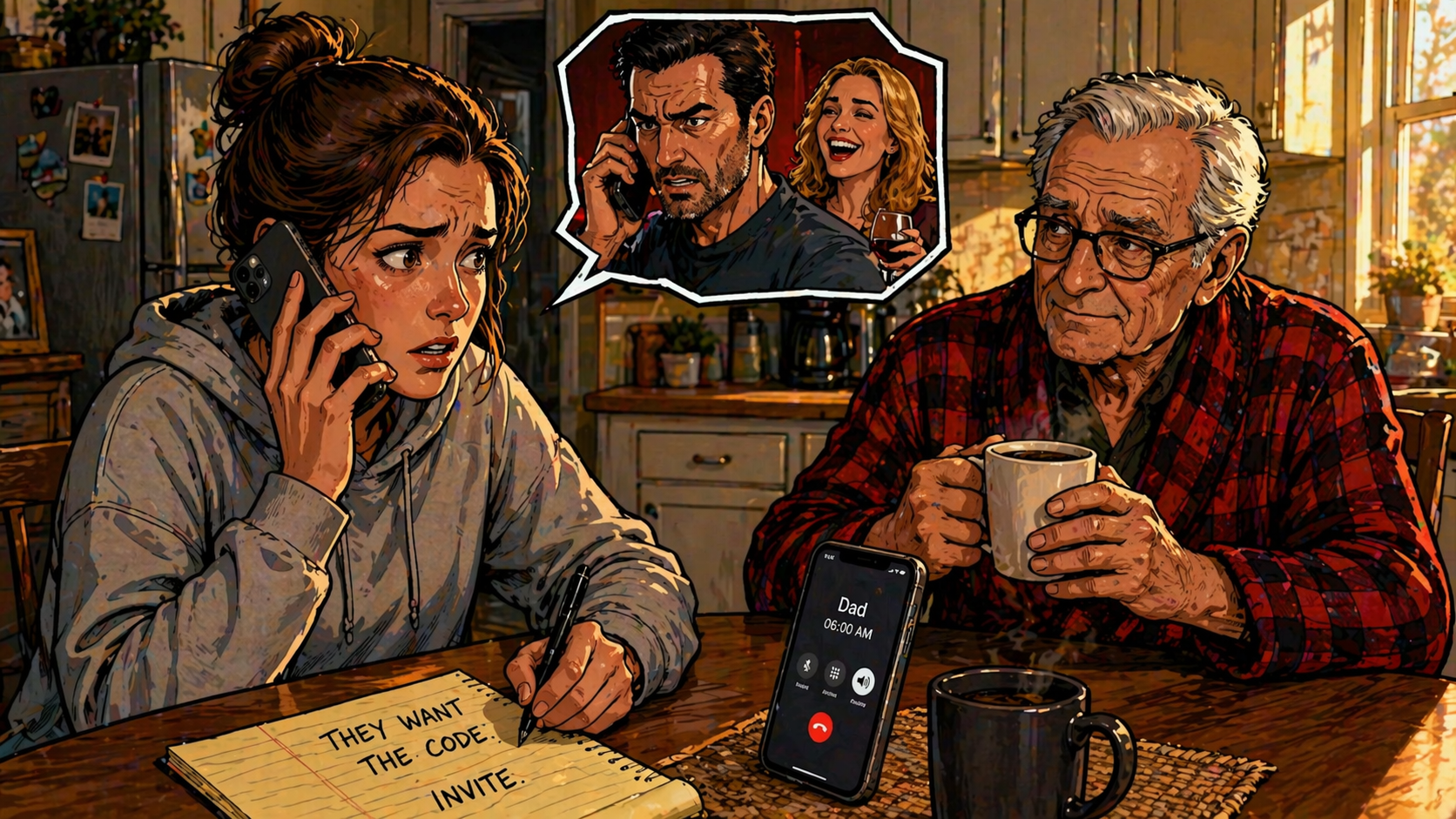
“Grandpa died last night,” my father said, in the same voice he used to ask for extra ranch at a drive-thru. “We need the safe combination before the bank freezes everything.”
Then, somewhere behind him, my mother laughed.
Not a sad laugh. Not a nervous one. It was light and mean, like she’d just heard a joke at somebody else’s expense.
“Finally,” she said. “Call the broker. We sell by noon.”
I didn’t scream. I didn’t drop the phone. I didn’t even breathe for about two full seconds.
I just hit mute and looked across my kitchen table.
Grandpa was sitting right there, alive, wrapped in his red-and-black flannel robe, one bony ankle crossed over the other, a white ceramic mug warming both hands. The steam from his coffee blurred his face for a second, and when it cleared, his expression was the worst part of all. He didn’t look shocked. He looked tired. Like a man watching a bridge collapse that he’d been warning people about for years.
The refrigerator hummed. My cheap wall clock clicked. Outside, a delivery truck groaned down my street and then moved on. Inside my kitchen, the whole world had narrowed to the soundless shape of my father’s mouth still moving on the screen.
Grandpa set his mug down with a soft porcelain tap.
I grabbed a legal pad from the junk drawer so fast I tore off three pages by accident. My fingers were clumsy, thick with adrenaline. I wrote: They want the code.
He adjusted his reading glasses, took the marker from me, and wrote one word underneath mine.
Invite.
I stared at it.
He tapped the page once with his forefinger. Invite them in.
He wanted witnesses. No—more than witnesses. He wanted them to commit.
I swallowed so hard it hurt and unmuted the phone.
“Dad?” I let my voice shake. That part came easy. I’d spent most of my life sounding scared around him.
“Where have you been?” Marcus snapped. I could hear movement on his end—cabinet doors, footsteps, my mother’s cup clinking against a counter. “We don’t have time for one of your episodes.”
“I—I don’t know the code,” I said. “I’m trying to think.”
“Think faster.”
“I found something, though.”
Silence. Not the peaceful kind. The hungry kind.
“What?” he asked.
I rustled some papers near the microphone. “When Grandpa came by last week, he left his old coat here. There was a folded note in the pocket. It looks… official. I don’t know. It might be a will.”
My mother was suddenly very close to the phone. “Read it.”
I looked at Grandpa. He gave one small nod.
“It says…” I made my breathing sound ragged. “It says he knows he’s been hard on you, Dad. It says he wants to make things right. It leaves the house, the accounts, and all personal property to Marcus Carter as sole beneficiary.”
I heard my father inhale sharply.
“Read the date,” my mother said, sharp as a blade.
“Last month.”
Another beat of silence, but this time I could almost hear the greed recalculating.
“Listen to me carefully,” Dad said. His voice had changed. The irritation was gone. Now he sounded alert. Alive. “Don’t call a lawyer. Don’t call the bank. Don’t call anyone. Put that paper somewhere safe.”
“I don’t want to get in trouble,” I whispered. “If it’s not filed right, if somebody says I hid it—”
“We’re coming over,” he said immediately. “Twenty minutes. Keep your mouth shut until we get there.”
The line went dead.
I set the phone down and looked at Grandpa.
“They’re coming,” I said.
“Good,” he said, and pushed his chair back.
Even at seventy-eight, he moved with an old military crispness, like his joints had gotten rusty but his instincts hadn’t. He walked to the sink, rinsed his cup, and dried it with a dish towel like this was any other morning. The smell of black coffee and lemon cleaner hung in the air. Dawn light came in flat and gray through my kitchen window, catching the little scratches in the granite countertop and the dust on the fruit bowl I kept meaning to wipe down.
“You know what they’ll do,” he said, still facing the sink.
“Bully me?”
He looked over his shoulder. “First that. Then whatever comes after when bullying doesn’t work.”
That landed in my stomach like a cold stone, because he wasn’t wrong. Marcus wasn’t the kind of man who escalated slowly. He was the kind who treated every inconvenience like a personal attack and every person near him like furniture he could kick.
“You should leave,” I said. “If he sees you alive, this could get ugly fast.”
He nodded once. “Detective Miller’s expecting me.”
That surprised me enough to blink. “You already called the police?”
His mouth twitched. “Three weeks ago.”
I stared at him.
He reached into his robe pocket and pulled out a folded sheet of paper. Bank statements. Transfer logs. Handwritten notes in the margins. Numbers circled in blue ink. “I didn’t know how far Marcus had gone,” he said. “I wanted to.”
A chill ran through me. This morning wasn’t the beginning. It was just the first time I was seeing the whole board.
We moved fast after that. I grabbed the black document box I used for high-value shipping logs at work and propped my tablet inside it, camera facing up through a crack in the lid. I laid out chain-of-custody forms, affidavit templates, signature lines. At my logistics job, paperwork was religion. If it wasn’t documented, it didn’t exist. If it was documented badly, it could bury you. For the first time in my life, all the boring, obsessive habits people mocked me for felt like weapons.
Grandpa stood at the back door while I tested the video feed. Detective Miller’s face flickered on the screen for half a second—square jaw, tired eyes, neutral expression—then disappeared as the camera switched to record.
“Are you ready?” Grandpa asked.
I thought about the birthdays Marcus missed unless he needed money. The emergency dental bill I covered for my mother while she posted beach photos from Biloxi. The years I lived on ramen because I believed I owed them for a childhood surgery Dad said had ruined him financially. I thought about the way my mother had laughed at his fake death.
“I’m ready,” I said.
He touched my shoulder once, quick and warm, then slipped out the back.
The minute the door shut, the apartment felt bigger and emptier at the same time. I wiped down the counter. I dumped the coffee grounds. I messed up my hair, rubbed my eyes red, and sat on the stool nearest the island like a girl waiting to be told what she’d done wrong.
At 6:38, I heard tires on gravel.
At 6:39, somebody tried the old key in my lock.
At 6:40, the knob rattled hard enough to shake the frame.
“Open the damn door, Erica,” my father shouted.
I stood up, fixed my face into frightened obedience, and reached for the deadbolt.
Then I heard my mother say, low and excited, “Get the paper first. Then the code. Don’t let her stall us.”
And just like that, with my hand on the lock and my heart pounding against my ribs, I understood they hadn’t come as family. They’d come like looters to a fire—and I was the only thing standing between them and the ashes.
Part 2
When I opened the door, Marcus didn’t wait for space. He shoved past me so hard my shoulder clipped the wall.
Cold morning air rushed in behind him, bringing the smell of wet leaves, stale cigarettes, and the sharp synthetic bite of his aftershave. He wore the same tan jacket he’d had since I was in middle school, the collar darkened with neck grime. His hair was uncombed. His eyes looked too bright.
He didn’t ask where Grandpa’s body was.
He didn’t say I’m sorry.
He scanned the apartment like a man who had misplaced a winning lottery ticket.
“Where is it?” he demanded.
My mother came in slower, one hand around a paper coffee cup, oversized sunglasses still on even though the sky outside was the color of dirty dishwater. Deborah always moved like she was making an entrance, even into a one-bedroom apartment with a crooked coat rack and a stack of Costco paper towels by the pantry.
She looked around once and wrinkled her nose. “God, Erica. It smells like bleach.”
“I was cleaning,” I murmured.
“No kidding.”
Marcus slammed the door shut behind him. “The paper.”
I pressed the manila folder to my chest. “Dad, I’m scared. If I hand you something before probate, and it’s wrong, could I get arrested?”
His face changed so fast it was almost interesting. The greed didn’t leave, but it got covered by something hotter.
“You selfish little brat,” he hissed, stepping close enough that I could see burst capillaries on his nose. “After everything I’ve done for you, you’re worried about yourself?”
There it was. The old song.
“I sold fifty thousand dollars in stock when you were ten,” he snapped. “Do you remember that? To pay for your surgery? My retirement, Erica. Gone. Because of you.”
I looked down like I always did. The tile floor had a hairline crack near the dishwasher. I’d been meaning to seal it. Funny what your brain notices when it wants to leave your body.
“I know,” I said softly. “I’m sorry.”
Then Deborah laughed.
Not the phone laugh from before. A real one. Full-bodied. Mean.
“Oh, stop,” she said, leaning against the breakfast bar. “She still believes that?”
Marcus shot her a look.
She ignored it.
“Honey,” she said to me, lifting her sunglasses onto her head, “your father sold those stocks three months before you got sick. Lost every cent in Vegas. Horses, mostly. Maybe blackjack. The point is, none of that had anything to do with you.”
The room went very still.
Marcus rubbed a hand over his face. “It doesn’t matter now.”
It mattered to me.
For nineteen years, that lie had lived in my chest like a stone. I had paid bills I couldn’t afford because I thought I owed them. I had apologized for existing. I had skipped field trips, cheaped out on food, worked overtime, sent money, answered midnight calls, tolerated insults, all because some part of me believed I was the reason our family was broken.
Turns out I’d just been useful.
The grief I had always carried for the parents I wished I had didn’t crack. It evaporated. Fast and clean, like rain on hot asphalt.
“Give me the folder,” Marcus said.
I lowered it onto the counter carefully. “I need signatures first.”
He stared at me. “What?”
“For chain of custody,” I said. “If this gets questioned later, I need proof I transferred it correctly. My job does this with all high-liability shipments.”
Deborah rolled her eyes. “It’s a piece of paper, not plutonium.”
“I know. I’m just trying to protect everyone.”
That was a phrase Marcus loved when it was used to control other people. He visibly swallowed his impatience and held out a hand. “Fine. Where do I sign?”
I laid out the forms one by one, making a little show of straightening the edges. The pendant lamp over the island threw a warm yellow pool across the granite, enough light to catch the sweat beading at Marcus’s hairline. From inside the black document box, the hidden tablet camera had a perfect angle.
“This first one,” I said, tapping the line, “just states that you’re taking possession of estate-related documents.”
He signed without reading.
“This one acknowledges you’re assuming any tax liability tied to immediate liquidation.”
He grunted and signed again.
“Final page,” I said, and slid over the affidavit. “This is the main one.”
He barely looked at the header.
I watched his eyes do exactly what I hoped they’d do: skip all the text, jump straight to the clipped-on fake handwritten will, then drop to the signature line.
His phone buzzed on the counter. He glanced at it, and all the color drained out of his face.
“What?” Deborah asked.
“Nothing.”
“Marcus.”
He turned the phone face down. “Where do I sign?”
“Right there,” I said. “It certifies time of death and beneficiary claim, so you can present yourself as sole heir if anyone asks questions before formal probate.”
He uncapped the pen with his teeth. “Jesus Christ, Erica. You turn everything into a hostage situation.”
“Read the bold print,” I said, making my voice small. “Please. I don’t want you mad at me later.”
He didn’t read it. He signed.
Hard. Angry. Fast. The pen dug so deep it embossed the page underneath.
I slid the next line toward Deborah. “Witness signature.”
“Seriously?” she said.
“It’s cleaner if there are two.”
She sighed like I was asking her to move a couch and signed with a dramatic swirl.
That was the moment. Ink drying. Camera recording. Two grown adults certifying under penalty of perjury that a living man was dead in order to seize his assets.
Evidence had a smell to it, I realized. Warm toner paper. Cheap ballpoint ink. My mother’s hazelnut coffee. My father’s sweat.
Marcus tossed the pen down. “Done. Give me the code.”
I pointed at the black fireproof box.
“The safe contents are in there,” I said. “Cash keys, bond slips, the number sheet.”
He smiled then. A nasty, private smile. He actually reached over and tapped my cheek three times with two fingers.
“See?” he said. “That wasn’t so hard. You were always good for cleanup.”
Deborah smirked into her coffee lid.
Marcus flipped the latch.
The lid sprang open.
Inside was no cash. No bonds. No slips.
Only the tablet.
On the screen, in a fluorescent-lit interview room with cinder block walls, sat my grandfather in his reading glasses, holding that morning’s newspaper.
Alive.
Very much alive.
Marcus made a sound I had never heard from a grown man before. It was not a word. More like the air getting punched out of him from the inside.
“Hello, Marcus,” Grandpa said from the screen, calm as winter. “Interesting paperwork.”
Deborah leaned forward so fast she sloshed coffee onto my counter. “That’s fake.”
Grandpa lifted the newspaper closer to the camera. Date visible. Tuesday. Today.
“It’s not fake, Deborah,” he said. “Though the death certificate you were hoping to create certainly is.”
Marcus stumbled back a step. “Dad, listen—”
“No,” Grandpa said. “You listen.”
Detective Miller moved into frame beside him and held up his badge. “Portland Police Bureau. Financial Crimes. This conversation is being recorded.”
Marcus looked at me then, really looked at me, and something in his face changed. The contempt was still there, but now it had company. Panic. Real panic.
“You set me up,” he said.
I picked up the affidavit from the counter, careful not to smudge the signatures. “No. I gave you forms. You chose to lie on them.”
“You tricked me.”
“You called me at 6:15 and announced a living man dead so you could loot his accounts before the bank locked them.” My voice came out steady. Almost bored. “That sounds more like your hobby than mine.”
Deborah set down her cup. “Marcus, do something.”
He lunged for the paper.
“Don’t move,” Detective Miller barked through the tablet speakers.
Marcus froze.
The detective’s voice went flat. “Units are already in motion. Search warrant is en route to your residence. We’ve preserved the bank notifications, the broker messages, and the attempted estate transfer activity.”
My father’s mouth opened and closed. For once in his life, words were failing him.
“Why?” he whispered to Grandpa. “I needed the money.”
“Then you should have asked,” Grandpa said. “Instead you buried me while I was drinking my coffee.”
That landed harder than yelling would have.
Deborah grabbed Marcus’s sleeve. “We need to go.”
He shook her off, eyes still locked on me. “Erica. Please. Just give me that paper. I’ll leave. You’ll never hear from me again.”
And for one weird second, I saw the outline of the child I used to be—the one who would have done anything to make the room stop feeling dangerous.
Then my father looked at me like I was a filing cabinet.
Not a daughter. Not a person. Storage.
The old reflex died right there.
“No,” I said.
I lifted the form slightly. “Chain of custody is complete.”
Grandpa leaned closer to the screen. “It’s too late, son.”
Marcus swore, grabbed Deborah by the elbow, and bolted for the door. She was crying now, mascara beginning to smear under her eyes, but she still managed to hiss at me, “You think this makes you smart?”
The door slammed so hard one of my framed grocery-list magnets dropped off the fridge.
Then there was silence.
On the tablet screen, Detective Miller looked down at something off-camera, then back up at me. “Erica,” he said, “don’t touch anything else. An officer will collect the documents in fifteen minutes.”
I nodded.
Grandpa was watching me with a face I couldn’t read.
“Kid,” he said softly, “this part’s over.”
But Detective Miller shook his head before I could answer.
“No,” he said. “Not even close. Your father didn’t risk a felony breakfast for one house and a bank account.”
He paused.
“We think he was trying to get ahead of a transfer worth just over four point six million dollars—and we think he’s not the only one involved.”
My fingers tightened around the affidavit.
Because suddenly the forged death, the broker, the rush, the signatures—none of it looked like a desperate son making a sloppy cash grab.
It looked like a plan.
And somehow, I had just stepped into the middle of it.
Part 3
By 8:10 that morning, I was sitting in Interview Room 3 at downtown precinct headquarters with a foam cup of vending-machine coffee that tasted like burnt pennies.
The room smelled like old paper, floor polish, and the faint sourness of too many nervous people breathing recycled air. There was a metal table bolted to the floor, three plastic chairs, and a clock mounted high on the wall that ticked louder than any clock had a right to. I kept looking at the second hand sweep around and thinking, Somewhere out there, my parents are still moving.
Detective Miller sat across from me with a yellow legal pad and a recorder.
Grandpa sat to my right, coat buttoned, chin lifted, looking less like a victim than a retired general forced to explain why his own troops had mutinied.
Miller clicked on the recorder. “State your name for the record.”
“Erica Carter.”
“Tell me when your father first contacted you this morning.”
I did. The call. The lie. The way my mother laughed. The fake will. The signatures. The box.
As I talked, the whole morning started to feel less real, not more. My own voice sounded detached, almost crisp. That was something I’d learned at work too—when a shipment went wrong, feelings were a luxury item. You noted what happened. Times. Objects. Who touched what. Later, if there was room, you fell apart.
Miller asked precise questions, the kind that didn’t let you hide in generalities.
“Did Marcus mention the bank by name?”
“Yes. Columbia Crest Private.”
“Did he say why noon mattered?”
“No. Just that they had to sell by noon.”
“Did he ask for cash specifically?”
“He asked for the safe combination first. Then the will. Then the code.”
Miller wrote something down.
Across the table, Grandpa rubbed the bridge of his nose. The skin there looked thin and papery. I had never noticed before how old his hands were. Not weak. Just used. The knuckles broad. Veins raised blue under the skin. Hands that had built shelves, fixed carburetors, stitched up split fingers with fishing line in a pinch.
“Archibald,” Miller said, switching his attention, “tell her what we found.”
Grandpa exhaled. “Three weeks ago, my banker called to verify a request.”
“What request?” I asked.
He looked at me, and I saw the shame there before the words came. “A transfer. Seven hundred and fifty thousand dollars from one of my trust accounts to an LLC I’d never heard of. Carter Property Solutions.”
I barked out a laugh before I could stop myself. “He named the fake company after himself?”
Grandpa’s mouth twitched once. “Marcus has never respected subtlety.”
He explained the rest in pieces. Small irregularities at first. A request for duplicate account credentials. Questions from a title company about the family house outside Astoria. A funeral home calling to “confirm next-of-kin preferences” when nobody in the family had died. Then a real estate broker leaving him a voicemail about listing property “once the estate event is finalized.”
He had forwarded everything to Miller.
“We didn’t move too soon,” Miller said, reading my expression. “We needed intent. Opportunity. A clean act on record. This morning gave us that.”
I nodded, but something inside me still itched.
“If you already knew he was trying something,” I said to Grandpa, “why come to my place last week? Why not just change everything and disappear?”
His eyes dropped to the table.
Because of course there was a reason. There was always a reason old people held onto dangerous hope longer than they should. They called it family. Sometimes it was just inertia dressed up nice.
“I thought,” he said carefully, “if Marcus believed I suspected him, he’d get desperate. And desperate men break patterns.”
Miller reached into a manila file and slid over a printout.
A screenshot of an email thread. My father’s name at the top. A broker I didn’t know replying beneath.
SUBJECT: Estate Sale Window / Noon Deadline
The message beneath made my stomach turn.
Buyer requires same-day confirmation of death filing, successor authority, and original deed packet. Wire release available upon verification. Estimated close: $4.6M.
Original deed packet.
I looked up. “What deed packet?”
Grandpa’s face changed.
It wasn’t dramatic. Just a tiny tightening around the mouth, a faint drop in his shoulders. But I saw it.
Miller saw it too. “Archibald?”
“There’s a second safe,” Grandpa said quietly.
The clock ticked once. Twice.
“Where?” Miller asked.
“In the house on Cedar Hill. Old family property.”
“Contents?”
He hesitated too long.
My pulse started to pound.
“Grandpa.”
He looked at me, then away. “The original deed. Trust amendments. Mineral lease agreements on the back acreage.” His voice got flatter with each item, like saying them quickly might make them smaller. “And a ledger.”
“What kind of ledger?” Miller asked.
“The kind that explains why Marcus thinks rushing a sale is worth prison.”