Another pause.
“That’s not what you told me.”
He turned away from us, lowering his voice.
I couldn’t hear Kip’s response, but I could see its effect.
Grant’s free hand moved to the back of his neck.
Then he said something that made me stop breathing for a moment.
“What do you mean, the restriction follows the property?”
He listened again.
“Even if she sells it?”
Another pause.
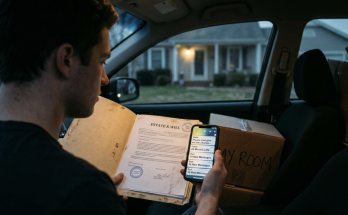
“Then what the hell was the point of the appraisal?”
He ended the call abruptly.
When he turned back, he looked less like a man who had been inconvenienced and more like someone who had discovered that the ground beneath him was not as solid as he had believed.
Karen noticed it too.
“What did Kip say?”
Grant slipped his phone into his pocket.
“Nothing useful.”
“Grant.”
“He says the restriction is enforceable.”
I waited.
He looked at me.
“And he says we can’t just remove it because the property has increased in value.”
The wind rustled the papers on my table.
I thought of the yellow note beneath the citronella bucket.
The appraisal.
The question about whether the restriction expired.
The house had become more valuable, and Grant had started looking at it as though its value somehow made it available to him.
But there was something else he had said.
What was the point of the appraisal?
I felt a cold certainty settle over me.
“Grant,” I asked, “why were you getting an appraisal of my house?”
He stared at me.
For a few seconds, I thought he might answer.
Instead, he turned to Karen.
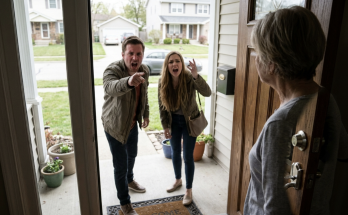
“Get in the truck. We’re leaving.”
Karen didn’t move.
“Why were you getting an appraisal of Mom’s house?”
“Because I wanted to know what it was worth.”
“Why?”
“Because I did!”
His voice cracked across the driveway.
Dale slowly lowered himself onto the edge of the recliner. Bernice put the serving spoon on the kitchen counter and stepped outside.
The movers stood near the truck, pretending not to listen.
Karen looked at her husband.
“Were you planning to sell it?”
Grant’s silence was answer enough.
My daughter took a step backward.
“Grant, tell me you weren’t planning to sell my mother’s house.”
He rubbed both hands over his face.
“I wasn’t going to sell it tomorrow.”
That was not a denial.
It was an admission with better manners.
I felt the hurt, but beneath it was something clearer.
I had spent years worrying that Grant would someday try to take control of my home. I had imagined arguments, pressure, perhaps even a legal dispute.
I had never expected him to begin planning the future of my property while I was still living in it.
“Who did you speak to?” I asked.
“No one who matters.”
“Did you contact a real estate agent?”
He looked at the ground.
Karen whispered, “Grant?”
He finally answered.
“I asked someone what the property could be worth if the restrictions were lifted.”
“And who was that?”
“Kip introduced me to a developer. That’s all.”
A developer.
The word seemed to hang in the cold mountain air.
I looked toward the house, at the metal roof, the oatmeal-colored siding, the woodshed I had built in 2009, and the windows through which I had watched nineteen winters pass.
To Grant, it had become a number on a page.
To me, it was the place where I had learned to live alone after my husband died. The place where I had paid every bill, repaired every broken hinge, and planted the aspens that now shaded the driveway.
It was the place where I had finally found peace.
I wasn’t going to let anyone turn that peace into a financial opportunity.
“Then this conversation is over,” I said.
Grant stared at me.
“What?”
“You need to arrange somewhere else for your parents to stay. The movers need to take their belongings off my property. I will cooperate with the county inspector, and I will follow every condition attached to this house.”
“You can’t just end the conversation!”
“I can end a conversation in my own driveway.”
His face reddened again.
“You’re making a terrible mistake.”
“No, Grant. I’m correcting one.”
I turned toward the front door.
Before I stepped inside, I looked back at Dale and Bernice.
“The casserole is in the refrigerator. The bedroom is ready if the county confirms that a short visit is permitted. I won’t make promises before I know the rules, but I will help you find a place if you need one.”
Bernice nodded through her tears.
Dale said nothing.
Grant remained in the driveway, surrounded by the consequences of a decision he had made without asking anyone’s permission.
For the first time in nineteen years, I didn’t feel responsible for making him comfortable.
I felt responsible for protecting my home.
And that was enough.
But the moving truck had not yet left the mountain.
At 11:47 that morning, while the movers were putting Dale’s recliner back onto the truck, my phone rang.
The caller was a woman from the county housing office.
She introduced herself as Ms. Ellison, the compliance officer assigned to my property.
“Mrs. Thatcher,” she said, “I need to confirm something before we arrive for your scheduled inspection.”
“Of course.”
“Has anyone attempted to establish permanent occupancy at your address?”
I looked through the window.
Grant was standing beside his pickup, speaking furiously into his phone. Karen sat on the front step with her face buried in her hands. Dale and Bernice were quietly gathering their belongings.
“Yes,” I answered. “My son-in-law arranged for his parents to move in without my consent. I submitted the required request, and it was denied. I have not authorized them to establish permanent residence here.”
There was a pause.
Then Ms. Ellison said, “Thank you for clarifying that. Please preserve all correspondence and documents relating to the proposed move. The inspection may require us to review more than the current household composition.”
I straightened.
“What else would you need to review?”
“I can’t make that determination over the telephone. But there is something in the property’s original file that I would like to discuss with you in person.”
I glanced at the certified restriction on the table.
“What is it?”
Another pause.
“Mrs. Thatcher, your property was flagged for a routine program review last month. The review was initiated before your household-composition request was submitted.”
My fingers tightened around the phone.
“Why?”
“I would rather explain when I see you. Please make sure you have your original purchase agreement and all subsequent notices available.”
She gave me the inspection time, confirmed the address, and ended the call.
I remained by the window for several seconds.
The county had already been reviewing my property before Grant tried to move his parents in.
That meant the timing was a coincidence—or something much more troubling.
I went back to the filing cabinet and opened the folder from 2007.
The fourteen pages were still there.
I checked the purchase agreement, the annual certifications, and the notices I had received over the years. Everything appeared to be in order.
Then I noticed something I had overlooked when I reviewed the folder the previous night.
Behind the final page was a thin sheet of paper I didn’t recognize.
It bore the county seal and a date from six weeks earlier.
I unfolded it.
The first paragraph was ordinary administrative language. The second referred to a review of the property’s eligibility status.
But the final paragraph contained a name.
Grant Thatcher.
I read it once.
Then again.
My son-in-law had never owned this house. He had never made a mortgage payment on it. He had never paid for the roof, the heating system, or the gravel that kept the driveway passable in winter.
So why was his name in the county’s file?
I turned the page over, hoping there would be an explanation on the back.
There was only one handwritten note.
Please verify the submitted household-interest declaration before the scheduled compliance inspection.
I looked through the window again.
Grant was no longer talking on his phone.
He was watching my house.
And for the first time that morning, I wondered whether the moving truck had ever been the real reason he came up the mountain.
Because whatever Grant had told the county, he had done it before I ever knew there was a problem.
PART 4
When the county inspector arrived that afternoon, Grant was still standing in my driveway.
Ms. Ellison examined the documents, checked the house, and finally asked Grant why he had submitted a declaration claiming an interest in my property.
Grant’s face went pale.
He had apparently told someone that he was authorized to help manage the house and had a future financial interest in it. But I had never granted him ownership, management authority, or permission to represent me.
The inspector made copies of the documents and explained that the county would investigate the declaration separately. She also confirmed that Dale and Bernice could not establish permanent residence under the existing approval.
Grant tried to argue, but the paperwork spoke more clearly than he could.
By late afternoon, the moving truck was heading back down the mountain. Dale and Bernice had arranged a short-term rental in town, and I gave them the names of two local agencies that helped older residents find affordable housing.
Before leaving, Bernice hugged me.
“I am sorry we believed everything without asking you,” she whispered.
“I hope you understand why I had to say no.”
She nodded, tears in her eyes.
“I do now.”
Karen stayed behind after Grant drove away. We sat together at the kitchen table, beside the casserole neither of us had eaten.
“Mom, I should have defended you,” she said. “I was so afraid of upsetting him that I let him make decisions for everyone.”
I reached across the table and took her hand.
“You can love someone without giving them permission to control every part of your life.”
She cried then—not loudly, but with the exhausted sadness of someone who had been holding too much inside for too long.
I didn’t tell her to leave Grant. That decision belonged to her, just as the decision about my house belonged to me.
Over the following weeks, the county investigated the declaration. Grant eventually admitted that he had approached a developer about the property’s potential value and had exaggerated his authority. He was required to correct the record, and the county warned him against making further representations on my behalf.
The restriction remained in place.
My house remained mine.
And the developer never came back.
Months later, Karen began seeking counseling and making decisions about her future without asking Grant for permission first. Our relationship didn’t heal overnight, but she started visiting me alone, sometimes bringing coffee and sometimes simply sitting quietly beside the kitchen window.
One autumn morning, she looked toward the blue bedroom.
“Do you ever regret not letting them stay?”
I watched the golden aspens sway beyond the glass.
“No,” I said. “I regret that they were put in that position. I regret that you felt unable to speak honestly. But I don’t regret protecting the home I worked nineteen years to earn.”
That evening, I folded my father’s old ruler and returned it to the drawer.
I had kept it because he taught me that a good foundation mattered more than an impressive appearance.
He had been right.
A house could have beautiful rooms, expensive furniture, and a million-dollar appraisal. But without honesty and respect, none of those things made it a home.
At sixty-nine, I had finally learned that saying no didn’t make me cruel. It meant I understood the value of what I had built.
I still live fourteen miles above Anel Pass. I still drink coffee by the kitchen window, listen to hail sing against the metal roof, and enjoy afternoons when nobody crosses my cattle guard.
And whenever someone asks whether I ever felt guilty for refusing to surrender my home to family, I give the same answer.
“I didn’t take a home away from anyone. I simply refused to let someone take mine.”
The house is still standing. The aspens still turn gold every fall.
And for the first time in years, the peace inside my home belongs entirely to me.