Yet somehow, I still found myself standing in my hallway, asking a thirty-year-old man whether he had checked the box where he kept them.
“Yes, Grandma.”
“The blue box?”
“Yes.”
“The small blue box inside the larger one?”
There was a pause.
Then a drawer opened at the other end of the line.
“Oh.”
I smiled.
“Found them?”
“Yes.”
“You’re welcome.”
He laughed.
For a moment, he was ten again.
Calling from his bedroom because the thing he needed had disappeared into the terrible wilderness beneath his bed.
Then he said, “Are you okay?”
I looked toward Lena’s photograph.
She was eighteen forever.
Barely older than a girl.
Her son was getting married.
“Yes,” I told him. “I’m okay.”
“Are you crying?”
“A little.”
“Happy?”
“Mostly.”
He understood the answer.
By then, he had lived long enough to know that happiness did not always arrive alone.
At the wedding, there was a small photograph of Lena near the flowers.
Nothing dramatic.
Nothing that turned the ceremony into a memorial.
Just a place for someone who belonged there.
Nora had suggested it.
When I thanked her, she squeezed my hand.
“She’s part of why he is who he is.”
“So are you now,” I said.
She smiled, then looked toward the room where Miles was waiting.
“I hope so.”
Adrian stood near the front, adjusting his cuffs.
He looked older.
There were fine lines beside his eyes and a little gray at his temples.
I could still remember the frightened young man in Dr. Adler’s office.
Now he was greeting guests and checking whether the chair beside mine had enough space for my walking stick.
Time had changed him.
So had practice.
So had choosing, over and over, to remain.
Before the ceremony, Miles came to find us.
He looked at Adrian.
Then at me.
For a moment, none of us said anything.
Finally, Miles asked, “Do I look all right?”
I brushed an invisible thread from his shoulder.
“You look like someone who found his cuff links.”
Adrian laughed.
Miles closed his eyes.
“You told him?”
“I’ve known him for twenty years. I’m allowed a little conversation.”
He hugged me carefully.
Then he hugged his father.
I saw Adrian close his eyes.
I saw the effort it took him not to hold on too long.
At the reception, Miles thanked the people who had helped raise him.
He did not give a speech about forgiveness.
He did not turn our history into something simple enough for applause.
He said I had taught him how to make a home.
He said Adrian had taught him that keeping a promise was work you did more than once.
Then he looked toward Nora.
“And she’s teaching me that a home can keep getting bigger.”
I cried.
Of course I cried.
But this time, when I looked around, I did not see only the person who was missing.
I saw everyone who had stayed long enough to belong.
Three years later, Miles called before dawn.
I woke to the sound of my phone vibrating against the bedside table.
For one dreadful second, I was back in that hospital corridor.
A ringing phone.
The dark outside.
News that could divide a life into before and after.
Then I heard his voice.
“Grandma?”
I sat up.
“What’s happened?”
“She’s here.”
I put my hand over my heart.
“The baby?”
He laughed softly.
“Yes. Nora’s okay. The baby’s okay.”
I closed my eyes.
For a few seconds, I could not speak.
He waited.
He had learned that from me.
At the hospital, Adrian was already in the waiting area.
He stood when he saw me.
We looked at each other.
I knew what he was remembering.
So did he.
Not because he had been in that corridor with me ten years after Lena’s death.
Because absence had a shape too.
Because there had been another birth.
Another child.
Another morning he had not been allowed to understand correctly.
“How is she?” I asked.
“Nora’s resting.”
“And Miles?”
Adrian smiled.
“He’s asked the nurse three times whether the baby’s breathing sounds normal.”
“That sounds like him.”
We walked down the corridor together.
I held my bag too tightly.
Adrian noticed, but he did not tell me to relax.
When we entered, Nora was propped against the pillows.
She looked exhausted and radiant and entirely unimpressed by the idea that anyone expected her to entertain visitors.
“Come meet her,” she said.
Miles stood beside the bed.
In his arms was a bundle so small that I forgot every sensible thing I had intended to say.
He turned toward me.
“Grandma.”
I moved closer.
The baby’s face was pink and creased.
One hand had escaped the blanket.
Her fingers opened, then closed around nothing.
“What’s her name?” I whispered.
Miles looked at Nora.
She nodded.
“Elise Lena Mercer-Vale.”
I sat down before my knees could fail me.
Miles placed his daughter in my arms.
There are moments too full for immediate understanding.
You live through them first.
The meaning comes later.
I looked at that tiny face and remembered another baby.
Another blanket.
A nurse asking whether I was ready to take him home.
I had not been ready.
I had taken him anyway.
Now he was standing beside me, watching me hold his child.
“She’s beautiful,” I said.
My voice broke on the last word.
Nora reached for a tissue.
Miles laughed quietly.
“We bought extra.”
I kissed Elise’s forehead.
“Hello, little girl.”
Adrian stood a short distance away.
His hands were clasped.
His expression was difficult to read.
Not because he felt nothing.
Because he was trying to make room for everything without asking anyone else to carry it.
After a while, Miles lifted Elise from my arms.
Then he turned.
“Your turn, Grandpa.”
Adrian stared at him.
Miles smiled.
“Dad.”
Adrian stepped forward.
He sat where I had been sitting, and Miles placed the baby carefully in his arms.
Adrian looked down.
For a moment, his face held no expression at all.
Then he began to cry.
Quietly.
Without looking up to see who noticed.
He touched one finger to Elise’s tiny hand.
She gripped it.
I watched his shoulders shake.
This time, no one had lied.
No one had kept him outside the story.
But he was not holding his granddaughter because blood had automatically opened a door.
He was there because, years earlier, a little boy had written a letter.
Because that boy had been allowed to remain angry.
Because Adrian had returned after difficult visits.
Because he had learned how to tell the truth before fear could turn it into another absence.
Miles stood beside him.
One hand rested on his shoulder.
I looked at them and thought of Lena.
Not only of her death.
Of her laugh.
Her stubbornness.
The way she had insisted a future with a baby could still be a future.
She had not lived to see this one.
I would always grieve that.
But her absence did not make the love in the room less real.
Two years later, we returned to the cemetery.
It was the thirty-fifth anniversary of Lena’s death.
Miles was thirty-five.
Elise was two.
I walked slowly by then.
The hill had become steeper, though everyone insisted it was the same hill.
Adrian offered his arm.
I took it.
Ahead of us, Elise carried a small bunch of yellow wildflowers.
Nora had tied them loosely so they would fit inside her hand.
She stopped every few steps to examine something.
A leaf.
A stone.
A beetle she believed needed to be introduced to everyone.
Miles waited patiently.
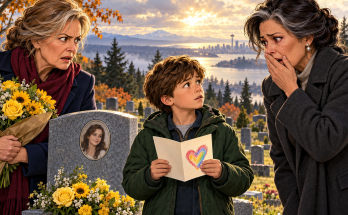
I wondered whether he remembered running back to the car for his handmade card.
Later, he told me he did.
He remembered the gray sky.
The muddy grass.
The strange woman who cried when she saw him.
He remembered knowing something had changed before anyone told him what it was.
When we reached Lena’s grave, he crouched beside Elise.
“That’s your Grandma Lena,” he said, pointing to the photograph.
Elise studied it.
Then she looked up at her father.
“She looks like Daddy.”
I smiled.
“She does.”
Miles placed the flowers beside the headstone.
For a while, we stood together.
There were no secrets to reveal.
No envelope waiting in someone’s handbag.
No question that would break the afternoon open.
Just a family visiting someone they loved.
Nora helped Elise straighten the ribbon.
Miles brushed a few fallen leaves from the base of the stone.
Adrian stood beside me.
On his wrist, beneath the edge of his coat, I could still see the faded bracelet.
Eventually, Elise announced that she was hungry.
Nora laughed.
Miles picked her up.
They began walking toward the cars.
Adrian and I remained behind.
He looked at Lena’s name.
Then at me.
“Judith?”
“Yes?”
“Thank you for opening the door.”
I watched Miles shift his daughter higher on his hip.
“I almost didn’t.”
“I know.”
“There were days afterward when I wondered whether I’d made a mistake.”
Adrian nodded.
“I know that too.”
I looked at him.
“Opening it wasn’t enough.”
“No.”
“You had to keep coming back.”
His eyes moved toward Miles.
“Yes.”
We stood quietly.
Then he said, “I still think about what I missed.”
“So do I.”
“I suppose that doesn’t stop.”
“Not completely.”
He breathed out.
For once, neither of us tried to make the truth more comfortable.
There were years we had lost.
Marianne had died knowing that.
Conrad had died without answering to us.
Lena would never become older than the girl in the photograph.
Nothing we built afterward changed those facts.
For a long time, I had imagined a corrected past.
Marianne mailing the letter.
Me driving to Vermont.
Adrian learning the truth before Miles’s first birthday.
Sometimes I followed those imagined years so far that returning to my real life felt like losing something all over again.
Eventually, I learned to stop myself.
Not because the lost years didn’t matter.
Because the people in front of me mattered too.
Miles had needed more than my anger on his behalf.
He had needed room to ask questions whose answers might change what he wanted.
He had needed permission to love me without rejecting his father.
To know Lena without turning her into someone flawless.
To forgive Marianne in his own time.
To remain angry about things even after he had begun to heal.
Most of all, he had needed to know that none of the adults’ choices had ever proved he was unwanted.
He had been wanted.
By Lena, who named him before she saw his face.
By me, even when grief made every morning feel impossible.
By Adrian, whose love had once been too tangled with fear to become action, and who had finally learned that wanting a child in your life meant doing the work of being there.
Knowing all of that did not give Miles a perfect childhood.
It gave him an honest account of the one he had lived.
At the car, Elise reached toward me.
“Great-Grandma, come.”
I smiled.
“I’m coming.”
Miles opened the passenger door.
Then he stopped.
“Grandma?”
“Yes?”
“Do you still have Mom’s letter?”
“Of course.”
“Would you make another copy?”
“For you?”
He glanced at his daughter.
“For her. When she’s old enough.”
I nodded.
“All of it?”
He thought for a moment.
“Yes. All of it.”
That evening, after we returned home, I took the letter from the box where I kept Lena’s things.
The cream-colored envelope was more fragile now.
My name remained clear across the front.
Judith.
I placed the pages beneath the lamp.
I had read them so many times that I knew where every crease crossed a sentence.
For years, the letter had felt like evidence.
Of love.
Of cruelty.
Of cowardice.
Of promises made and broken.
Now, holding it again, I saw something else.
My daughter had written because she believed the truth belonged to us.
Even when it was painful.
Even when it arrived late.
She had not asked me to pretend Adrian had done nothing wrong.
She had asked me to know the whole story before deciding who he was.
I looked toward the living room.
Miles was on the floor helping Elise stack wooden blocks.
Nora sat beside them, laughing as the tower leaned.
Adrian reached to steady it.
Elise pushed his hand away.
“Me do it.”
He withdrew his hand immediately.
“All right.”
The tower fell.
Elise stared.
Then she laughed.
Everyone laughed with her.
I remained at the kitchen table for another moment.
There had been a time when every sound from that room reminded me of the person missing from it.
Now the sounds belonged to the people who were there.
I folded Lena’s letter carefully.
Placed it back inside the envelope.
And went to join them.
For ten years, I had believed the missing piece of our family was the identity of Miles’s father.
It was the truth.
When it finally arrived, it did not bring my daughter home.
It did not return the birthdays.
It did not erase the questions a small boy had asked on the stairs.
But it gave him answers.
It gave him choices.
And it gave the rest of us the responsibility to do something better with the time that remained.
We had lost years.
We had not lost the future.
That became our real inheritance.
Not Conrad’s money.
Not a surname.
Not even the letter itself.
A family in which a child could ask a difficult question and receive an honest answer.
A family in which an apology had to become a change in behavior.
A family that no longer let fear decide who would be left outside the door.
THE END
Story by Dramaverdict