The Day I Chose My Daughter Over My Blood
Part 1
I didn’t know a child’s scream could split a life in half until I heard my daughter’s.
Not the dramatic kind kids use when they’re tired or denied candy. Not the loud fake crying that comes with a scraped elbow and a quick glance to see who’s watching. This was different. It was raw and high and full of actual fear, the kind that reaches your body before your thoughts catch up. By the time I made it to the driveway, my old life was already over. I just didn’t know it yet.
For most of my life, I told myself my father was difficult, not dangerous.
There’s a difference, or at least that’s what I used to believe. Difficult men slam doors, bark over dinner, make the whole house tiptoe around their moods. Dangerous men cross lines. Dangerous men leave bruises people can point to. My father lived in the space right before that, and because he never crossed the final line in a way anyone named out loud, my mother trained us to survive him instead of confronting him.
She had a whole language for it. He’s under stress. You know how your father gets. Don’t provoke him. It’s not worth making a big deal out of it.
That sentence raised me almost as much as she did.
It’s not worth making a big deal out of it.
So I learned to shrink my reactions before anyone asked. I learned to swallow anger, talk softer, move carefully. I learned how to read the weather in a room before I stepped fully into it. If my father’s jaw tightened, I stopped asking questions. If his voice sharpened, I made myself smaller. If he called me too sensitive, I apologized.
Children who grow up like that don’t call it fear. They call it normal.
Then I had Mia.
She changed the meaning of normal so fast it gave me whiplash. From the minute they placed her on my chest, pink and furious and perfect, something in me rewired. The things I had tolerated growing up stopped looking like discipline or family temperament or “just how some people are.” They started looking ugly. Unnecessary. Wrong.
Mia was sunshine in sneakers. Four years old, all questions and crayons and curly brown hair that never stayed in one clip for long. She drew on everything if I wasn’t paying attention—receipts, paper napkins, the backs of mailers, once the side of a cardboard cereal box because, as she explained, “it was empty on purpose.” She believed every bug deserved investigation and every grocery trip required commentary. She trusted the world in that dangerous, beautiful way only little kids do.
After my divorce, that trust mattered even more.
Brandon and I had not been a successful marriage, but we had become decent co-parents. There was a lot we had failed at together, but we never failed at loving Mia. Money was tighter after the split. Time was tighter too. We traded weekends, worked around schedules, bit our tongues over old resentments because Mia came first. Always.
So when my mother called and suggested I bring Mia out for the weekend, I hesitated.
I should have paid attention to that hesitation. It wasn’t subtle. It sat heavy under my ribs the whole time she talked, some animal part of me already shifting away from the idea. But my mother sounded warm, almost eager. She said they missed me. She said the house felt too quiet. Then she added, in the soft careful voice she used when she was trying to slide something past my defenses, “Your father wants to spend time with his granddaughter.”
I actually went silent.
That alone should have warned me.
Dad had never been much for children, not even his own. When I was little, he tolerated us the way some men tolerate weather—something inconvenient that happened around them and sometimes needed controlling. So hearing that he wanted to spend time with Mia should have rung louder in my head than it did.
Maybe she heard my pause, because she rushed to add, “He’s been better lately.”
Better.
That word has done a lot of damage in my life.
I packed Mia’s overnight bag anyway.
The first day at my parents’ house felt too smooth, which in retrospect was its own warning. My mother had cleaned in that aggressive way she always did before guests, so the place smelled like lemon polish and furniture wax. The curtains were open. Light fell across the hardwood in wide yellow strips. My mother had made chicken salad and sweet tea. Even the old clock in the hallway sounded overly polite, ticking away like it had been coached.
Dad was quieter than usual. Not kind. Not warm. Just… contained.
He sat in his chair near the den window and watched Mia more than he spoke to her. That’s what unsettled me. If he had ignored her, I would have recognized the pattern. If he had snapped at her, I would have braced myself properly. Instead he studied her. Like he was trying to figure out what kind of child she was, what worked on her, what didn’t.
Mia, being Mia, kept trying.
She showed him a drawing of a house with purple windows and a sun with eyelashes. “Grandpa, this is our apartment,” she said. “But I made it bigger so the couch could have more room.”
He looked at it for maybe one second. “It’s messy.”
That was all.
Mia nodded like she accepted the review and went to color in the tree darker.
Something pinched in my chest.
My sister Bryn was there too. We’d never been close. She had inherited my father’s talent for contempt and my mother’s talent for pretending it was reason. She wore her hair in a severe twist and somehow made a cardigan look hostile. She barely acknowledged me. She acknowledged Mia even less.
At one point Mia came over with another drawing, this one of a cat in rain boots, and Bryn said without even glancing up from her phone, “You should teach her not to interrupt adults.”
Mia backed away quietly.
I watched her do it and felt that old sickness rise—the one that comes when you see a child adjusting herself to adult coldness as if it’s her job.
I still said nothing.
Because I was thirty-two years old and educated and divorced and raising a child, and somehow my family could still pull me back into that old script with almost no effort at all. Don’t make a scene. Don’t be sensitive. Don’t overreact. It’s one weekend.
The second morning, the house had changed.
You could feel it before anything obvious happened. Breakfast smelled like coffee and toast and orange juice, but beneath it was something sharper, the emotional equivalent of metal on the tongue. Dad was shorter with everyone. My mother talked too brightly. Bryn kept sighing. Mia sat beside me in her little pink T-shirt, trying hard to be good in the noticeable way children do when they sense a storm but don’t understand its direction.
Then she knocked over her juice.
It wasn’t dramatic. Just one quick elbow, one little gasp, orange liquid spreading across the placemat and dripping off the edge of the table.
Dad slammed his palm down so hard the silverware jumped.
“Pay attention.”
Mia froze.
That was the moment I knew I had made a mistake.
Not because he shouted. He had shouted all my life. It was Mia’s face that did it. Her eyes went wide and shiny, and her whole body seemed to fold inward on itself. I had seen that look before—in mirrors, in old memories, in photographs of myself at eight years old standing too straight in the kitchen.
My daughter was learning my fear.
I cleaned up the juice. My mother murmured something useless about everyone being tired. Dad muttered under his breath. Bryn rolled her eyes. And all through it, Mia stayed unnaturally still, her small hands folded in her lap as if movement itself might trigger him again.
I remember thinking, We should leave.
I remember not doing it.
By afternoon, Bryn was loading things into her car. My mother asked me to help with dishes. Mia took her crayons outside and sat in the driveway because drawing was what she did whenever a room felt unsafe. She built herself a little paper world on any flat surface she could find.
I was at the sink with my hands in soapy water when I heard her scream.
And even before I ran, I knew that “better lately” had been another lie I was expected to survive.
Part 2
I dropped a plate into the sink so hard it cracked.
That’s one of the things I remember most clearly—the sharp ceramic snap under the scream, water splashing up my shirt, my mother saying “Claire?” as if I had made the disturbing sound. Then I was moving. Through the kitchen, past the hallway, shoulder clipping the doorframe because I was going too fast to calculate angles.
The afternoon air hit me hot and bright when I burst outside.
For a split second, my brain refused to arrange what I was seeing into something real.
My father had one fist buried in Mia’s hair.
Not brushing it aside. Not steadying her. He had grabbed a full handful at the scalp, close enough to the roots that her head was yanked back at a vicious angle, and he was dragging her across the driveway like she weighed nothing and mattered less. Her crayons were scattered under his boots, bright broken sticks against the concrete. One piece of yellow had rolled near the curb. Her paper was crumpled under the edge of Bryn’s tire.
Mia was screaming so hard her voice had already started to crack.
She kept grabbing at his wrist with both hands, trying to pull his fingers loose. Her knees scraped over the rough concrete and bits of gravel. I saw skin tear. I saw the thin white of one sock darken with dirt. I saw her mouth opening around panicked sobs and still, for half a second, I couldn’t make it fit inside reality.
“Dad, stop!”
The sound that came out of me didn’t feel like my voice. It felt pulled from somewhere below language.
He didn’t stop.
He didn’t even turn around right away. He just kept hauling her forward, jaw locked, as if this were a reasonable solution to some ordinary inconvenience.
“She’s in the way,” he snapped.
Like that explained it. Like that justified a grown man dragging a four-year-old by her hair.
Then I saw Bryn.
She was standing beside her car with her arms crossed, keys in one hand, expression flat as drywall. Not shocked. Not moving. Just watching. Watching my daughter claw at my father’s hand and skid across the driveway while he dragged her toward the big wheeled trash can near the garage.
Something inside me didn’t crack. Cracking sounds accidental, like stress and pressure finally did what they do. This was different. This was a complete and deliberate break from the version of me my family had always counted on.
Mia was sobbing now, “I’m sorry, I’m sorry,” over and over again, in that automatic desperate rhythm kids fall into when they know an adult is angry and they don’t know why. That sound will stay with me until I die. She wasn’t even defending herself anymore. She was trying to solve his violence with apology, because that’s what children do when power is bigger than they are.
And then he lifted her.
Still by the hair at first, then under one arm with a jerk so rough her little legs kicked out sideways, and he dumped her into the trash can.
The whole world seemed to pause around that thud.
Plastic rattled. The can rocked once and settled. For one second I could hear birds in the hedge, a car passing somewhere down the block, my own heartbeat punching at my ribs. Then Mia’s sobbing rose from inside the bin, muffled and frantic.
Dad let go and laughed.
Actually laughed.
“Useless things belong in the trash,” he said.
That sentence burned away anything I had left that resembled denial.
I ran at him.
Not to hit him, though part of me wanted to with a clarity that still embarrasses me a little. I ran past him, shoved the lid aside, and reached in for my daughter. She was curled sideways against a black trash bag, cheeks wet, curls tangled with dirt and dead leaves. When I lifted her out, she clung so hard to my neck I almost lost my balance. Her whole body was shaking in little violent tremors. I could feel every one of them through my shirt.
“Mama,” she cried into my shoulder. “Grandpa hurt me.”
My father said something behind me—I don’t even remember what. Some version of don’t be dramatic, probably. Some variation of discipline, or respect, or she needs to learn. The usual vocabulary men like him use when they want brutality to sound instructional.
I didn’t answer him.
That was what shocked them, I think. They were ready for the old playbook. Me crying. Me shouting. Me trying to reason with someone who enjoyed being unreasonable. They were prepared for chaos, because chaos can be redirected. It can be minimized later. It can be turned into “everybody got upset.”
What they were not prepared for was my silence.
Because the second I had Mia in my arms, something in me went cold and still and horribly clear.
I looked at her knees first. Both scraped open, dirt embedded in the raw skin. Then her scalp, where a patch near her part had already gone angry red. She kept gasping in those breathless little aftershocks children get after they’ve been truly terrified, each inhale catching before it landed properly.
My mother had come onto the porch by then, one hand pressed to her chest like she was the one in distress.
“Claire,” she started, “your father was just—”
I turned and whatever was on my face made her stop.
“Don’t,” I said.
It came out quiet. That was the frightening part.
“Don’t you dare finish that sentence.”
She actually took a step back.
Bryn uncrossed her arms, finally, as if she had just remembered she was expected to have some shape in the scene. “You’re blowing this out of proportion,” she said.
I looked at her. Really looked at her. At the blankness in her expression, the annoyance more than concern, the complete absence of anything human enough to qualify as alarm.
“My daughter is bleeding,” I said.
“She was in the way.”
That was Bryn, not my father. Cool. Logical. Almost bored.
I shifted Mia higher against my shoulder and walked past all of them.
Mom called after me from the porch, voice rising now that I was leaving the script. “Claire, don’t be ridiculous. Where are you going?”
“We’re leaving.”
“Over this?”
I stopped at my car long enough to get the back door open.
Mia had not let go of my shirt. It took me nearly a full minute to pry her fingers loose enough to buckle her in. She was still crying, hiccuping now, eyes swollen and wild. “Don’t leave me,” she said.
“I’m right here,” I whispered. “I’m right here, baby.”
I shut the door and turned.
Dad was still by the trash can.
For a second we just stared at each other across the driveway. My whole childhood stood in that look. Every dinner where I’d measured my words. Every Christmas morning arranged around his moods. Every apology I gave to keep peace I hadn’t broken. Every time my mother asked me not to make a big deal out of it.
Then he said, “If you leave like this, don’t come back.”
I opened my car door.
“Good,” I said.
The drive felt endless and strangely sharp, like the whole world had been turned up too bright. Every red light lasted too long. Every stop made Mia whimper. I kept checking the rearview mirror, checking her knees, checking her face, checking the place in her hair where the scalp was red and tender. Halfway home I saw an urgent care sign and pulled in so hard the tires chirped.
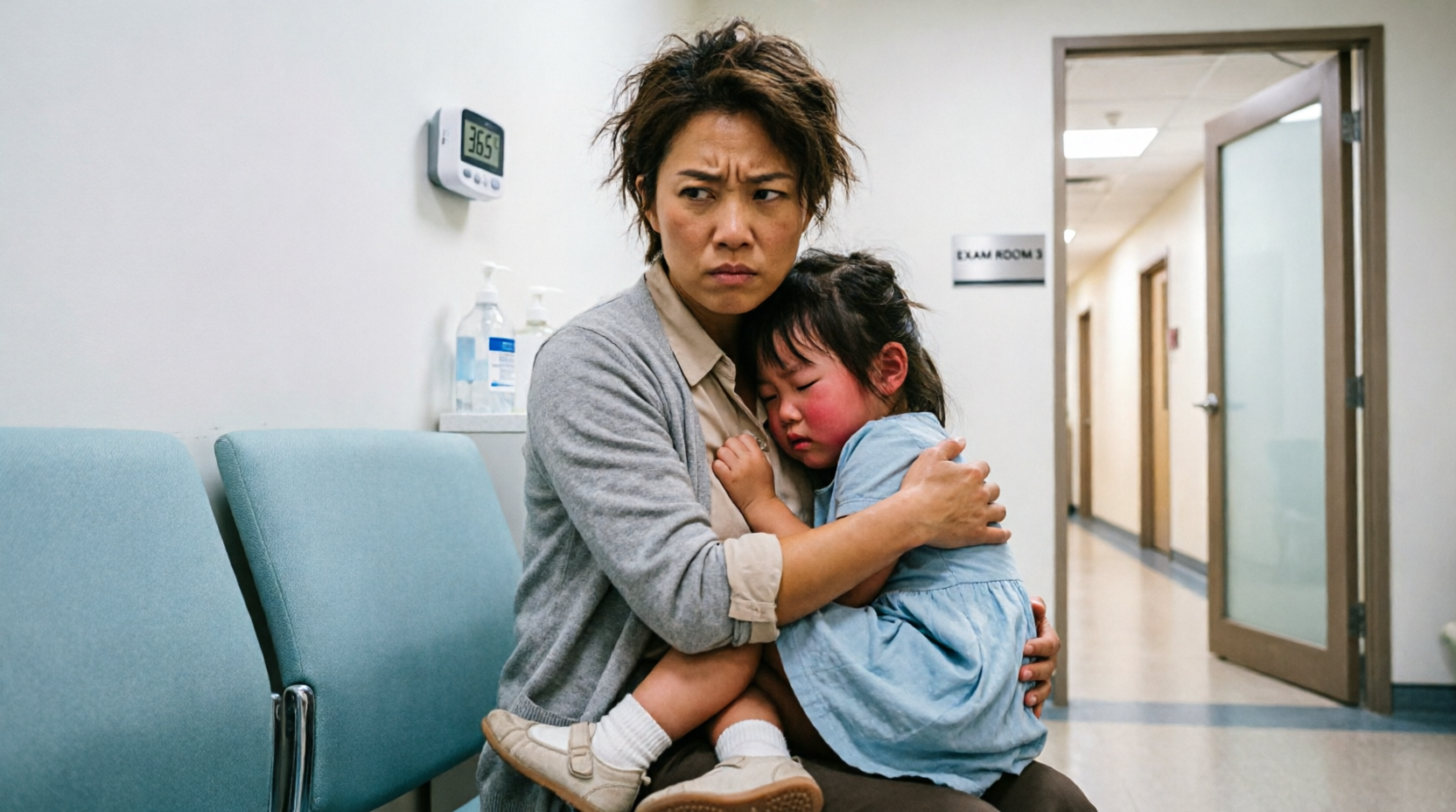
The waiting room smelled like rubbing alcohol and cheap coffee. There was a fish tank in the corner and a stack of old magazines no one touched. The receptionist took one look at Mia and stood up.
“What happened?”
I heard myself answer before I had time to decide whether I could say it.
“My father assaulted her.”
The words fell into the room heavy and final.
A nurse led us back immediately. The doctor examined Mia gently, documented the abrasions on her knees, the bruising around her upper arm where he’d grabbed her, the inflamed patch on her scalp. They took photographs. Notes. Measurements. The doctor’s mouth tightened the farther she got into the exam.
Mia winced when they cleaned the gravel out of her knees and gripped my fingers so hard I lost feeling in two of them.
“You’re safe,” I kept whispering. “You’re safe now.”
But inside, another sentence had already taken shape, colder and stronger.
This doesn’t stay in the family.
By the time Mia fell asleep in the car on the rest of the drive home, still sniffling in her sleep, I knew exactly what came next.
That night, after I tucked her into my bed and watched her tiny hand relax on the blanket, I made three phone calls.
The first was to a lawyer.
The second was to the police.
The third was to Brandon.
And the moment he walked through my front door and saw our daughter’s injuries, his face changed in a way that told me this would not end quietly.
Part 3
Brandon used to have the kind of face people trusted too fast.
Open expression, easy smile, the sort of warm brown eyes that made strangers tell him things in grocery store lines. Divorce changed some of that. Fatherhood sharpened the rest. When he stepped into my apartment that night and saw Mia asleep under my blanket with gauze on both knees and a pink irritated patch along her scalp, every trace of softness vanished.
He crouched beside the bed without touching her.
“Who did this?” he asked.
His voice was low, but it had a dangerous stillness in it.
“My dad.”
He looked up at me then, just once, and whatever he saw on my face made him nod as if a door had closed in his mind.
“Okay,” he said. “Then we handle it.”
No speech. No hesitation. No useless outrage that goes nowhere. Just certainty.
I didn’t realize how much I needed that until I heard it.
We sat at my kitchen table under the yellow light over the stove and went through everything in order. The urgent care paperwork was spread between us. I could still smell antiseptic on my hands no matter how many times I washed them. My shirt had a faint dirty streak where Mia’s face had pressed against it in the driveway, and I couldn’t make myself change yet.
Brandon asked simple questions, the kind meant to keep me on the rails. What time did we arrive? Who was there? When did the breakfast incident happen? Did anyone else see the driveway? Had the doctor taken photos? Had I saved my mother’s texts?
I answered all of it.
Around midnight, two officers arrived to take the initial report.
One was a woman in her forties with tired eyes and a voice so calm it made me want to cry. The other was younger, taking notes and glancing toward the bedroom every time Mia whimpered in her sleep. They photographed the paperwork from urgent care and asked if I wanted them to wake Mia for a statement.
“No,” I said too quickly.
The older officer shook her head. “Not tonight.”
That kindness nearly undid me.
So I talked. I told them about the phone call from my mother, about the first day being too smooth, about Dad studying Mia instead of engaging with her. I told them about breakfast and the spilled juice and the look on Mia’s face afterward. Then I told them about the scream and the driveway and the trash can.
The younger officer stopped writing for half a second when I said that part.
“He put her in the trash can?”
“Yes.”
“With force?”
“Yes.”
By the end of the statement, the room smelled like stale coffee, legal paper, and stress. My mother had texted five times while I was talking. I didn’t read the messages. I only saw the previews lighting up my screen.
Claire this is getting out of hand.
Call me right now.
Your father did not mean—
Please do not involve strangers.
Brandon saw the screen and reached over to flip the phone face down without a word.
The next few days blurred.
A detective was assigned. A formal interview got scheduled. The lawyer I’d called, a woman named Marisol Velez with sleek black hair and absolutely no patience for abusers, met me in her office and walked me through restraining orders, documentation, and what to expect if the district attorney pursued charges. Her office smelled like coffee beans and expensive printer toner. She wore a cream blouse and spoke in clean, unsoftened sentences.
“You are not overreacting,” she said before I even sat down properly. “I need that understood immediately.”
I laughed, but it came out cracked.
“I didn’t say I was.”
“You grew up with these people,” she said. “Your face says you’ve heard that your whole life.”
I stared at her.
Then I nodded.
At home, Mia got quieter.
That may have been the hardest part. Not the tears. Not even the nightmares that started three nights later, when she woke up screaming and clawing at her own hair until I turned on every light in the bedroom and held her against my chest. It was the quiet.
She still drew, but now she asked permission for everything. Can I use the red one? Can I sit here? Is this okay? If I moved too fast near her, she flinched before recovering. Once, when I dropped a spoon in the sink and the clang rang too sharply through the kitchen, she burst into tears.
Children are loud when they feel safe. I had forgotten that until I watched fear teach my daughter to move more softly.
Then my mother came to my apartment.
Unannounced, of course. She always believed access was her right.
It was raining that morning. Thin gray weather, the kind that makes the windows look tired. Mia was coloring at the coffee table with a blanket around her shoulders, and when the buzzer rang, she looked up so fast her crayon slid off the page.
“I’ll get it,” I said.
I knew it was my mother before I opened the downstairs door. Maybe because only she would show up instead of calling after being ignored. Maybe because some part of my body had spent too many years learning the exact frequency of her crises.
When I opened the apartment door, she brushed past me like this was still her daughter’s home and not a boundary she had no right to cross.
Then she saw the gauze on Mia’s knees and stopped.
Not because it moved her. Because it made the whole thing harder to dismiss.
“Mommy?” Mia said from the living room.
I stepped in front of my mother’s line of sight. “Go to your room for a minute, baby.”
Mia hesitated, reading the tension even if she didn’t understand it. Then she gathered her crayons and blanket and went.
My mother folded her arms. “You need to stop this.”
I almost laughed, because there it was. No How is she? No I’m sorry. Straight to management.
“Stop what?”
“The police. The lawyer. Claire, this is insane.”
“He dragged her by her hair.”
“She was in the way.”
The words came out of her so fast it was like she didn’t even hear herself.
I stared at her.
She corrected course immediately, voice softening into that poisonous calm I knew too well. “I mean, it happened quickly. Your father has a temper. You know that. But ruining his life over one bad moment—”
“He threw a four-year-old into a trash can.”
“Don’t say it like that.”
I felt my whole body go still.
“How exactly should I say it?”
She looked away first.
Rain tapped at the window over the sink. In Mia’s bedroom, I could hear the faint scratch of crayon on paper.
My mother lowered her voice. “Families survive things.”
“Not this one.”
Her face hardened then, the sympathy mask slipping. “You’re being dramatic.”
I opened the front door.
For one second she didn’t move. She honestly looked shocked, as if she had forgotten I was a grown woman with a deadbolt and choices.
“Out,” I said.
“Claire—”
“Out.”
She stepped into the hall, stiff with fury. “If you do this, there’s no coming back from it.”
I smiled without humor. “That’s the idea.”
The restraining order hearing was three days later.
The courtroom smelled like old wood and cold air. My father sat at the respondent’s table in a dark jacket, face set in that familiar furious calm he used when he believed the real offense was being questioned. My mother sat behind him wringing tissues. Bryn stared at her lap like detachment could turn her invisible.
The judge looked at the photos from urgent care for less than a minute.
Then he signed.
“Stay away from the child,” he said.
My father stood up so suddenly his chair scraped backward. “This is ridiculous.”
The judge looked over his glasses. “Sit down.”
He didn’t. He started shouting then, blaming me, blaming “modern parenting,” calling me ungrateful and hysterical and disloyal. The bailiff moved in. My mother started crying. Bryn finally looked up, but only to glare at me.
I sat there with my hands folded and realized, almost peacefully, that nothing about him had changed.
He was the same man.
I was the one who had finally moved.
And when the judge warned him that one more outburst would speed up his legal problems in a way he would not enjoy, I saw something flash across my father’s face that I had never seen when I was growing up.
Fear.
The arrest warrant came two days later.
And when the detective called to tell me they were picking him up, my hands stopped shaking for the first time since the driveway.
Part 4
The day they arrested my father, I cleaned out Mia’s backpack.
Not because it needed cleaning. Because I couldn’t sit still. Trauma leaves you full of useless energy, all that adrenaline with nowhere respectable to go. So while a detective somewhere across town was putting handcuffs on the man who raised me, I stood at my kitchen counter under the hum of bad apartment lighting and dumped crayons, fruit snack wrappers, two tiny socks, and a folded drawing onto the laminate.
The drawing was of a house with three windows and a giant purple dog standing in the yard.
One figure stood near the front door. Another, much smaller one, stood beside it. Above them Mia had written in crooked letters she was still learning to shape: ME AND MOMMY SAFE HOME.
I had to sit down after that.
Mia started therapy the following week.
The office was painted in soft colors that were probably chosen by someone with a degree in trauma-informed care and a grant budget. There were beanbags, shelves of puppets, baskets of toys organized by emotion, and a sand tray in the corner. It smelled faintly like crayons and vanilla hand lotion. The therapist, Dr. Evelyn Shore, had warm eyes and the kind of voice that made children feel invited instead of examined.
Mia didn’t talk much the first session.
She drew.
That didn’t surprise me. Drawing had always been her first language anyway. She drew houses, trees, a sun with a face, then finally a trash can with jagged black lines around it like it was making noise. Dr. Shore didn’t push. She just sat nearby and asked gentle little questions.
“Who’s in the picture?”
“What’s happening here?”
“How does this part feel?”
I sat in the parent room next door pretending to read a magazine while listening to the muffled cadence of their voices through the wall.
When Mia came out forty-five minutes later, she looked tired but lighter, as if someone had loosened one knot inside her.
“Did you play?” I asked.
She shrugged. “A little.”
That became our routine. Therapy Tuesdays. Mac and cheese afterward if she wanted it. A sticker from the receptionist if she remembered to ask. Small rituals matter when a child is rebuilding a sense of safety. They tell the body what to expect.
I started therapy too, though I told almost no one.
There are humiliations you carry privately, and one of mine was realizing how much of my own childhood I had mislabeled. Not because I was stupid. Because survival is a terrible historian. It edits as it goes. It turns fear into habit, minimization into loyalty, silence into maturity.
My therapist, a dry, sharp woman named Karen who wore silver bangles that clicked softly when she took notes, listened to me describe my father for twenty minutes and then said, “So you grew up in coercive emotional control and learned to call it temperament.”
I remember blinking at her.
“I guess.”
“No,” she said. “Not I guess. That’s what happened.”
Truth can feel rude when you’re used to excuses.
Meanwhile, the legal process kept moving.
The district attorney assigned to the case, Elise Morrow, had a precise face and a voice that suggested she had long ago run out of patience for men who hurt children and expected nuance in return. She met Brandon and me in her office, spread the file open, and walked us through the charges they were considering: child abuse, assault on a minor, endangerment, and additional counts based on force and injury.
“Your medical documentation is strong,” she said. “The photographs are strong. The timing is strong. The defendant’s behavior at the restraining order hearing did him no favors.”
That was a graceful way of saying my father had acted like exactly the kind of man juries dislike on sight.
“What about my mother?” I asked.
Elise folded her hands. “Not enough for criminal exposure on the current evidence.”
That answer lodged like a stone in my throat.
Because of course. My mother had built a whole life out of standing near harm without technically touching it.
Bryn was trickier too. She had witnessed it. She had done nothing. Morally, that was enough to damn her forever in my mind. Legally, indifference is harder to prosecute than action.
So the case narrowed where the law could grip it best: my father.
He responded exactly the way men like him always do when consequences become real.
He lied.
His attorney floated the word “discipline” in pretrial discussions like it might magically civilize what happened in the driveway. He suggested Mia had been throwing a tantrum, that my father had only tried to move her out of danger because Bryn was backing out of the driveway, that the “trash can incident” was a grotesque distortion of a minor corrective moment. As if the right vocabulary could shrink a child’s terror.
Marisol, my lawyer, forwarded me one of those filings with a single line in the email body: Let them keep talking.
Brandon read the same filing and said, “I would love five minutes alone with his attorney in a room with no cameras.”
“I know.”
“I’m serious.”
“I know.”
For all our differences, Brandon understood something important about anger: it’s useful only when aimed. So instead of blowing up, he documented. He pulled old texts from my mother about family visits. He found the weekend schedule messages. He wrote out his own detailed statement about Mia’s demeanor before and after that visit. He came to therapy consults. He took extra parenting time when I had legal meetings. He became, without ever announcing it, the steady witness to our recovery.
That mattered more than I could explain then.
A month before trial, my mother sent a letter.
Not an email. A real letter in a cream envelope with her looping careful handwriting, as if stationery could still perform innocence. I opened it at the kitchen counter while Mia colored at the table.
Inside, three pages.
No apology.
Just pleas. For reason. For compassion. For discretion. She wrote that my father was old-fashioned, overwhelmed, ashamed. She wrote that men from his generation “didn’t always know how to handle little girls.” She wrote that prison would destroy him, and what good would that do anyone?
At the end she added, almost as an afterthought: You know he loves family in his own way.
I read that sentence twice.
Then I tore the letter in half. Then in half again.
Karen, my therapist, later called that “the first emotionally proportionate reaction you’ve probably ever had to your mother’s minimizing.”
I told her that sounded obnoxiously accurate.
The night before trial, Mia climbed into my lap after bath time, damp hair smelling like strawberries, and asked, “Do I have to see Grandpa?”
“No.”
“Ever?”
“No.”
She leaned against me, thinking. “Is he still mad?”
The question hit harder than almost anything else had.
Not Did he do a bad thing. Not Why did he hurt me. Just Is he still mad.
Children raised around volatile adults learn to understand danger as mood first, morality second.
I tightened my arms around her. “His feelings are not your job, baby.”
She nodded like she understood, but I knew that sentence would take years to fully root.
The next morning, I dressed in a gray suit Marisol said would photograph well and make me look “steady, not breakable.” The courthouse steps were slick from overnight rain. Reporters clustered near the entrance, not many, but enough. Someone called my name. Someone else shouted a question about family violence and accountability. Brandon put a hand at the center of my back and guided me forward without letting me speed up or slow down.
Inside, the hallway smelled like wet coats and floor polish.
And when I stepped into the courtroom and saw my father at the defense table, shoulders squared like he was the offended party, I understood something cold and final.
He still didn’t think he had done anything wrong.
Which meant the trial was not going to be about remorse.
It was going to be about exposure.
And when Elise rose for opening statements, I realized I was ready for that.
Part 5
There is something indecent about courtroom clocks.
They keep moving at the same polite pace while people’s lives are being cut open in public. A woman can sit ten feet away from the man who terrorized her child, and above them all some clock will go on ticking like it’s timing a school assembly.
I stared at that clock during opening statements because if I looked at my father too long, I might remember old versions of him. The one who carried me on his shoulders at the county fair when I was six. The one who taught me how to ride a bike by shouting instructions I misunderstood as encouragement because I needed to. Memory is disloyal like that. It offers sweetness exactly when it will hurt the most.
Elise Morrow stood before the jury and gave them the version of the story stripped of family haze.
She did not dramatize. She didn’t need to.
She told them a four-year-old child had been grabbed by the hair, dragged across a driveway, and thrown into a trash can by a man entrusted to love and protect her. She told them the child sustained abrasions, scalp injury, bruising, and measurable emotional trauma. She told them the defendant had shown no remorse and had instead attempted to relabel violence as discipline.
When she said, “The evidence in this case is not complicated. It is simply ugly,” even the judge looked up.
My father’s attorney, on the other hand, tried for soft edges.
He used phrases like unfortunate overreaction, chaotic family misunderstanding, generational difference. He described my father as a stern man who had momentarily lost patience with a disobedient child in a moving-vehicle situation. He actually said “moving-vehicle situation” as if Mia had been dangling from an axle and not sitting on the driveway with crayons.
Marisol leaned over and whispered, “He’s already losing.”
I hoped so. But hope is a hard thing to trust when the stakes are your child’s body.
The urgent care doctor testified first.
Dr. Lila Conway wore a navy suit and the same expression she’d had when she cleaned gravel from Mia’s knees: brisk professional anger. She identified the photographs, explained the injury patterns, described the redness and traction irritation on the scalp. When the defense tried to suggest the hair injury could have resulted from “ordinary childhood pulling,” she looked at the attorney like she was embarrassed for him.
“Ordinary childhood play does not present with a localized patch of traction inflammation alongside acute distress and concurrent dragging abrasions to both knees.”
I wrote that sentence down later because it felt good to have medical language cut through euphemism.
The responding officer testified next, then the detective. Calm facts. Time of report. Observations of Mia’s condition. The restraining order hearing outburst. My father’s changing story. Every official detail tightened the case one notch further.
Then it was my turn.
The witness stand felt both too exposed and oddly distant, like I was sitting in a glass box inside the room instead of the room itself. I could smell old varnish on the wood rail. The microphone picked up every little breath. Elise walked me through the weekend slowly, letting the jury see the whole shape rather than just the worst frame.
My childhood first.
Not in exhaustive detail, but enough. Dad’s temper. Mom’s minimizing. The atmosphere of constant adjustment. Bryn learning to survive by becoming hard. Me learning to survive by becoming careful. Then the invitation. The promise that he had “been better lately.” The first unsettling day. Mia trying to connect. My father calling her drawing messy. Bryn telling me to teach her not to interrupt adults. Breakfast. The spilled juice. Dad slamming his hand on the table. Mia freezing.
When I described that look in her eyes, my own voice nearly broke.
Elise let the silence sit before asking, “Why did that matter to you?”
“Because I recognized it,” I said. “I had that look as a child.”
The courtroom went very still.
Then I described the scream.
The run through the house.
The driveway.
My father’s hand in Mia’s hair.
Dragging her.
The trash can.
His laughter.
I kept my voice even because rage had already done its job. The facts were stronger without it.
When I repeated his words—“Useless things belong in the trash”—my mother put a hand over her mouth in the gallery like she had just now realized how terrible it sounded. Too late. Far too late.
On cross-examination, my father’s attorney tried to turn me into an unreliable daughter with a grudge.
He asked about the divorce, implying stress.
He asked about my relationship with my family, implying resentment.
He asked whether my father had a history of “firm discipline.”
“No,” I said. “He had a history of intimidation.”
He tried to get me to admit that I had always “misunderstood” my father’s personality.
“I understood it perfectly,” I said. “I just stopped excusing it once it touched my child.”
I saw two jurors write something down after that.
Brandon testified after me.
He was excellent. Calm. Controlled. Detailed. He talked about seeing Mia that night—the injuries, the tremors, the way she refused to let go of my shirt even in her sleep. He did not embellish. He didn’t need to. Truth sounded better in his mouth than anger would have.
The defense asked whether his divorce from me might motivate him to support “her version.”
Brandon looked at the lawyer for a second too long, then said, “I support my daughter’s medical records.”
Even the court reporter smiled.
By the time we broke for the day, my shoulders ached from tension I hadn’t known I was holding. In the hallway outside the courtroom, the air smelled like coffee and wet wool from people’s coats. Reporters hovered, but Marisol steered us away.
“How bad was it?” I asked once we were in a quieter corridor.
She tucked a file under her arm. “For them? Very.”
Elise joined us a minute later, expression thoughtful.
“He wants to testify,” she said.
I stared at her.
“Your father?”
She nodded. “Against counsel’s advice, apparently.”
Marisol made a low sound that was almost delighted. “Excellent. Let him.”
I should have felt relief. Defendants who insist on testifying often think passion will fix facts. Juries usually hate that. But what I felt instead was dread.
Because I knew my father.
He was never more dangerous than when he believed authority itself belonged to him. Give him a microphone, a captive audience, and the chance to justify his anger, and he could turn plain cruelty into something almost persuasive if you had grown up loving him.
That night at home, Mia sat at the coffee table drawing a castle with three towers and asked whether I would still read two bedtime stories even though it was late.
“Of course,” I said.
After she fell asleep, I sat alone in the dark living room and tried to prepare myself for hearing the man who raised me explain why my daughter deserved what happened.
I thought I was ready.
The next day proved I wasn’t.
Because the first thing my father did when he took the stand was call Mia “a difficult child.”
And the second thing he did was blame her for making him angry.
Part 6
If there had been any small, ridiculous piece of me still hoping my father would use the stand to show remorse, he killed it in under three minutes.
He sat there in his wrinkled suit with one hand flat on the witness stand and spoke in that familiar gravelly tone that had ruled my childhood dinners, and he described my four-year-old daughter as if she were a problem appliance.
“She doesn’t listen,” he said. “She’s always underfoot. Always making noise.”
Not a child. A nuisance.
Elise let him talk at first. That was the brilliance of it. She understood what I knew in my bones—my father always revealed himself if given enough rope. He mistook permission to speak for proof that he was winning.
He said Mia had been “defiant.” He said she was in the way while Bryn was trying to leave. He said he moved her “firmly” because someone had to maintain order. When Elise asked whether “firmly” included pulling a child by her hair, he actually shifted in his seat and said, “That’s your language, not mine.”
The jury hated him for that. I could feel it.
Then came the part that made the whole room recoil.
Elise asked, “Did you place the child into a trash receptacle?”
He shrugged.
“I set her down where she wouldn’t interfere.”
The courtroom stayed silent for one shocked second.
Then the judge said, very mildly, “Answer the question asked.”
Dad’s jaw tightened. “Yes.”
My mother, in the gallery, started crying quietly into a tissue. Bryn stared straight ahead.
Elise moved in.
“Did you laugh?”
“No.”
She held up the urgent care note where I had reported that exact statement immediately, before lawyers, before strategy, before time could soften memory.
“Did you say, ‘Useless things belong in the trash’?”
“No.”
She showed him the police report. Same sentence. Same day. Same details.
He glanced at it and then, unbelievably, said, “If I said anything like that, it was frustration. Not literal.”
Not literal.
I stared at him and felt something settle permanently in me. That was the part people outside situations like mine rarely understand. It isn’t always the violence alone that severs the last thread. Sometimes it’s the contempt afterward. The smooth, casual way they try to edit reality while you are still carrying it in your body.
Elise asked the question that finally pinned him to the wall.
“When you saw the injuries afterward, did you call a doctor?”
“No.”
“Did you call emergency services?”
“No.”
“Did you express concern for the child’s safety?”
He hesitated.
“No.”
“Did you attempt to apologize to the child?”
Silence.
Then, “No.”
No remorse. No aid. No confusion. Just power, then denial.
By the time he stepped down, even his own attorney looked exhausted.
My mother testified next, and somehow that was worse.
Because my father had always been obvious. Loud. Demanding. Angry. My mother was the softer knife. She took the stand in a pale blouse and small pearl earrings and tried to perform grief. Her voice trembled in all the right places. She said she loved Mia. She said the whole event happened “so quickly.” She said Claire—me—had always been emotional and quick to interpret things harshly.
That part didn’t even hurt. It was too familiar.
Elise walked her through every opportunity she’d had to intervene.
When Mia was criticized.
When breakfast turned tense.
When I shouted from the driveway.
When she came outside and saw my daughter crying.
When she later came to my apartment and asked me not to “ruin his life over a mistake.”
My mother kept trying to blur the edges.
“He didn’t mean—”
“What did he mean, Mrs. Whitaker?”
“I can’t speak for him.”
“But you defended him.”
“I wanted to keep the family together.”
Elise stepped back then and let that sit in the room. Because there it was, the real religion of my mother’s life: not safety, not truth, not mercy. Preservation. Keep the family together, even if what you are preserving is rotten.
Bryn wasn’t called.
The prosecution didn’t need her, and the defense clearly didn’t trust her to humanize anything. She remained a cold shape behind the attorneys, all clipped expressions and offended posture. The sight of her bothered me in a different way than my parents did. She was younger. She had seen what our father was all our lives. She could have broken the pattern and chose instead to inherit it like property.
Closing arguments came the next morning.
Elise was relentless and brief. She reminded the jury of the timeline, the photos, the medical testimony, the defendant’s own admissions. She talked about trust. About power. About what it means when a child apologizes while being hurt because she has already learned that adults value obedience over her reality.
The defense tried one last time to wrap violence in the word discipline.
It didn’t work.
The jury deliberated less than four hours.
I sat in the hallway with Brandon and Marisol while we waited. The vending machine behind us hummed. Someone down the corridor was arguing quietly into a cell phone. I kept folding and unfolding a receipt in my hands until the paper tore.
When the bailiff finally called us back in, my stomach dropped so hard I thought I might be sick.
The courtroom felt smaller.
The foreperson stood.
On the primary assault charge: guilty.
On child abuse: guilty.
On endangerment: guilty.
On every count that mattered: guilty.
My father didn’t react at first. That was almost eerie. Then his face changed, not into sorrow, not into shame, but into something meaner. Offended disbelief. As if he had just discovered the world no longer agreed to revolve around him.
My mother made a sound like a chair leg scraping the floor. Bryn never looked at me.
I didn’t cry.
Not then.
I just breathed. Deeply. For what felt like the first time in weeks.
Sentencing was set for two weeks later.
Outside the courthouse, cameras waited again. I ignored them. Brandon drove us home. The sky was the flat gray of unpolished steel, and traffic kept stopping for no good reason, and all of it felt weirdly ordinary for a day when your father became, officially, a convicted child abuser.
That evening, Mia sat cross-legged on the rug drawing a picture of a fox with a backpack.
“Did you have court?” she asked without looking up.
“Yes.”
“Did they believe you?”
The question hit me so hard I had to sit down.
“Yes,” I said.
She nodded and kept coloring.
Like that mattered to her. Like belief itself was a kind of medicine.
Then she asked, “Does that mean he can’t yell at me anymore?”
I swallowed and said, “That’s exactly what it means.”
She smiled, just a little, and went back to her fox.
Later that night, after she was asleep, I stood alone in the kitchen and finally let myself cry. Not because the verdict wasn’t what I wanted. Because it was. Because I had spent so much of my life learning how to survive my father that watching strangers name him correctly felt like grief too.
Two weeks later, the judge would decide how long he paid for what he did.
But the moment the jury said guilty, I knew one thing with total clarity.
Whatever sentence the court gave him, he had already lost the version of me that used to call him Dad.
Part 7
Sentencing took less time than I expected and hurt more than I wanted.
That was the pattern with everything after the driveway. The legal system was efficient in places I had assumed would drag, and emotionally brutal in moments I thought would feel clean.
The courtroom was quieter that day. Fewer reporters. Fewer spectators. The rush of the story had cooled now that the verdict was in. Public outrage likes the chase more than the paperwork. I almost preferred the thinner crowd. Less noise around something that mattered this much.
I wore black because I didn’t care what Marisol thought would “read well” anymore. Brandon wore a navy tie Mia had picked because she said it looked like “serious sky.” He hadn’t argued.
My father looked smaller than he had at trial.
Not humbled. Just reduced. Jail waiting does that to some men. It strips away the rhythm they use to project authority. He still sat too straight, still held his jaw at that familiar angle, but the force field around him was gone. For most of my childhood, his anger had entered a room before he did. Now he was just an aging man in county restraints waiting to hear what another man was going to do with his future.
The judge reviewed the facts in a flat, almost tired voice. A child. A position of trust. Physical injury. Emotional harm. Complete absence of accountability. He mentioned the medical documentation, the testimony, the restraining-order outburst, the defendant’s refusal to accept responsibility even under oath.
Then he sentenced my father to eighteen months in prison.
My mother broke down immediately, making those thin strangled sobs she always used when she wanted pain to sound refined. Bryn went rigid. My father twisted in his seat and finally looked at me, really looked, with pure hatred in his eyes.
Not remorse. Not regret.
Hatred.
As if I had done this to him.
That was the last useful thing he ever gave me. Certainty.
Because even after conviction, even after evidence, even after hearing a judge say in open court that what he had done was criminal violence against a child, he still believed himself wronged.
The bailiff moved in. The courtroom stirred. Brandon’s hand covered mine on the bench, steady and warm and real.
And I felt… nothing dramatic. No triumph. No righteous satisfaction. Just a long, slow exhale. Like some part of my body had finally stopped waiting for permission to tell the truth.
Outside the courthouse, my mother tried to come toward me.
Marisol intercepted her so fast it almost looked choreographed.
“Not today,” she said.
My mother’s face crumpled. “Claire, please.”
I kept walking.
Bryn called my name once, sharp and furious, but I didn’t turn.
That was its own kind of ending.
Life afterward did not become easier overnight. Safer, yes. Simpler in some ways, yes. Easier, no.
Mia’s nightmares got worse for a while after the trial.
Dr. Shore warned me that might happen. Children don’t always process resolution the way adults assume they will. Sometimes when danger becomes official and public, the body finally has room to panic. So the screaming came back for a while. So did the clinginess. So did the fear of garbage trucks, parking lots, men shouting on television, anything with the smell of sour trash or hot concrete.
One night she woke up shaking so badly her teeth knocked together.
I carried her into the living room because sometimes a different room helped. Rain tapped softly at the windows. The digital clock over the stove read 2:14 a.m. I wrapped us both in a blanket and sat on the couch with her in my lap, too big now to fit there comfortably but still small enough to try.
Her hair smelled like the lavender detangler spray she liked. Her skin was hot from fear.
“Is he coming back?” she whispered.
“No.”
“How do you know?”
Because the judge said so. Because prison. Because restraining orders. Because Brandon would burn the city down first. Because I would.
I didn’t say any of that.
“I know,” I said, “because I won’t let him.”
She pressed her face against my neck and stayed there until dawn softened the edges of the room.
Therapy kept working, slowly.
So did routine.
Preschool again. Then weekend pancakes. Drawing at the kitchen table. Tiny rituals of safety built over and over until they started to feel ordinary instead of constructed. Brandon and I got better at reading her storms. Better at not making our own fear the center of the room. Better at answering the questions that came out sideways.
“Mama,” she asked one evening months later while I braided her damp hair after a bath, “why did Grandpa call me useless?”
My hands stopped.
The bathroom smelled like bubble soap and strawberry toothpaste. A little puddle of bath water was spreading under the hamper. Ordinary details. Catastrophic question.
I sat down on the closed toilet lid so I was at her eye level in the mirror.
“Because he is a mean person,” I said carefully, “and mean people say things that are not true when they want power.”
She considered that.
Then: “Am I useless?”
I pulled her into me so fast the hairbrush hit the floor.
“No,” I said into her curls. “You are not garbage, and you are not useless, and you are not in anyone’s way. You are the best thing that ever happened to me.”
She held on so tightly I could feel her heartbeat through the towel.
That question shattered something in me that had survived even the courtroom. Because bruises heal. Scalp tenderness fades. Knees lose their scabs. But when a child starts asking whether she belongs in the trash, you understand in a whole new way how violence keeps moving after the hands are gone.
The first letter from prison came two months later.
Cream paper. My father’s heavy block handwriting. My full name on the envelope, not Claire-bear or kiddo or anything falsely affectionate. Just Claire, as if I were a bureaucratic problem now. I stood at the mailbox with it in my hand and already knew there would be a “but” in it somewhere. Men like him always love the word but. It lets them gesture vaguely toward apology without surrendering control of the narrative.
I was right.
I’m sorry, but you forced my hand.
I’m sorry, but children need discipline.
I’m sorry, but this should never have gone public.
I read exactly one page, then fed the rest through the shredder in my office while the machine whined and chewed and spit his excuses into soft white strips.
More letters followed.

