Another inch.
Years gathered that way.
Inches.
A soccer goal. A sleepover. A school play. Raising her hand in class. Laughing with her whole body. Letting Coach Sandra hug her after a championship loss. Standing near an elevator without checking the emergency button.
Lucas grew too.
For a long time, I had worried about the guilt I carried for not seeing sooner. Lucas carried a different kind: guilt for being upstairs with cartoons while Emma suffered below.
When he was nine, he asked, “Why didn’t they hurt me?”
I sat beside him on the porch while Portland rain ticked through the gutters.
“Because Beverly believed boys mattered more.”
His face twisted.
“That’s stupid.”
“Yes.”
“I should’ve known.”
“You were little.”
“So was Emma.”
I put my arm around him.
“Yes.”
He cried then, angry tears, and I let him.
The Hartleys took things from both my children, just in different rooms.
Five years after the trial, Emma was thirteen.
Tall, strong, fast on the soccer field, still cautious in unfamiliar houses, still sleeping with a small light on during storms, still seeing Dr. Chambers twice a month. She wanted to be a lawyer.
“Not a prosecutor,” she told me one morning over cereal. “Maybe a lawyer for kids. The kind who believes them.”
I smiled into my coffee.
“That sounds like you.”
Beverly’s appeals failed.
Kristen’s appeals failed.
Todd’s appeals failed.
Nathan drifted in and out of supervised visitation with Lucas, but Emma refused all contact. At thirteen, the court respected her choice.
Nathan sent one email after the last appeal was denied.
You poisoned her against me.
I answered once.
No. You chose not to protect her, and she remembered.
Then I blocked him except through the parenting app required for Lucas.
I thought, foolishly, that the past had finally settled into its cage.
Then, in Emma’s eighth-grade year, Beverly sent one last letter.
Not to Emma.
To me.
And the first line made me sit down before I finished reading.
You may think prison taught me regret, Rachel, but all it taught me is patience.
Part 9
I did not finish Beverly’s letter in the kitchen.
I carried it outside to the back porch, where the rain had stopped and the air smelled like cedar, wet soil, and the rosemary plant Lucas kept forgetting to water. I wanted open air around me while I read her words. I wanted no walls close enough to feel like a basement.
The letter was four pages long.
Beverly’s handwriting remained elegant. Of course it did. Some people can make poison look like calligraphy.
She wrote that prison had given her time to pray. She wrote that “discipline” had been misunderstood by a society too soft to raise strong children. She wrote that Emma would one day understand the difference between love and indulgence.
Then came the line I would remember most.
You destroyed everything I built.
I stared at it for a long time.
The old Rachel, the woman who had once tried to earn Beverly’s approval by bringing the right salad to family dinners, might have felt a flicker of guilt.
This Rachel felt nothing but clarity.
I called Richard.
“She sent another letter.”
“Did she threaten you?”
“Not directly.”
“Scan it.”
I did.
His response came ten minutes later.
“Keep the original. We’ll notify the facility. Do not respond.”
But that night, after Emma and Lucas went to bed, I sat at the dining table and wrote one sentence on a blank card.
You destroyed yourself the first time you hit my daughter. I only made sure everyone knew.
I did not mail it.
I burned it beside her letter in a steel bowl on the porch.
Some answers are for the fire.
By then, our Oregon life had roots.
I had become controller at the manufacturing company, with an office overlooking the loading docks and a team that trusted me because I trusted numbers more than office politics. Lucas was obsessed with robotics. Emma had close friends, a part in the school play, and a left-footed soccer shot that made parents gasp on the sidelines.
We were not untouched.
But we were alive in ways that had nothing to do with the Hartleys.
On Emma’s fourteenth birthday, she asked for a backyard dinner instead of a party. Kayla came, along with two girls from support group and a boy from soccer who turned red every time Emma looked at him. Lucas hung string lights crookedly across the fence. I grilled burgers. Someone spilled lemonade. Nobody was punished.
After cake, Emma found me in the kitchen.
“Mom?”
“What’s up?”
She leaned against the counter, taller than I wanted to admit, her hair pulled into a messy ponytail. “Do you ever wish you hadn’t married Dad?”
The question landed softly but deep.
I dried my hands on a towel.
“I wish I had known how to see his family sooner.”
“That’s not what I asked.”
No, it wasn’t.
I looked through the window at Lucas laughing under crooked lights.
“If I hadn’t married him, I wouldn’t have you and Lucas. So I can’t wish it away. But I do wish I had trusted myself earlier.”
Emma nodded.
“Do you hate him?”
“I don’t spend much time feeling anything about him anymore.”
“Is that what healing is?”
“Sometimes.”
She looked down at her socks.
“I hate Grandma Beverly.”
“That makes sense.”
“Dr. Chambers says hate can be heavy.”
“It can.”
“But forgiving her feels disgusting.”
“Then don’t.”
Emma looked up, startled.
I continued, “Forgiveness is not rent you owe for healing. You can have peace without giving her absolution.”
Her eyes filled, but she smiled.
“Grandma Eleanor would have liked you.”
I laughed. “Who’s Grandma Eleanor?”
She shrugged. “Nobody. Just sounds like someone wise from a book.”
We both laughed then, and the sound moved through the kitchen like clean water.
Senior year arrived too quickly.
Emma became captain of her soccer team. She volunteered at the child advocacy center, sorting donated stuffed animals like the fox she had held years before. She wrote her college essay about truth, but not the details of her abuse. “I don’t want strangers deciding I’m impressive because I survived,” she told me. “I want them to know what I plan to do with it.”
She got into three universities.
She chose one with a strong pre-law program and a campus full of old trees.
The summer before she left, she asked to visit Denver.
I nearly dropped the mug I was washing.
“Why?”
“I don’t want to see them,” she said quickly. “Not Dad. Not anyone. I want to see the courthouse.”
“The courthouse?”
She nodded. “I remember pieces. Cameras. Your hand. The hallway. But I was little. I want to stand there as me now.”
Dr. Chambers thought it could be empowering if Emma led the trip and controlled the boundaries.
So we went.
Just the two of us.
Denver looked both familiar and foreign. Dry air. Wide sky. Mountains in the distance like a memory I had stopped arguing with. We drove past our old neighborhood, but Emma did not ask to stop. We passed Hartley Construction’s former headquarters too. The sign was gone. Another company occupied the building.
Emma stared out the window.
“That’s where all their important stuff was?”
“Yes.”
“It looks boring.”
“It was.”
The courthouse steps were crowded with people rushing through their own emergencies. Nobody knew us. Nobody turned.
Emma stood at the bottom and looked up.
For a long while, she said nothing.
Then she took my hand.
“I thought I’d feel scared.”
“Do you?”
“A little. But mostly…” She searched for the word. “Mostly I feel bigger than it.”
I squeezed her hand.
“You are.”
We went inside. The same marble floors. Same echo. Same old coffee smell. Emma walked the hallway outside the courtroom where Beverly had been convicted. The room itself was in use, so we sat on a bench nearby.
“I remember asking if Grandma could still get me from prison,” she said.
“I remember that too.”
“She can’t.”
“No.”
“She never could after I told you.”
My throat tightened.
“No, baby. She never could after that.”
Emma leaned back against the bench.
“I used to think the brave thing was not crying while I told.”
“That was brave.”
“Maybe. But I think the braver thing was believing I deserved help.”
I could not speak for a moment.
Because there it was.
The sentence I had waited years for.
Not I am fine.
Not I forgot.
Not It didn’t matter.
I deserved help.
We flew home the next day.
At the airport, Emma bought a keychain shaped like a tiny gavel. She said it was cheesy and then clipped it to her backpack anyway.
College move-in came in August.
Her dorm room smelled like fresh paint and nervous teenagers. We made the bed together, hung string lights straighter than Lucas ever had, arranged photos on her desk: me, Lucas, Kayla, the soccer team, and one picture of Emma at thirteen holding a rescued orange cat we had fostered for exactly two weeks before failing completely and keeping him.
Before I left, Emma walked me to the parking lot.
She hugged me hard.
“I’m scared,” she admitted.
“Of college?”
“Of being away from you.”
I held her face.
“Being scared does not mean you aren’t ready.”
She nodded, crying and laughing at once.
Then she said, “Thank you for going to the police.”
The sentence hit harder than any verdict.
I kissed her forehead.
“Thank you for telling me.”
On the drive home, the passenger seat was empty, but the emptiness did not feel like loss exactly. It felt like space she had earned.
That evening, I sat on the porch with Lucas, who was pretending not to miss his sister.
“House is quiet,” he said.
“Too quiet.”
He leaned his head on my shoulder.
“She’ll come back for Thanksgiving.”
“Yes.”
“And probably boss us around.”
“Definitely.”
My phone buzzed.
A text from Emma.
Dorm closet has no lock. I checked. Also my roommate seems nice. I’m okay.
I looked at the words until they blurred.
Then another message appeared.
I’m more than what happened.
I typed back with shaking fingers.
You always were.
And for the first time in years, I slept through the night without listening for footsteps.
Part 10
Years later, people still ask me how I stayed so calm.
They ask at conferences sometimes, after I speak on financial abuse and family systems. They ask in quiet emails from mothers who have found bruises, teachers who suspect something, aunts who are afraid of being wrong. They ask like calm was a personality trait I possessed, like courage was something I had stored in a drawer before I needed it.
It wasn’t.
The truth is simpler and colder.
They hurt my child.
After that, fear became background noise.
Not gone. Never gone. But smaller than purpose.
Emma is twenty-two now.
She is in law school, exactly as she once promised over cereal. She wears blazers with sneakers, keeps emergency chocolate in her backpack, and volunteers with a clinic that helps children navigate court systems without being swallowed by them. She still does not like dark closets. She still sits where she can see exits. She still sometimes texts me after nightmares.
But she also laughs loudly.
That matters more than people know.
Lucas is twenty, studying engineering, taller than every doorway seems prepared for, still angry in a quiet way about the cartoons upstairs at Beverly’s house. He has learned, with therapy and time, that being spared was not the same as being chosen, and not knowing was not the same as failing his sister.
Nathan lives somewhere in Arizona now.
Lucas sees him once or twice a year. Emma does not. Nathan sent her a letter when she turned eighteen, full of explanations about pressure, confusion, and being caught between people he loved.
She mailed it back unopened.
On the envelope, she wrote: You were not caught. You chose.
I framed nothing from the Hartley years except one drawing.
Emma’s fourth-grade picture of herself on a soccer field under a bright yellow sun still hangs in my living room. The paper has faded a little. The tape marks show at the corners. I have better frames now, better furniture, better locks, better sleep.
But that drawing stays.
Because it was the first time my daughter put herself back under light.
Beverly died in prison when Emma was nineteen.
A stroke, according to the notification letter. Kristen remains incarcerated. Todd was released after serving most of his sentence, but his name remains on every registry and order that matters. None of them have come near us.
When Beverly died, I expected to feel something sharp.
Triumph, maybe.
Relief.
Instead, I felt the kind of quiet you notice after a refrigerator stops humming.
Emma called me that night.
“Do you think I’m supposed to be sad?” she asked.
“No.”
“Do you think it’s bad that I’m not?”
“No.”
“She was my grandmother.”
“She was also one of the people who hurt you.”
Emma was quiet.
Then she said, “I hope she understood at the end that she lost.”
I looked at the rain sliding down my window.
“She lost the day you told the truth.”
A month later, a small package arrived from an attorney handling Beverly’s remaining personal items. I almost threw it away unopened, but Richard advised me to inspect it in case it contained legal documents.
Inside was a pearl bracelet, a church program, and a folded note.
Rachel,
You turned my family against itself. You taught Emma to hate blood. I hope you are satisfied.
Beverly
I showed Emma.
She read it once.
Then she laughed.
Not a broken laugh. Not a bitter one.
A real laugh.
“She really never got it.”
“No,” I said. “She didn’t.”
Emma took the note, tore it into strips, and dropped it into the compost bin.
“Let the worms have her.”
Lucas applauded from the kitchen.
That was our memorial.
People sometimes want stories like ours to end with forgiveness.
They want a hospital-bed apology, a tearful reunion, a family photo softened by time. They want Nathan to realize the truth and Emma to let him walk her down some future aisle. They want Beverly to have been strict because she was damaged, Kristen to have been jealous because she was lonely, Todd to have been weak because he was afraid.
Maybe all of that is true.
Maybe damaged people damage people.
But explanations are not keys.
They do not unlock cages for the people who were harmed. They do not erase belt marks, dark closets, threats whispered into a child’s ear. They do not return two years of safety. They do not give an eight-year-old her unafraid body back.
So no, Emma did not forgive them.
Neither did I.
We healed anyway.
That is the part people do not always understand. Forgiveness is not the tollbooth on the road to peace. Sometimes peace is a locked door, a changed phone number, a courtroom order, a new state, a therapist’s couch, a soccer field, a lunchbox note, a daughter laughing in a dorm room with the closet door open.
Sometimes peace is refusing to call cruelty complicated.
On the tenth anniversary of the day Emma told me, she came home from law school for the weekend.
We made pancakes for dinner because that had become our tradition on hard anniversaries. Lucas joined by video call and complained that pancakes without him were a betrayal. Emma wore sweatpants and one of my old college shirts, her hair piled on her head, no makeup, no armor.
After dinner, she brought out the shoebox.
I had not seen it in years.
The lunchbox notes.
You are loved.
You are safe.
You did nothing wrong.
You are brave.
Your voice matters.
She had kept every single one.
“I used to think these were cheesy,” she said.
“They were.”
“They helped.”
I sat very still.
She took one note from the box and unfolded it carefully.
It was the first one she had saved.
You are not what they did to you.
Emma looked at it for a long time.
Then she said, “I believe this now.”
I covered my mouth.
She leaned her head on my shoulder, just like she had when she was small, only now she was grown and strong and still here.
Outside, rain tapped softly on the porch roof.
Inside, my daughter breathed easily.
That was justice too.
Not the prison sentences, though those mattered.
Not the money, though it paid for therapy and school and safety.
Not the headlines, the verdicts, the orders, the ruined Hartley name.
Justice was Emma at twenty-two, alive and loud and planning to stand beside children who needed someone to believe them.
Justice was Lucas becoming gentle without becoming weak.
Justice was a house no Hartley had ever entered.
Justice was the knowledge that the people who thought they could hurt a child in the dark had been dragged into the light and left there.
Before bed, Emma paused in the hallway.
“Mom?”
“Yeah?”
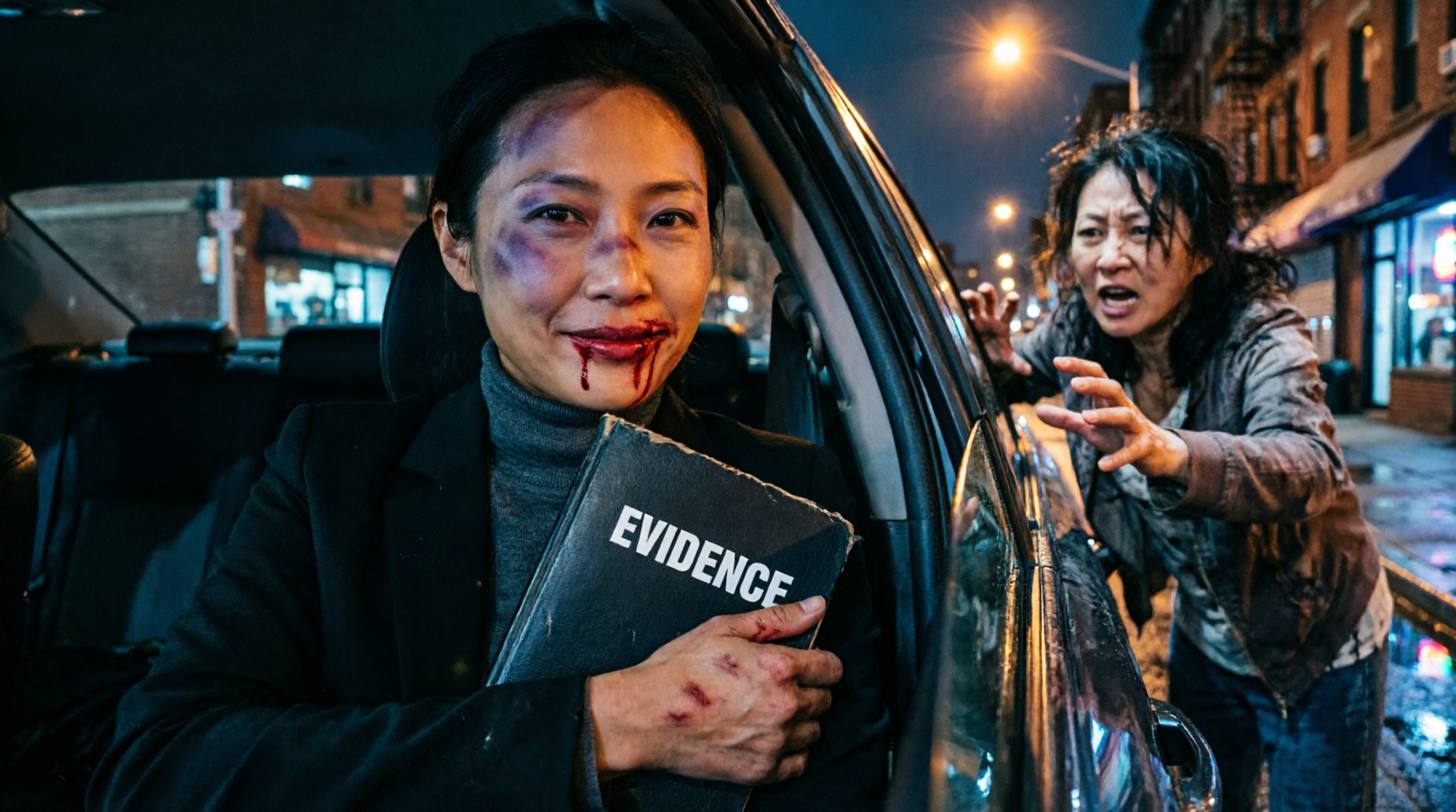
“Back then, when Aunt Kristen punched you, were you scared?”
I thought about the driveway. The blood in my mouth. Kristen’s perfume. Emma screaming upstairs. My phone recording in my hand.
“Yes,” I said. “But I was angrier than I was scared.”
Emma smiled faintly.
“I’m glad.”
“Me too.”
She hugged me goodnight, then walked to the guest room. She did not check the closet first. Not that night.
I stayed in the hallway for a moment after her door closed, listening to the ordinary sounds of my home: the heater clicking on, rain in the gutters, the old floor settling under its own weight.
No threats.
No whispers.
No footsteps coming to take what was mine.
I thought of Beverly’s last accusation.
You destroyed everything I built.
Maybe she was right.
I destroyed the silence she built. The fear she built. The family myth she built from money, obedience, and locked doors.
And I would do it again.
I would do it in every lifetime, in every version of the story, with blood on my lip and my daughter’s truth in my hands.
Because the night Emma whispered, “They’ll hurt you really bad,” she thought she was handing me danger.
What she actually handed me was the end of theirs.