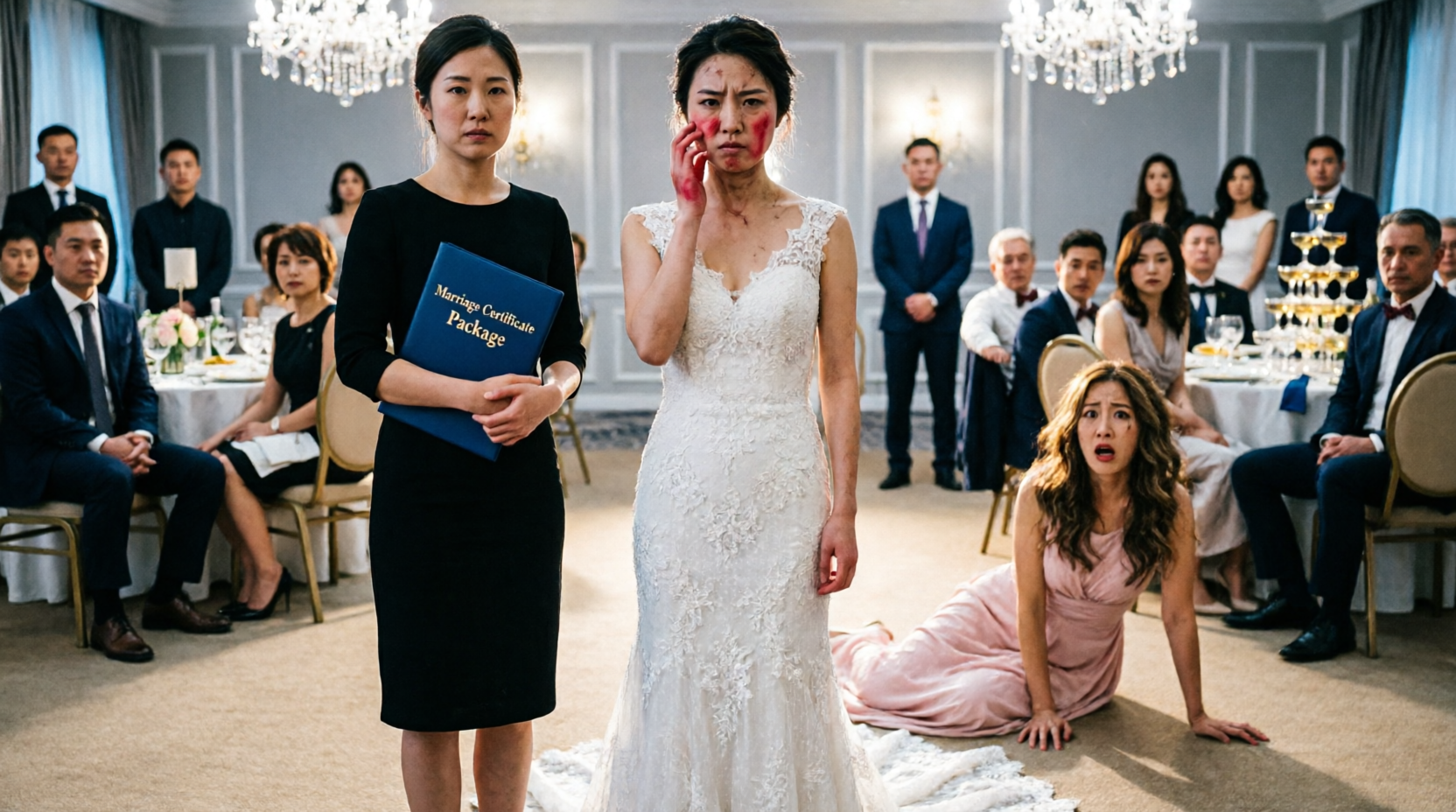
Veronica planned to announce a fake pregnancy at my wedding after our mother slapped me and our father twisted my arm so I would cooperate.
Julia never wrote back.
Therapy helped.
Not immediately. The first few sessions felt like taking boxes off a high shelf and discovering they were full of broken glass. My therapist, Dr. Meyers, had a small office that smelled like peppermint tea and old books. She didn’t gasp when I described my wedding morning. She didn’t tell me to forgive. She didn’t ask what I had done to provoke them.
She asked, “How old were you when you first remember feeling responsible for Veronica’s emotions?”
I almost said, I don’t know.
Then a memory rose so clearly I could smell the wax crayons.
I was five. Veronica was seven. I had drawn a house with a yellow sun and purple flowers. My teacher put a sticker on it. I brought it home excited, holding it carefully so it wouldn’t bend.
Mom glanced at it and said, “That’s nice, honey. Put it on the fridge.”
Veronica came in crying because she had gotten a B on a spelling quiz.
My drawing stayed on the kitchen counter until orange juice spilled on it the next morning.
In therapy, I told that story and felt silly.
Dr. Meyers did not look amused.
“Children learn their place through repetition,” she said. “Not one big event. Hundreds of small ones.”
Hundreds.
That word followed me home.
I began writing memories down. Not to send anyone. Not to prove anything. Just to stop them from floating around inside me like ghosts.
Veronica’s birthdays with rented ponies, magicians, custom cakes. Mine with grocery store cupcakes because “we just did a big party for your sister.” Veronica crashing Dad’s car and getting a replacement because accidents happen. Me paying for my own repairs after someone hit me in a parking lot because I needed to learn responsibility. Veronica crying during my high school graduation dinner because her boyfriend had canceled plans, and everyone leaving the restaurant early to comfort her.
Patterns emerged.
Not drama. Not jealousy.
A system.
Golden child. Scapegoat.
When Dr. Meyers used those words, I hated them at first. They sounded too neat for something that had lived inside my chest for decades. But over time, the labels helped. They gave shape to the fog.
Their dysfunction, not my inadequacy.
I wrote that phrase on a sticky note and put it on my bathroom mirror.
One morning, James saw it and added another below it.
You were always enough.
I cried over my toothbrush.
As the trial approached, Veronica’s defense shifted from denial to blame. She claimed Nathan controlled her. Then Lucas manipulated her. Then I orchestrated a vendetta. Then Taylor violated her privacy. Each story contradicted the one before it, but my parents repeated all of them like gospel.
Finally, Lucas took a plea deal.
Taylor called me the day it happened.
“He’s testifying,” she said.
I sat down on the stairs.
“What will he say?”
“That Veronica initiated the affair. That she planned the transfers. That Costa Rica was her idea. That the pregnancy lie was supposed to buy sympathy and distract Nathan from the missing money.”
My hand tightened around the phone.
“Distract him?”
“Yes.”
Suddenly the fake announcement sharpened into something even uglier. It wasn’t just about stealing my spotlight. It was cover. A smoke bomb. Another tool.
Taylor was quiet for a moment.
“There’s one more thing,” she said.
My pulse jumped.
“What?”
“She planned to claim twins later. Then a miscarriage.”
The stairs seemed to shift beneath me.
A fake pregnancy was cruel.
A fake loss was monstrous.
I pressed my hand over my mouth, feeling sick, as one terrible question settled in my chest.
How far would Veronica have gone if nobody had stopped her?
Part 8
The trial began eighteen months after my wedding.
By then, the internet had mostly moved on. New scandals, new villains, new clips of strangers behaving badly in public. Every so often, someone would tag me in the tackle video, and I would delete the notification without watching.
My life had become quieter.
Not perfect. Quiet.
James and I bought a small house with a blue front door and a maple tree in the yard. Taylor came over every Sunday for dinner unless work pulled her away. Aunt Linda visited once a month, always bringing something unnecessary and wonderful: peach jam, vintage baby books though I wasn’t pregnant yet, a ceramic owl she insisted “had my energy.”
I was learning the difference between peace and boredom.
Peace, I discovered, still had texture. The smell of garlic in a pan. James laughing from the laundry room because he had found one of my socks stuck to the inside of his shirt. Taylor sitting barefoot on our couch, eating takeout noodles and complaining about a cheating husband she was following for a case.
Boredom was empty.
Peace was full.
Then the trial pulled the old story back into the light.
I did not go to court, but Taylor did for key days, partly because she had to testify and partly because she knew I would want the truth without having to sit ten feet from my parents.
Her updates were precise.
Veronica wore navy to look humble. Mom cried loudly when the jury entered. Dad sat with his arms crossed, staring down every witness as if intimidation could reverse bank records.
The prosecution built the case piece by piece.
Invoices to fake vendors.
Transfers to accounts linked to Lucas.
Hotel receipts.
Flight confirmations.
Forged signatures.
Photos.
Texts.
Emails.
The fake pregnancy appeared not as the main crime, but as evidence of Veronica’s pattern: manipulation, false sympathy, strategic victimhood. Taylor testified about the investigation, about the texts between Veronica and Mom, about the plan to use my wedding reception as a stage.
My mother reportedly whispered, “Liar,” loud enough for three rows to hear.
The judge warned her once.
The forensic accountant was the witness who changed everything. Taylor described him as a calm man with rimless glasses and the emotional range of a printer. He walked the jury through every missing dollar, every shell company, every transfer split into smaller amounts to avoid attention.
At one point, he displayed a chart showing how company funds went from Silverstone to a consulting entity, then to a travel account, then to luxury hotels.
Veronica stared at the table.
Mom stood up and shouted, “My daughter is not a criminal!”
The judge threatened to remove her.
I heard that part from three different relatives within an hour.
Family embarrassment used to make me feel responsible.
This time, I made tea and turned my phone over.
Lucas testified on day seven.
He had lost weight, Taylor said. His expensive confidence was gone. He admitted the affair. He admitted helping hide money. He claimed Veronica told him Nathan was cruel, controlling, and dangerous. But under cross-examination, he admitted he had never seen Nathan behave abusively. He admitted Veronica had access to money. He admitted she had joked in texts that Nathan was “too trusting to check under the hood.”
That phrase haunted me.
Too trusting.
My parents had called me too sensitive. Too dramatic. Too selfish.
Nathan’s crime, apparently, had been trust.
Several character witnesses came forward, though not the kind Veronica wanted.
A college roommate testified that Veronica had once lied about being pregnant to keep a boyfriend from leaving her. A former friend described how Veronica borrowed money for “medical bills” and spent it on a designer bag. A business acquaintance said Veronica tried to plant the idea that Nathan was stealing from his own company months before the investigation began.
It was like watching lights turn on in a house I had always known was rotten.
Room by room, the damage became visible.
My parents drained their savings for Veronica’s defense. They refinanced their house. Sold Dad’s car. Started a crowdfunding campaign calling Veronica a victim of “malicious prosecution and family betrayal.” It raised less than three thousand dollars before the platform removed it.
I felt less satisfaction than I expected.
Mostly, I felt tired.
That surprised me. I thought justice would feel bright, like victory. Instead, it felt like cleaning out an infected wound. Necessary. Painful. Not something you cheered while doing.
The verdict came on a Thursday.
Guilty on embezzlement.
Guilty on fraud.
Guilty on forgery.
Not guilty on one lesser charge the prosecutors had always considered a stretch.
Taylor called from the courthouse steps.
“It’s done,” she said.
I sat at my kitchen table, staring at the maple tree outside. Its leaves had turned orange at the edges.
“How is Nathan?”
“Quiet. Relieved, I think. Sad.”
“And my parents?”
“Your mom collapsed into your dad. Your dad called the prosecutor corrupt. The judge threatened contempt.”
Of course.
No apology. No reckoning. Just more performance.
Sentencing came two weeks later.
Taylor attended again. I spent the morning painting the upstairs guest room because I needed my hands busy. The color was soft green, and by noon I had paint in my hair and on my elbow.
When Taylor called, I sat on the floor with my back against the wall.
“Three years,” she said. “Eligible for parole after eighteen months.”
I closed my eyes.
Veronica was going to prison.
My sister, who had once cried for three days because Mom wouldn’t buy her the prom dress she wanted, who had screamed at me for borrowing a sweater she hadn’t worn in years, who had stood in my bridal suite and told me my wedding day wasn’t about me anymore, was going to prison.
“Did she say anything?” I asked.
“She cried. Said she made mistakes. Said she deserved another chance.”
I opened my eyes.
“Did she apologize?”
Taylor was quiet.
“No.”
There it was.
Even at the edge of consequence, Veronica could not step outside herself long enough to see the people she had harmed.
Nathan wrote a letter asking the judge for justice, not revenge. Taylor said that letter probably kept the sentence from being harsher. That sounded like Nathan. Even wounded, he did not want to become cruel just because cruelty had touched him.
After the call, I sat in the half-painted room for a long time.
James found me there when he came home.
He looked at my face and set down his keys without asking for details.
“Come here,” he said.
I went into his arms.
That night, we ordered pizza and watched a stupid comedy neither of us paid attention to. Around nine, my email pinged.
The subject line was from my father.
Family Healing Meeting.
I opened it before James could stop me.
The message was long. It spoke of forgiveness. Unity. Hard seasons. Supporting Veronica during her incarceration. Protecting the family name. It mentioned God twice and accountability zero times.
My name appeared only once.
Claire, we expect you to attend with an open heart.
I stared at those words until they blurred.
Then Aunt Linda’s reply-all arrived.
I will not attend any meeting that asks Claire to carry the burden of Veronica’s crimes or Catherine and Ronald’s denial. Veronica is guilty. Claire was harmed. Start there or don’t start at all.
One by one, more relatives replied.
I agree with Linda.
Claire owes nobody an apology.
This family has enabled Veronica for too long.
Please remove me from this conversation.
By midnight, the family healing meeting was dead.
I should have felt relieved.
Instead, I sat in the glow of my laptop with my heart pounding, because for the first time, other people had said out loud what I had spent my whole life whispering to myself.
Part 9
My parents never apologized.
Not after the trial.
Not after the sentencing.
Not when they sold their house at a loss and moved two towns over because their social life had collapsed under the weight of Veronica’s crimes and their own public denial.
Mom lost her position on two charity boards. Dad’s business associates stopped inviting him to golf. Their church friends, who had once praised Catherine’s “devotion to family,” became suddenly busy when she called.
I heard these things through relatives, never directly.
My parents were blocked everywhere.
Blocking them did not feel dramatic after a while. It felt like locking the front door at night. Basic. Sensible. Protective.
Still, healing was not a straight road.
Some mornings, I woke with guilt sitting on my chest before I even opened my eyes. I would think, My mother is suffering. My father is aging. My sister is in prison.
Then another thought, quieter but stronger, would answer.
And they chose every step that led there.
Dr. Meyers helped me understand that guilt could be a reflex, not a command.
“You were trained to respond to their discomfort,” she told me. “That doesn’t mean their discomfort is your responsibility.”
I wrote that down too.
James and I kept building our life.
We painted rooms. Bought a dining table secondhand and sanded it in the garage. Burned the first roast chicken we attempted together and ate cereal for dinner on the kitchen floor. Hosted Thanksgiving with his parents, Aunt Linda, Taylor, and two friends who had nowhere else to go.
That first Thanksgiving without my parents was strange.
There was no tension humming under the table. No Veronica arriving late and somehow making it everyone else’s fault. No Mom criticizing the potatoes while praising Veronica’s salad. No Dad demanding we avoid “sensitive topics,” which usually meant anything that made Veronica uncomfortable.
Instead, James’s father carved the turkey badly and laughed at himself. Taylor brought pie from a bakery and claimed she had “supervised its creation.” Aunt Linda told a story about getting banned from a neighborhood book club in 1987 for calling the host’s husband boring to his face.
I laughed until I cried.
Not sad tears.
Surprised ones.
This was family too.
Warm plates. Bad jokes. People helping with dishes without being asked. No one keeping score.
After dessert, Aunt Linda found me in the kitchen wrapping leftovers.
“Your mother called me,” she said quietly.
My hands paused over the foil.
“When?”
“Last week.”
I folded the foil carefully over a bowl of stuffing. “What did she want?”
Linda leaned against the counter. “She wanted me to convince you to write to Veronica.”
I laughed under my breath. “Of course.”
“She said prison is breaking her spirit.”
I said nothing.
“She also said you’d always been hard-hearted.”
That one slid between my ribs, but not as deeply as it once would have.
“What did you say?”
Linda’s eyes softened. “I told her Veronica tried to fake a pregnancy at your wedding, stole from her husband, lied under oath, and never apologized. I said if her spirit is breaking, maybe that’s the first honest thing it’s done in years.”
A startled laugh escaped me.
“Linda.”
“What? I’m old. We get privileges.”
I hugged her then, right there between the sink and the dishwasher.
A month later, I found out I was pregnant.
The test turned positive on a Tuesday morning while James was outside trying to fix a gutter he had no business fixing. I stood in our bathroom, staring at the two lines, my heart beating so hard I could hear it in my ears.
For a second, fear came first.
Not joy.
Fear.
What if I became my mother? What if love turned into comparison without me noticing? What if I had two children one day and damaged them without meaning to? What if family patterns were bloodstains that never fully washed out?
Then James yelled from outside, “I may have made the gutter worse!”
I started laughing and crying at the same time.
I walked to the back door holding the test.
He turned, saw my face, and dropped the screwdriver into the grass.
“Claire?”
I held it up.
His mouth opened. Closed. Then he crossed the yard so fast he nearly tripped over the hose. He wrapped me in his arms, muddy gloves and all, and kept saying, “Really? Really?” like he needed the universe to repeat itself.
We told only safe people at first.
Taylor cried and then immediately began researching baby-proofing products as if the child were arriving armed. James’s parents shouted with joy over speakerphone. Aunt Linda sent a tiny knitted hat that looked like a strawberry.
I did not tell my parents.
That decision sat heavy for exactly one day.
Then it became light.
Pregnancy made my childhood memories sharper. Maybe it was hormones. Maybe it was the strange intimacy of growing a new life while grieving the one you had come from.
I remembered being eight and sick with the flu while Veronica had a dance recital. Mom left me with crackers and a bucket so both parents could attend. I remembered being thirteen and winning a writing contest, only for Dad to say, “Don’t brag. Veronica had a hard week.” I remembered being twenty-two and calling home after a breakup, only for Mom to ask if I could send Veronica money because she was “between paychecks.”
Each memory hurt.
But now, they also instructed.
Do not do this, they said.
When our daughter was born, the hospital room smelled like antiseptic, warm blankets, and the faint lavender lotion the nurse used after washing her hands. Labor was long. I cursed creatively. James cried openly. Taylor waited in the hall with coffee nobody drank.
Then Grace arrived.
Tiny. Furious. Perfect.
The nurse placed her on my chest, and the world narrowed to the weight of her body, the damp softness of her hair, the astonishing strength of her cry.
“Hi,” I whispered. “I’m your mom.”
The word mom almost scared me.
Then Grace opened her eyes, dark and unfocused, and something inside me rearranged itself.
Not magically. Not completely.
But enough.
A nurse asked if there was anyone else we wanted to call.
James was texting his parents. Taylor was already on her way in. Aunt Linda had been notified.
My phone sat on the bedside table.
For one moment, I thought of my mother’s blocked number.
Catherine would want to know. She would say she deserved to know. She would say family is family. She would cry about being denied her granddaughter.
I looked down at Grace’s tiny face.
Then I turned the phone screen down.
The past knocked from the other side, but for the first time in my life, I did not open the door.
Part 10
Motherhood did not heal me in the soft, instant way people sometimes pretend babies heal things.
It sharpened me first.
Grace was three weeks old when I understood that love could be exhausting and still never cruel. She woke every two hours. She cried with her whole body. She needed milk, clean diapers, warmth, rocking, burping, and the kind of patience that makes minutes feel like wet cement.
I was tired enough to put cereal in the refrigerator and milk in the pantry.
Still, when she cried, I picked her up.
I did not punish her for needing me.
That realization broke something open.
One night, at 3:12 a.m., I sat in the rocking chair while rain tapped against the nursery window. Grace was curled against my chest, making tiny snuffling sounds. The room glowed with the dim amber light of a lamp shaped like a moon.
I thought of myself at five, standing beside the refrigerator with my ruined drawing.
At eight, alone with a fever.
At thirteen, hiding my writing certificate in a drawer because Veronica had cried.
At twenty-nine, standing in a bridal suite with my cheek burning.
I looked at my daughter and whispered, “Never. Not you.”
James heard me from the doorway.
He came in quietly and sat on the floor beside the rocker.
“Hard night?” he asked.
“Not with her.”
He understood without needing more. He reached up and rested a hand on my knee.
The first year with Grace became a season of deliberate choices.
We celebrated small things loudly. First smile. First laugh. First time she rolled over and looked shocked by her own body. We took photos and printed them, not just leaving them trapped in phones. We clapped when she stacked blocks. We comforted her when she knocked them down and cried.
When she was six months old, Aunt Linda visited for Thanksgiving again.
Grace sat in a high chair wearing a bib covered in sweet potatoes. Taylor sat beside her making airplane noises with a spoon. James’s mother kept taking pictures. The house smelled like rosemary, butter, and cinnamon.
Halfway through dinner, Linda touched my arm.
“Your mother has been asking about the baby.”
My fork paused.
James looked at me, but didn’t speak.
“What did you tell her?” I asked.
“That Grace is loved and safe.”
A warmth spread through my chest.
Linda hesitated. “She says you’re punishing her.”
“I’m protecting my daughter.”
“I know.”
“Does she?”
Linda’s mouth tightened. “She says she never would have hurt a baby.”
The room noise seemed to dim around me.
I thought of Mom’s hand striking my face. Of her telling me to let Veronica have her moment. Of her asking me to help repair Veronica’s reputation before asking if I was okay.
“She hurt her own baby,” I said.
Linda’s eyes filled.
“I told her that.”
I looked toward Grace, who had smeared sweet potato into her hair and was laughing at Taylor’s terrible airplane crash landing.
“No visits,” I said. “No photos. No updates. If she asks again, you don’t have to carry messages.”
Linda nodded. “I won’t.”
That boundary became easier each time I protected it.
Veronica was released after serving just under two years.
I learned that from Taylor, who still monitored public records the way other people checked the weather. Veronica moved in with my parents. Lucas had vanished to another state after finishing his own legal obligations. Nathan sold the house he had nearly lost and relocated closer to his brother in Colorado.
He sent me one message before he left.
I hope your life is peaceful now. Mine is getting there. Thank you for not looking away.
I replied, I hope Colorado is kind to you.
That was the last direct contact we had for a long time.
Veronica’s release stirred old dust. Mom created a new social media account and posted vague quotes about redemption and judgment. Dad wrote a long post about “cancel culture destroying families.” Several relatives sent me screenshots until I asked them to stop.
Then, on a rainy Tuesday afternoon, a letter arrived.
The envelope was thin, gray, and stamped from the correctional facility’s forwarding system. My name was written in Veronica’s handwriting, those dramatic loops I had once envied when we were children.
I stood at the kitchen counter with Grace napping upstairs and rain sliding down the window.
For a full minute, I didn’t move.
Then I called James.
He came home early without asking me to justify it.
We sat at the dining table, the same secondhand table we had sanded together, and I opened the envelope with a butter knife.
Three pages.
Of course.
Veronica had always believed her feelings deserved length.
The letter began with Claire, I hope you’re finally ready to hear my side.
Not I’m sorry.
Her side.
She wrote that prison had given her time to reflect, then spent two paragraphs explaining that Nathan had been emotionally unavailable. She admitted the fake pregnancy announcement was “in poor taste,” but said I had “overreacted by involving law enforcement,” as if Taylor’s folder had forced her to steal two hundred thousand dollars.
She claimed Mom and Dad were brokenhearted.
She said I had always been “luckier” because I was quieter and people expected less from me.
She said she wanted to meet Grace.
I stopped reading.
James reached across the table. “You don’t have to finish.”
“I want to.”
So I did.
The final paragraph was the only part that resembled an apology.
I’m sorry things got so out of hand, but you need to understand that I was desperate. If you can write a letter supporting my early record clearing and tell the family you forgive me, we can all start fresh. I miss having a sister.
I stared at the last sentence.
I miss having a sister.
She didn’t miss me.
She missed access. She missed the old arrangement. She missed a version of me who absorbed damage quietly and called it love.
James sat still, waiting.
“What do you want to do?” he asked.
I folded the letter carefully.
For a moment, I pictured replying with every truth I had swallowed since childhood. I pictured listing the ruined veil, the slap, the stolen money, Nathan’s face, the fake twins, the fake miscarriage she had planned, the way she still couldn’t say I hurt you without placing herself at the center.
But some people turn every response into rope.
I was done handing Veronica rope.
I stood, walked to the fireplace, and struck a match.
The paper caught slowly at first, then all at once, flames curling through her loops and excuses until the words blackened and disappeared.
James came to stand beside me.
I watched the last corner fold into ash.
“No answer?” he asked.
“No answer.”
Grace stirred upstairs, making a soft sound through the baby monitor.
I turned toward it immediately.
That was the difference.
When my child called, I went.
Behind me, the ashes settled, and I felt nothing but clean air where obligation used to be.
Part 11
Years later, people still sometimes recognized me from the video.
Not often. Not in any way that mattered. Usually it was a cashier squinting at me for half a second too long, or someone at a party saying, “Wait, are you the bride from that crazy wedding clip?”
I always answered the same way.
“I used to be.”
That confused people, which I liked.
Because I was not the bride frozen in that ballroom anymore. I was not the woman with concealer over a slap mark, waiting for her sister to steal one more thing. I was not the daughter begging her mother to understand something as simple as kindness.
I was Claire.
James’s wife.
Grace’s mother.
Taylor’s chosen sister.
Aunt Linda’s emergency contact.
A woman who grew tomatoes badly, forgot laundry in the washer, cried at school plays, and could make a decent lemon cake if nobody rushed her.
My parents tried twice more to reach me.
The first time was through a Christmas card sent to our old address and forwarded by the post office. It contained a photo of them with Veronica in front of a decorated tree. Veronica looked thinner, harder, her smile sharp at the edges. Mom had written, Life is short. Don’t teach your daughter bitterness.
I threw it away.
The second time was after Grace turned three. Dad emailed James at work, accusing him of “keeping Claire from her family.”
James showed me the email that evening while Grace built a crooked tower of blocks on the rug.
“What do you want me to do?” he asked.
“Nothing.”
He nodded and deleted it.
That was love too.
Not fighting battles I hadn’t asked him to fight. Not pushing forgiveness because it sounded noble. Not confusing peace with reunion.
Veronica never met Grace.
My parents never held her.
Some people would call that sad, and maybe it was. But sadness was not the same as regret.
Grace grew up surrounded by people who delighted in her. James’s parents came to every preschool event with embarrassing enthusiasm. Taylor taught her how to spot “suspicious behavior,” which mostly meant noticing when James tried to sneak extra cookies. Aunt Linda told her stories that began with “When I was young and foolish,” though I suspected Linda had never stopped being either.
On Grace’s fourth birthday, we held a party in the backyard.
Nothing huge. No ponies. No rented performers. Just balloons, cupcakes, a bubble machine, and a dozen children running through the grass like tiny drunk squirrels.
Grace wore a yellow dress and rain boots because she had strong opinions. When we brought out the cake, she gasped like we had wheeled in the moon.
Everyone sang.
She blew out the candles one by one, cheeks puffed, eyes shining.
Afterward, she climbed into my lap with frosting on her nose.
“Mommy,” she said, “was this my special day?”
I smoothed her curls back.
“Yes, baby. All yours.”
She considered this seriously. “But everyone had cupcakes.”
I smiled. “People can share cupcakes without taking your day away.”
She nodded, satisfied, and ran off toward Taylor, who was pretending to lose a bubble battle.
I sat there for a moment, feeling sunlight on my arms and grass beneath my feet.
That sentence stayed with me.
People can share cupcakes without taking your day away.
It sounded simple enough for a child because healthy love often is simple. There is room. There is enough. Someone else’s joy does not require your erasure.
My family had never understood that.
Or maybe they had, and chose not to care.
Either way, I no longer needed them to understand in order for me to be free.
Later that evening, after the guests left and Grace fell asleep surrounded by new stuffed animals, James and I sat on the back steps with leftover cupcakes between us. The yard was messy with ribbons, paper plates, and the last stubborn bubbles drifting through the dusk.
Taylor had stayed to help clean and was now inside loading the dishwasher with the intensity of a woman defusing a bomb.
James bumped my shoulder with his.
“You okay?”
I looked through the window at our kitchen. Taylor laughing at something Aunt Linda said. Grace’s birthday banner hanging crooked. James’s mother wrapping leftovers. A house full of people who stayed after the party because love washed dishes too.
“I am,” I said.
And I meant it.
Not because the past had vanished. It hadn’t. There were still days when an old memory could bruise me. Still moments when Grace’s innocence made my own childhood ache. Still dreams where I was back in that bridal suite, trying to hold on to a veil someone else had already decided to tear.
But healing had never meant forgetting.
Healing meant the memory no longer got to drive.
Veronica’s life remained Veronica’s life. I heard, through the family grapevine I no longer watered, that she struggled to find work, blamed Nathan for blacklisting her, blamed Lucas for abandoning her, blamed me for exposing her. My parents continued orbiting her like exhausted moons, spending their later years protecting the fantasy that their golden child had only fallen because someone pushed her.
I did not correct them.
I did not rescue them.
I did not forgive my way back into the fire.
Some betrayals close doors that should stay closed.
Nathan eventually remarried, or so Aunt Linda told me with a pleased little smile. “A veterinarian,” she said. “Very kind. Wears practical shoes.” That made me happier than I expected. Not because Nathan needed a romantic ending to matter, but because he deserved a life not defined by what Veronica stole.
So did I.
And I got one.
The night after Grace’s party, I went upstairs to check on her before bed. Her room smelled like bubble soap, clean pajamas, and the strawberry shampoo she loved. A night-light cast stars across the ceiling.
She was asleep on her side, one hand tucked under her cheek.
On her dresser sat a drawing she had made that morning. Our house, with a blue door. Three stick figures holding hands. A fourth figure with wild hair labeled TAYR because she was still learning letters. A big yellow sun in the corner.
I had framed it that afternoon.
Not because it was perfect.
Because she was proud of it.
I stood there looking at that crooked little drawing, and for a moment I saw another one: a house with purple flowers, left on a counter until juice ruined it.
The old grief rose.
Then it passed.
Downstairs, James called softly, “Claire?”
“Coming.”
I kissed Grace’s forehead and whispered, “You are so loved.”
Then I turned off the lamp and walked toward the life waiting for me.
My wedding day had not been the fairy tale I imagined. It had been loud, humiliating, brutal, and public. My veil was torn. My family was exposed. My reception became a courtroom before the real courtroom ever began.
But it was also the day I stopped paying for love with silence.
It was the day I learned that truth, when finally given air, can look messy before it looks beautiful.
And in the end, I did get my happy ending.
Not because the people who hurt me came back with apologies in their hands.
Because they didn’t.
I got it because I walked away from them, chose the people who chose me, and built a home where nobody had to steal the spotlight to feel seen.
Outside Grace’s room, I paused at the top of the stairs and listened to the sounds below: dishes clinking, James laughing, Taylor arguing with the dishwasher, Aunt Linda telling someone not to stack wet plates like an amateur.
Warmth filled my chest.
For once, there was no question waiting at the end of the night. No threat behind the door. No performance to survive.
Only my life.
Mine at last.