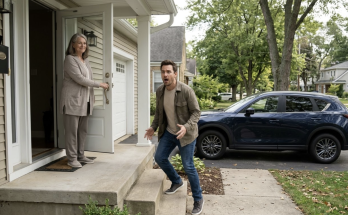
Two weeks later, Daniel came back.
This time, he didn’t arrive alone.
My granddaughter Emily was sitting in the passenger seat.
She was twenty-three years old, recently graduated from college, and had always been the person in our family who asked questions nobody else wanted to answer.
She knocked on my front door.
“Grandma?”
I opened it.
She immediately hugged me.
“Oh, Grandma.”
I held her tightly.
“What brings you here, sweetheart?”
She stepped inside.
“Dad told me everything.”
I looked toward Daniel.
He was standing on the porch, looking older than I remembered.
“Everything?” I asked.
Emily nodded.
“He told me about the grave, the money, and the court.”
I looked at Daniel.
“Did you tell her why?”
He lowered his head.
“Yes.”
Emily sat at the kitchen table.
“Grandma, I don’t understand how he could do that to you.”
I touched her hand.
“Sometimes people make selfish choices, even when they love someone.”
“But he promised Grandpa.”
“I know.”
Daniel finally entered the kitchen.
He didn’t sit down immediately.
Instead, he placed a large envelope on the table.
“Mom, I brought something.”
I opened it.
Inside was a cashier’s check.
$12,000.
Every dollar he had taken from my account.
I stared at it.
“Where did this come from?”
“I sold my motorcycle. I also used some savings.”
I looked at him.
“Why?”
He swallowed.
“Because I should never have taken it.”
It was the first time he had said those words without adding an excuse.
Then he pulled out another piece of paper.
It was a written statement acknowledging that the cemetery sale had been made through an improper use of his authority and that he had no ownership interest in my burial plot.
Margaret had requested the documentation as part of the legal resolution.
I read it carefully.
Then I put it down.
“Thank you.”
Daniel looked surprised.
“That’s it?”
“What else would you like me to say?”
He rubbed his eyes.
“I don’t know. I thought you’d be angrier.”
“I was angry. I was hurt. I spent many nights wondering whether I had raised a son who saw his mother as nothing more than something to use.”
His face crumpled.
“Mom, I’m sorry.”
I took a slow breath.
“Daniel, I can accept an apology. But I cannot pretend nothing happened.”
He nodded.
“I understand.”
“And you will not have power of attorney again. Margaret will help me arrange everything properly.”
“I understand.”
“And if you ever need help, you can ask me. But you cannot take what belongs to me and call it help.”
He began crying.
Emily reached for his hand.
I watched them.
For a moment, I wished Harold were sitting beside me.
He would have known what to say.
He always knew how to make difficult conversations feel a little less impossible.
The legal process continued for several more weeks.
The cemetery completed its investigation and corrected the ownership records.
The authorities reviewed the financial transactions and the misuse of the power of attorney. Daniel cooperated, repaid the money, and faced the consequences of his actions through the appropriate process.
I didn’t interfere with that process.
I had already learned that protecting someone from the consequences of their choices could sometimes mean allowing them to hurt other people again.
Meanwhile, Jenny and I began speaking occasionally.
She told me she had moved Patricia’s belongings into a small storage unit.
One afternoon, she invited me to see something.
It was a photograph of Patricia standing in front of her garden.
She was smiling, holding a basket of tomatoes.
“Mom loved gardening,” Jenny said.
I studied the picture.
“Harold loved tomatoes.”
Jenny laughed softly.
“Really?”
“He planted them every spring. Usually too many. We’d end up giving them away to half the neighborhood.”
She smiled.
“Maybe Mom would have liked him.”
“I think they would have argued about how to grow them.”
For the first time, we laughed together without feeling uncomfortable.
Then Jenny looked at me.
“I want you to know something. I never wanted your place beside Harold.”
I looked at her.
“I know.”
“I wish Daniel had told me the truth.”
“So do I.”
She took my hand.
“I hope one day we can all sit together again.”
I squeezed her fingers.
“One day at a time.”
Winter approached.
My cardiologist told me my heart condition was progressing.
There were medications to adjust, appointments to attend, and days when walking from the bedroom to the kitchen left me exhausted.
I wasn’t frightened of dying.
I had been married to Harold for forty-seven years.
I knew what it meant to love someone deeply enough that losing them changed the shape of every day.
But I wasn’t ready to leave yet.
There were still things I wanted to do.
So I made a list.
At the top was something simple.
I wanted to finish planting the roses along the front fence.
Harold had started that garden thirty years earlier.
I wanted it to look beautiful again.
Emily came over every Saturday to help.
She trimmed the branches while I sat in a chair and told her stories about her grandfather.
One afternoon, she asked me something.
“Grandma, do you think Grandpa would be disappointed in Dad?”
I looked at the roses.
I thought about Harold’s patience, his gentle nature, and the way he always believed people deserved another chance.
Then I answered honestly.
“I think your grandfather would be disappointed in what your father did. But I also think he would want him to become a better man.”
Emily nodded.
“Do you think Dad can?”
“I don’t know, sweetheart. That’s something he has to prove.”
She was quiet for a moment.
Then she smiled.
“You’re stronger than you think, Grandma.”
I laughed.
“Your grandfather used to say the same thing.”
On the first Sunday of December, Daniel called.
“Mom, can I visit the cemetery with you?”
I looked at the calendar.
It was the anniversary of Harold’s birthday.
“Of course.”
We met at the entrance at ten in the morning.
Daniel was carrying a small bouquet of white roses.
I had brought Harold’s favorite coffee in a thermos.
We walked together beneath the maple tree.
Daniel stopped when he saw the empty plot beside his father’s grave.
He stared at it for a long time.
Then he turned toward me.
“Is this where you’ll be buried?”
“Yes.”
He looked down.
“I still can’t believe I did that.”
I placed the coffee beside Harold’s headstone.
“Neither can I.”
He knelt and placed the roses between the two plots.
“I’m sorry, Dad,” he whispered.
I didn’t interrupt.
He stayed there for several minutes.
Then he stood up and looked at me.
“Mom, I know I don’t deserve to ask this, but can I come here with you again next Sunday?”
I looked at my son.
He wasn’t the little boy who had broken the window anymore.
He was a grown man who had made a terrible decision and was finally beginning to understand its cost.
“Yes, Daniel.”
He nodded.
We sat on the stone bench.
For a while, neither of us spoke.
Then Daniel asked, “Do you remember when Dad used to bring you coffee here?”
I smiled.
“Every Sunday.”
“He always brought two cups.”
“Yes.”
“Even after you stopped drinking coffee in the afternoon.”
I laughed.
“He said he didn’t want to sit alone.”
Daniel smiled sadly.
We sat together until the coffee was gone.
When it was time to leave, Daniel offered me his arm.
I accepted.
Not because I needed him to make decisions for me.
But because sometimes a mother still wants to walk beside her son.
By spring, my headstone was ready.
The cemetery called to say it had been installed.
I went alone that Sunday.
The maple tree was beginning to grow new leaves.
Harold’s name was carved into the granite on the left.
My name was on the right.
Between them was a small engraved line:
Together in life. Together in peace.
I ran my fingers over the letters.
For a long time, I simply stood there.
Then I noticed a small envelope tucked beneath the flowers on Harold’s grave.
My name was written on it.
I recognized Daniel’s handwriting.
Inside was a letter.
Mom,
I have written this several times, but I never knew how to begin.
I keep thinking about the day you called me and asked why Jenny’s mother was buried beside Dad.
I remember how quickly I tried to explain it away.
I told myself I was helping Jenny. I told myself you weren’t using the plot. I told myself I would fix everything later.
But the truth is that I made a decision because I thought your feelings didn’t matter as much as my convenience.
I was wrong.
I also thought being your son gave me the right to make decisions for you. It didn’t.
I know paying back the money doesn’t erase what happened. I know moving Pat’s grave doesn’t erase the pain. And I know saying sorry doesn’t automatically make you trust me again.
But I want to spend whatever time we have left making sure you never feel like you have to fight your own family to protect yourself.
I miss Dad.
I miss the way our family used to be.
And I miss being the son you could trust.
I’m sorry, Mom.
Love, Daniel.
I folded the letter carefully.
Then I placed it inside my handbag.
I didn’t cry.
Instead, I looked at Harold’s name.
“Well, sweetheart,” I whispered. “Our boy is trying.”
A breeze moved through the maple branches.
I sat on the stone bench and watched the sunlight move across the grass.
For years, I had imagined my final resting place as something simple.
A quiet piece of ground.
A place beside the man I loved.
But I had never imagined that protecting that small piece of ground would teach me so much about the living.
I learned that love without respect can become a weapon.
I learned that family does not give anyone permission to take away your choices.
And I learned that forgiveness is not the same as forgetting.
Sometimes forgiveness means opening the door again.
Sometimes it means keeping the door closed.
And sometimes it means allowing someone to walk beside you while making sure they never hold the keys to your life again.
I looked at the two names carved into the granite.
Harold Avery.
Eleanor Avery.
Forty-seven years together.
And now, finally, the ground between us belonged to no one else.
I stood slowly, picked up the empty coffee thermos, and brushed a fallen maple leaf from Harold’s stone.
“I’ll see you next Sunday,” I whispered.
Then I walked toward the cemetery gate.
My heart was still failing.
My body was growing weaker.
But my life was still mine.
And as I reached the gate, I saw Daniel waiting beside his car.
He opened the passenger door.
“Ready, Mom?”
I smiled.
“Ready.”
He helped me into the car.
As we drove away, I looked back one last time at the maple tree.
For the first time in two years, I didn’t feel that someone had stolen my place.
Because they hadn’t.
I had taken it back.
And that was the last thing I wanted my family to understand: You can love someone with your whole heart without surrendering your right to decide what happens to your own life.