PART 3
He looked toward the backhoe, then at the two men standing beside it. One was the cemetery superintendent. The other was a licensed funeral director named Thomas Reed.
Daniel’s face changed when he noticed the third person standing beside me.
My attorney, Margaret Collins.
“Mom, this is ridiculous. We already discussed this.”
“No, Daniel. You discussed it. I listened.”
Margaret stepped forward.
“Mr. Avery, your mother obtained a court order authorizing the correction of the burial placement following an investigation into the unauthorized transfer of her property. The cemetery has agreed to comply with the order.”
Daniel stared at her.
“Unauthorized? I had power of attorney!”
“Not unlimited authority to give away your mother’s burial rights for your personal convenience,” Margaret replied.
Jenny finally spoke.
“Mrs. Avery, please. Can we talk about this privately?”
I looked at her.
“Privately? You had two years to speak to me privately. Two years to tell me what your husband had done.”
She lowered her eyes.
I continued.
“I visited my husband’s grave every Sunday. I brought him coffee. I talked to him about my heart appointments, the weather, and the little things happening in the neighborhood. And every single time, I sat beside the grave of your mother without knowing that the ground beneath her belonged to me.”
Jenny began crying.
“I didn’t know he sold it.”
I believed her.
That was the worst part.
I believed her.
Daniel stepped between us.
“Mom, Pat was already buried. She was dead. What difference does it make now?”
I looked at my son for a long moment.
Then I opened Harold’s photograph album.
Inside was a picture taken in 1979.
Harold and I stood beneath the very same maple tree, young enough to believe we had another fifty years together. He was holding the cemetery deed in one hand, and I was laughing at something he had said.
On the back, in Harold’s handwriting, were six words:
“Together here, just as in life.”
I held the photograph out to Daniel.
“Your father and I bought those two plots together. We saved for them. We chose them together. He wanted us to be side by side when our time came.”
Daniel looked at the picture but didn’t take it.
“Mom, I know.”
“No, you don’t. You know the price of the land. You know how much you received. But you don’t know what it meant.”
I closed the album.
“And that’s why we’re here.”
The cemetery superintendent approached us.
“Mrs. Avery, everything is ready.”
I nodded.
The backhoe moved slowly toward Patricia’s grave.
Daniel suddenly stepped forward.
“Stop! You can’t dig up Jenny’s mother!”
The superintendent raised his hand, signaling the operator to wait.
Margaret took a document from her folder.
“Mr. Avery, the court order requires that the cemetery follow the relocation procedure. Mrs. Avery has also arranged and paid for a new burial plot for Mrs. Walsh, including the transfer of the headstone and all associated expenses.”
Jenny looked up.
“What?”
I turned toward her.
“Your mother deserves a proper resting place. I am not trying to punish a dead woman for something she never did.”
Jenny covered her mouth.
“I’ve arranged a beautiful plot in the garden section, beneath a flowering dogwood tree. It’s peaceful. It’s private. There is room for the family to visit.”
For the first time that morning, Daniel looked genuinely ashamed.
“Mom…”
I raised my hand.
“Please. Let them finish.”
The cemetery workers began their carefully supervised work.
I didn’t watch every movement. I couldn’t.
Instead, I walked to Harold’s grave and placed my hand on the cold granite.
“Well, Harold,” I whispered. “It looks like we have some rearranging to do.”
I could almost hear him laughing.
He had always said I was stubborn.
He wasn’t wrong.
The relocation took several hours.
Everything was handled respectfully, with the funeral director supervising each step. Patricia’s remains were transferred according to the court’s instructions, and her new burial arrangements were completed that afternoon.
Jenny stayed until the end.
Daniel left before noon.
I didn’t chase him.
For the first time in my life, I understood that loving someone did not mean running after them every time they walked away.
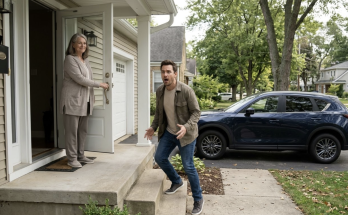
Three days later, Jenny came to my house.
She was carrying a small cardboard box.
I opened the door and found her standing on the porch with swollen eyes.
“May I come in?”
I stepped aside.
We sat at the kitchen table where I had celebrated birthdays, Christmas dinners, and countless family gatherings.
Jenny placed the box between us.
“I found these in my mother’s apartment.”
Inside were bank statements, a small notebook, and several envelopes.
I looked at her.
“What are these?”
“Things Daniel gave my mother. I didn’t know about them until after everything happened.”
My stomach tightened.
Jenny opened the notebook.
“Mom kept track of the money he gave her. She wrote down everything.”
I read the first page.
March 2024.
Received $4,000 from Daniel. Burial plot purchased. He said his mother would never need it.
My hands went cold.
I turned another page.
April 2024.
Daniel promised to help with the remaining expenses.
May 2024.
Daniel says his mother has enough money and won’t notice.
I stopped reading.
Jenny was crying again.
“There’s more.”
She removed an envelope.
Inside was a bank transfer confirmation.
The money from the sale had not gone toward Patricia’s funeral.
It had gone into Daniel’s personal account.
Then I found something that made me look up.
A second transfer.
$2,800.
The recipient was a home renovation company.
Jenny shook her head.
“He told me the money came from a bonus at work.”
I leaned back.
“Why are you showing me this?”
“Because I don’t want to protect him anymore.”
She wiped her cheeks.
“After Pat died, I asked Daniel how he managed to find a burial plot so quickly. He told me not to worry about it. I believed him.”
She took a breath.
“But last week, after he found out about the court order, he told me you were having memory problems. He said you had become confused and that he might need to take control of your finances.”
I stared at her.
“Did he?”
Jenny nodded.
“He contacted a lawyer. He wanted to know if there was a way to reinstate his power of attorney.”
For several seconds, I couldn’t speak.
Then I carefully placed the papers back inside the box.
“Thank you for bringing these to me.”
Jenny reached across the table.
“I’m sorry.”
I looked at her hand.
“Jenny, your mother wasn’t my enemy. And I don’t want you to become one either.”
She began sobbing.
I let her cry.
Sometimes people need forgiveness.
Sometimes they need consequences.
And sometimes, they need both.
The following Monday, Margaret called me.
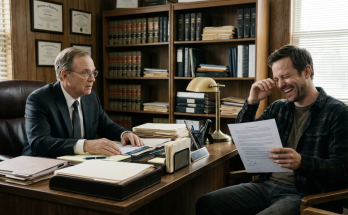
“Mrs. Avery, I reviewed the documents Jenny brought you. There is something else we need to discuss.”
“What is it?”
“Your son appears to have used the original power of attorney to access more than the cemetery transaction. I recommend that we review your financial records for the last two years.”
I closed my eyes.
“How much?”
“I don’t know yet. But I would not ignore this.”
That afternoon, I went to the bank.
I requested statements for every account Daniel had been authorized to manage.
The bank manager printed a thick stack of papers.
I sat in a private office and began reading.
At first, everything looked normal.
Then I noticed a monthly withdrawal.
$500.
Another month.
$500.
And another.
The withdrawals had started shortly after Harold died.
I counted them.
Twenty-four months.
Twelve thousand dollars.
I turned to the manager.
“Who authorized these?”
He examined the records.
“They were initiated under the financial power of attorney.”
“Where did the money go?”
He showed me the account number.
It belonged to Daniel.
I felt something inside me go very still.
The money wasn’t enormous compared with what some people had.
But it was mine.
It was the money Harold and I had saved by repairing things instead of replacing them, cooking at home instead of eating out, and putting away a little every month.
It was the money I had planned to use for medication, groceries, and whatever years I had left.
I asked the manager to freeze Daniel’s access immediately.
Then I called Margaret.
By Friday, we had enough documentation to begin formal proceedings to recover the money and investigate the transactions.
I also learned something else.
Daniel had been telling relatives that I was becoming forgetful.
He had told my sister-in-law that I sometimes confused dates.
He had even told my granddaughter, Emily, that I might eventually need to move into assisted living.
I had never once forgotten an appointment.
I had never missed a bill.
And I still remembered the exact day Harold proposed to me.
But apparently, in Daniel’s version of my life, I was already incapable of making my own decisions.
That hurt more than the stolen money.
Because money could be replaced.
Trust was different.
Two weeks later, Daniel finally came to see me.
He arrived without calling.
I was watering the roses Harold had planted when I heard his car pull into the driveway.
He walked toward me with his hands in his pockets.
“Mom.”
I turned off the garden hose.
“Daniel.”
“Can we talk?”
I pointed toward the porch.
We sat in the same chairs where he used to sit as a boy, eating ice cream after school.
For a moment, I saw the little boy who had once fallen asleep on my shoulder during a thunderstorm.
Then he spoke.
“Jenny told me she gave you the papers.”
“She did.”
He looked down.
“Mom, I can explain.”
“I’ve heard your explanations.”
“I was going through a difficult time. The house needed repairs. Jenny’s mother was sick. I was trying to keep everyone happy.”
“And taking twelve thousand dollars from me helped?”
He rubbed his forehead.
“I was going to pay it back.”
“When?”
He didn’t answer.
I leaned forward.
“Daniel, do you remember when your father was dying?”
His eyes lifted.
“You used to come over every evening. You sat beside his bed and promised him you would look after me.”
“I meant it.”
“Then what happened?”
He looked away.
I waited.
Finally, he whispered, “I don’t know.”
I nodded slowly.
“That’s the first honest thing you’ve said to me.”
His eyes filled with tears.
“Are you really taking me to court?”
I looked at him.
“I didn’t take you to court because you made a mistake. I took action because you kept making choices that belonged to me.”
“You’re my mother.”
“And I am still a person, Daniel. I am not an account you can withdraw from. I am not a property you can sell. And I am not a woman whose future you can decide because you think she won’t be around long enough to complain.”
He began crying.
I didn’t.
Then I said something I had been practicing in my head for weeks.
“I love you. But I will not give you the power to hurt me again.”
He stood up.
For a moment, I thought he might hug me.
Instead, he walked to his car.
At the driveway, he turned around.
“Can I still visit?”
I looked at him.
“Yes. But you will have to come as my son, not as the person who controls my life.”
He nodded.
Then he drove away.
I watched until his car disappeared.
And for the first time since Harold died, I went inside without feeling completely alone.
Because I finally understood that protecting my peace was not the same thing as giving up on my family.
It was simply refusing to disappear inside it.
PART 4
Three months passed after Daniel drove away from my house.
Autumn arrived early that year.
The maple trees outside my kitchen window turned orange and red, and the mornings became cold enough that I started wearing Harold’s old cardigan again.
Every Sunday, I continued visiting the cemetery.
Only now, when I sat beside Harold, the ground on his other side was finally empty.
The new grass had begun growing where Patricia’s grave had been.
I had ordered a small wooden marker to remain there temporarily until my headstone was ready.
It wasn’t much.
Just a simple inscription:
Reserved for Eleanor Avery. Beloved Wife of Harold Avery.
I wanted to see my name there.
Not because I was in a hurry to die, but because after everything that had happened, I wanted to know that at least one decision about my future still belonged to me.
And then, one Thursday morning, Margaret called.
“Mrs. Avery, we have an update regarding Daniel.”
I sat down.
“Go ahead.”
“The bank has completed its review. The withdrawals totaling $12,000 were made without your informed consent. The cemetery transaction is also part of the investigation.”
“What happens now?”
“Your son has been formally notified that he must repay the money. We have also recommended that the relevant authorities review the documents he submitted under the power of attorney.”
I looked through the kitchen window.
“Will he go to prison?”
“That isn’t something I can promise or predict. But the evidence is now documented, and the appropriate authorities will decide what happens next.”
I thanked her and hung up.
I wasn’t celebrating.
I wasn’t hoping to destroy my son.
I simply wanted the truth to exist somewhere outside my own memory.
For too long, Daniel had been able to change the story whenever it suited him.
Now there were bank statements, signatures, transfer records, and court documents.
There was no more room for excuses.