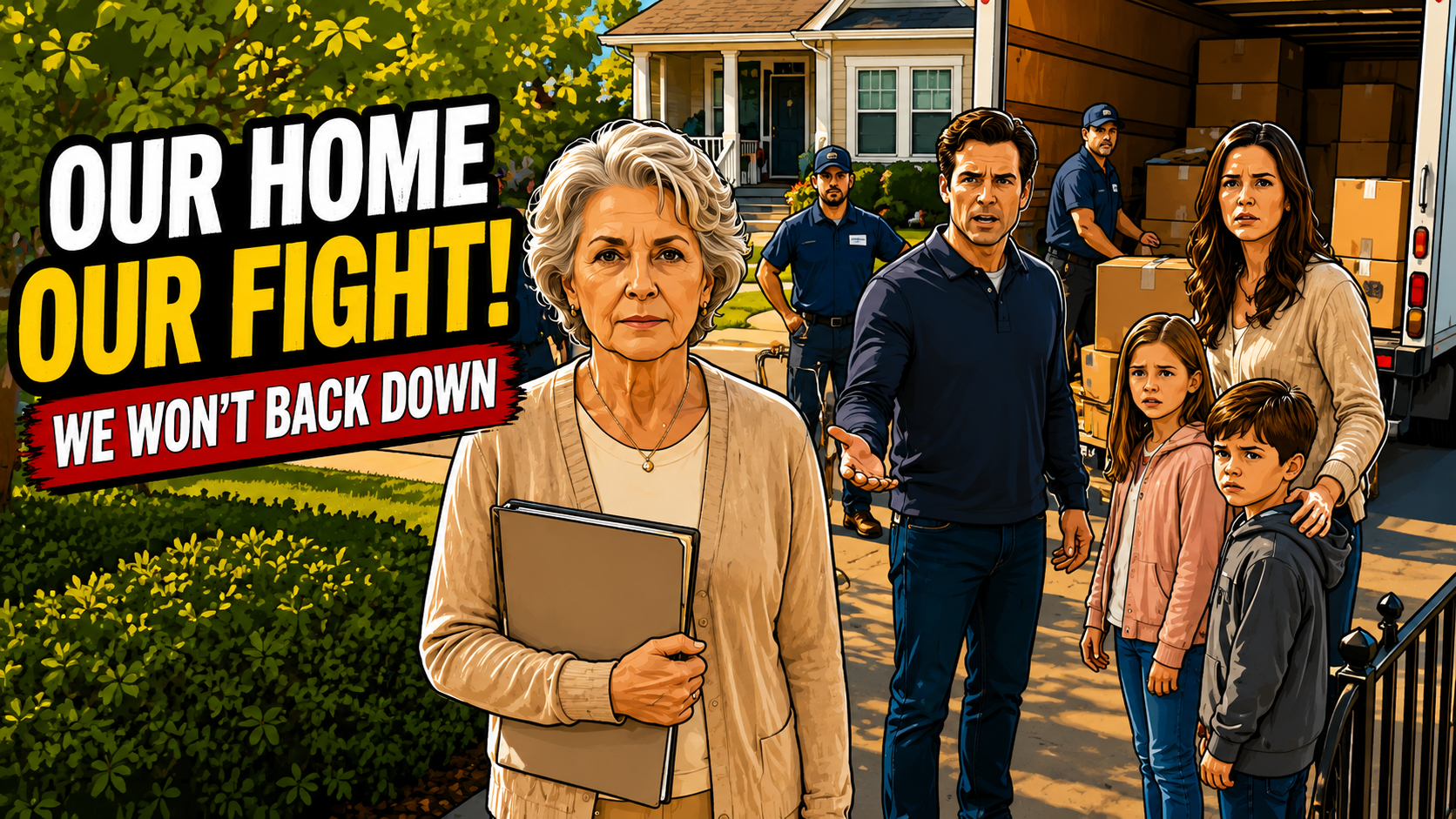
Randall blinked at me like he hadn’t heard me correctly.
Then he laughed.
Not loudly. Not cruelly, at least not in the way cruelty is usually performed. It was the same dismissive little laugh he had given me on Tuesday—the one that said I was an obstacle, not a person.
“Mom,” he said, already irritated, “what does that even mean?”
“It means,” I said, still calm, “no one is moving into my house today.”
The movers shifted behind him.
One of them glanced at the other, already sensing what kind of morning this was about to become.
Randall exhaled sharply and put his hands on his hips, performing patience for the benefit of everyone watching.
“Don’t do this in front of the kids.”
That, more than anything, almost made me smile.
As if public humiliation were my weapon and not the one he had brought to my front lawn in a rented truck.
Penelope stood very still beside the passenger door, one hand resting on her youngest daughter’s shoulder. Her face had already changed. The confidence she’d arrived with was gone. In its place was something sharper.
Confusion.
Gladys, meanwhile, looked annoyed to be standing in the sun.
“Randall,” she snapped, “tell your mother to stop being dramatic and open the house.”
I turned to her.
“No.”
She looked stunned.
Not angry yet.
Just startled in the way entitled people often are when someone answers them plainly.
Randall took a step closer.
“Mom, we already talked about this.”
“No,” I said. “You talked. I listened.”
His jaw tightened.
From behind him, one of the children—my eldest grandson—tugged at Penelope’s sleeve.
“Mom? Why are we waiting?”
Penelope didn’t answer.
She was looking at me now.
Really looking.
Not like a mother-in-law.
Not like an inconvenience.
Like a woman trying very quickly to determine whether she had been lied to.
Randall lowered his voice, trying for control.
“Open the door.”
I held his gaze.
“No.”
He stepped closer.
I had seen that look before. Not just in him. In his father. In men who believed proximity was power. The quiet physical intimidation. The lowered voice. The expectation that if they moved close enough, a woman would retreat on instinct.
Twenty years ago, maybe I would have.
Not that morning.
“Take one more step toward me like that,” I said evenly, “and the next person I speak to will not be you.”
He stopped.
It was subtle, but everyone saw it.
The movers.
The neighbors peeking through curtains.
Penelope.
That was the moment the morning shifted.
Randall realized this was no longer a private act of pressure. It was public now. Witnessed. And whatever script he had written in his head no longer belonged to him.
His face hardened.
“You’re seriously doing this?”
“Yes.”
He threw a hand toward the truck.
“After we packed everything? After the lease ended? After the kids said goodbye to their school?”
I nodded once.
“You should have thought of that before arranging a move into a house that wasn’t yours.”
His voice rose.
“I’m your son.”
“And I am your mother,” I said. “Not your retirement plan.”
The silence that followed was immediate and total.
Even the movers looked down.
Randall stared at me like I had slapped him.
That was the sentence that landed.
Not because it was cruel.
Because it was true.
Gladys recovered first, as women like Gladys always do.
She stepped forward, leaning on her cane, her mouth already curled in outrage.
“This is exactly what I told Penelope would happen. Selfish old women always become cruel when they age.”
I turned to her and opened the folder.
“No,” I said. “Careful women become prepared.”
Then I pulled out the first document.
“I spent Friday morning with my attorney.”
Randall’s expression changed instantly.
Not much.
But enough.
A flicker.
The smallest crack in certainty.
Penelope noticed it too.
I lifted the papers and continued.
“These are copies of the legal notice formally revoking your access to this property.”
Randall went still.
I reached into my handbag and held up the old brass house key.
“The locks were changed yesterday.”
Then I dropped the old key into the folder and closed it.
The metallic sound echoed harder than it should have.
“You no longer have access to this home.”
Randall’s face drained.
“You changed the locks?”
“Yes.”
“You’re insane.”
“No,” I said. “I am finished being managed.”
Penelope looked at him.
Not me.
Him.
A slow, dawning disbelief spread across her face.
“You had a key?”
Randall didn’t answer.
Her voice sharpened.
“You had a key to her house?”
Still nothing.
That told her everything.
I watched the realization move through her in real time.
He had not just lied to me.
He had lied to her too.
She turned fully toward him now.
“You told me she asked us to move in.”
Randall said nothing.
“You told me she was lonely.”
Silence.
“You told me she needed help.”
Still nothing.
Penelope’s face changed in a way I will never forget.
Not dramatic.
Not explosive.
Worse.
It was the expression of someone watching the floor disappear beneath a marriage.
She took one slow step away from him.
“Did you ever ask her?”
Randall ran a hand over his face.
“Penelope, not now.”
Her voice cut clean through his.
“Did. You. Ever. Ask. Her.”
He looked at me.
Then at the truck.
Then at the relatives who had come expecting an easy takeover and were now very interested in the ground.
And because liars are cowards at their core, he chose the smallest truth available.
“I was going to work it out.”
Penelope laughed once.
A short, stunned sound with no humor in it at all.
“You were going to work it out?”
She glanced at me, then back at him.
“You told me your mother agreed.”
He snapped.
“Oh, come on, Penelope, she lives alone in a three-bedroom house—”
The words had barely left his mouth before she recoiled.
There it was.
Not concern.
Not family.
Asset calculation.
And she heard it too.
Not your mother.
A three-bedroom house.
Something to occupy.
Something to use.
Something to convert into convenience.
The children stood frozen by the truck, sensing enough to know that adults were no longer speaking in safe voices.
Gladys tried to intervene.
“Penelope, don’t start this nonsense now. We need to get the children inside.”
“No one is going inside,” I said.
Gladys turned to me, furious now.
“You would put your own grandchildren out on the street?”
I met her stare.
“No. Their parents did that when they made them pack for a home that was never offered.”
That one landed on Penelope like a blow.
She looked at her children.
At the boxes.
At the truck.
At the humiliation of them standing in a driveway with their whole life packed because two adults had built a plan on manipulation.
Her youngest began to cry.
Quietly at first.
Then harder.
Penelope moved immediately, kneeling to gather her daughter close.
And as she held her, she looked up at Randall with something colder than anger.
“You moved our children out of their home,” she said, “before securing another one?”
“Temporary,” he said. “This was temporary.”
She stood.
“No. Temporary is a hotel. Temporary is asking. Temporary is not ambushing a seventy-year-old widow on her own lawn.”
Randall’s ears went red.
“Don’t do this here.”
It was almost funny, how badly he wanted privacy now.
How allergic men become to witnesses the moment accountability arrives.
Beverly stepped out then from the side gate, exactly on cue, wearing her walking shoes and carrying two coffees like this was the kind of Saturday she had expected all along.
She handed one to me.
“Still hot,” she said.
Then she looked at Randall.
“Oh good. You’ve started without us.”
Randall glared.
“This is none of your business.”
Beverly sipped her coffee.
“The moment a moving truck blocks her driveway, sweetheart, it becomes everybody’s business.”
One of the movers coughed into his hand to hide a laugh.
Randall rounded on them.
“What are you standing there for? Start unloading.”
The older mover didn’t move.
Instead, he looked at me.
Then at Randall.
Then said, “Sir, we need confirmed access before unloading.”
Randall stared at him.
“I’m confirming it.”
The mover shook his head once.
“Not your property.”
A silence fell so complete it almost rang.
Randall looked like he might actually lunge at someone.
Instead, he turned to me one last time.
“This is unbelievable.”
I took a slow sip of coffee.
“No, Randall. What was unbelievable was you thinking this would work.”
Then I opened the folder again and removed the second document.
“This,” I said, holding it up, “is a formal trespass notice.”
That got everyone’s attention.
I looked directly at my son.
“You are not welcome to enter this property without my permission. Not today. Not tonight. Not next week. Not with a key. Not with a story. Not because you are my son.”
He stared at the paper like it was written in another language.
I continued.
“If you step onto this porch after I have told you not to, I will call the police.”
The relatives shifted uncomfortably.
One by one, they began doing what cowards do best when consequences appear.
They got quiet.
Then distant.
Then invisible.
No one had much to say now about duty.
About sacrifice.
About what a good mother should do.
Because the truth was standing in daylight now, and it looked ugly on everyone.
Penelope straightened.
Then turned to the movers.
“How much to put this in storage?”
Randall spun toward her.
“What?”
She didn’t look at him.
“I asked how much to put it in storage.”
“Penelope—”
She cut him off.
“No.”
It was the calmest voice she’d used all morning.
“No, Randall. You lied to your mother. You lied to me. You packed my children into a truck with nowhere legal to take them. So whatever happens next will not involve forcing your mother out of her own home.”
He stared at her, stunned.
She reached for her daughter’s hand.
Then her son’s.
Then looked at Gladys.
“Get in the car.”
Gladys looked scandalized.
“Excuse me?”
“You heard me.”
For the first time that morning, Gladys had no reply.
Randall stood in the driveway, surrounded by boxes he could not place, relatives who would not help, and the wreckage of his own certainty.
And for the first time in his life, I think my son understood something no one had ever forced him to learn:
Love does not mean access.
Motherhood is not surrender.
And a woman who has spent her whole life surviving can become very dangerous the moment she decides she is done being used.