Late one Tuesday night, while standing barefoot in my kitchen in Portland trying to convince myself that cereal counted as dinner, I received a phone call that instantly changed my life. The nurse on the line introduced herself from St. Agnes Medical Center and calmly explained that an eleven-year-old boy had listed me as his emergency contact after being injured in a traffic accident. I laughed nervously and told her there had to be a mistake because I was thirty-two years old, single, and definitely did not have a son. But the nurse lowered her voice and said the boy wouldn’t stop asking for me by name. Somehow, he had my full address and phone number written on a card in his backpack. The moment she said his name was Oliver, something deep inside me tightened with fear and confusion.
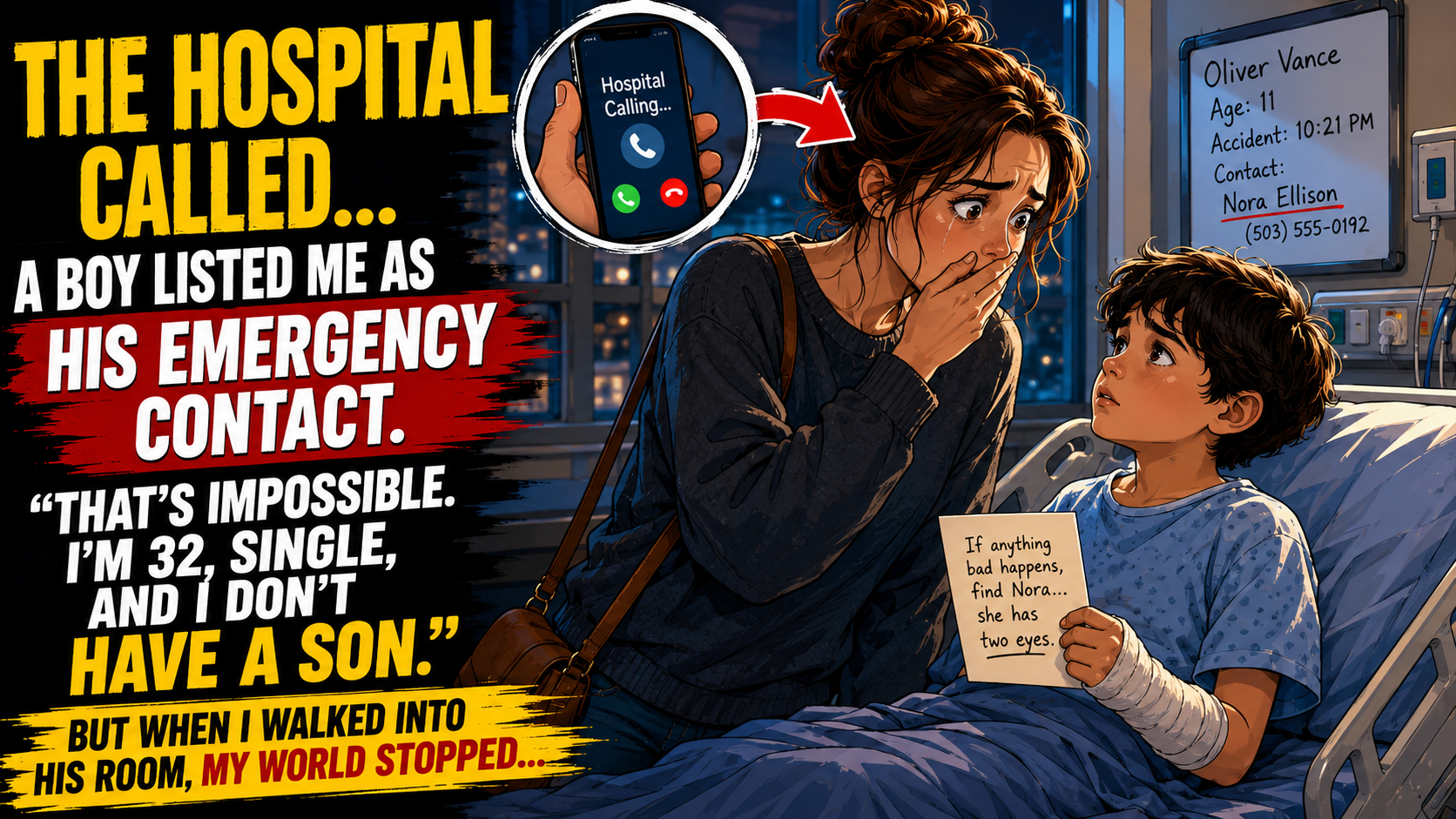
Even though every logical part of me wanted to refuse, I couldn’t ignore a frightened child asking for me from a hospital bed. Twenty minutes later, I walked through the hospital doors exhausted, wearing mismatched socks and still trying to understand what was happening. A nurse named Maribel met me and gently asked whether I recognized the name Rachel Vance. The second I heard it, the air left my lungs. Rachel had once been my best friend in college—the kind of friend who could turn terrible moments into adventures and make everyone around her laugh. But twelve years earlier, after one violent night and one terrible argument, she vanished from my life completely. Hearing her name again felt like opening a wound I thought had healed long ago.
Maribel explained that Oliver claimed Rachel was his mother. My knees nearly gave out as I followed her toward room twelve. Inside, a small frightened boy sat upright in bed with bruises on his face, a split lip, and his wrist wrapped in bandages. The second his eyes met mine, he whispered my name softly, like he already knew me. Then, with trembling lips, he said something I would never forget: “Mom said if anything bad happened, I had to find the lady with two eyes.” I stood frozen in the doorway trying to understand what he meant. Oliver explained that Rachel used to say I was the only person who had ever truly seen both sides of her—the happy version everyone loved and the terrified version nobody wanted to acknowledge.
At nineteen years old, Rachel had been brilliant, funny, and magnetic, but beneath her charm she carried pain nobody wanted to see. I remembered the bruises she excused too quickly and the nights she cried after fights with her boyfriend, Mark Vance. I had begged her to leave him, but she always defended him until one night I finally called campus security after hearing screams from her dorm room. Instead of thanking me, Rachel accused me of exaggerating everything. Mark convinced our friends I was jealous and dramatic, and within days Rachel disappeared from my life entirely. Now, twelve years later, her son was sitting in front of me looking terrified and alone, like the past had somehow found its way back to my doorstep.
When I asked Oliver where his mother was, his face crumpled as he admitted he didn’t know. The hospital staff explained that he had been riding in a rideshare vehicle involved in a serious accident near Burnside, but Rachel hadn’t been in the car with him. Instead, she had intentionally sent him to me. Oliver pulled a sealed envelope from his backpack and said his mother told him not to open it unless he became scared. My name was written across the front in Rachel’s handwriting. Sitting beside his hospital bed, I carefully unfolded the letter with shaking hands. Rachel explained that Mark had found them again, that she feared for Oliver’s safety, and that she trusted nobody except me. She apologized for abandoning our friendship years ago and begged me not to let Oliver go with his father.
The letter shattered me. Rachel admitted that I had been right all those years ago—that I had been the only person brave enough to tell the truth about Mark. She asked me to contact Detective Jonah Reed and warned me that Oliver’s father could not be trusted. When Oliver quietly asked if his mother was in danger, I struggled to answer honestly without terrifying him further. I simply told him that I believed she was trying to keep him safe. He asked if she was coming back, and the truth hurt more than any lie could have. “I don’t know yet,” I whispered. Outside the room, Detective Reed confirmed my worst fears. Rachel had recently filed reports about stalking, threats, and harassment from Mark, but she disappeared before meeting investigators. Reed warned me not to let anyone claiming to be Oliver’s father near him.
That night I stayed beside Oliver’s bed while the hospital slowly transformed into a blur of police interviews, paperwork, and sleepless fear. Every loud sound made Oliver jump awake searching for me, terrified I might disappear too. Early the next morning, Mark Vance arrived at the hospital pretending to be a worried father. I recognized him instantly despite the years that had passed. He wore polished shoes and a calm expression, but his eyes were exactly the same—cold and manipulative beneath the performance. The second Oliver heard his voice outside the room, his entire body stiffened with panic. Mark saw me through the hospital glass and smiled in a way that made my skin crawl before mocking me for “inserting myself” into other people’s lives again. But this time, security officers stepped in before he could get near Oliver.
Detective Reed soon arrived with additional officers, and Mark’s confidence quickly collapsed when his custody paperwork failed to hold up under scrutiny. Rachel had already filed emergency protection requests, and Oliver bravely admitted that his father had been following them for weeks. Later that afternoon, investigators finally found Rachel alive inside a women’s shelter where she had hidden after realizing Mark was tracking her movements. When she walked into Oliver’s hospital room, he burst into tears and clung to her like someone finally returning home after surviving a storm. Rachel collapsed beside his bed apologizing over and over while Oliver wrapped his arm around her neck and whispered proudly, “I found the two-eyes lady.” Rachel looked up at me through tears and quietly admitted that after all these years, I was still the only person she trusted completely.
Mark was arrested two days later after police connected him to stalking, threatening messages, illegal tracking devices, and violations of a protection order. The legal process that followed wasn’t clean or dramatic like movies pretend it is. It was exhausting, slow, and emotionally brutal. Rachel spent months rebuilding her life while working with lawyers and trauma counselors, and during that time I became Oliver’s temporary emergency caregiver. I wasn’t replacing his mother or trying to save anyone—I was simply the person who answered when he called for help. Slowly, Oliver and I built trust together. He loved dinosaur documentaries, hated elevators after the accident, and constantly drew elaborate city maps from memory. One day he asked why Rachel and I stopped being friends, and I explained as gently as I could that sometimes people become angry at the ones who notice they’re being hurt because facing the truth feels terrifying.
Six months later, Rachel and Oliver moved into a small safe apartment near Eugene where Oliver started school, joined a robotics club, and slowly began sleeping through the night again. On the first anniversary of that life-changing phone call, Rachel invited me over for dinner. Her apartment was modest but warm, filled with ordinary peaceful sounds instead of fear. Before I left, Oliver handed me a framed drawing showing the three of us standing together under a giant blue umbrella. Beneath it, he had written: “People who come when called.” I cried alone in my car afterward because I realized something beautiful had grown from the wreckage of our past. We didn’t become family because of blood or obligation. We became family because, when fear and danger arrived, none of us looked away from each other again.