Last night, my son hit me… and I did not cry He stopped on the last stair when he saw his father. For one second, Diego’s face went completely blank. Not angry. Not arrogant. Not even afraid. Blank. As if his mind had walked into a room it did not recognize and could not find the door. Roberto sat at the table with both hands wrapped around a cup of café de olla he had not touched. The steam rose between us like a warning. Beside his cup lay a brown folder. Inside that folder were papers Diego had never imagined I would dare to gather. The house documents. Copies of bank transfers. Receipts from debts I had paid in secret. A lawyer’s number. A police report form. An eviction notice. And every shred of proof that the roof Diego had threatened me under had never belonged to him. My son looked from his father to me. Then his eyes dropped to the tablecloth. The embroidered white one. The one my mother had given me when I married Roberto. The one I used for Christmas, baptisms, birthdays, and moments when a family was supposed to remember who they were. I had ironed it before sunrise with my cheek still burning from his hand. Diego smiled, but the smile came late and crooked. “What is this?” he asked. His voice still had sleep in it. It also had contempt. I stood by the stove, holding a wooden spoon I no longer needed. The red chilaquiles were done. The beans were warm. The eggs with chorizo sat covered in a pan. Everything smelled like mornings I used to love. Everything looked like a celebration. It was not. It was a boundary. Roberto did not answer him. He only watched our son with a stillness I had not seen in him since the day we buried his mother. Diego took another step into the kitchen. “What is he doing here?” I set the spoon down. “Sit down,” I said. His eyes narrowed. “Don’t talk to me like I’m a child.” “Then stop making me treat you like one.” The words left my mouth calmly. That surprised all three of us. Diego’s face hardened. Only hours earlier, that look would have made my stomach fold into itself. Only hours earlier, I would have rushed to soften my voice, smooth the air, and protect him from the consequences of his own cruelty. But something in me had changed after his hand struck my face. Not because the slap was the worst thing he had ever done. It was not. The worst thing was the shrug afterward. The worst thing was the way he looked at me for one second, decided my pain was not important, and walked upstairs as if he had knocked over a chair instead of his mother. That shrug killed the last lie I had been living inside. I was not dealing with stress. I was not dealing with a difficult phase. I was not dealing with a wounded boy who only needed more patience. I was living with a grown man who had learned that my love could be used as a leash around my own neck. Diego pulled out a chair and sat. He did it slowly. Carelessly. As if he still owned the room. As if he still owned me. Then he leaned back and looked at his father. “So she called you crying?” Roberto’s jaw moved once. “She called me because you hit her.” Diego rolled his eyes. “It was one slap.” The kitchen went silent. A bird called somewhere outside the window. The refrigerator hummed. The clock above the doorway ticked with a sound so sharp it felt like a nail tapping glass. One slap. Those two words entered the room and showed me exactly who my son had become. Not because he had lost control. Because he had already begun to defend what he had done. I looked at him across the table and tried to find the little boy who used to press his face into my neck after nightmares. I tried to find the child with scraped knees who believed I could make pain disappear by kissing the wound. I tried to find the teenager who still brought me wildflowers from the empty lot behind the school because he had no money for Mother’s Day. But the man sitting in front of me had his arms folded and his chin lifted. He looked insulted by my hurt. That was when I understood something that hurt worse than my cheek. A mother can love the child she remembers and still protect herself from the man he has become. My name is Elena Garza. I was fifty-one years old that morning. I had lived in San Nicolás de los Garza my whole life, in the same city of hot afternoons, crowded markets, concrete walls, barking dogs, church bells, and women who learned to carry entire households without letting the beans burn. I worked in the library of a public secondary school. I was the woman who stamped books, repaired torn pages with tape, told children to lower their voices, and secretly kept crackers in my drawer for students who came to school hungry. People thought of me as patient.
They thought of me as calm. They thought of me as the kind of woman who could endure anything because I rarely complained. That is the dangerous thing about quiet women. People mistake silence for permission. For years, I had believed endurance was love. I learned it from my mother. She had stayed with my father through shouting, betrayal, debts, and disappearances. When I was a girl, she used to say, “A family does not break just because one person is difficult.” I carried that sentence like scripture. Then I built my whole life around it. When Roberto and I divorced, I told myself I would never let Diego feel abandoned. Roberto moved to Saltillo for work after the separation. He called. He sent money when he could. He visited on birthdays and some Sundays. But distance changes fatherhood, even when a man tries. The daily weight stayed with me. The school meetings. The fevers. The shoes that no longer fit. The angry silences. The heartbreaks. The questions. The bills. The loneliness. I became both pillow and wall. I comforted Diego when he cried. I absorbed him when he raged. At first, I thought his anger was grief. He was fifteen when Roberto moved away. Fifteen is an age made of open flames. Diego began slamming doors. He stopped calling me mamá in front of his friends. He answered kindness with sarcasm. He accused me of driving his father away. The first time he said it, I cried in the bathroom with the faucet running so he would not hear. Then I wiped my face and made him dinner. That became the pattern of my life. He hurt me. I fed him. He shouted. I folded his laundry. He disappeared all night. I waited with the porch light on. He came home smelling like beer and cigarettes. I warmed tortillas. When he apologized, I believed him. When he did not, I invented the apology for him in my own head. He is young. He is wounded. He misses his father. He will grow out of it. He just needs time. Women like me are very good at building prisons out of explanations. After high school, Diego entered college for business administration. He lasted one year. Then half a semester. Then he stopped going and did not tell me for three months. I found out because the university called about unpaid fees. When I confronted him, he said classes were useless. He said professors were arrogant. He said people like us never got ahead by following rules. I asked him what he planned to do. He looked at me as if the question itself insulted him. “Something better than stamping books all day,” he said. That night, I cried again. The next morning, I made him eggs. I told myself he had spoken out of shame. Maybe he had. But shame, when left unchecked, can become cruelty. He found jobs and lost them. A hardware store. A warehouse. A phone repair shop. A delivery service. Every boss was stupid. Every coworker was jealous. Every schedule was unfair. Every rule was disrespect. Nothing was ever Diego’s fault. Then came the girlfriend. Her name was Mariana. She was kind, sharp-eyed, and too smart to stay. For two years, she came to our house with her hair tied back and her nails painted red, bringing pastries from her aunt’s bakery and greeting me with a kiss on the cheek. She loved Diego, but not blindly. I admired that. I also feared it. Women who know their worth frighten men who expect obedience. The night she left him, he punched a hole in his bedroom door. I stood in the hallway while plaster dust floated in the air. “Diego,” I whispered. He turned on me with red eyes. “She left because of you.” “Because of me?” “You always look at her like she’s too good for me.” I had no answer. Because secretly, I had thought exactly that. He saw the truth on my face. He laughed bitterly.
“Of course.” Then he slammed the damaged door so hard the frame cracked. The next day, I called a repairman and told him I had moved furniture badly. That was the first real lie I told to protect him. After that, lies came easier. A broken glass became an accident. A missing two thousand pesos became a misunderstanding. A neighbor’s complaint about shouting became exaggeration. A red mark on my wrist became clumsiness. And each lie buried me deeper. Diego did not become violent all at once. That is something people outside the house rarely understand. They imagine violence enters like a storm, loud and obvious. Sometimes it does. But sometimes it arrives like humidity. First, the air changes. Then breathing becomes difficult. Then one day you realize the walls are sweating and everything you own smells like rot. The first time he called me stupid, I froze. He apologized later. The first time he grabbed my arm, he said I had been walking away while he was talking. The first time he threw a plate, he said he meant to hit the wall. The first time he demanded money instead of asking, I told myself he was embarrassed to need help. The first time he stood in the doorway of my bedroom and refused to move until I opened my banking app, I told myself he was desperate. The first time I slept with my phone under my pillow, I told myself all mothers worry. By the time I admitted I was afraid of my own son, fear had become part of the furniture. I knew which floorboards creaked under his steps. I knew the difference between his drunk key in the lock and his angry key. I knew when to speak and when to lower my eyes. I knew how to make my voice soft enough not to scratch his pride. And worst of all, I knew how to hate myself for knowing. One evening, my neighbor Violeta came over with pan dulce. She was sixty-eight, widowed, and impossible to fool. Her house was beside mine, separated by a low wall and a bougainvillea that dropped purple flowers onto both our patios. She sat at my kitchen table and watched me pour coffee. There was a bruise on my forearm from where Diego had gripped me during an argument about money. I had covered it with a sweater, though it was warm outside. Violeta noticed anyway. “What happened there?” she asked. “I bumped into the pantry door.” “Your pantry has fingers?” I almost dropped the spoon. She looked at me over the rim of her cup. “Elena.” I turned toward the sink. “It’s nothing.” She was quiet for a long moment. Then she said, “Nothing is what women call pain when they are afraid someone will ask them to choose themselves.” I gripped the counter. The truth in her words pressed against my back. I wanted to turn around and confess everything. I wanted to sit at the table and say, I am scared. I wanted to ask how a mother survives admitting her son has become the danger in her house. But Diego’s footsteps sounded upstairs. Heavy. Restless. Violeta heard them too. Her eyes shifted toward the ceiling. Then she lowered her voice. “You can come to me anytime.” “I know.” “No, you don’t.” I looked at her. She reached across the table and touched my wrist. “Anytime means even if you are ashamed.” That nearly broke me. But I smiled and changed the subject. That is another thing women like me learn. We become magicians of distraction. We make the truth disappear while everyone is watching. By the time everything shattered, it was a Thursday in late September. The heat had not yet loosened its grip on the city. The afternoon sky hung low and white. At school, the air conditioner in the library had failed, and the children came in restless and sticky, their uniforms rumpled, their voices too loud. A boy named Mateo returned a book with the cover torn. He looked terrified when he handed it to me. “I’m sorry, señora.” I taped the cover carefully and told him books survive worse than we think. He smiled with relief. The words stayed with me. Books survive worse than we think. People do too. But surviving is not the same as living. I came home after six. My legs hurt from standing. My back ached. My blouse stuck to me. In my bag, I had tortillas, tomatoes, and one small packet of chicken I had bought because it was discounted. I remember this because poverty trains memory around prices. I opened the front door and immediately smelled beer. Not old beer from a bottle left in the sink. Fresh beer. Spilled beer. Careless beer. Diego was in the living room with his feet on the coffee table, watching videos on his phone. There were two empty cans on the floor. A third on the armrest. He did not look up. “Make something,” he said. Not hello. Not how was work. Make something. I stood in the doorway holding the grocery bag. “There is food in the fridge.” “I said make something.” “I heard you.” He looked up then. Something in my tone had changed. He heard it before I did. “What’s your problem?” I walked to the kitchen. “My problem is that I am tired.” “So?” I put the groceries on the counter. The tomatoes rolled out of the bag. One fell to the floor and split. Red juice spread across the tile. I stared at it. Something about that small ruined tomato made my eyes burn. “Clean that,” Diego said from behind me. I turned slowly. He stood in the kitchen doorway. Tall. Broad. My son. My threat. “You clean it,” I said. His eyebrows lifted. “What?” “You heard me.”
The air thickened.
He stared at me as if I had spoken in a foreign language.
Then he laughed.
A short, ugly sound.
“You’re in a mood.”
“No.”
“I am finished.”
He took a step inside.
“With what?”
“With paying for your drinking.”
“With cleaning your mess.”
“With pretending you are a child.”
“With pretending this house belongs to you because you are loud inside it.”
His face changed.
I should have stopped.
The old Elena would have stopped.
She would have seen the danger and reached for gentleness like a towel to cover broken glass.
But I had carried too much for too long.
A truth once risen in the throat must either be spoken or choke you.
Diego came closer.
“You think you’re brave now?”
“I think I am your mother.”
“And I think I am the person who pays for this house.”
“So?”
“So it is over.”
“I am not giving you one more peso for parties, drinking, lies, or debts.”
His lips parted.
For one second, he looked genuinely stunned.
Then fury entered him like fire through a dry field.
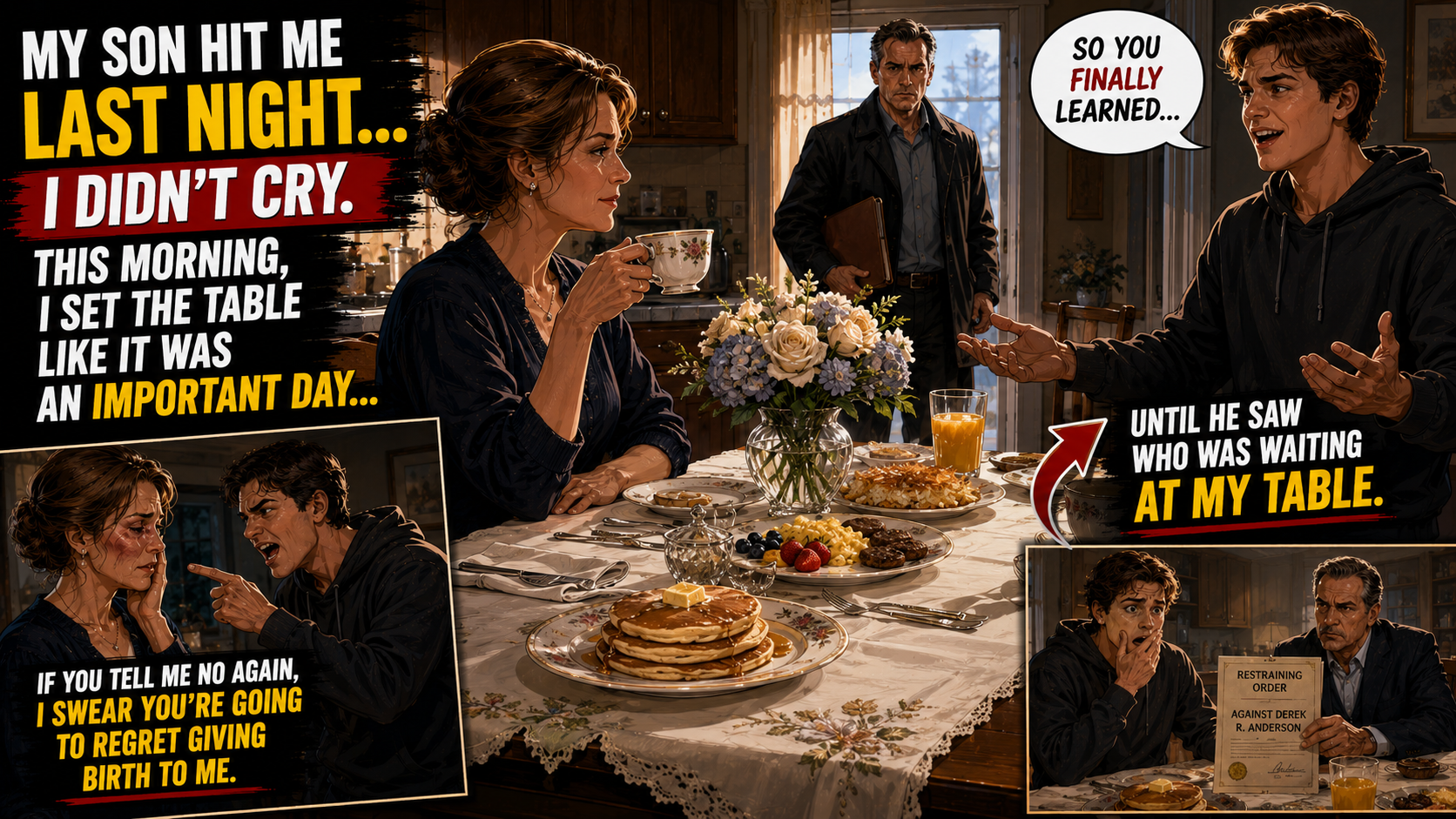
“If you ever tell me no again,” he said, his voice low, “I swear you’ll regret the day you gave birth to me.”
The words struck before his hand did.
They were so monstrous I almost could not understand them.
My own child had taken the day I became his mother and turned it into a weapon.
I remember feeling my fingers go cold.
“Diego,” I said.
My voice sounded far away.
“Listen to yourself.”
He moved so fast I did not see the decision happen.
His hand hit my face with a dry, brutal crack.
Not hard enough to knock me down.
Hard enough to end a world.
My head turned.
My palm caught the edge of the counter.
For a moment, I saw nothing but the white tile, the split tomato, and one drop of red juice sliding slowly toward my shoe.
The kitchen became enormous.
The refrigerator hum roared.
The clock ticked like a hammer.
A dog barked outside.
Somewhere down the street, a motorcycle passed.
Life continued with obscene confidence.
I raised my hand to my cheek.
It burned.
Diego stood in front of me breathing hard.
His eyes were dark.
His mouth was slightly open.
For one terrible heartbeat, I thought he might apologize.
I thought I might see horror in him.
The kind of horror a human being feels after discovering what his own hand has done.
Instead, he looked away.
Then he shrugged.
As if I had forced him.
As if the problem was not that he had hit me but that I had made the room uncomfortable.
“I’m going out,” he said.
He walked past me, then stopped near the stairs.
He turned back.
“You better have money tomorrow.”
Then he went upstairs and slammed his bedroom door.
I stayed in the kitchen.
My cheek burned.
My hand rested on the counter.
The split tomato bled quietly on the floor.
I did not cry.
That frightened me more than tears would have.
Crying would have meant shock.
Crying would have meant I was still trying to make sense of it.
But I stood there dry-eyed and still, and a calmness moved through me so cold it felt almost holy.
I was no longer safe in my own home.
The sentence did not arrive as panic.
It arrived as fact.
Clear.
Unavoidable.
Final.
I cleaned the tomato from the floor.
Not because Diego had told me to.
Because I needed my hands to do something while the rest of me caught up with the truth.
I washed the knife.
I put the chicken in the refrigerator.
I turned off the kitchen light.
Then I sat at the table in the dark.
Upstairs, Diego played music.
He laughed once at something on his phone.
That laugh traveled through the ceiling and settled over me like dust.
I thought of him as a baby.
I thought of the first night he had fever and I stayed awake pressing damp cloths to his forehead while Roberto drove across the city searching for medicine.
I thought of the way Diego’s tiny hand used to curl around my finger.
I thought of him at six, running through the patio with a plastic sword.
At ten, crying because a classmate called him poor.
At fourteen, standing taller than me and pretending not to need hugs.
At seventeen, shouting that I had ruined his life.
At twenty-three, hitting me and shrugging.
A mother’s memory is a cruel archive.
It preserves the sweetness and forces you to hold it beside the wound.
At 1:20 in the morning, I picked up my phone.
My thumb hovered over Roberto’s name.
I had not called him at that hour in years.
Pride stopped me first.
Then shame.
Then fear that he would say, “I told you so.”
He had warned me before.
Not directly.
Never cruelly.
But after one of Diego’s broken-job disasters, Roberto had said, “Elena, he is not learning responsibility because you keep paying the price for him.”
I had answered, “It’s easy to judge from Saltillo.”
He had gone quiet.
We did not speak for a week after that.
Now, sitting in the dark kitchen with my cheek swelling under my fingers, I understood he had not been judging from afar.
He had been seeing what I refused to see up close.
I pressed call.
Roberto answered after the third ring.
His voice was thick with sleep.
“Elena?”
For two seconds, I could not speak.
My throat closed around twenty-three years of motherhood.
Then I said the words that ended the lie.
“Diego hit me.”
Silence.
Not empty silence.
The kind that gathers force.
Then Roberto’s voice changed.
“I’m coming.”
I closed my eyes.
“I didn’t call for you to fight him.”
“I know.”
“I mean it.”
“I know.”
“Roberto.”
“Elena, listen to me.”
His voice was firmer than I had heard it in years.
“I’m coming.”
The call ended.
I sat there holding the phone.
Only then did I cry.
Not loudly.
Not dramatically.
The tears fell without permission, one after another, down the side of my face he had not struck.
I cried for the slap.
I cried for the threat.
I cried for the boy I had lost slowly while pretending he was only hiding under anger.
I cried for the woman I had abandoned in order to save him from himself.
Then, sometime before four, I stood.
I washed my face.
I looked in the bathroom mirror.
The mark on my cheek had darkened.
There was no hiding it.
For once, I did not try.
I went to the linen drawer and pulled out the good tablecloth.
The white embroidered one.
My hands trembled as I unfolded it.
The cloth smelled faintly of cedar and old celebrations.
I ironed it carefully.
The hot metal hissed over the fabric.
Steam rose.
I remembered laying it across the table when Diego turned five.
There had been a cake shaped like a soccer ball.
He had smeared frosting on Roberto’s nose.
I remembered using it the Christmas after my mother died because I wanted the house to feel less orphaned.
I remembered the last anniversary dinner before Roberto and I separated, when the cloth lay between us like snow over a grave.
Now I laid it across the kitchen table for a different kind of ceremony.
Not a celebration.
Not a mourning.
A decision.
Then I cooked.
Red chilaquiles first.
I toasted the dried chiles until the kitchen filled with their smoky warmth.
I boiled tomatoes and garlic.
I blended the sauce until it turned deep red.
I fried tortilla chips and folded them in just enough to soften the edges.
Diego loved them that way.
Not too soggy.
Not too crisp.
Then refried beans with a little lard because that was how my mother made them.
Eggs with chorizo.
Warm tortillas wrapped in a cloth.
Café de olla with cinnamon and piloncillo.
I cooked like a mother.
I arranged the table like a judge.
At a little before six, headlights washed across the front window.
Roberto’s truck stopped outside.
I opened the door before he knocked.
He stood on the porch in a dark coat, his hair grayer than I remembered, his face lined by the road and whatever he had imagined during the drive.
Under one arm, he carried a brown folder.
For a moment, neither of us spoke.
He looked at my face.
At the swollen cheek.
At the bruise rising under my skin.
Something broke in his expression.
Not loudly.
Not theatrically.
But I saw it.
The father in him.
The man who had held our son the day he was born.
The ex-husband who had failed me in some ways and still remembered how to care.
“Elena,” he whispered.
“I’m fine.”
He looked at me.
For once, he did not let me have the lie.
“No, you’re not.”
The words almost undid me.
I stepped aside.
He entered quietly, as if the house were a church after a funeral.
In the kitchen, he noticed the table.
The food.
The coffee.
The tablecloth.
A sad smile crossed his face.
“You always cooked like this when you were about to change something big.”
I looked at him, and for the first time in years, I felt seen.
Not as the woman who kept things running.
Not as the mother who made excuses.
Not as the ex-wife with too much pride.
Me.
“Today this ends,” I said.
He placed the folder on a chair.
“Then answer me one thing.”
His voice was low.
Careful.
But there was steel beneath it.
“Is he leaving this house today?”
I closed my eyes.
For one second, I saw Diego at three years old asleep against Roberto’s chest, one small fist tangled in his father’s shirt.
Then I saw the Diego from last night.
His hand across my face.
His shrug.
His demand for money tomorrow.
I opened my eyes.
“Yes,” I said.
“Today.”
Roberto nodded.
He did not cheer.
He did not say he was proud.
He knew better.
There are decisions so necessary they still feel like amputation.
He opened the folder.
“I brought what you asked for.”
“All of it?”
“All of it.”
He spread the papers across the table beside the coffee cups.
The house deed.
My bank statements.
Copies of transfers made to Diego’s creditors.
Receipts from the motorcycle repairs I had paid after he crashed drunk and lied about it.
A record of the loan Roberto and I had quietly covered to keep men from coming to the house.
A written notice stating Diego was to leave and arrange to collect his belongings lawfully.
The number of a lawyer Roberto trusted.
The contact information for a women’s support center in Monterrey.
And a blank police report form, because sometimes a woman needs to see the line before she can decide to cross it.
My hands stopped trembling.
Not because I was no longer afraid.
Because fear was no longer the only thing inside me.
Roberto looked toward the stairs.
“Has he woken up?”
“No.”
“Does he know I’m here?”
“No.”
“Good.”
He pulled out a chair.
“Then we wait.”
So we waited.
The food sat between us.
The coffee cooled.
Morning brightened slowly behind the curtains.
Neither of us ate.
At one point, Roberto said, “I should have come sooner.”
I looked at the tablecloth.
“I should have called sooner.”
“That is not the same thing.”
“No.”
“But both are true.”
He accepted that with a nod.
That was one thing I had always respected about Roberto.
He could be stubborn, proud, and emotionally clumsy, but when truth stood in front of him, he did not decorate it.
He looked at my cheek again.
“Did he apologize?”
I almost laughed.
“No.”
Roberto’s hands tightened around the cup.
“He shrugged.”
I saw the impact of that word hit him.
A slap can be explained by rage.
A shrug reveals belief.
“He thinks I’ll forgive him by breakfast,” I said.
Roberto looked at the table.
“And so you made breakfast.”
“Yes.”
“Why?”
I thought about it.
“Because this is the last morning I will serve him as if nothing happened.”
His eyes lifted to mine.
“And because I wanted him to remember the table before he lost it.”
Roberto looked away.
For a moment, I thought he might cry.
Then the stairs creaked.
Slow.
Heavy.
Careless.
Diego was coming down.
He appeared in a black T-shirt and sweatpants, his hair messy, his face relaxed in the satisfied way of someone who believes the world has already adjusted around his violence.
He looked at the food first.
A smile tugged at his mouth.
“So you finally learned,” he said.
Then he saw Roberto.
The smile died.
“What is this?”
That was where this morning began.
With my son sitting across from his father, the table full of food, the folder open like a blade, and my cheek still marked by his hand.
Diego leaned back in his chair.
“Seriously?” he said.
“You called him because of a little argument?”
Roberto’s voice stayed even.
“You hit your mother.”
Diego tapped his fingers on the table.
“I already said it was one slap.”
“No,” I said.
Both men turned toward me.
I sat down slowly.
“It was not one slap.”
Diego laughed.
“What, now you’re going to exaggerate?”
I looked at him.
“It was the last slap.”
The room changed.
I saw it in his face.
For months, maybe years, Diego had been playing a game where he pushed and I retreated.
He broke, I repaired.
He demanded, I paid.
He threatened, I softened.
He mistook my love for surrender because I had taught him to.
Now the rule had changed, and he did not know where to put his anger.
He pointed at Roberto.
“So what, you two planned this little show?”
“This is not a show,” Roberto said.
“Then what is it?”
“It is the morning you leave this house.”
Diego stared at him.
Then he burst out laughing.
Loud.
Mocking.
Too long.
He looked at me as if expecting me to laugh too.
I did not.
His laughter faltered.
“You’re serious?”
“Yes,” I said.
He leaned forward.
“This is my house.”
“No.”
His face flushed.
“I live here.”
“You lived here because I allowed it.”
“I’m your son.”
“Yes.”
“And I am your mother.”
His mouth twisted.
“You can’t throw me out.”
“I can protect myself.”
“From me?”
The way he said it almost sounded wounded.
That was the part that nearly pulled me back.
A flicker of the old reflex rose in me.
Explain.
Soothe.
Apologize for his pain.
Then my cheek throbbed.
“Yes,” I said.
“From you.”
His eyes changed.
For the first time that morning, fear flashed through his anger.
Not fear of hurting me.
Fear of losing control.
Roberto slid the notice across the table.
“You will pack what you need today.”
“You will leave before noon.”
“We can arrange another time for the rest of your belongings with witnesses present.”
Diego slapped the paper away.
It slid across the table and hit the plate of chilaquiles.
Red sauce smeared the corner.
“I’m not going anywhere.”
Roberto stood.
He did not raise his voice.
“You are.”
Diego stood too.
He was taller than his father now.
Broader.
Younger.
For a moment, I saw the danger of male pride meeting male pride in a kitchen that had already seen too much.
I rose quickly.
“No.”
Both looked at me.
“No fighting.”
My voice shook, but I kept going.
“I did not call you here for blood, Roberto.”
“And I did not set this table for a war.”
Diego sneered.
“You set it because you’re dramatic.”
I turned to him.
“I set it because I wanted to look at you clearly.”
He rolled his eyes.
“Here we go.”
“No, Diego.”
“You will listen.”
He opened his mouth.
I raised my hand.
Not to strike.
Never to strike.
Just to stop him.
And perhaps because he remembered that hand feeding him, bathing him, touching his forehead in fever, he fell silent.
“You were born at 3:42 in the morning,” I said.
His face flickered.
Roberto looked down.
“You were purple and furious.”
“You screamed before the doctor could even hold you properly.”
“Your father cried so hard the nurse laughed at him.”
Roberto’s mouth trembled.
Diego’s jaw tightened.
I continued.
“When you were two, you would not sleep unless I sang the same song four times.”
“When you were five, you cried because we would not let you bring a street dog into your bed.”
“When you were ten, you gave me a drawing of our house with the words ‘safe place’ written above the door.”
Diego looked away.
My voice broke, but I did not stop.
“I have loved every version of you.”
“I loved the baby.”
“I loved the boy.”
“I loved the angry teenager.”
“I loved the young man who was lost.”
“I loved you when you failed.”
“I loved you when you lied.”
“I loved you when you made it difficult.”
“I loved you when everyone told me to stop protecting you.”
Then I touched my cheek.
“But last night, you used my love as proof that you could hurt me and still be fed in the morning.”
He stared at the floor.
For a second, I thought I had reached him.
Then his face closed.
“You always do this.”
Roberto exhaled sharply.
Diego pointed at me.
“You make everything about how much you sacrificed.”
“You want me on my knees thanking you for being my mother?”
“No,” I said.
“I want you out of my house.”
The words landed with a force I felt in my bones.
Diego’s expression cracked.
Then rage filled the crack.
He shoved the chair backward.
It hit the wall.
“You think he’ll save you?”
He pointed at Roberto.
“This coward who left?”
Roberto flinched.
Diego turned on him fully.
“You left us.”
“You ran to Saltillo and played father on weekends.”
“Now you come here like some hero?”
Roberto’s eyes darkened.
“You’re right.”
The room went still.
Diego had expected denial.
Anger.
Not agreement.
Roberto stepped closer to the table, palms open.
“I left.”
“I told myself it was work.”
“I told myself your mother and I fought too much.”
“I told myself money and visits were enough.”
“They weren’t.”
Diego stared at him.
Roberto’s voice roughened.
“I failed you in ways I cannot repair with one morning.”
“But I will not let my failure become an excuse for you to abuse your mother.”
Diego blinked.
For a moment, he looked younger.
Then he said, “You don’t know anything.”
“I know enough.”
“No, you don’t.”
His voice rose.
“You don’t know what it was like here.”
“She was always tired.”
“Always worried.”
“Always acting like I was another bill she had to pay.”
The words struck me because they were not entirely false.
Pain in a family rarely belongs to one person only.
There were years when I was tired all the time.
Years when I moved through motherhood like a woman carrying buckets of water through a burning house.
Maybe Diego had felt that.
Maybe my fear had made him feel like a burden before his anger made him one.
But wounds explain.
They do not excuse.
“I am sorry for the ways I failed you,” I said.
He looked at me sharply.
“I am.”
“I was tired.”
“I was scared.”
“I did not always know how to help you.”
“But I did not make your hand hit my face.”
Diego’s mouth tightened.
His eyes darted toward the door.
I saw calculation there.
That frightened me.
Not because he might leave.
Because he was measuring how much power remained.
He looked at the papers.
Then at the food.
Then at me.
“So you want me gone?”
“Yes.”
“Where am I supposed to go?”
“That is your responsibility.”
He laughed bitterly.
“My responsibility.”
“Yes.”
“You’ll put your own son on the street?”
Roberto answered.
“No.”
“I called your uncle Javier.”
Diego’s head snapped toward him.
“What?”
“He has agreed to let you sleep in the spare room for one month.”
“One.”
“On the condition that you work at his shop, stay sober, and pay him something weekly.”
Diego’s face twisted.
“I’m not going to work for that old hypocrite.”
“Then find another place.”
I said it quietly.
Diego turned back to me.
“What happened to you?”
I almost smiled.
It was such a strange question coming from the man who had changed so violently that I no longer recognized him.
“What happened to me,” I said, “is that I finally believed you.”
He frowned.
“When you threatened me, I believed you.”
“When you hit me, I believed you.”
“When you shrugged, I believed you.”
His face flushed.
“I didn’t mean it like that.”
“Yes, you did.”
“No.”
“You did.”
I leaned forward.
“You may regret it now because there are consequences, but last night you meant it.”
He looked at Roberto.
“This is insane.”
Roberto took out his phone and placed it on the table.
“If you become violent, I call the police.”
Diego’s nostrils flared.
“So that’s it?”
“You’ll have me arrested?”
I spoke before Roberto could.
“If I have to.”
The words tasted like blood.
Diego stared at me.
For the first time, he seemed to understand that the old world was gone.
His mother, the woman who had invented excuses for every bruise, had disappeared sometime between his slap and the sunrise.
In her place sat a woman with a swollen cheek, trembling hands, and a spine made of all the years she had survived.
He backed away from the table.
“You’ll regret this.”
My heart clenched.
Even now, even with papers between us and Roberto standing beside me, the threat reached the mother inside me.
It reached the part that still wanted to say, Please do not make me lose you completely.
But I had learned something in the dark.
A threat obeyed becomes a chain.
“No,” I said.
“I regret not doing it sooner.”
He stormed upstairs.
The door slammed.
The ceiling shook.
Roberto closed his eyes.
I stood frozen until we heard drawers opening above us.
Things hitting the floor.
Curses.
A chair scraping.
My body wanted to run upstairs and help him pack.
That old instinct was humiliating.
Even now, I wanted to make leaving easier for him.
Roberto seemed to read my face.
“Sit down.”
“I can’t.”
“Elena.”
“If I sit, I’ll fall apart.”
“Then stand.”
We stood in the kitchen while our son destroyed the room I had once painted blue because he said it looked like the sky.
Twenty minutes later, Diego came down with a duffel bag.
His hair was wet, though I had not heard the shower.
His eyes were red.
Whether from anger or tears, I did not know.
He had changed into jeans and a clean shirt.
That hurt.
The small dignity of preparation.
As if part of him understood this was not just a tantrum.
He stopped near the table.
The food had gone cold.
For a second, his eyes rested on the chilaquiles.
I remembered him at eight, sitting in that same chair, red sauce around his mouth, asking for more cheese.
I nearly broke.
Then he spoke.
“Can I eat?”
The question pierced me.
Roberto looked at me.
I looked at Diego.
There are moments when cruelty would be easy and perhaps deserved.
There are moments when kindness feels like surrender but is not.
I took a plate.
I served chilaquiles, beans, eggs, and two tortillas.
I placed the plate at the end of the table, not where he usually sat.
He noticed.
His jaw tightened.
But he sat and ate.
None of us spoke.
He ate quickly at first, then slower.
His shoulders began to shake.
He kept his head down.
A tear fell onto his plate.
Then another.
I gripped the edge of the counter so hard my fingers hurt.
I wanted to go to him.
I wanted to hold his head against my stomach and say, My son, my son, how did we get here?
But mothers must sometimes let tears fall without rushing to clean them.
Because some tears are not wounds.
Some are consequences.
When he finished, he pushed the plate away.
“Happy?” he muttered.
“No,” I said.
“I am heartbroken.”
He looked up then.
His face crumpled for less than a second before pride rebuilt it.
“I hate you,” he whispered.
I nodded.
“I know.”
That answer seemed to hurt him more than if I had argued.
He stood.
Roberto picked up the notice and handed it to him again.
This time, Diego took it.
His hands shook.
“You need to call your uncle before noon,” Roberto said.
“He is expecting you.”
Diego stuffed the paper into his bag.
He walked toward the front door.
Then he stopped.
He did not turn around.
For one wild second, I thought he might apologize.
Instead, he said, “Don’t touch my room.”
The door slammed behind him.
The house shook.
Then the house became quiet.
Not peaceful.
Quiet.
There is a difference.
I stood in the kitchen surrounded by cold food, official papers, and the echo of my son leaving.
Roberto came toward me.
I lifted a hand to stop him.
“Not yet.”
He stopped.
I walked to the sink.
I turned on the water.
I began washing dishes.
It was absurd.
The table was still full.
The morning was still bleeding.
But my hands needed warm water, soap, something ordinary.
I washed Diego’s plate last.
Red sauce clung to the edge.
A little egg yolk had dried near the fork mark.
I scrubbed too hard.
The plate slipped from my hands and cracked against the sink.
Not shattered.
Cracked.
A clean line through the middle.
That was when I finally made a sound.
Roberto crossed the kitchen and caught me before my knees gave out.
I cried against his coat.
Not because I wanted him back.
Not because the past had healed.
But because he was there, and I had been alone too long.
He held me carefully.
Like someone holding a broken cup that still mattered.
“He’s gone,” I said into his coat.
“Yes.”
“He ate before he left.”
“Yes.”
“Why does that hurt?”
Roberto’s voice broke.
“Because you’re his mother.”
I cried harder.
For the rest of that morning, we moved like survivors after a storm.
Roberto called Javier to confirm Diego was on his way.
I called Violeta and told her enough.
Not everything.
Enough.
She came through the back gate ten minutes later wearing slippers and carrying a rosary in one hand and a plastic container in the other.
“I brought soup,” she announced.
“It’s morning,” Roberto said.
She gave him a look.
“Pain does not check the clock.”
Then she saw my face.
Her expression changed.
She came to me and touched my cheek lightly.
“Oh, Elena.”
That was all.
No questions.
No accusations.
No why didn’t you.
She only pulled me into her arms, and I let another woman hold the shame I had carried for too long.
Later, Roberto and I went upstairs.
Diego’s room looked as if grief had passed through it angrily.
Drawers open.
Clothes on the floor.
The broken old bedroom door still marked by the hole from the night Mariana left him.
Posters curling at the corners.
Dusty trophies from childhood soccer.
A shoebox under the bed spilling old birthday cards.
On the desk, I found a photograph of the three of us from when Diego was seven.
We were at Parque Fundidora.
Roberto was kneeling behind him.
I was laughing at something outside the frame.
Diego had chocolate ice cream on his shirt and both arms around our necks.
I picked it up.
My thumb covered the boy’s smiling face.
“Was he always angry?” I asked.
Roberto stood in the doorway.
“No.”
“Did we make him this way?”
He was quiet.
Then he said, “We helped make the house he grew inside.”
I closed my eyes.
“That is not the same as making his choices.”
I turned.
He looked old.
Older than he had at sunrise.
“We have to hold both truths,” he said.
“I hate that.”
“So do I.”
I packed some of Diego’s remaining clothes into boxes.
I did it slowly.
Not tenderly, exactly.
But not with rage.
Every shirt carried a memory.
The blue hoodie from college.
The black jacket Mariana bought him.
The work boots he wore for two weeks at the warehouse.
A red scarf from when he was twelve and pretended not to like it.
I folded them because I am his mother.
I put them in boxes because I am also a woman who deserves safety.
By afternoon, Roberto left for Saltillo.
Before he went, he stood at the door awkwardly.
It reminded me of the early days of our separation, when we had not yet learned the choreography of goodbye.
“Call me tonight,” he said.
“I will.”
“I mean it.”
“I know.”
He hesitated.
“Elena, I am sorry.”
“For what?”
“For leaving you to become the wall between him and the world.”
The sentence sank into me.
I had not known I needed to hear it.
“Thank you,” I said.
He nodded.
Then he touched my shoulder and left.
That night, the house was too quiet.
Diego’s music was gone.
His footsteps were gone.
His careless laughter was gone.
His anger was gone.
His smell of beer and cologne and unwashed clothes was gone.
And beneath the relief, there was a grief so huge it frightened me.
I had imagined peace would feel clean.
Instead, it felt like standing in a room after furniture has been removed and seeing the stains it hid.
I locked the front door.
Then the back door.
Then I checked both again.
I slept on the sofa with the lights on and my phone in my hand.
At 2:11 in the morning, Diego texted.
The message said, “You really did it.”
I stared at it for a long time.
Then another came.
“Hope you enjoy being alone.”
That one found its target.
My thumb hovered over the screen.
I wanted to write, I have been alone for years.
I wanted to write, I still love you.
I wanted to write, please become someone who can come home someday without making home unsafe.
Instead, I wrote one sentence.
“I love you, but you cannot live here while you threaten or hurt me.”
He did not answer.
The next days were strange.
I went to work with makeup over the bruise.
The children noticed anyway.
Children always notice what adults pretend is hidden.
Mateo, the boy with the torn book, looked at me and asked, “Did you fall?”
I almost said yes.
The lie rose automatically.
Then I stopped.
“No,” I said softly.
“Someone hurt me.”
His eyes widened.
“Are you okay?”
“I am getting safe.”
He nodded solemnly, as if I had handed him an important book.
At lunch, I sat in the staff bathroom and cried with my hand over my mouth.
Not because I regretted making Diego leave.
Because I did not.
That was the complicated mercy and cruelty of it.
I missed him and feared him.
I loved him and would not let him return.
I wanted to save him and knew saving him had almost destroyed me.
A week later, he came back for more belongings.
Roberto came too.
So did Violeta, who planted herself in the living room like a saint with a knife hidden under her apron.
Diego looked thinner.
He did not greet me.
He went upstairs.
He packed in silence.
When he came down carrying two boxes, he stopped near the kitchen.
His eyes moved over the table.
The tablecloth was gone now.
Only the ordinary plastic cover remained.
He looked at my cheek.
The bruise had faded yellow.
Something moved across his face.
I held my breath.
“Javier says I have to pay rent,” he said.
I almost laughed.
That was what he had chosen to say.
Not I am sorry.
Not how are you.
Rent.
“Yes,” I said.
“That is how living somewhere works.”
His eyes sharpened, but the old confidence was weaker.
“He treats me like a child.”
“No.”
“He treats you like a man who must contribute.”
He looked away.
Roberto stepped into the room.
“Ready?”
Diego nodded.
At the door, he paused again.
This time, he turned slightly.
His voice was low.
“I didn’t mean to hit you that hard.”
The sentence landed poorly.
A half-apology wrapped in self-defense.
A starving apology.
A broken one.
But it was the first crack in his pride.
I did not rush to accept it.
I did not comfort him for giving it badly.
I simply said, “You hit me.”
His face tightened.
“Yes.”
“And you threatened me.”
His eyes flicked to Violeta, embarrassed.
“Yes.”
“You need help, Diego.”
He swallowed.
“I’m not crazy.”
“I did not say crazy.”
“I said help.”
He looked at me then.
Really looked.
For one second, the boy appeared.
Terrified.
Ashamed.
Then he looked down.
“I don’t know how,” he whispered.
Those four words almost knocked me over.
Roberto exhaled.
Violeta crossed herself silently.
I kept my voice steady because if I softened too fast, he might never learn to stand in the discomfort.
“Your father has numbers.”
“Your uncle has rules.”
“You decide whether you want to change.”
He nodded once.
A tiny movement.
Then he left.
I shut the door behind him.
This time, I did not collapse.
I stood there with my hand on the lock and felt something unfamiliar enter my body.
Not happiness.
Not victory.
Self-respect.
It did not feel triumphant.
It felt quiet and sore, like a muscle used after years of neglect.
Over the next month, Diego sent only short messages.
“Need birth certificate.”
“Where is my blue jacket?”