At 2:00 a.m., my stepfather kicked down the door to my Navy apartment and beat me so badly I could barely stand. What he did not know was that before I lost consciousness, I managed to send one military distress signal. By sunrise, people who had smiled beside him in family photos would know exactly what kind of man Richard Lawson had always been. My name is Lieutenant Ava Reynolds. For most of my life, I thought distance could protect me from the man who raised me in fear. I thought a military career, a new lease, a base gate, and a locked apartment door could make me unreachable.
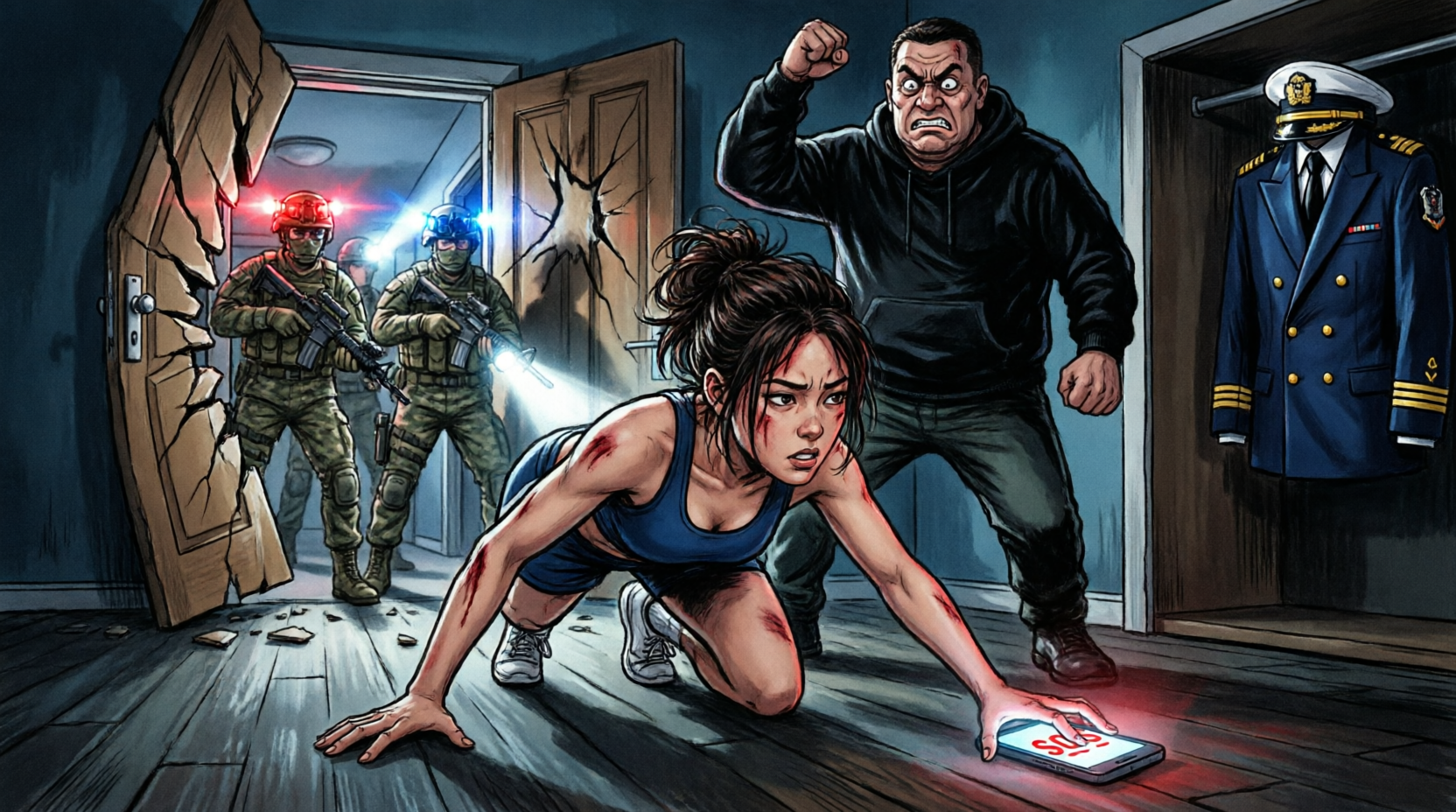
I was wrong. That night should have been quiet. My apartment outside Naval Station Norfolk was small, clean, and ordinary in the way I had worked hard to deserve. There was a couch I had bought secondhand, a kitchen table with one wobbly leg, a paper coffee cup drying by the sink, and a pressed Navy dress uniform hanging from the closet door for morning inspection. The air conditioner clicked every few minutes. The room smelled like laundry soap, cheap floor cleaner, and the stale coffee I had left unfinished after reviewing documents for the next day. For the first time in weeks, I had gone to sleep without checking the deadbolt twice.
That is the part I still think about.
Not because it was my fault.
Because peace, when you have spent years surviving someone, can feel so unfamiliar that you do not trust it even when it arrives.
I was ten years old when Richard Lawson married my mother.
He came into our life with gifts that looked expensive to a child and a smile that made adults lower their guard.
He bought my mother roses from the grocery store and called me “kiddo” in front of neighbors.
He fixed the loose railing on our front porch and told everyone he believed in family.
Inside the house, he measured every room by how afraid he could make it.
He did not start with fists.
Men like Richard rarely do.
He started with rules that changed without warning.
He started with comments about my clothes, my voice, the way I walked too loudly through the hallway.
He started with punishments my mother called “discipline” because that word was easier to live with than the truth.
By sixteen, I knew how to read his footsteps.
By eighteen, I knew how to leave a room without making the floor creak.
By twenty-two, I had joined the Navy partly because I believed service would give me a future and partly because uniforms had rules Richard could not rewrite.
For years, it worked.
I built a life around order.
I kept my apartment clean.
I answered to ranks and schedules.
I trusted checklists, protocols, timestamps, and locked doors.
I stopped answering unknown calls.
I stopped explaining myself to relatives who thought forgiveness meant giving an abuser another map to your house.
The last time I spoke to Richard before that night, he told me I had forgotten where I came from.
I told him I remembered exactly where I came from.
That was why I was not going back.
Three years passed.
I heard through my mother, mostly in short messages, that he was angry.
Then angrier.
Then drinking again.
She always made it sound like weather.
Something unfortunate.
Something everyone had to endure.
Never something she could name.
At 2:00 a.m., the pounding started.
It did not sound like a neighbor knocking on the wrong door.
It sounded like someone trying to break through wood with his whole body.
The deadbolt rattled.
A picture frame over the couch jumped against the wall.
I came awake instantly, my heart already moving faster than my thoughts.
For one terrifying second, I was not in Virginia.
I was back overseas, hearing impact noise in the dark and waiting for the next sound to tell me whether to run, duck, or grab someone bleeding.
Then I heard his voice.
“Ava!”
My whole body locked.
Richard Lawson.
I sat up in bed with my phone in my hand before I remembered reaching for it.
Another crash hit the door.
The handle twisted so violently the metal shrieked.
“Open the door,” he shouted.
I did not answer.
There are moments when your body knows the truth before your pride does.
My hand was shaking, but my thumb moved toward the screen.
I needed to call base security.
I needed to get into the emergency shortcut.
I needed ten seconds.
I did not get them.
The deadbolt snapped with a sharp crack.
The door burst inward and slammed against the wall hard enough to leave a mark.
Richard staggered into my apartment smelling like whiskey, sweat, and old rage.
His hair was damp at the temples.
His eyes were bloodshot.
His breathing came heavy through his nose.
The hallway light behind him made the broken doorframe look split open like bone.
The worst part was his face.
Not the anger.
The comfort.
He looked around my apartment like he had a right to inspect it.
Like the three years of silence, the miles, the uniform, the life I had built, all meant nothing because he had decided to step inside.
“You think you can ignore family?” he snarled.
“Richard, stop.”
My voice came out calm.
Too calm, maybe.
It was the same voice I used in trauma units when panic would only make a bleeding person bleed faster.
But my hands were shaking around the phone.
His eyes dropped to it.
Then he scanned the room.
Kitchen.
Window.
Bedroom door.
Closet.
No roommate.
No boyfriend.
No witness.
That was when he lunged.
His shoulder slammed into my chest and drove me backward onto the tile.
The air left my lungs so completely I could not even scream at first.
Pain flashed through my back.
My phone bounced once and skidded across the floor toward the kitchen table.
I rolled onto my side and reached for it.
He grabbed my arm and twisted it behind me.
Something in my shoulder popped hot and wrong.
White pain shot up my neck.
“You embarrassed me,” he hissed above me.
I could smell the whiskey on his breath.
“You turned your mother against me.”
My mother.
Even then, her name hit somewhere deeper than the pain.
Because she knew.
She had always known.
She knew what his footsteps meant.
She knew why I kept my bedroom door locked as a teenager.
She knew why I left and why I never came home for holidays if he would be there.
Silence looks passive from the outside.
Inside a house, silence can become the lock on every door.
I fought to pull my arm free.
He shoved me down again.
My cheek hit the tile.
The room blurred for a second, and I forced myself to breathe through my nose.
Training does not make fear disappear.
It gives fear a job.
Protect your airway.
Create distance.
Stay conscious long enough to signal.
My phone was under the kitchen table now, faceup, the screen cracked but glowing faintly.
Richard started pacing and shouting about respect.
He called me ungrateful.
He called me a liar.
He called me a daughter as if the word itself gave him ownership.
At 2:03 a.m., I dragged myself six inches across the tile.
At 2:04, he noticed and stepped toward me.
At 2:05, his boot came down near my wrist hard enough to pin me in place.
Pain shot through my fingers.
I screamed then.
Not loudly.
Not like in movies.
It came out torn and thin.
He laughed once, but there was no humor in it.
“You always thought you were better than us,” he said.
I looked at my uniform hanging from the closet door.
Pressed.
Ready.
So absurdly neat in the middle of the wreckage.
For one ugly heartbeat, I wanted to hurt him back.
There was a heavy mug on the lower shelf.
There was a chair close enough to grab.
There were sharp corners and hard surfaces all around me.
I pictured him on the floor instead of me.
Then I let the picture pass.
Rage can feel like strength when you are desperate.
Survival is quieter.
I went for the phone.
He was still talking when I stretched my fingers under the table.
That was his mistake.
He loved the sound of his own voice more than he feared mine.
The screen was cracked in a spiderweb pattern.
My vision doubled.
My hand shook so badly that I missed the first tap.
But military protocol is designed for fear.
It is designed for blood, smoke, noise, confusion, and hands that do not work the way you need them to.
Three taps.
Hold.
Transmit.
The phone blinked.
SOS SIGNAL SENT.
Location attached automatically.
Naval emergency response alerted.
Apartment number logged.
Time recorded.
Audio capture initiated.
Richard heard the tone.
It was small.
Clean.
Almost gentle.
The room changed around it.
He stopped pacing.
His eyes moved from my face to my hand under the table.
Then to the cracked phone glowing against the tile.
“What did you do?”
I looked up at him through one swollen eye.
Blood and floor dust filled my mouth.
For the first time all night, I smiled.
“You shouldn’t have come here.”
His face shifted.
That is the only way I can describe it.
The anger did not disappear.
It cracked.
Underneath it was fear.
Real fear.
He crouched toward me and grabbed for the phone.
Before his fingers reached it, another tone sounded.
This one was sharper.
A confirmation alert.
He looked at the screen.
I saw him read enough to understand.
My location had been sent.
The alert had gone out.
The response clock had started.
Then the second line appeared.
AUTO-RECORDING UPLOADED.
Richard froze.
He had not known that part.
Most people outside the service would not.
But emergency protocols do not only ask for help.
They preserve what happens before help arrives.
Every crash.
Every threat.
Every word he had shouted into my apartment.
Every sound of my body hitting the floor.
It was already somewhere he could not kick, twist, threaten, or delete.
“Cancel it,” he whispered.
I could barely breathe.

“No.”
The word was quiet, but it was mine.
Then my mother’s name appeared in a missed-call banner at the top of the screen.
Three missed calls.
All from 1:58 a.m.
Richard saw them too.
Something flickered across his face that was not just fear anymore.
It was calculation.
It was the look of a man realizing the story he had prepared might not survive the evidence.
From the hallway came the crackle of radios.
Then footsteps.
Not running.
Controlled.
Professional.
The kind of sound that told me the world outside that apartment had finally entered the room.
Richard stood too fast.
His heel slipped against the tile.
For a second, he looked down at me as if he still might try one last order.
But the broken doorway filled with light.
A military police officer appeared there, one hand raised, the other near his radio.
His eyes moved quickly.
Broken frame.
Overturned chair.
Phone under the table.
Me on the floor.
Richard standing over me.
The officer’s expression hardened.
“Sir,” he said, “step away from Lieutenant Reynolds.”
Richard lifted his hands halfway.
“This is a family matter.”
The officer did not blink.
“No, sir. It is not.”
A second officer came in behind him.
Then a third voice came through the radio, repeating my apartment number.
I remember the sound more than the words.
I remember the rhythm of authority that did not belong to Richard.
I remember Richard looking smaller with every second that passed.
He tried to talk over them.
He said I was unstable.
He said I had invited him.
He said I had attacked him first.
Men like Richard always carry a second weapon.
When force fails, they reach for the story.
But this time, the story had a timestamp.
The first officer picked up my phone with gloved fingers.
The cracked screen still glowed.
The recording indicator was active.
The officer listened for less than ten seconds.
His jaw tightened.
He looked at Richard again.
“Turn around.”
Richard’s mouth opened.
No words came.
That was new.
The man who had filled rooms with fear for most of my life had finally run out of sound.
They moved him away from me.
One officer knelt beside me and asked if I could tell him my name.
“Ava Reynolds,” I said.
My voice sounded far away.
“Rank?”
“Lieutenant.”
“Do you know where you are?”
“My apartment.”
“Do you know what time it is?”
I tried to turn my head toward the phone.
“After 2:06.”
His face changed just slightly.
Not pity.
Respect.
“Help is here, Lieutenant.”
I did not cry when Richard broke the door.
I did not cry when he twisted my arm.
I did not cry when the pain made the room tilt.
But when that officer said help was there, something inside me gave way.
Not loudly.
Just enough that my breath shook.
Medical came next.
They checked my shoulder, my wrist, my pupils, my breathing.
They asked questions slowly and repeated themselves when I lost track.
Someone draped a blanket over me even though the apartment was not cold.
Someone photographed the doorframe.
Someone bagged the phone.
Someone wrote down the time the first distress signal was received.
The official report listed 2:06 a.m. as the activation time.
It listed forced entry.
It listed visible damage to the door.
It listed my injuries in clinical language that sounded too clean for what they felt like.
It listed Richard Lawson by full name.
That mattered more than I expected.
For years, he had existed in our family as a mood, a storm, a thing everyone adjusted around.
On paper, he became a person responsible for what he had done.
By sunrise, the apartment was quiet again, but not peaceful.
The broken door had been secured temporarily.
My uniform still hung from the closet.
The coffee cup was still by the sink.
Everything ordinary was still there, which somehow made the violence feel even stranger.
My commanding officer came in person.
She stood near the kitchen table, looked at the floor, then looked at me.
“You did exactly what you were trained to do,” she said.
I wanted to believe her.
Part of me did.
Another part of me was still ten years old, listening for footsteps, trying not to make anyone angrier.
Then my phone, now in evidence custody, produced one more piece of the night.
The missed calls from my mother.
Investigators contacted her after Richard was taken away.
At first, she said she had been asleep.
Then she said she had called by accident.
Then, when they told her the calls came minutes before the forced entry, she stopped answering questions.
Later, she admitted Richard had taken her car.
She admitted she knew he was going to my apartment.
She said she thought he only wanted to “talk sense into me.”
Those were her words.
Talk sense.
I sat in a hospital room with a brace on my wrist and my shoulder wrapped while a nurse taped an intake band around my arm, and I finally understood something I had avoided for years.
My mother’s silence had not been empty.
It had been permission.
That truth hurt differently from everything else.
Bones and bruises follow a kind of schedule.
They darken, swell, ache, and heal.
Betrayal does not obey the body’s calendar.
It returns when you are making coffee.
It returns when a phone rings.
It returns when someone says family like the word is supposed to erase what happened.
Richard’s name did not become famous in the way dramatic stories make people famous.
There were no flashing headlines at my door.
There was a report.
There was a command notification.
There were statements.
There was an arrest record.
There were people who had believed his version of himself for years suddenly reading words like forced entry, assault, distress activation, uploaded audio, and military police response.
By sunrise, the country did not know him as a charming stepfather or a misunderstood husband.
The system knew him by his actions.
And in a world built on paperwork, timestamps, and official records, that was enough to begin undoing the lie.
My mother called once from a blocked number.
I did not answer.
She left a voicemail.
Her voice sounded small.
She said she never wanted me hurt.
She said Richard had been drinking.
She said she hoped I would not “ruin his life over one night.”
One night.
That was what she called it.
Not the years before it.
Not the silence.
Not the warnings ignored.
Not the way he knew exactly how to find my door.
I deleted the voicemail after investigators saved what they needed.
That was the first time I understood deletion as mercy.
Not for her.
For me.
The legal process moved the way legal processes move.
Slowly in some places.
All at once in others.
There were interviews.
There were medical records.
There was the emergency audio file.
There were photographs of the broken deadbolt, the cracked phone, the marks on the tile where the chair had gone over.
There was Richard’s voice on the recording, saying my name like it belonged to him.
There was my voice, barely audible, saying, “You shouldn’t have come here.”
People later told me that was brave.
Maybe it was.
At the time, it felt like the only true sentence left in the room.
Richard tried to claim he had been worried about me.
He tried to claim he entered because I would not answer.
He tried to claim the injuries happened during a misunderstanding.
The recording answered for me.
So did the door.
So did the timestamps.
So did the report from the first officer who saw me on the floor and Richard standing over me.
That is what evidence does when people are tired of telling the truth into rooms that prefer lies.
It stays.
I wish I could say healing was dramatic.
It was not.
It was physical therapy for my shoulder.
It was learning to sleep with one lamp on without hating myself for needing it.
It was replacing the apartment door.
It was buying a new phone and flinching the first time an emergency tone played during a test.
It was standing in front of my dress uniform again and realizing I still knew how to button it.
It was letting people help me without apologizing for the inconvenience.
My commanding officer checked in more than once.
So did people from my unit.
One sailor left a grocery bag outside my door with soup, crackers, and a note that said, “No need to text back.”
That note made me cry harder than the voicemail from my mother.
Care, real care, does not demand a performance.
It leaves soup at the door and gives you room to breathe.
Months later, I went back to the apartment one last time before moving.
The new deadbolt shined too brightly against the old door.
The kitchen table still had the same wobble.
The floor had been cleaned, but I knew where I had crawled.
I stood there for a long time.
Not because I wanted to remember.
Because I needed to stop being afraid of the room.
I looked at the spot under the table where my hand had found the phone.
Three taps.
Hold.
Transmit.
Such a small movement.
Such a different life on the other side of it.
I used to believe distance could protect me from Richard Lawson.
I was wrong about that.
Distance gave me room.
Training gave me tools.
Evidence gave me a voice when my body was too hurt to keep arguing.
But the thing that saved me first was simpler than all of that.
I believed myself fast enough to act.
For anyone who has ever lain awake listening for footsteps, I hope you remember this.
You do not have to wait until someone else agrees it was bad enough.
You do not have to make the story pretty.
You do not have to call it family when what it really is is fear.
At 2:00 a.m., my stepfather kicked down the door to my Navy apartment and beat me so badly I could barely stand.
At 2:06 a.m., I sent one military distress signal.
By sunrise, Richard Lawson’s name was no longer protected by our family’s silence.
It was written down where silence could not reach it.
