The phone buzzed in Marissa’s hand while Eleanor drew her fist back from the door. The first time it had happened, the sound had shocked Marissa awake. Now, standing barefoot in the thin gray light of morning, she could hear the pattern inside it. Eleanor was not knocking. She was punishing the door for refusing her. The deadbolt trembled again.
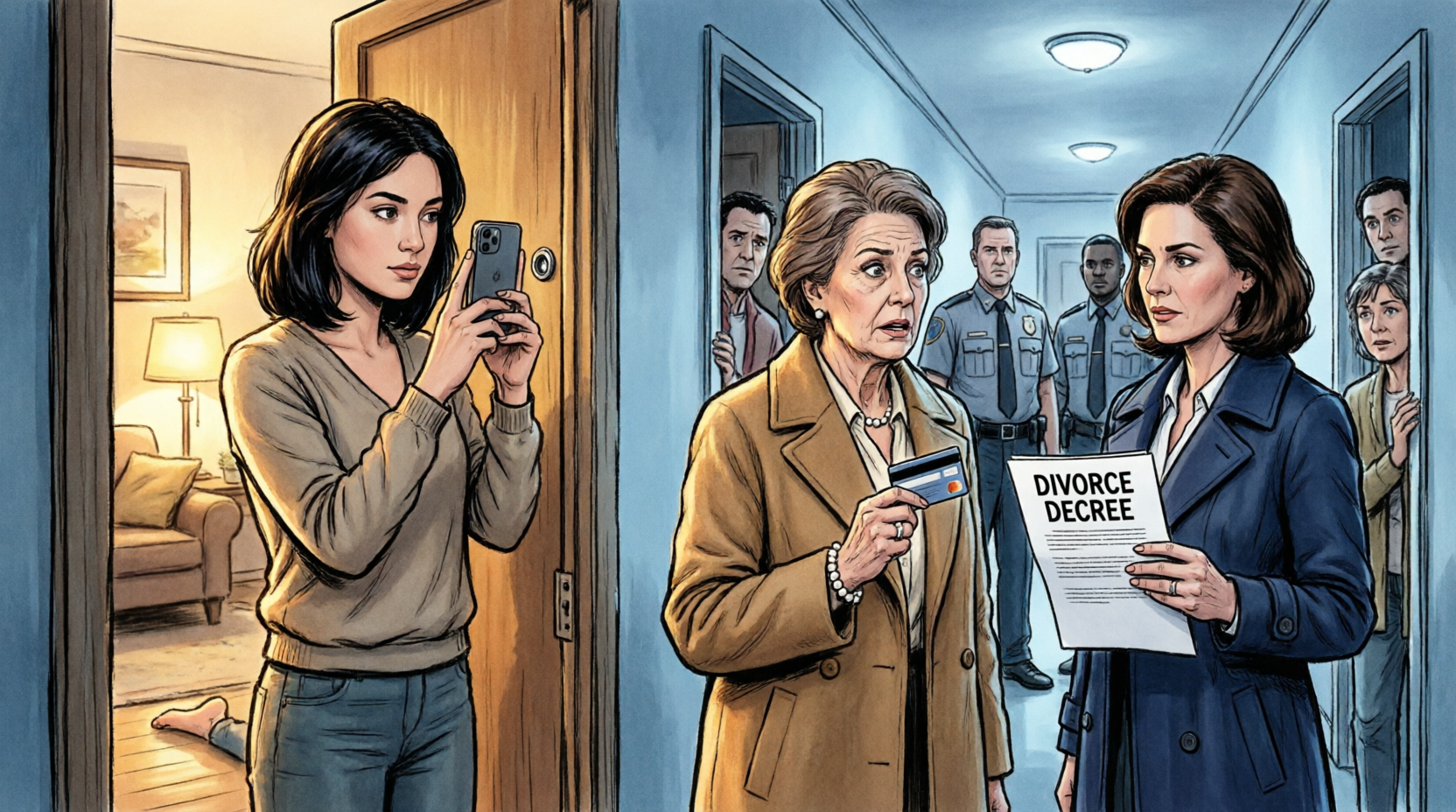
Marissa stood three feet away and did not move. Her apartment still smelled faintly of espresso, dish soap, and the quiet dinner she had made for herself the night before, when she believed the divorce order had finally turned her home into a sealed room. She had been wrong. The divorce had not ended the war. It had simply changed the battlefield. Outside, Eleanor shouted her name again. “Marissa!” The sound struck the hallway marble and came back thinner. Marissa stared at the glowing phone. UNKNOWN NUMBER. She knew before answering that it was Anthony. He had always believed a boundary was only real until he found a side entrance.
She let it ring.
The pounding started again.
“Open this door before I make this worse for you,” Eleanor said.
Marissa’s bare toes curled against the floor.
There had been a time when that sentence would have sent her rushing.
Not because she believed Eleanor had power over her.
Because Anthony had trained her to treat Eleanor’s embarrassment as an emergency.
The phone stopped ringing.
A voicemail appeared.
Marissa did not play it yet.
She backed toward the kitchen counter, keeping her eyes on the door as if Eleanor might somehow see through it.
The courthouse folder sat beside her laptop.
The yellow legal pad lay open.
The bank confirmation was still visible on the screen because Marissa had checked it twice before bed and once again at dawn.
Authorized user removed.
Luxury card closed.
No future charges permitted.
Plain words.
Clean words.
Words that had made Eleanor arrive like a storm.
Marissa picked up the legal pad and stared at her own handwriting.
It was not beautiful.
It was practical, cramped, and pressed deep into the paper, the kind of handwriting that came from a woman trying to make facts permanent.
Bank statements.
Call logs.
Receipts.
Screenshots.
Attorney notes.
Anthony had called that keeping score.
Marissa now understood that people who benefit from your confusion always resent your records.
Another text came through from the unknown number.
Tell my mother to leave before security gets involved. You are making this worse.
Marissa felt something inside her go still.
Anthony was not asking if she was safe.
He was not asking why his mother was at her door before seven in the morning.
He was not even pretending to be embarrassed.
He was warning her not to inconvenience the woman who had come to collect money that was not hers.
Marissa opened her messages and sent one sentence to Catherine Bell, her attorney.
Eleanor is outside my apartment striking the door and Anthony is texting from an unknown number.
Then she called the concierge.
The front desk answered on the second ring.
“This is Marissa Vale in 27B,” she said.
Her voice was calm enough to frighten her.
“Eleanor Vale is outside my apartment door. She is striking it and refusing to leave. I need security sent up immediately.”
There was a pause.
Marissa knew that pause.
She had heard it at restaurants when Eleanor insulted waiters in a voice soft enough to pass for preference.
She had heard it at fundraisers when Anthony corrected Marissa in public and everyone suddenly became fascinated by their wineglasses.
It was the pause people used when they wanted the disturbance to resolve itself without requiring them to choose a side.
“Of course, Ms. Vale,” the concierge said finally.
Outside, Eleanor’s heel clicked once against the marble.
“Do not call staff on me,” she snapped through the door.
Marissa almost answered.
She did not.
Silence had always belonged to them before.
Anthony’s silence at dinners.
Eleanor’s silence after an insult, while everyone waited to see whether Marissa would be rude enough to react.
The guests’ silence when Eleanor laughed at her dress and asked whether “that little card issue” could be handled by morning.
Marissa had mistaken silence for weakness.
Now she let it become a locked room.
The elevator dinged.
Two security guards stepped into view through the peephole.
One was older, broad-shouldered, with a careful expression.
The other was younger and already uncomfortable.
Eleanor turned on them at once.
“This is a family matter.”
The older guard did not move closer.
“Ma’am, you need to step away from the door.”
“I will do no such thing.”
From somewhere down the hall, a door opened.
Then another.
Mr. Kaplan from 27D appeared in a navy robe, his silver hair flattened on one side.
The young woman from 27A held a small dog against her chest.
A man near the elevator lowered his newspaper slowly, as if the paper might protect him from being considered involved.
Nobody moved.
That stillness hurt more than Marissa expected.
Because she knew that stillness.
She had lived inside it for five years.
It was the stillness of people who saw enough to understand but not enough to help.
Eleanor raised the dead platinum card between two fingers.
“This woman has stolen from me,” she announced.
Marissa closed her eyes.
Of course.
The first public sentence Eleanor chose was not apology.
It was accusation.
Marissa stepped close enough to the door that her voice carried.
“The card was attached to my account.”
Eleanor’s head snapped toward the peephole.
“So now you hide behind doors?”
“I stand behind locks when someone is trying to force her way into my home.”
The younger guard looked at the door.
The older one looked at Eleanor.
A small shift passed through the hallway.
It was not support yet.
It was attention.
Eleanor hated attention she had not choreographed.
“She gave this to me,” Eleanor said.
“No,” Marissa replied. “Anthony gave you access to my credit during the marriage. The divorce is final. Your access ended yesterday at 4:06 p.m.”
The number struck the hallway like a gavel.
Eleanor’s mouth tightened.
“You petty, vindictive little girl.”
“Ma’am,” the older guard said.
But Marissa was not finished.
She opened the voicemail Anthony had left.
His voice spilled out through the apartment speaker, harsh and familiar.
“Marissa, if you think a judge signing papers means you can disgrace my family, you’re insane. My mother has been treated like a criminal because of your little stunt. Fix the account before this becomes ugly.”
The hallway changed.
It was not dramatic.
No one gasped.
No one stepped forward.
But the air shifted.
For five years, Anthony had been careful in rooms with witnesses.
He could be charming when charm was useful.
He knew how to lower his voice, touch Marissa’s back, and say her name like he was the reasonable one.
But this was his voice without the suit pressed over it.
This was the voice that arrived after midnight when Eleanor had overspent and Anthony wanted Marissa to absorb the cost quietly.
This was the voice that called boundaries betrayal.
Marissa stopped the recording and saved it.
Then she sent it to Catherine.
Eleanor’s phone rang.
She looked down.
The name on the screen changed her expression before she answered.
“Anthony,” she said sharply. “Tell this ridiculous woman—”
Her words stopped.
Anthony was speaking fast.
Marissa could not hear every word through the door, but she knew panic when she heard it.
Eleanor glanced toward the neighbors.
Then toward the guards.
Then toward the peephole.
Her hand lowered with the card still trapped between her fingers.
The elevator dinged again.
Catherine Bell stepped into the hallway wearing a navy coat and carrying a leather folder.
Marissa had never been so relieved to see another woman look unimpressed.
Catherine walked with the controlled pace of someone who had already decided what mattered.
She did not look at the neighbors first.
She did not look at the guards.
She looked at Eleanor.
“Mrs. Vale,” she said, “step away from my client’s door.”
Eleanor recovered enough to lift her chin.
“This is private.”
“No,” Catherine said. “It became a building security matter when you came to her residence, struck her door, accused her of theft in front of witnesses, and attempted to pressure her into restoring access to an account you no longer have permission to use.”
The older guard straightened slightly.
Eleanor looked at the folder.
“What is that?”
“The divorce order.”
“I know what the divorce order says.”
“I’m not sure you do.”
Catherine opened the folder and removed a page.
There was nothing theatrical about it.
No slammed briefcase.
No threat dressed as a speech.
Just paper.
Marissa watched through the peephole as Eleanor’s eyes moved across the page.
The color left her face slowly.
Catherine’s voice remained even.
“Anthony agreed that all financial benefits connected to Marissa’s accounts ended upon entry of the final order. He also acknowledged that neither he nor any third party connected to him had authority to access, request, pressure, or attempt to obtain funds from her personal accounts after the divorce was finalized.”
Eleanor swallowed.
“That has nothing to do with me.”
“It has everything to do with you if you are the third party.”
“My son told me—”
Catherine’s eyes lifted.
Eleanor stopped.
Marissa felt her pulse in her throat.
“What did Anthony tell you?” Catherine asked.
Eleanor’s mouth closed.
The hallway had become very quiet.
Even the dog stopped moving.
Catherine waited.
That was one of the things Marissa admired about her.
Catherine did not rush frightened people, and she did not rescue arrogant ones from the consequences of their own sentence.
Eleanor looked toward the elevator.
Anthony was not there.
For once, he had sent his mother into a room and failed to arrive in time to manage the damage.
“He said he would handle it,” Eleanor said finally.
“Handle what?”
“The card.”
Catherine did not blink.
“After the divorce?”
Eleanor said nothing.
Marissa’s phone buzzed again.
She looked down.
This time, the message was not from Anthony.
It was from the bank fraud department.
A new digital card was added to your account at 6:39 a.m. Was this you?
Marissa read it once.
Then again.
Her hand went cold.
6:39 a.m.
Three minutes before the first pounding tore through her apartment.
She opened the bank app with fingers that suddenly did not feel like hers.
A pending attempt appeared.
Luxury retail.
Digital wallet.
Declined.
Marissa stared at the screen until the words blurred.
The dead platinum card in Eleanor’s hand had not been the only attempt.
Someone had tried to add a new digital card to Marissa’s account that morning.
Someone had tried before Eleanor began pounding.
Someone had known the old access was dead and reached for another door.
“Marissa,” Catherine said from the hallway, “what did you just receive?”
Marissa forced herself to speak.
“A fraud alert.”
Eleanor’s eyes flickered.
Catherine turned fully toward the door.
“What kind?”
“A new digital card was added to my account at 6:39 a.m.”
The older guard looked at Eleanor’s hand.
Eleanor closed her fingers around the dead platinum card.
Catherine’s face changed only slightly, but Marissa saw it.
The attorney had moved from prepared to dangerous.
“Was it you?” Catherine asked Eleanor.
“No.”
The answer came too fast.
Catherine tilted her head.
“Then who had your phone this morning?”
Eleanor’s mouth tightened.
“No one.”
“Who told you the old card was declined?”
“My son.”
“At what time?”
“I don’t know.”
“Before or after 6:39?”
Eleanor looked away.
That was the wrong answer.
Marissa opened the door chain but left the deadbolt locked.
The sound made everyone turn.
She did not open the door.
She only spoke through the narrow seam.
“Catherine, I have screenshots of Anthony texting me from an unknown number, and I have the voicemail where he told me to fix the account.”
“Send me the fraud alert,” Catherine said.
Marissa did.
Then she sent the screenshot of the bank app.
Then the unknown number texts.
Then the voicemail file again.
Small forensic pieces moved through the air silently.
Screenshot.
Timestamp.
Voicemail.
Fraud alert.
Doorbell camera clip.
Marissa remembered, suddenly, the small black lens above her apartment door.
Anthony had mocked her when she installed it two years earlier.
“What are you afraid of?” he had asked.
She had been afraid of exactly this, though she had not known the shape of it yet.
She opened the security app.
The clip was already there.
6:42 a.m.
Eleanor stepping out of the elevator.
Eleanor checking her phone.
Eleanor lifting her fist.
Eleanor striking the door.
Marissa sent that too.
Catherine read something on her phone.
Then she looked at Eleanor again.
“Mrs. Vale, I’m going to advise you very carefully. Do not delete any messages from Anthony. Do not discard that card. Do not contact Marissa again.”
Eleanor gave a short laugh.
“You advise me?”
“Yes.”
“I have done nothing wrong.”
“Then preserving the evidence should not concern you.”
The younger guard looked down.
Mr. Kaplan’s eyebrows rose.
The woman with the dog whispered, “Oh my God,” so softly it barely counted as sound.
Eleanor heard it anyway.
Her face flushed.
“This is obscene,” she said. “I came here because I was humiliated in public.”
Marissa finally opened the door.
Not all the way.
Only enough for the chain to catch and reveal her face.
The hallway saw her then.
Barefoot.
Hair loose.
Gray sleep shirt.
No makeup.
No armor.
But not broken.
Eleanor’s eyes ran over her, searching for the old Marissa.
The one who apologized before she understood what she had done.
The one who covered charges because Anthony looked tired.
The one who sat through family dinners while Eleanor performed injury with perfect posture.
That woman was not at the door anymore.
“You were humiliated,” Marissa said, “because you tried to spend money that was not yours.”
Eleanor’s mouth opened.
Marissa kept going.
“And when that failed, someone tried to add new access to my account. Then you came here and accused me of theft.”
Anthony’s name appeared on Eleanor’s phone again.
She looked down.
Catherine saw it.
“Put it on speaker,” Catherine said.
Eleanor’s head snapped up.
“No.”
“Then decline it.”
Eleanor did neither.
The ringtone played delicately between them.
It sounded absurd in the ruined quiet.
Marissa looked at the screen through the gap in the door.
Anthony.
Not unknown now.
His real name.
His real number.
Eleanor’s thumb hovered.
Marissa knew that hesitation.
She had lived inside Anthony’s hesitation for years.
He never chose openly when silence could make someone else carry the consequence.
The call ended.
Then Anthony sent a text.
Eleanor looked at it.
Her face changed again.
Catherine noticed.
“Mrs. Vale,” Catherine said, “show me the message.”
“I will not.”
“Then I’ll request it formally.”
“This is harassment.”
“No,” Catherine said. “This is documentation.”
Marissa’s phone buzzed again.
Another unknown number text.
You don’t understand what you’re doing. Open the door.
She screenshotted it.
Then another.
My mother doesn’t know anything. Leave her out of it.
Marissa read that one aloud.
The hall went completely still.
Eleanor whispered, “Anthony.”
Catherine turned toward her.
“What exactly does he think you don’t know?”
Eleanor’s posture changed.
It was small.
A collapse hidden under expensive wool.
Marissa saw it and understood something new.
Eleanor was not only angry because the card had died.
She was afraid because Anthony had told her enough to make her useful and not enough to keep her safe.
The cruelty had a hierarchy.
Marissa had been below both of them for years.
But Eleanor, for all her polished command, had also been useful to Anthony.
Useful as pressure.
Useful as excuse.
Useful as a weapon he could later claim had acted alone.
Catherine stepped closer.
“Marissa,” she said, without taking her eyes off Eleanor, “call the bank fraud department. Put them on speaker inside your apartment. Ask when the digital card was added and what device attempted it.”
Marissa did exactly as she was told.
The hold music felt unreal.
A bright, cheerful loop playing while her ex-husband’s mother stood outside her door with building security watching.
When the representative answered, Marissa verified her identity.
Her voice cracked once on the final security question.
She hated that.
Then the representative confirmed the attempt.
A digital card had been added to a mobile wallet at 6:39 a.m.
It had been used for an attempted transaction seconds later.
The device name was partially visible.
Marissa repeated it slowly.
“Anthony’s iPhone.”
Eleanor shut her eyes.
The hallway heard it.
Catherine heard it.
The guards heard it.
The neighbors heard it.
And Marissa heard, beneath the shock, a strange silence opening inside her.
It was not peace.
Not yet.
It was the sound of a lie losing oxygen.
The bank representative asked if Marissa wanted the account frozen and reissued.
“Yes,” Marissa said.
She did not look at Eleanor.
“I want everything frozen. I want new account numbers. I want a fraud report opened. And I want written confirmation sent to my email.”
Catherine gave a small nod.
Eleanor suddenly seemed older.
Not softer.
Just exposed.
The senior guard said, “Ma’am, you need to leave the floor now.”
Eleanor looked at Marissa through the gap in the chained door.
For the first time, she did not look triumphant.
She looked betrayed.
Not by what she had done.
By the fact that she had been seen doing it.
“You have no idea what you’ve done,” Eleanor said.
Marissa’s hand rested on the doorframe.
Her knuckles were white again, but her voice held.
“I know exactly what I’ve done.”
Catherine closed the folder.
“We’ll be filing for enforcement, harassment protections, and fraud-related discovery. Anthony can explain the device.”
At the sound of his name, Eleanor flinched.
It was quick, but Marissa saw it.
The woman who had once made entire tables bend around her mood now stood in a hallway full of witnesses, holding a dead card and a story that no longer worked.
The guards escorted her toward the elevator.
She did not fight them.
That was almost worse.
Her silence was not surrender.
It was calculation.
When the elevator doors opened, Eleanor turned back once.
Her eyes found Marissa’s.
“You think this makes you clean?” she said.
Marissa looked at the card in Eleanor’s hand.
Then at the folder in Catherine’s arm.
Then at the neighbors who still had not moved.
“No,” Marissa said. “It makes me finished.”
The elevator doors closed.
Only then did the hallway breathe.
Mr. Kaplan stepped back into his apartment without a word.
The woman with the dog whispered that she was sorry.
Marissa nodded because she did not know what else to do with an apology that arrived after the danger was already over.
Catherine waited until the hallway cleared.
Then she turned to Marissa.
“May I come in?”
Marissa closed the door, removed the chain, and opened it properly.
Catherine entered and glanced once at the dent near the lock.
“Photograph that.”
Marissa did.
The dent.
The deadbolt plate.
The hallway camera angle.
The messages.
The voicemail.
The fraud alert.
The banking confirmation.
Evidence, again.
Only this time, she was not collecting proof to convince Anthony that something had happened.
She was collecting proof because something had happened, and she no longer needed his permission to name it.
Catherine sat at the kitchen counter while Marissa made coffee she did not drink.
The espresso machine hissed.
The sound should have felt ordinary.
Instead, it felt like the first normal sound after an alarm.
Catherine reviewed the messages in silence.
Marissa watched her attorney’s face and tried to read the future there.
Finally, Catherine set the phone down.
“This was reckless,” she said.
“Eleanor?”
“Anthony.”
Marissa looked toward the door.
“He tried to add the digital card.”
“That is what the bank indicated.”
“He knew the account was closed.”
“Yes.”
“He sent his mother here anyway.”
Catherine’s mouth pressed into a thin line.
“That appears to be the sequence.”
The sequence.
Marissa almost laughed.
Lawyers had such clean words for dirty things.
A sequence sounded like something organized and neutral.
This had been a raid.
First the declined card.
Then Anthony’s outrage.
Then the unknown number.
Then the digital wallet attempt.
Then Eleanor at the door.
Pressure from every direction until Marissa opened something.
Her door.
Her account.
Her fear.
Anything.
Catherine leaned forward.
“I need to ask you something uncomfortable.”
Marissa nodded.
“During the marriage, did Anthony ever have access to your banking passwords?”
Marissa looked down.
The answer was yes.
Not because she had handed them over in one grand foolish moment.
Because marriage had been used against her in increments.
Anthony had once needed to transfer money while she was in a meeting.
Then he had needed to check whether a payment cleared.
Then he had saved her login to his phone because it was “easier.”
There it was again.
The family word.
The Anthony word.
Easier.
“Years ago,” Marissa said. “I changed everything during the divorce.”
“Did you change your email password?”
“Yes.”
“Cloud backup?”
Marissa paused.
Catherine saw it.
“Do that now.”
Marissa did.
Password.
Recovery email.
Two-factor authentication.
Device list.
One old tablet still showed as trusted.
Anthony’s old iPad.
Marissa stared at it.
She had forgotten it existed.
Catherine did not speak.
Marissa removed it.
Then she sat back, feeling slightly sick.
“How much of my life did I leave open because I thought a divorce order was enough?”
Catherine’s voice softened.
“You trusted the legal ending to create a behavioral ending. That is not foolish. It is human.”
Marissa swallowed hard.
She had not cried when Eleanor was at the door.
She had not cried when Anthony’s device appeared in the fraud alert.
But that sentence nearly undid her.
Human.
Not stupid.
Not dramatic.
Not petty.
Human.
Her phone rang.
This time, the number was not hidden.
Anthony.
Marissa stared at it.
Catherine said, “Do not answer.”
Marissa did not.
A text arrived.
Marissa, please. This has gone too far.
She laughed once.
It sounded nothing like humor.
Another message came.
My mother misunderstood.
Then another.
You know I would never steal from you.
Then another.
Call me before Catherine turns this into something it isn’t.
Marissa took screenshots until her camera roll looked like an evidence locker.
Catherine watched the messages stack.
“Do you see what changed?” she asked.
Marissa kept looking at the screen.
“He’s scared.”
“Yes.”
Anthony had never been afraid of hurting her.
He had been afraid only of being seen.
By noon, the bank fraud report was open.
By one, Catherine had filed notice of the harassment incident and preservation requests.
By three, the building manager had sent Marissa the hallway footage.
By four, Anthony had called eleven times from four numbers.
Marissa answered none of them.
At 5:12 p.m., a courier arrived.
Marissa did not open the door until the front desk confirmed him.
The envelope was from Anthony’s attorney.
Catherine told her to scan it.
Inside was a letter written in the clean, bloodless language of people trying to make panic look procedural.
Anthony denied wrongdoing.
Anthony was concerned about reputational harm.
Anthony believed Marissa’s conduct was inflammatory.
Anthony wished to resolve all remaining misunderstandings privately.
Marissa read the last sentence twice.
Privately.
That was where harm liked to live.
Catherine’s reply was shorter.
All future communication through counsel.
Preserve all devices.
Preserve all messages.
Preserve all banking records.
Preserve all communications with Eleanor Vale regarding Marissa’s accounts.
At 6:42 p.m., exactly twelve hours after Eleanor had first struck the door, Marissa stood in the same hallway with a locksmith.
The old deadbolt came out in his hand.
The new one slid into place with a clean metallic click.
Marissa almost cried at the sound.
The locksmith handed her the keys.
“Want the old lock?”
She looked at it.
Scratched metal.
Tiny dents.
A tired mechanism that had held.
“Yes,” she said.
She did not know why.
Maybe because it had done its job.
Maybe because she had.
That night, Marissa did not drink the Amarone.
She made tea instead.
She placed the new keys in a bowl by the door.
She put the old lock in a drawer with the legal pad, the printed bank confirmation, and Catherine’s card.
Not because she wanted to remember the fear.
Because she wanted to remember the moment fear stopped being an instruction.
At 10:53 p.m., the same time she had checked her phone the night before, Marissa checked it again.
No new calls came through.
No texts reached her.
The bank account was frozen.
The passwords were changed.
The building had been instructed not to admit Eleanor or Anthony.
The city glittered below the window, restless and bright.
Marissa stood there in the quiet.
Not happy quiet.
Not yet.
But clean quiet.
The refrigerator hummed.
The espresso machine sat dry and still on the counter.
The courthouse folder rested near her laptop, no longer looking like the end of something.
Now it looked like the beginning of proof.
The next morning, Catherine called.
“I have an update,” she said.
Marissa sat down before answering.
“What happened?”
“Anthony’s attorney wants a settlement conference.”
“For what?”
“To avoid escalation.”
Marissa looked at the door.
At the new lock.
At the place Eleanor’s fist had left a faint mark in the paint.
“What does that mean?”
Catherine paused.
“It means they know the fraud report is real.”
Marissa closed her eyes.
For five years, Anthony had made her feel cruel for noticing numbers.
Charges.
Dates.
Amounts.
Times.
Now those same numbers were turning into a language he could not charm his way around.
4:06 p.m.
Access removed.
6:39 a.m.
Digital card added.
6:42 a.m.
Eleanor arrived.
One day, Marissa thought, maybe she would stop measuring her life in timestamps.
But not yet.
For now, timestamps were the stones across the river.
She needed every one.
Catherine continued.
“There’s something else.”
Marissa opened her eyes.
“What?”
“The Bergdorf transaction was declined, but the digital wallet attempt was tied to a device that had been authenticated using an old backup credential.”
“The iPad?”
“Most likely.”
Marissa looked toward the drawer where she had placed the old lock.
“That means he did have a way in.”
“He had a way to try.”
Catherine’s correction mattered.
Marissa breathed around it.
“He failed.”
“Yes,” Catherine said. “He failed.”
The sentence moved through Marissa slowly.
Anthony had failed.
Eleanor had failed.
The card had failed.
The pressure had failed.
The door had held.
The lock had held.
Marissa had held.
Later that afternoon, she walked to the building office and signed the restricted-access form.
Anthony Vale.
Do not admit.
Eleanor Vale.
Do not admit.
She expected her hand to shake.
It did not.
The concierge who had paused the morning before looked embarrassed when he accepted the form.
“I’m sorry about yesterday, Ms. Vale.”
Marissa studied him for a second.
Then she nodded.
“Next time someone is pounding on a resident’s door, don’t wait for the resident to make it easier for you.”
His face reddened.
“Yes, ma’am.”
She stepped outside into the Manhattan afternoon.
The air was cold enough to sting.
Traffic moved in red and yellow lines.
Somewhere, a woman laughed into her phone.
Somewhere, a delivery driver cursed at a cab.
The city had not stopped for her fear, and strangely, Marissa was grateful.
It meant she could step back into it without asking the world to mark the spot.
Her phone buzzed once.
A message from Catherine.
Settlement request confirmed. I recommend we decline unless they provide full written admissions and device records.
Marissa read it standing beneath the awning of the building where she had spent years trying to become acceptable to people who only respected access.
Then she typed back.
Decline.
A few seconds later, she added another sentence.
I’m done paying for silence.
She sent it.
Then she walked down the sidewalk alone, past the storefronts Eleanor loved, past windows full of quilted bags and gold chains and things people called timeless because they wanted the price to sound like virtue.
For once, Marissa did not feel small in front of them.
She felt taller than the glass.
Behind her, in an apartment twenty-seven floors above the city, a new lock sat in a reinforced door.
A courthouse folder waited on the counter.
A yellow legal pad held the first honest map of what had happened.
And somewhere across Manhattan, Anthony was learning what Marissa had learned the hard way.
A signature can end a marriage.
But evidence ends a lie.

