“If you want to know who died in my place, go to the ranch in Austin and ask for the son Charles and Hector believed they buried when he was a newborn.” I read the message three times inside the cab. It didn’t make sense. Or maybe I refused to let it.
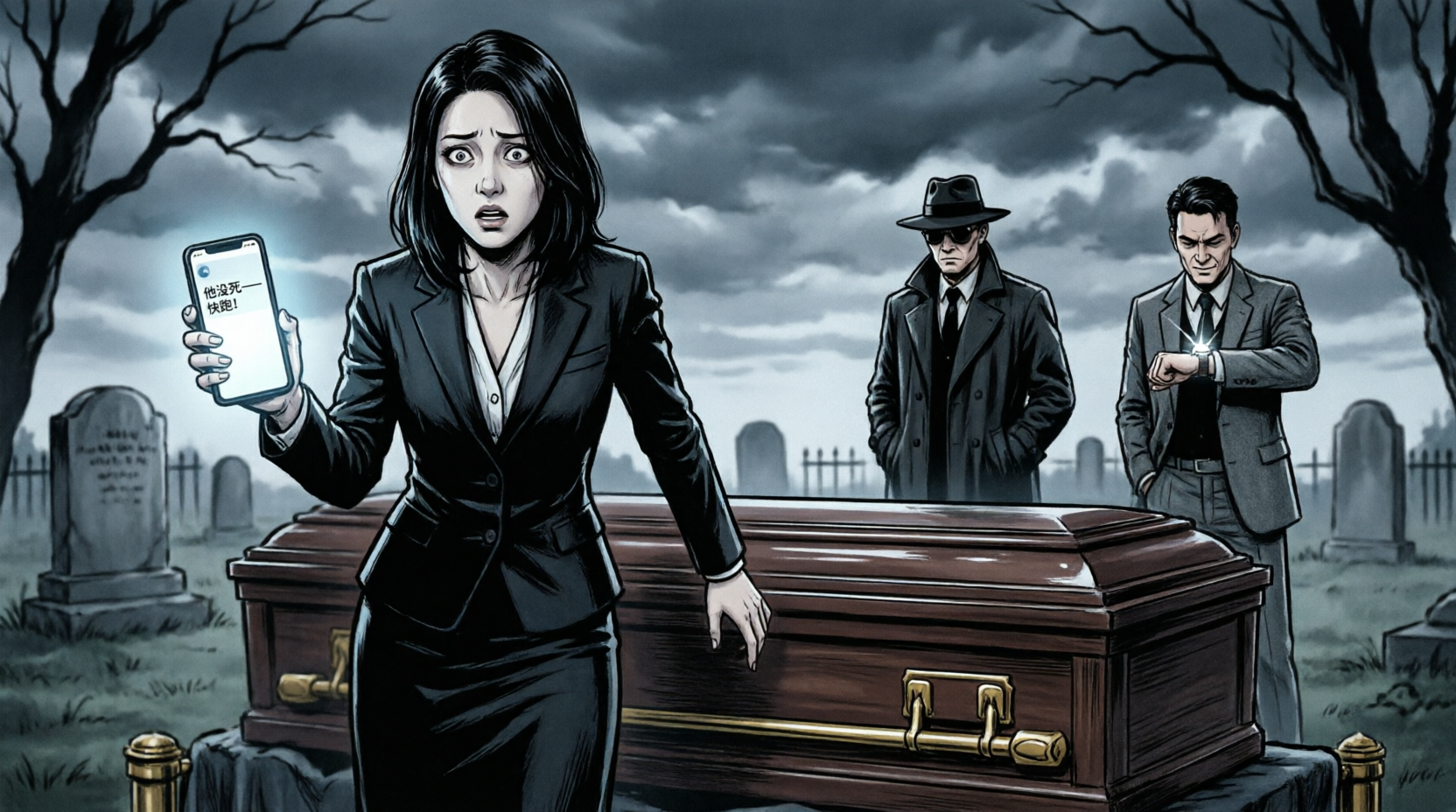
Mr. Arthur drove in silence, both hands steady on the wheel. No radio. No words. Just the hum of tires against the highway and the life I thought I understood slipping further behind me—Beverly Hills, my home, my sons, a closed casket, and forty-three years of marriage collapsing into something unrecognizable. “Mr. Arthur…” I whispered. “Is Robert alive?” In the rearview mirror, his eyes met mine.
“Yes, Mrs. Teresa.”
My hand flew to my mouth. The sob that came out wasn’t relief. It was something far worse—rage tangled with fear, betrayal tangled with love.
“And the man in the casket?”
He hesitated too long.
“He’s the one who has to explain that.”
We drove through the night.
Rain struck the windshield as Los Angeles disappeared behind us. Highway lights blurred into streaks. Truck taillights flickered like distant warnings. Somewhere along the road, I realized I was carrying more than grief inside my purse.
A letter.
A USB drive.
An empty vial.
And Robert’s revolver.
I had never felt so old.
Or so awake.
By dawn, Texas opened before us—wide skies, dry wind, and earth that smelled like truth after rain.
The ranch was modest. A white house surrounded by mesquite trees and cracked stone paths. Nothing about it felt like the life I left behind.
And then I saw him.
Robert.
Alive.
Sitting on a wooden chair, unshaven, a bandage on his arm, guilt carved into every line of his face.
I stepped out of the car, unsure whether I wanted to run to him or strike him.
He stood.
“Teresa…”
I slapped him.
Not out of cruelty.
Out of everything he had stolen from me in silence.
“I mourned you,” I said, shaking. “I buried you in front of your sons.”
His head lowered.
“I’m sorry.”
“Don’t apologize. Speak.”
Inside the ranch kitchen, no one touched the coffee that was served.
Robert placed a folder on the table. His hands trembled.
“Charles and Hector planned to have you declared incompetent,” he said. “They already had a doctor. They were going to take everything—your accounts, the house, the estate. They forged the beginning of a will.”
My stomach turned.
“They were drugging me too,” he added.
My eyes dropped to the vial in my purse.
“With this?”
He nodded.
“Sedatives. Small doses. Enough to make you appear confused. They said it was aging.”
I remembered Charles bringing coffee every night with a gentle smile.
“Dad, you should rest.”
My chest tightened.
“And you faked your death?”
“Not at first,” Robert said quietly. “I tried to protect you legally. But then Raphael died.”
The name hit like a fracture in glass.
“Raphael is dead,” I whispered automatically.
Robert shook his head.
“No. He wasn’t.”
The room tilted.
“That’s impossible.”
“My mother took him,” Robert said. “She told me he was too sick. That you wouldn’t survive it. That he died days after birth.”
My breath stopped.
“I never saw him,” I whispered.
“I know.”
His voice broke.
“Because he didn’t die.”
He paused.
“He lived.”
I couldn’t breathe.
“You’re telling me my son lived his entire life without me?”
Robert’s eyes filled.
“He found me eight months ago. He was sick. His heart was failing. He didn’t want to meet you only to lose you again.”
Silence crushed the room.
Then Robert opened a door.
A small bedroom.
A bed.
A candle.
And a framed photo.
A man in his forties.
My eyes.
My mouth.
My son.
I collapsed.
“My boy…”
On the bed lay a letter.
“Momma Teresa…”
My hands shook as I opened it.
“I forgave you before I met you. They told me you didn’t want me. I believed it for years. When I learned the truth, I was already running out of time. I only wanted you to know I existed. That I loved you before I ever met you.”
The letter slipped from my fingers.
I didn’t cry quietly.
I broke.
Later, Robert told me the rest.
Raphael had died days earlier.
But Charles and Hector had already moved to erase evidence—fast cremation, forged identity, rushed paperwork.
And in their haste, they buried him under Robert’s name.
Not knowing Robert was already gone from the house.
Not knowing the truth was already walking toward them.
When we returned to Los Angeles, I was no longer the woman who left it.
At the funeral home, Charles was arguing with staff.
Hector was on the phone.
“We’ll sedate her again when she returns,” he said. “She’s unstable.”
I walked in.
“What exactly am I unstable about?”
Silence.
Then Robert stepped in behind me.
Everything broke at once.
The cremation was halted.
Documents surfaced.
Police arrived.
A doctor was exposed carrying forged psychiatric evaluations with my name on them.
And for the first time, my sons realized the story was no longer theirs to control.
Charles tried one last time.
“You chose him over your family.”
I looked at him.
“No,” I said quietly. “You stopped being my family when you decided I was easier to erase than to protect.”
Raphael was buried in Austin under his real name.
No ceremony of wealth.
No performance of grief.
Just earth.
Wind.
And a mother finally arriving too late—but arriving nonetheless.
“I’m sorry,” I whispered. “I found you when I should have held you first.”
The legal aftermath came like winter.
Fraud.
Forgery.
Elder abuse.
Conspiracy.
The kind of words no mother ever expects to learn about her children.
They lost everything.
Not because I took it.
Because they tried to steal it through lies.
Hector came back months later.
Smaller.
Quieter.
Holding cheap flowers.
“Mom… I’m sorry.”
I looked at him for a long time.
“Forgiveness doesn’t restore what you tried to destroy,” I said. “It only decides what comes after it.”
He nodded.
And left.
Robert and I never returned to what we were.
He saved my life.
But he also broke it in ways that never fully healed.
Some nights we spoke.
Some nights we didn’t.
Grief doesn’t demand resolution. It only demands honesty.
Years passed.
A foundation was built in Raphael’s name.
Mobile clinics reached rural towns.
Children who never knew our story received care because of it.
That became my quiet redemption.
Robert died years later.
No secrets.
No messages.
No chaos.
Just an ending.
I placed a flower on his grave and said:
“This time, I know where you are.”
Today, I am eighty years old.
The house is quiet.
The desk still sits in the study.
Inside its hidden compartment are letters.
From Raphael.
From Robert.
And from me.
A record of truth, grief, and survival.
Because I learned something I never expected:
A woman can bury a husband, lose a child, confront betrayal, and still rise—not because she was spared pain…
but because she finally stopped letting others define her reality.