At 6:02 on Mother’s Day, my mother sent me an invoice for $347,000 and titled it Cost Of Raising A Disappointment.
I was asleep on my couch in my Somerville apartment when my phone buzzed against the cushion near my cheek. For one stupid, dreamy second, I thought it was my alarm. Then I cracked an eye open and saw her name.
From: Linda Moore
Subject: The cost of raising a disappointment
There are names that make your body react before your mind does. My mother’s was one of them. My stomach went cold. The back of my neck prickled. My hand hovered over the screen because after twenty-eight years of knowing Linda Moore, I understood something most people didn’t: she never wrote when she could wound in person, unless she wanted a record.
I opened the email.
It wasn’t a note. It was a performance.
She had attached a spreadsheet-turned-PDF titled Bianca_Cost_Breakdown_FINAL and copied every relative we had. Aunts, uncles, cousins, cousins’ spouses, the uncle who only came around when somebody died, the aunt in Arizona who sent chain emails in all caps, even my grandmother. Forty-eight addresses lined up in one vicious little row.
In the body of the message, she had written only one sentence:
You may never repay me emotionally, but you can at least understand the numbers.
Below that was the list.
Hospital birth – $12,400
Diapers (0–2 years) – $2,800
Clothing (0–18 years) – $15,600
Braces – $8,000
Summer camps – $4,500
Dance classes – $6,200
Cell phone bills – $8,400
Birthday parties (18 years) – $11,200
School lunches – $9,360
First car – $12,000
College room & board – $48,000
Miscellaneous support – $49,500
And at the bottom, centered and bold, like a total at the bottom of a restaurant receipt:
TOTAL COST OF RAISING A DISAPPOINTMENT: $347,000
I stared at it long enough for the room to come into focus around me. Gray morning light on my living room rug. Empty coffee mug on the side table. Spreadsheet tabs still open on my laptop from the client work I had been doing until almost two in the morning. The radiator giving off that soft clicking sound old radiators make when they cool down.
Then I scrolled back up and looked at the CC line again.
Every relative.
Every person she had ever charmed at holidays. Every person who had watched her do tiny, elegant violence to me over casseroles and birthday cake and Christmas coffee and never said a word because Linda’s cruelty always wore lipstick and a smile.
She thought this was going to do what it had always done.
Humiliate me. Silence me. Push me into the old shape.
I should tell you that for most of my life, it probably would have worked.
If she had sent that email when I was sixteen, I would have cried until my face swelled and then found some way to apologize for making her do it. At twenty-two, I would have written a panicked, careful reply trying to explain that I wasn’t ungrateful, that I knew I had been expensive, that I loved her, that I never wanted to be a burden.
But by twenty-eight, I worked in finance.
And numbers do something very useful for a person raised by a mother like mine: they teach you that truth is patient.
Truth sits in ledgers. It sits in routing numbers, application dates, signatures, account transfers, tax records, credit histories. It waits. It does not beg to be believed. It simply exists until somebody is finally willing to read it.
My mother thought she was sending a bill.
What she had actually sent was permission.
The family group chat started exploding almost immediately.
What is this? from Aunt Martha.
Linda, is this supposed to be funny? from Uncle Robert.
A thumbs-up reaction from my older sister Vicki, because of course she moved first and because of course her first instinct was to publicly stand beside our mother.
I closed the email.
Then I opened the folder I kept buried under three innocuous subfolders on my phone.
Insurance.
That was the name I’d given it, because if my mother ever had my phone in her hand—and for years that had been a real enough possibility to account for—I didn’t want her curiosity pinging at a folder called Evidence or Theft or Things You Did To Me.
Inside were screenshots, scans, PDFs, statements, letters, credit reports, tax notices, trust documents, copies of signatures, memos from banks, and one master spreadsheet with dates, accounts, balances, and notes color-coded by category.
I had started it out of panic.
I kept it out of discipline.
And somewhere along the way, it had become a shield.
My thumb hovered over the first image: a scan of the bank record showing an $89,000 withdrawal from the education trust set up in my name by my grandparents, transferred into Linda Moore’s personal account one month before I started college.
She had titled her invoice “The cost of raising a disappointment.”
Fine.
We were going to compare costs.
I hit reply all.
I attached one screenshot.
No note. No explanation. No “see attached.”
Just the image.
Then I set my phone face-down on the coffee table and went to make coffee because if there was ever a morning in my life that required caffeine, it was that one.
While the kettle heated, I leaned my hands against the kitchen counter and stared out the narrow window above the sink at the alley below. A woman in a red coat was walking a dog that looked too fluffy for early spring. Somewhere a truck backed up with an electronic beep-beep-beep. The world, astonishingly, had not paused for my mother’s latest act of war.
That screenshot I had sent was not random.
It was the cleanest cut.
One transfer. One account. One undeniable line item.
EDUCATION FUND – FULL WITHDRAWAL
From: Harrison Family Trust – Bianca Moore
To: Linda Moore Personal Checking
Circled in red.
My grandparents had set up equal college funds for Vicki and me when we were little. It was one of the few things in our family that had ever been equal on paper, which, of course, did not mean it stayed equal in real life.
Vicki graduated law school without a dollar of debt.
I graduated college with sixty-seven thousand dollars in student loans and my mother explaining, with a sigh full of martyrdom, that I had “used up” more of my trust because I needed “extra support” over the years.
At eighteen, I believed her.
At twenty-eight, I knew how to read a bank statement.
That’s the thing about the truth. Once you learn the language it’s written in, it gets a lot harder for other people to narrate over it.
The first reply hit before my coffee was done brewing.
Linda, why does this say Bianca’s college fund went into your account? from Aunt Martha.
Then another.
I thought her trust covered school. from Aunt Susan.
Then one from my father, not to me but to the full chain.
There has to be some explanation here.
My mouth twisted around a humorless little smile.
That sentence could have been engraved on my mother’s wedding ring. There has to be some explanation. There always had to be one. A context. A nuance. A misunderstanding. A migraine. A stressor. A moment. A reason the thing she’d done should not be judged as the thing she’d done.
My phone buzzed again. Private message this time.
Mom says you’re trying to humiliate her. Call me.
—Vicki
I didn’t.
Instead, I poured the coffee, sat down at my tiny kitchen table, and let the past unspool in my head the way it always did when money and family crossed wires.
When people hear “financial abuse,” they tend to imagine rich husbands hiding bank accounts from wives in sprawling suburban houses, or adult children draining elderly parents’ accounts. They do not picture mothers who pack school lunches in cute bentoboxes and remember to iron church dresses. They do not picture women who volunteer for fundraisers and know everyone’s birthday and cry in the right public moments.
My mother was excellent at looking like care.
That was part of why it took me so long to understand what she was.
Linda Moore was a woman who could weaponize generosity faster than anyone I’ve ever known. She gave gifts the way loan sharks hand over cash—always with the invisible contract attached. Every dollar became a future argument. Every favor turned into a line item in some emotional ledger only she was allowed to audit.
My sister Vicki learned early that the easiest way to survive in my mother’s orbit was to mirror back exactly what she wanted to see.
Vicki was the golden child in a way that would have been almost funny if I hadn’t lived under it. Four years older than me, beautiful in the polished, sorority-president way, brilliant when it served her, strategic always. She knew how to tilt her face when my mother was emotional, when to laugh at our father’s jokes, when to call home with “good news” so she could feed the family machine more of the same story: Vicki succeeds, Mom glows, Bianca lingers somewhere in the wrong light.
I was not a bad kid.
That’s one of the things I need to say clearly because people love to assume the scapegoat child must have done something outrageous to earn the role. I wasn’t rebellious. I didn’t sneak out, get arrested, wreck cars, or disappear with boys. I got good grades. I did my chores. I babysat cousins for free. I cooked when my mother didn’t feel like it. I took care of forms and reminders and practical things because I had a brain that liked systems and lists and making sure nothing got dropped.
I just wasn’t Vicki.
And in our house, that was enough to make me wrong.
Vicki got a graduation party with rented linens and a champagne fountain when she finished law school.
I got a text three weeks after my college graduation that said, Congrats. Proud of you.
No exclamation point. No call. No flowers. No celebration.
At the time, I still thought the problem was me. That if I were warmer, prettier, softer, louder, more grateful, less intense, less analytical, less “difficult,” my mother would one day turn to me with the same face she turned to Vicki.
Then the IRS sent me a letter.
That was the first crack that let real light in.
It arrived in a plain white envelope two years after college, when I was working my first full-time job in Boston and living in a studio apartment with one small window and a radiator that clanged like a pipe organ every winter. I opened it standing at my mailbox, expecting something routine. Instead I found a notice about inconsistencies in prior-year filings under my social security number.
Income I hadn’t earned.
Dependents claimed in ways that made no sense.
A refund already issued.
I remember the exact feeling that came over me. Not fear, not immediately. Confusion so sharp it felt physical.
I called the number.
The woman at the IRS was polite and deeply uninvested in my emotional wellbeing, which was exactly what I needed.
“Yes, Ms. Moore,” she said. “Multiple returns were submitted using your information.”
“That has to be a mistake,” I said. “I file my own taxes. I’ve only ever filed one return each year.”
“According to our records,” she said, “you were also claimed as a dependent.”
I laughed because it was absurd.
“I haven’t been a dependent in years.”
There was a pause while she clicked through screens. “Well,” she said, “someone seems to think otherwise.”
When I called my mother, she sighed before I even got the explanation out.
“Oh, Bianca. You always make everything into a crisis. Those people are impossible. It’s probably just some clerical issue. Forward me the letter.”
I almost did.
God, that still humiliates me a little. That I almost handed the evidence right back to the person who had created it.
Instead, maybe because I was tired or maybe because working with numbers all day had started to harden some soft, gullible corners of me, I said, “No. I’ll handle it.”
Her tone changed so fast it should have warned me even then.
“Well,” she said coolly, “if you don’t want help, don’t come crying to me when it gets messy.”
It was already messy. I just didn’t know how much.
That night I pulled my credit report for the first time.
I expected a thin file, maybe some student loan activity.
Instead I found three credit cards, all opened when I was between eighteen and twenty, all with balances near their limits. I found late payments. Collection notices. Addresses I had never lived at. My credit score sat there at the top of the report like a slap: 520.
I had never missed a payment on anything in my life.
The first apartment I’d tried to rent after college had turned me down because of that score. The landlord had smiled tightly and said, “We’ve decided to go with another applicant,” and I’d gone home and cried because I thought adulthood was already outrunning me.
I had blamed myself.
There is a special kind of rage that comes from realizing you have been carrying shame that belongs to someone else.
That was when the folder began.
Screenshot. Letter. Call log. Downloaded statement. Another screenshot. Then a spreadsheet. Then a friend in compliance at work quietly telling me how to request supporting records from banks. Then a CPA who specialized in identity-theft cleanup sitting across from me in a plain office, eyebrows rising higher and higher as I laid everything out.
“This is not accidental,” he said finally.
“No,” I said.
He leaned back in his chair. “Do you know who did it?”
I thought of my mother’s neat handwriting. My sister’s address on one of the statements. The timing. The lies.
“Yes,” I said. “I just don’t know yet how much I want to destroy.”
That was three years before the invoice.
By then, the destruction had already been underway.
Mother’s Day at my grandmother’s farmhouse was not, technically, my mother’s event. Eleanor Harrison was the family matriarch, the steady axis around which holidays usually turned. But my mother had spent years gradually taking over gatherings until everyone else behaved as though she were the host even in someone else’s home.
So when she announced the “family Mother’s Day reunion” and insisted everyone come to Grandma’s place because “it means more when we’re all together,” no one questioned her. No one even noticed the manipulation. They heard love, tradition, sentiment. I heard logistics and stage management.
And still I went.
Because it was Grandma.
Because for all my sharpened instincts and hard-won boundaries, there was still a small stupid piece of me that hoped maybe, in a room full of witnesses, my mother might restrain herself.
I arrived at seven in the morning because Vicki had texted, You’re coming early to help, right? Like usual.
Like usual.
That phrase should have been our family motto.
The farmhouse stood on ten acres outside Concord, all white clapboard and blue shutters and hydrangeas lining the front walk. When I was a child it felt magical to me. The porch swing. The old red barn. The kitchen with its copper pots and deep porcelain sink and smell of cinnamon, no matter the season.
At seven a.m., it smelled like coffee and floor polish and the beginning of labor.
I let myself in through the back door with the spare key Grandma had given me years earlier.
She was already awake, of course, in a navy cardigan and slacks, silver hair pinned neatly back. Eleanor Harrison did not drift through life in house slippers pretending age exempted her from discipline. She believed in order, sharp pencils, and butter that was actually butter.
“Morning, darling,” she said, not looking up from the guest list she was checking off with a fountain pen. “The peonies came. They’re too pink. We’ll make them work.”
I kissed her cheek. “Good morning to you too.”
For the next four hours we worked.
I washed berries and trimmed asparagus and arranged flowers and lined up serving platters while Grandma checked deliveries, coordinated with the part-time caterer, and occasionally muttered blistering one-line assessments of various relatives under her breath.
“Your Uncle Robert will bring mediocre wine and talk too loudly about the market,” she said while tying ribbon around folded napkins. “Pretend to listen and keep him away from the deviled eggs.”
I laughed.
It felt easy in her kitchen in a way family spaces almost never did.
Then my mother arrived.
You could always tell when Linda entered a room by the pressure change. She didn’t need to speak. The atmosphere reorganized around her.
She swept in wearing a pale blue dress and a smile sharpened to social perfection, carrying a bouquet she hadn’t bought and taking one look around the kitchen like she was evaluating a staff she paid poorly.
“Oh good, you started,” she said to me, handing me her purse without asking. “We need more glasses on the back table and the roast chicken should not sit under those lights too long. Where are the place cards?”
No hello.
No thank you.
No acknowledgment that I’d been there for hours.
Just another day of me being the hands and her being the mouth.
Vicki came later, naturally. Around eleven-thirty, in a silk cream dress, heels she immediately kicked off because “farmhouse gravel is impossible,” and carrying peonies expensive enough to look effortless. She kissed my mother, hugged Grandma, and told everyone the house looked stunning.
“You really outdid yourself,” she told Mom, right in front of the flower arrangements I had spent ninety minutes fighting into shape.
Mom smiled modestly. “It all came together.”
I sliced strawberries and kept my face neutral.
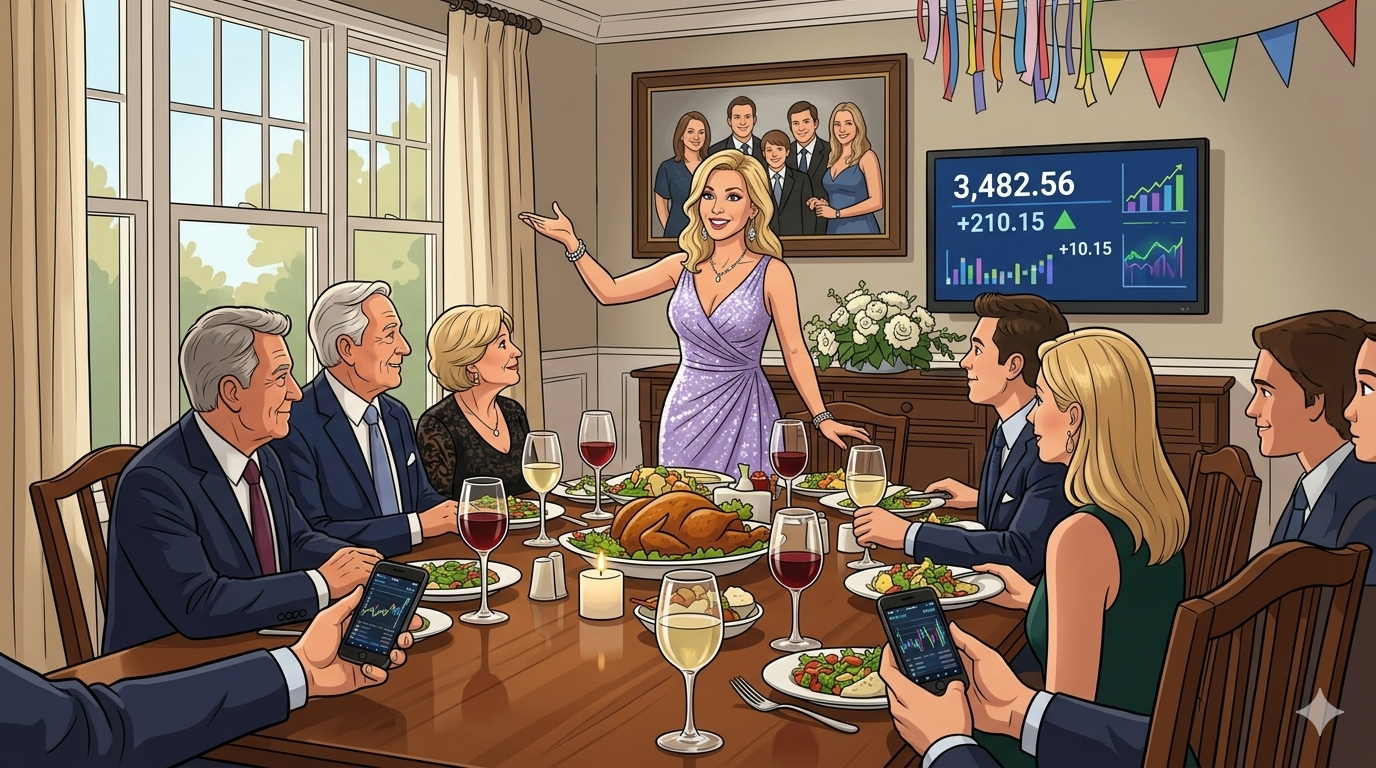
By noon, the house had filled with relatives. Forty-eight in total, if you counted spouses and the older cousins’ teenage children. The dining room table had been extended nearly the full length of the room. Extra chairs lined the walls. In the living room, children were already making a mess of Grandma’s puzzle table.
Everyone kissed my mother hello first.
Then, if they noticed I was carrying hot dishes or balancing a tray of drinks, they’d say, “Bianca! There you are. You always make yourself useful.”
Useful.
That was my family’s favorite compliment for me.
Not brilliant. Not accomplished. Not successful. Useful.
A wrench is useful. So is duct tape.
Nobody calls either one beloved.
Lunch came and went in waves of noise. People ate roast chicken and rosemary potatoes and praised Grandma’s table without understanding that the hands that cooked half of it were mine. My mother accepted compliments with the gracious modesty of a woman who had done almost none of the work but all of the narrative construction.
Then came the family photograph on the porch.
This detail matters because sometimes cruelty is quietest in the things everyone else finds normal.
We arranged ourselves under the white porch columns while my cousin’s husband tried to frame the shot. Tall people in back. Grandchildren seated in front. Grandma and Mom centered, naturally. Vicki near Mom, of course, one hand resting elegantly on Grandma’s chair.
When I moved to stand near the center out of simple spatial logic, my mother touched my elbow lightly and said, with a smile meant for the group rather than me, “Bianca, honey, move back a little. You’re blocking the line.”
I moved back.
Not because she was right. Because the correction itself was familiar. Because I could already feel the heat of every eye and did not want to spend the next twenty minutes hearing about how I always made little moments complicated.
The camera clicked. Flash. Smiles. Done.
As people drifted back inside, Grandma’s fingers closed around my wrist.
“Whatever she tries today,” she said under her breath, “do not shrink for it.”
I looked at her.
There was something in her face I couldn’t quite name. Not surprise. Not dread.
Preparation.
“What does that mean?” I asked quietly.
But she had already turned away to ask someone to bring more ice.
By three o’clock, I understood.
The men had moved to the den with whiskey. The children had been sent outside with cousins old enough to keep them from drowning in the pond. The women and a few leftover husbands gathered in the dining room for dessert and coffee.
That was when my mother stood.
You have to understand that Linda Moore adored an audience. She did not merely enjoy attention; she organized life into opportunities for it. She could turn a grocery store return into a story with beginning, middle, and end if enough people were around to nod.
So when she stood, tapping her spoon lightly against a water glass, the room obediently quieted.
“Before we have dessert,” she said, smiling, “I wanted to say something.”
Of course she did.
She lifted her chin slightly, eyes shining with that manufactured emotion she could summon at will.
“Motherhood,” she began, “is the greatest privilege of my life.”
Aunt Patricia made a soft, approving sound.
“It is also,” my mother continued, “the hardest work I have ever done. The most thankless. The most invisible.”
I felt the first tug of dread under my ribs.
Beside me, Vicki smiled softly and lowered her lashes in what she probably thought was the expression of a moved daughter and I recognized as her court face.
“I have given everything to my daughters,” my mother said. “Everything. My time. My energy. My youth. My money. My peace.”
She let the silence sit for effect.
“And lately,” she said, with a sigh carefully shaped to sound more sad than sharp, “I have been thinking a lot about what parents are owed.”
That pulled a few murmurs from around the room. Agreement. Sympathy. Nervous chuckles.
Then she lifted her phone.
“If I’ve learned anything,” she said, “it’s that some children think they arrive in the world without cost. That mothers are just…resources. Infinite. Disposable.”
Her gaze landed on me and stayed there.
I did not move.
“So,” she said brightly, “I thought it would be useful to make the cost visible.”
She nodded toward the wall.
I turned.
Someone—probably one of the younger cousins she could boss around—had hung a gilded frame over the sideboard.
Inside it was a printout.
My invoice.
Neatly formatted. Bold total at the bottom. The phrase Cost Of Raising A Disappointment centered like a title on a museum plaque.
Around the table, people shifted, phones lighting up almost simultaneously as they checked their email and found the PDF sitting there with my name on it.
There was a small burst of uncomfortable laughter from somewhere near Aunt Martha.
My mother spread her hands.
“I thought,” she said, “that before anyone complains about what family owes them, they should understand what family has already spent.”
And then she smiled at me. Publicly. Sweetly. Like this was all affectionate teasing and not a deliberate act of humiliation planned in advance.
If I hadn’t had the folder, I think something in me would have broken for good in that moment.
Instead, something colder and cleaner slid into place.
I stood.
Not quickly. Deliberately.
The chair legs scraped the floor, pulling the room’s attention into a tighter line. My mother’s smile flickered. She knew enough about me to recognize that kind of stillness.
“Mom,” I said.
She tilted her head. “Yes, sweetheart?”
There is no cruelty quite like calling someone sweetheart in a room where you have just dehumanized them.
“You’re right,” I said. “It is useful to understand the numbers.”
A few people relaxed, thinking—what? That I was about to laugh it off? Apologize? Fold?
I took out my phone.
Vicki’s face changed first. Recognition. Fear. She knew about the folder, at least in pieces. She had spent three years praying I would never decide to use it.
“Bianca,” she said sharply, “don’t.”
Mom’s eyes narrowed. “What are you doing?”
“Replying,” I said.
I opened the email thread, hit reply all, and began attaching files.
The room stayed so quiet I could hear one of the kids outside shriek with laughter through the open window.
“Bianca,” my mother said again, lower now. Warning.
I hit send.
A wave of notification sounds rolled around the room.
One by one, faces dropped to screens.
Aunt Martha squinted. Uncle Robert’s eyebrows drew together. Cousin Beth whispered, “What is that?” before realizing she’d said it out loud.
My mother was still standing, still trying to hold the shape of the moment together through sheer force of posture.
“I’m glad you wanted everyone to understand the numbers,” I said. “Because I finally do too.”
I turned my screen outward so the nearest people could see the first document.
“This,” I said, “is the trust account Grandma and Grandpa set up in my name for college.”
Grandma said nothing. She just folded her hands more tightly in her lap.
“Equal amount to Vicki’s,” I continued. “Eighty-nine thousand dollars.”
A few eyes lifted from phones. A few turned to Vicki, who had gone very pale.
“You told me for years,” I said to my mother, “that my college fund ‘ran out’ because I needed extra tutoring and support and because I was more expensive than Vicki.”
My mother let out a small, incredulous laugh.
“Oh for heaven’s sake, Bianca. You’re going to do this now?”
“Yes,” I said. “I am.”
I tapped the highlighted transfer line.
“On August 3rd, 2016,” I said, “you withdrew the entire eighty-nine thousand dollars from my education trust and transferred it into your own account.”
The room changed.
It wasn’t dramatic. No one leapt up. No plates shattered.
It was subtler and, somehow, more devastating. Shoulders stiffened. Mouths opened. Air seemed to recalculate itself.
“That can’t be right,” Uncle Robert said automatically.
“It is,” said Grandpa’s former attorney from my phone speaker because I had included the official trust record in the attachment, complete with notarized disbursement authorization and account routing.
“You used that money,” I said, looking directly at my mother now, “to pay off your Lexus and the kitchen renovation you told everyone was funded by Dad’s bonus.”
“That money went to family expenses,” she snapped.
“Interesting,” I said. “Because my student loan statements show sixty-seven thousand dollars of debt in my name from the same period.”
I swiped to the next document.
My mother had always hated that I stayed calm when cornered. It denied her the high ground she preferred, where she could point at my emotion and call it instability.
This calm, I think, terrified her.
“For the past two years,” I said, “I’ve also been cleaning up tax returns filed in my name or using my identity. Some of you may not know this, but the IRS tends to notice when one person mysteriously has more than one return attached to their social security number.”
Dad’s face had gone slack with confusion.
“What?” he said.
I tapped the next page.
“From 2018 through 2024,” I said, “Mom claimed me as a dependent on federal tax returns. I was living on my own. Paying my own rent. Filing my own taxes. She still used my information to claim over thirty thousand dollars in deductions and credits.”
“That is not what happened,” my mother said sharply. “That’s a distortion.”
“No,” said Uncle George, who had been silent until then, reading with the unamused concentration of a retired accountant. “That is exactly what happened.”
He looked up over his glasses.
“This is textbook tax fraud.”
The word fraud fell into the room with a grim little finality.
My mother’s color changed. She turned toward him first because he was easier to challenge than me.
“You don’t know the context,” she snapped.
“I know the law,” he said.
Vicki stood abruptly. “Can we not do this here?”
I looked at her.
“Where would you prefer?” I asked. “Because I spent years trying private.”
That shut her up.
I pulled up the credit card records.
“This part,” I said, “is my favorite.”
No one smiled.
“I pulled my credit after the IRS mess started,” I said. “I found three credit cards opened in my name between ages eighteen and twenty. Maxed out. Missed payments. Store charges from places I’d never been.”
Now I turned to Vicki.
“One set of statements went to your condo.”
She didn’t even try to interrupt this time. She just looked like someone had removed a floorboard beneath her.
“A designer handbag. A bracelet. An engagement ring.” I paused. “Charged to a card in my name.”
Her husband Derek, who until then had clearly believed he had married into a merely dramatic family rather than a criminally entangled one, stared at her hand.
“Is that the ring?” he asked.
The room was so quiet that Vicki’s inhale sounded huge.
“She told me Bianca knew,” Vicki blurted finally, too fast, too desperate. “Mom said she knew and didn’t care because she had bad credit already anyway—”
My mother rounded on her so violently her chair nearly tipped.
“Victoria!”
But it was too late.
There is a point in every collapse where the pieces stop trying to hold each other up.
We had reached it.
Dad stood slowly from his chair, eyes moving from my mother to me to Vicki and back again.
“Linda,” he said, voice rough, “tell me this isn’t true.”
She looked at him, and for one split second I thought I saw the old move gather in her face. Tears. Injury. A story with just enough missing edges to make him comfort her instead of question her.
Then she realized the numbers had outflanked her.
“This family has lived well because I did what I had to do,” she snapped, and the mask split cleanly down the middle. “You think any of this was easy? You think money just appeared? Bianca always had more than enough. She’s always been dramatic about everything. I borrowed. I managed. I kept this family afloat.”
“With my identity,” I said.
“With my trust,” I added.
“With my credit,” I finished.
No one looked away.
My mother, who had spent my whole life narrating me into smaller and smaller shapes, finally had nowhere to put the story.
That should have been the end.
It wasn’t.
Because humiliation was only half of what she had intended for me.
The other half, I realized in that room full of suddenly horrified relatives, was erasure.
She hadn’t sent that invoice because she wanted money. Not really.
She sent it because she wanted everyone to agree that I was a burden first and a person second. She wanted the whole family to nod along and confirm that whatever she had done to me, I probably deserved it because look at all she’d spent.
And something about that realization made the last piece of fear inside me fall away.
So I said the one thing no one expected.
“I am done being your evidence,” I told her.
My mother blinked. “What?”
“You have spent my whole life punishing me for not making your story easier,” I said. “No more.”
She laughed then, high and brittle. “Punishing you? Bianca, please. If anyone has been punished, it’s me. You have no idea what it takes to deal with someone like you.”
There it was. The old refrain. The one that had taught me to doubt every feeling I had before I was old enough to spell gaslighting.
I looked around the room.
At my aunts. My uncles. My cousins. At Grandma, still silent, eyes hard as hammered glass. At Dad, who looked like someone had cut the strings that usually held him upright.
And I said, very clearly, “Everything she just did in this room is why I kept records.”
That landed differently than the financial documents had.
Because suddenly this wasn’t just about money. It was about pattern. Years. Character.
Aunt Martha set her phone down with care.
“Linda,” she said, “did you send that email because Bianca asked you for money?”
“No.”
“Did she threaten you?”
“No.”
“Then why did you do it?”
My mother opened her mouth and found no answer that could survive contact with daylight.
No one said anything for several seconds.
Then Grandma rose.
Eleanor Harrison was not a dramatic woman. She did not slam hands on tables or hurl crystal into fireplaces. Her authority came from a colder place than volume. She had survived three recessions, one cheating husband she buried with full honors anyway, and thirty-five years running the back office of my grandfather’s agricultural supply business with such competence that half the men who underestimated her ended up asking her for quiet advice.
When she stood, the room obeyed.
“Everyone out,” she said.
There was no need to clarify whom she meant.
People began to gather their bags and phones with the uneasy haste of witnesses suddenly desperate not to be implicated. Chairs scraped. Murmurs bloomed. One cousin slipped me a long look—sympathetic, ashamed, curious, all at once—before following the others toward the foyer.
By the time the room had emptied down to immediate family and Grandma, the silence was nearly physical.
Mom sank into a chair like her bones had turned unreliable.
Dad remained standing.
Vicki sat very still, both hands around her water glass, knuckles white.
Grandma looked at my mother and said, “You have exactly one chance to tell the truth.”
It was strange. After the avalanche of documents and reactions and my own steady voice, that sentence was the one that made my mother finally look afraid.
Not of me.
Of her.
“Mother—” Linda began.
“No,” Grandma said. “The truth.”
And maybe because the family audience was gone, or because the numbers had already gutted her main defenses, or because some people only collapse after the first floor gives way and the second realizes it has nowhere to go, my mother did something I had not expected.
She told the truth. Not all of it. Not gracefully. But enough.
She admitted taking the college fund “temporarily.” Admitted using my identity “because it was easier.” Admitted involving Vicki because “she understood what was at stake.” Admitted filing taxes in my name because “we needed the refund that year and then the next year it was just…already a pattern.”
She cried while saying it, which would have moved me once.
It didn’t move me then.
Dad listened with both hands braced against the back of a chair, head bowed, face gray.
When she finished, he said, very quietly, “How long?”
My mother blinked through tears. “What?”
“How long,” he repeated, “have you been doing things like this behind my back?”
She looked down.
That was answer enough.
He nodded once, like a man receiving a diagnosis.
Then he walked out of the room.
He did not slam the door. He did not shout. Somehow that made it worse.
Grandma looked at my mother for a long, long moment.
Then she turned to Thomas Bell, her attorney, who had apparently been downstairs in the study the whole time because of course my grandmother had planned further than any of us understood.
“Draft it,” she said.
Mom looked up sharply. “Draft what?”
“My amendment,” Grandma replied.
A thin vein pulsed at my mother’s temple.
“Mother, don’t be ridiculous. This is a family matter.”
Grandma’s gaze could have frozen boiling water.
“This is a criminal matter,” she said. “And now it is also an estate matter.”
Vicki made a sound like she might be sick.
My mother stood so fast her chair toppled backward.
“You can’t disinherit me over an argument,” she snapped. “You’re upset. You’re overreacting.”
Grandma’s voice did not rise.
“It was not an argument,” she said. “It was a reveal.”
Then she looked at me.
“Bianca,” she said, “come to my study in the morning.”
That was all.
By the time I reached my apartment that night, forty-seven relatives had blocked my mother.
Not because I told them to. I didn’t have to.
They did it one by one, in visible increments, because family group chats are deeply useful for tracking social collapse in real time. One cousin left. Then another. Aunt Patricia removed Linda from the “summer barbecue planning” thread. Uncle Robert texted me privately to say, I am ashamed I didn’t see this sooner. Even the Arizona aunt who lived on chain emails and denial sent a curt message that read, Well. This is beyond the pale.
Forty-seven.
The only person who didn’t block her was Grandma.
Because Grandma did something much colder.
She called her lawyer.
At nine the next morning, I sat in my grandmother’s study while Thomas Bell laid a sheaf of freshly printed papers on the desk between us.
My mother’s inheritance, which had once been substantial enough that she mentioned it jokingly whenever she wanted to remind me “the family legacy” mattered, had been reduced to a token amount impossible to contest but too small to comfort.
“Your grandmother wants no ambiguity,” Thomas said, sliding me a summary page. “This revision is immediate, witnessed, and airtight.”
Grandma sat in her high-backed chair with her glasses low on her nose, looking not triumphant but exact.
“I should have seen more,” she said to me. “I saw enough to know something was wrong. I did not push far enough.”
“This isn’t your fault,” I said automatically.
She lifted one eyebrow.
“We are not doing that,” she said. “Not today.”
I swallowed.
She took my hand across the desk. Her skin was papery and warm and steady.
“Your mother built her life on the assumption that she could keep taking from you without consequence,” she said. “That ends now.”
Something in my chest, something hard and buried for years, cracked clean open.
Not because of the money. Not because of the will.
Because someone older and wiser than me was finally saying, in plain language, that what happened to me had happened. That it mattered. That I did not have to shrink it for anyone’s comfort.
Thomas cleared his throat.
“There is one more thing,” he said.
He handed me another document.
It was a restitution agreement my grandmother had instructed him to draft—civil, not criminal. An offer that my mother could either accept quietly or refuse, at which point the folder on my hard drive would become the state’s problem instead of the family’s.
College fund. Tax damages. Credit repair costs. Fraudulent debt. Attorney’s fees.
A total.
Large enough to hurt.
Small enough to be merciful, given the alternatives.
“Do you want this?” Grandma asked me.
I thought of the invoice framed over the sideboard. Of the line items. Of the number at the bottom.
I thought of how she had tried to quantify my existence as a debt.
And then I looked at the restitution amount on the page in front of me.
“No,” I said.
Grandma and Thomas both looked at me.
“I want the option,” I clarified. “I want her to know exactly what she owes. I want it documented. I want it real.” I took a breath. “But I don’t want my life organized around chasing money from her anymore. If she wants to sign it and pay, fine. If not, I still want the records preserved. I still want my name cleared. And I want her out of my future.”
Grandma nodded once, slow and approving.
“There you are,” she said softly.
The weeks that followed were not neat.
My parents’ marriage shattered faster than I expected, slower than it probably should have. Dad moved into a furnished apartment in Cambridge near the river and spent several months alternating between anger, disbelief, and a stunned kind of grief that made him look both younger and older at once.
“I keep trying to rewrite the years in my head,” he admitted one Sunday over takeout Thai food on my couch. “Trying to remember if there were signs. There must have been signs.”
“There were,” I said gently. “You just trusted her explanations.”
He looked down at his hands.
“I trusted too much.”
I wanted to tell him he should have protected me better. That his softness had often functioned like complicity. That comfort without defense is not the same thing as safety.
I did tell him eventually. But not that night.
That night I just sat beside him while he cried for the first time in my memory, shoulders shaking, face turned away like he was embarrassed by grief itself.
Vicki lost more than face.
Her husband, Derek, stayed for exactly eight more weeks. Long enough to verify the worst pieces of the financial mess and realize he had married into something he lacked the stomach to endure. He left carefully, politely, citing “breach of trust on multiple levels,” which sounded like a line from a memo because Derek had always preferred distance dressed as professionalism.
Vicki called me the night he moved out.
“I know I deserve this,” she said before I could speak. “I know I do. But I also know Mom taught me exactly how to stand next to wrongness and call it survival.” She breathed shakily into the phone. “I don’t know how to be someone else yet.”
“You start by not lying,” I said.
“I’m trying.”
“I know.”
And I did know.
Because people like Vicki don’t become honest overnight. They become tired of the cost of performance first. Then maybe, if they’re lucky, they get honest later.
My mother, meanwhile, oscillated between rage and collapse.
She sent letters because I had blocked her calls. Long, exhausting letters that swung from apology to accusation and back again in the space of two pages. One paragraph would say I know I hurt you more than I admitted and the next would insist you always had a way of making me feel like a villain in my own house.
I didn’t answer.
She showed up at my office once. Security walked her back out.
She emailed Marcus. He forwarded it to me without opening it.
She left a voicemail on Grandma’s landline calling me “vindictive” and Grandma “senile.” Thomas Bell filed that away too.
The only thing that finally quieted her was the combination of legal boundaries and social exile. Once it became clear that her old audience was gone, the performance had nowhere to land.
That was, I think, the first truly unbearable thing she had ever experienced.
Not guilt.
Irrelevance.
By late summer, the dust had settled enough that my life began to feel like mine in a way it never had before.
The IRS matter was resolved. My credit report was corrected account by account. My student loan balance shrank after Grandma quietly gifted me enough to wipe out the predatory part of it. I kept working. Kept building. My clients didn’t care that my family had detonated over Mother’s Day. If anything, one or two of them seemed to regard me with slightly more respect once they learned how long I had been managing complex systems while standing inside one myself.
Marcus proposed in October.
Not in a restaurant. Not at some scenic overlook with hidden photographers in bushes.
In our kitchen.
He had flour on his forearm and there was a pot of tomato sauce bubbling on the stove and the radio was playing something old and soft in the background. He turned from the counter holding the ring like he’d just finally admitted to himself there was no better time than an ordinary, beloved one.
“I know your family has made ceremonies feel dangerous,” he said, and I was already crying before he got to the question. “So I want you to know this doesn’t have to be big to be real.”
Then he smiled, nervous and warm and fully himself.
“Bianca Moore,” he said, “will you marry me?”
I laughed through tears and said yes before he even finished the last word.
When I called Dad, he cried again.
When I told Grandma, she said, “About time. He looks at you as if he recognizes your actual value, which is rare enough to reward.”
When Vicki texted, I’m happy for you. Really, really happy, I believed her.
I did not tell my mother.
Not because I wanted to punish her. Because the news no longer belonged to her by default.
That may sound small. It was not.
People who grow up in loving families often don’t realize how much of adulthood is learning that privacy can be holy. That not every milestone must be offered up for inspection. That joy can be protected instead of negotiated.
A few months after the engagement, I got a letter from my mother.
Not emailed. Not hand-delivered. A real letter, mailed in a plain white envelope with her handwriting on the front.
I almost threw it away unopened.
Instead I sat at the kitchen table, Marcus reading on the couch behind me, and unfolded the pages.
For once, it was short.
No excuses.
No biblical references. No martyrdom.
Just this:
I know I cannot ask for forgiveness. I know I have spent years making you carry things that were mine. You were never the disappointment. You were the witness. I hated you for seeing me clearly when I could not bear to see myself. That was evil of me.
I am in therapy. I am sober now. I have sold the car. I am trying to become someone whose apology might one day mean something, even if that day never comes for you.
If you never respond, I understand.
Love,
Mom
I read it twice.
Then I folded it back up and set it in the drawer with the rest of the documents.
Not because it meant nothing.
Because meaning takes time.
The first Mother’s Day after the invoice, I turned my phone off.
Marcus and I drove out to the coast with sandwiches and a blanket and spent the afternoon near the water. The sky was pale blue. Wind snapped at the edges of the blanket. Somewhere farther down the beach, a child was trying and failing to fly a kite.
I sat with my knees drawn up and watched the tide pull in and out.
“Do you want to talk about it?” Marcus asked eventually.
I thought about the invoice. The screenshot. The dings around the dining room table. My grandmother’s hand on mine in the study. My father’s face when the truth landed. Forty-seven relatives blocking my mother by midnight. The forty-eighth rewriting her will instead.
Then I thought about where I was now.
Debt lighter. Name cleared. Ring on my finger. Future chosen rather than assigned.
“I think,” I said slowly, “for the first time, I don’t feel like Mother’s Day belongs to her.”
Marcus squeezed my hand.
“Good,” he said.
The ocean kept moving.
That is what healing has felt like, if I’m honest. Less like a breakthrough and more like a tide. It doesn’t erase what’s there. It returns and returns and returns until sharp things become something else.
Not harmless.
Just no longer able to cut you in the same place.
Sometimes I still wake up with that old stomach-drop panic after a text notification. Sometimes a spreadsheet can make me cry if the wrong number appears in the wrong place. Sometimes I still have to remind myself that love is not an itemized debt and that being useful is not the same thing as being valued.
But then I walk through the life I built.
The apartment with enough sunlight for herbs on the sill. The job I’m actually good at. The man who asks before assuming and listens before defending. The father who, in the aftermath of his own devastation, still looked at me and said, “You are my daughter.” The grandmother who saw the line my mother crossed and answered it not with performance, but with irrevocable action.
And I remember something that took me twenty-eight years to fully understand:
My mother was wrong about numbers.
Not the arithmetic. She can add.
The meaning.
You cannot calculate the worth of a child by tallying expenses and subtracting affection.
You cannot reduce a life to diapers and braces and school lunches and call the result truth.
A child is not a debt.
A daughter is not a bill.
And a disappointment is not the person who finally refuses to pay for the damage done to her by someone who calls it love.
The last Mother’s Day I ever spent with my family began with an invoice.
My mother thought I would cry, beg, maybe wire her money.
Instead, I sent one screenshot.
By morning, forty-seven relatives had blocked her.
The forty-eighth called her lawyer and cut her out of the future she thought she owned.
And me?
I made coffee. I balanced the books. I walked away with my name intact.
THE END