Part 2: The Letter in Blue Ink That Changed Everything
My father turned around in his seat.
And for the first time that evening, I saw something on his face I had never seen before.
Fear.
Not anger. Not irritation. Not that familiar expression of disappointment he had worn whenever he looked at me.
Fear.
Because sitting in the third row, wearing her blue Sunday dress and the pearl earrings my grandfather had given her fifty-six years earlier, was his mother.
My grandmother, Dessie.
The woman he had spent four years avoiding.
The woman he had told everyone was too frail to leave her house.
The woman whose home he had already begun treating like his future inheritance.
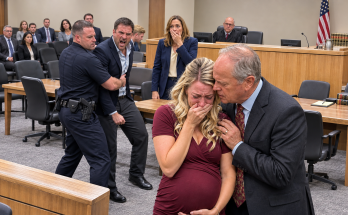
She sat in her wheelchair with a handkerchief pressed against her mouth.
And she was crying.
The dean adjusted her glasses and looked down at the letter.
“Before we present this award,” she said, “we would like to share a few words from someone who knows our recipient better than almost anyone.”
My stomach tightened.
I recognized the handwriting immediately.
Grandma’s handwriting.
Shaky blue letters, written carefully across lined notebook paper.
I hadn’t known she’d written anything.
Then the dean began reading.
The Letter My Grandmother Had Kept Secret
Dear Nursing Award Committee,
My name is Dessie Carter. I’m eighty-eight years old, and I have lived long enough to know the difference between someone who wants to look important and someone who does important things when nobody is watching.
A few people in the audience smiled.
The dean continued.
My granddaughter Emily is the second kind.
Six years ago, she decided to become a nurse. She was already working full-time, helping her family, and taking care of me.
I told her it was going to be hard.
She said, “Grandma, I’ve spent years answering calls from people having the worst day of their lives. I want to learn how to help them after the ambulance arrives.”
My eyes filled.
I remembered that conversation.
We had been sitting at the kitchen table eating leftover biscuits.
Grandma had looked at the nursing school brochure and asked whether I was sure.
I’d told her I was terrified.
She’d smiled and said, “Well, baby girl, being scared doesn’t mean you can’t do it.”
The dean turned the page.
I’ve watched Emily come home after twelve-hour shifts, put her books on the kitchen table, and study until midnight.
I’ve watched her fall asleep over those books.
I’ve watched her get up before sunrise to make sure I had my medicine, breakfast, and clean clothes before she went to work.
There were days when she could barely keep her eyes open.
But she never made me feel like a burden.
A quiet sob escaped my throat.
Across the gym, I could see Grandma wiping her cheeks.
Then came the sentence that made my father lower his head.
Some people in our family believe Emily wasted six years chasing a foolish dream.
The dean paused.
The room grew still.
I want those people to know that I have never seen a woman work harder for something she believed in.
And I want Emily to know that every hour she spent studying, every dollar she earned, and every sacrifice she made was worth it.
I pressed my fingers against my lips.
But the dean wasn’t finished.
The Sentence That Made My Father Turn White
There is something else I want to say.
Emily has never asked me for recognition.
She doesn’t tell people how much she does for me.
She doesn’t mention the nights she sits beside my bed when my arthritis is bad, or the mornings she misses breakfast because she’s making sure I’m comfortable.
She just does what needs doing.
I know what people say about old women like me.
They say we ought to be somewhere else.
Somewhere out of the way.
But my granddaughter has never treated me like something that needs to be put away.
The dean’s voice trembled slightly.
She treats me like a person.
And if that isn’t the heart of a nurse, I don’t know what is.
I heard someone begin clapping.
Then another person.
But the dean lifted her hand.
“One final paragraph,” she said.
I looked at Grandma.
She was staring straight at me.
Emily, if they read this aloud, I hope you’ll forgive an old woman for embarrassing you.
A small ripple of laughter moved through the audience.
I want you to remember something your granddaddy used to say.
The worth of a person isn’t measured by what they inherit.
It’s measured by what they give when nobody is keeping score.
You’ve given me seven years of love, patience, and dignity.
Now it’s your turn to build a life that belongs to you.
And don’t you dare feel guilty about it.
Love always,
Grandma Dessie.
The dean lowered the paper.
For a moment, nobody moved.
Then the entire gym erupted in applause.
I stood there crying so hard I could barely see.
And when I looked toward the second row, my father was sitting perfectly still.
His face had gone pale.
The Award I Never Expected
The dean turned toward me.
“Emily Carter, it is our honor to present you with this year’s Excellence in Compassionate Nursing Award.”
She handed me a framed certificate.
Then she leaned closer.
“Your instructor also wanted you to know that the committee’s decision was unanimous.”
I looked at Mrs. Nesbitt, standing beside the stage.
She was crying too.
I managed to whisper, “Thank you.”
But before I stepped away, the dean spoke again.
“Emily, your grandmother’s letter was one of several nominations. Your clinical evaluations consistently described your patience, professionalism, and dedication to patients.”
I felt my face grow hot.
“Your instructors tell us that you have a remarkable ability to make frightened people feel safe.”
I thought about the emergency calls I’d answered.
The voices shaking through my headset.
The elderly patients I’d met during clinical rotations.
The families waiting for news.
For six years, I had wondered whether I was good enough.
Now, standing beneath the bright gymnasium lights, I finally allowed myself to believe I might be.
When I walked down the steps, I didn’t go back to my chair.
I went straight to the third row.
Grandma held out both arms.
“Oh, baby girl,” she whispered.
I knelt beside her wheelchair and wrapped my arms around her.
“You wrote that?”
She laughed through her tears.
“Every word.”
“Why didn’t you tell me?”
She touched my cheek.
“Because you would’ve told me not to make a fuss.”
I laughed.
She smiled.
“And sometimes a fuss needs making.”
What My Father Said After the Ceremony
When the ceremony ended, people gathered around us.
Mrs. Nesbitt hugged Grandma.
My classmates congratulated me.
Rianne took photographs until Grandma complained that her cheeks hurt from smiling.
Then my father approached.
He still wore his brown sport coat.
His hands were shoved into his pockets.
“Well,” he said, “that was quite a performance.”
My smile disappeared.
Grandma’s expression changed.
“Thomas,” she said sharply.
He looked at her.
“What?”
“Don’t you start.”
My father glanced at the certificate in my hand.
“I suppose everyone thinks Emily’s a hero now.”
I felt that old familiar shame rising in my chest.
But before I could answer, Grandma spoke.
“She’s not a hero because she won an award.”
My father rolled his eyes.
“Here we go.”
Grandma straightened in her wheelchair.
“She’s a good woman because she does what’s right when it’s inconvenient.”
Then she looked directly at him.
“Something you might try sometime.”
Rianne went completely still.
My father stared at his mother.
“Are you really going to embarrass me in public?”
Grandma raised one eyebrow.
“Thomas, you embarrassed yourself years ago. I’m just pointing it out.”
I nearly laughed.
But then my father said something that made my stomach drop.
“Fine. Since we’re being honest, maybe it’s time we talk about the house.”
Grandma’s smile vanished.
The House He Thought Already Belonged to Him
“Not here,” I whispered.
My father ignored me.
“Mother, you can’t keep living alone forever.”
Grandma looked at him.
“I don’t live alone.”
“You know what I mean.”
“No,” she said. “I don’t believe I do.”
He crossed his arms.
“Emily can’t spend her whole life taking care of you. She has a career now. Maybe it’s time to make some sensible decisions.”
I stared at him.
For years, he’d told me nursing school was a waste of money.
Now he was using my graduation as an argument for selling Grandma’s home.
“You mean selling the house,” I said.
He shrugged.
“Eventually, yes.”
Grandma’s fingers tightened around her handbag.
“Thomas, that house is mine.”
“For now.”
The words hung in the air.
My grandmother looked at her son for a long moment.
Then she said quietly, “I think you’ve misunderstood something.”
He frowned.
“What?”
She turned toward Rianne.
“Sweetheart, would you get my folder?”
Rianne reached into the bag hanging behind the wheelchair.
She pulled out a large brown envelope.
My father stared at it.
“What’s that?”
Grandma smiled.
“Something I was going to discuss with you after Christmas.”
She looked at me.
“But I believe tonight is as good a time as any.”
The Papers Grandma Had Been Preparing
Inside the envelope were several documents.
Grandma handed them to me.
I recognized the name of a local attorney at the top.
“Grandma?”
She nodded.
“Read the first page.”
I scanned the document.
Then I stopped.
It was a copy of a deed.
My name appeared on it.
I looked up.
“What is this?”
Grandma took my hand.
“I’ve been making arrangements.”
My father stepped closer.
“What arrangements?”
Grandma looked at him.
“I’ve spoken with an attorney about the house, my estate, and how I want things handled when I’m gone.”
His expression hardened.
“You did that without telling me?”
“Yes.”
“I’m your son!”
“And I’m still your mother.”
He opened his mouth.
She raised one finger.
“Let me finish.”
The people around us had begun moving toward the exits.
Rianne quietly guided us toward a less crowded corner of the lobby.
Grandma continued.
“I have the right to decide what happens to my property. My attorney has helped me prepare documents that reflect my wishes.”
My father looked at me.
“What did you talk her into signing?”
The accusation hit me like a slap.
“Nothing!”
Grandma’s voice became firm.
“Emily didn’t know about any of this until tonight.”
He laughed bitterly.
“Sure.”
Grandma leaned forward.
“Thomas, I made these decisions because I wanted to. And my lawyer made certain I understood them.”
She paused.
“I intend for Emily to have a secure home, whether I’m here or not.”
My father stared at her.
Then at me.
And suddenly I understood why Grandma had insisted on attending the ceremony.
She wasn’t simply there to watch me graduate.
She was there to tell us both that she still had a voice.
The Conversation That Changed My Marriage
When we finally got home, Tim was unusually quiet.
He had barely spoken during the drive.
Grandma was exhausted, so Rianne helped me settle her into bed.
Afterward, I found Tim sitting at the kitchen table.
My certificate rested beside him.
“Congratulations,” he said.
“Thank you.”
He rubbed his forehead.
“That was quite a night.”
I sat across from him.
“Yes.”
For a while, neither of us spoke.
Then he said, “I didn’t realize how much your grandmother had been doing behind the scenes.”
I frowned.
“What do you mean?”
“The letter. The attorney. The house.”
I looked at him.
“Grandma isn’t helpless, Tim.”
“I know.”
“Sometimes I think everyone sees her wheelchair and forgets she’s still the smartest person in the room.”
He smiled faintly.
“Fair point.”
Then his expression changed.
“Emily, I owe you an apology.”
I stared at him.
“For what?”
“For telling you to quit school.”
My throat tightened.
He continued.
“I kept looking at our bank account and thinking about what we couldn’t afford. I never really stopped to think about what finishing meant to you.”
I looked down at my hands.
“There were nights I wanted to quit.”
“I know.”
“No,” I said softly. “I don’t think you do.”
He was quiet.
“I used to sit in my car outside the college and cry before class. I was exhausted. I felt too old. I thought everyone else understood things faster than I did.”
Tim reached across the table.
“Why didn’t you tell me?”
“Because I was tired of defending my dream.”
His eyes filled.
He squeezed my hand.
“I’m sorry, Em.”
For once, I believed he understood.
The Job Offer That Came Two Weeks Later
Two weeks after graduation, I received a phone call from the nursing director at the county hospital.
She introduced herself and congratulated me.
Then she said, “Mrs. Carter, your clinical instructor spoke very highly of you.”
I sat down.
“Thank you.”
“We have an opening in our emergency department’s new-graduate nurse residency program. Would you be interested in interviewing?”
My heart began pounding.
The emergency department.
The very place I had dreamed of working since my first year at the 911 center.
“Yes,” I whispered.
The director laughed gently.
“Wonderful. I’ll have our recruiter send you the details.”
I hung up and stared at my phone.
Then I ran into Grandma’s bedroom.
She was watching a cooking show.
“Grandma!”
She startled.
“Lord have mercy, Emily! What’s wrong?”
“I got an interview!”
She turned down the television.
“For what?”
“The emergency department!”
Her whole face lit up.
“Well, look at that.”
I laughed.
“I’m so nervous.”
She waved a hand.
“Baby girl, you’ve been answering emergencies for years. Now you’re just going to be on the other end of them.”
I sat beside her.
“What if they don’t hire me?”
She took my hand.
“Then you apply somewhere else.”
I smiled.
“That’s it?”
“That’s it. One closed door doesn’t mean the whole house is locked.”
Three weeks later, after completing the required hiring steps and licensing process, I received the offer.
I was going to be an emergency department nurse.
The Day My Father Came to the House
My father showed up on a Tuesday afternoon.
I was folding laundry when I heard his truck pull into the driveway.
Grandma was sitting on the porch.
I stepped outside just as he reached the front steps.
“Mother, we need to talk.”
Grandma didn’t move.
“Good afternoon to you too, Thomas.”
He ignored the remark.
“I spoke to an attorney.”
I felt my stomach tighten.
Grandma remained calm.
“That’s your right.”
“He says you can’t just cut me out.”
Grandma tilted her head.
“Did he say that?”
My father hesitated.
“He said there are things to consider.”
“I imagine there are.”
He looked at me.
“This is your doing.”
I felt anger rise in my chest.
But Grandma spoke first.
“Thomas, stop blaming Emily for decisions I made.”
He turned toward her.
“You’re giving away my inheritance!”
Grandma’s expression changed.
She looked suddenly older.
And deeply sad.
“Your inheritance?”
He said nothing.
She continued.
“Your father and I worked forty years to pay for this house.”
“I know.”
“We raised you here.”
“I know.”
“We helped you when you started your business. We helped you when your first marriage ended.”
My father looked away.
“And when your father died, I waited for you to visit.”
The porch fell silent.
Grandma’s voice trembled.
“I waited on birthdays. On Sundays. On holidays.”
He shifted uncomfortably.
“I was busy.”
“I know.”
She nodded.
“You were always busy.”
Then she looked directly at him.
“But you found time to send me a real estate agent’s business card.”
My father had no answer.
The Truth He Didn’t Want to Hear
Grandma took a slow breath.
“Thomas, I love you. You’re my son, and nothing will change that.”
His expression softened slightly.
“But loving you doesn’t mean I owe you my house.”
He stared at her.
She continued.
“Emily didn’t move in because she expected anything. She moved in because I needed help.”
I looked away, blinking back tears.
“She has given me seven years of her life.”
My father scoffed.
“And she’s lived here rent-free.”
Grandma nodded.
“Yes. And she’s cooked, cleaned, managed my appointments, helped me bathe, driven me to doctors, and sat beside me when I couldn’t sleep.”
Her voice grew stronger.
“You think that has no value because nobody handed her a paycheck?”
My father looked down.
“I’m not saying that.”
“Then what are you saying?”
He didn’t answer.
Grandma leaned back.
“I’ve made my decisions. I won’t discuss the details on my porch, and I won’t be pressured to change them.”
My father stood there for a long moment.
Then he turned toward his truck.
Before leaving, he looked at me.
“You’ve always been her favorite.”
I felt the familiar sting.
But this time, I didn’t lower my eyes.
“No, Daddy. I was the one who showed up.”
He stared at me.
Then he drove away.
The First Day I Wore My Nurse’s Badge
My first day at the hospital began before sunrise.
I stood in front of the bathroom mirror, adjusting my new scrubs.
For years, I had worn a headset at the dispatch center.
Now I wore a badge with two letters after my name.
Emily Carter, RN.
I stared at it until my eyes filled.
Then Grandma called from the kitchen.
“Emily! Your biscuits are getting cold!”
I laughed.
She had insisted on making breakfast.
Tim helped her with the dough, though Grandma complained that he used too much flour.
When I entered the kitchen, she looked me up and down.
“Well, don’t you look official.”
I smiled.
“Do I?”
She nodded.
“Like somebody I’d trust with my life.”
I hugged her.
Then I kissed Tim goodbye and drove to the hospital.
I was nervous.
Of course I was.
But beneath the nerves was something I hadn’t felt in years.
Confidence.
I had earned my place.
Not because someone had handed me an easy road.
But because I’d kept going when the road was hard.
The Patient Who Reminded Me of Grandma
Several months into my new job, an elderly woman arrived in the emergency department after a fall.
She was frightened and kept asking for her daughter.
I helped settle her into a bed and explained what was happening.
Her hands trembled.
“I’m sorry to be such a bother,” she whispered.
I stopped.
Those words sounded painfully familiar.
Grandma used to say the same thing when she needed help getting out of bed.
I pulled a chair closer.
“Ma’am, you’re not a bother.”
Her eyes filled.
“I hate needing help.”
I nodded.
“I understand.”
She looked at me.
“Do you?”
I smiled gently.
“My grandmother is eighty-eight. She’s taught me that needing help doesn’t make a person less important.”
The woman began crying.
I handed her a tissue.
Then I stayed with her for a few minutes while we waited for the next step in her care.
Later, my supervisor thanked me for the way I’d spoken to her.
I thought about Grandma’s letter.
She treats me like a person.
For the first time, I fully understood why those words had mattered so much.
The Surprise Grandma Had Been Planning
The following spring, Grandma asked me to take her to the attorney’s office.
Rianne came with us.
The attorney explained the estate documents carefully and confirmed that Grandma understood her choices.
By then, I’d learned that the deed Grandma showed me at graduation had been part of a larger estate plan.
Her attorney had arranged for the house to pass to me according to the legal documents she’d signed, while protecting Grandma’s right to live there during her lifetime.
I listened quietly.
Then I turned toward her.
“Grandma, you didn’t have to do this.”
She looked at me.
“I know.”
“I never stayed because of the house.”
“I know that too.”
My eyes filled.
She squeezed my hand.
“That’s why I want you to have it.”
I shook my head.
“I don’t know what to say.”
She smiled.
“Try thank you.”
I laughed through my tears.
“Thank you.”
Then she leaned closer.
“And promise me something.”
“Anything.”
“Don’t spend the rest of your life worrying about where you’ll sleep.”
I began crying harder.
Because she knew.
She had always known.
Every night I lay awake wondering what would happen when she was gone.
Every time Daddy threatened to sell the house.
Every time Tim worried about money.
Grandma had seen the fear I tried to hide.
And she’d decided to do something about it.
The Last Summer on the Porch
That summer, Grandma and I spent as much time together as we could.
On Saturday evenings, I still set her hair.
On Sundays, we made biscuits.
Sometimes she sat on the porch while I watered her flowers.
Other times, we watched old movies and argued about the endings.
Her health was becoming more fragile.
She tired easily.
Some days she needed more help than before.
But her mind remained sharp, and she still had an opinion about absolutely everything.
One evening, I sat beside her as the sun went down.
She looked at me.
“Are you happy, baby girl?”
I thought about the hospital.
My marriage.
My brother, who had finally finished school.
The little house with its creaking porch steps.
And the woman sitting beside me.
“Yes,” I said.
She smiled.
“Good.”
Then she reached for my hand.
“You know, I was never worried about whether you’d finish nursing school.”
I laughed.
“You weren’t?”
“No.”
“Grandma, I nearly quit a dozen times.”
She nodded.
“I know.”
“Then how could you be so sure?”
She looked toward the yard.
“Because every time life knocked you down, you got back up.”
I leaned against her shoulder.
She patted my hand.
“And because you’re too stubborn to stay down.”
We both laughed.
The Goodbye I Wasn’t Ready For
Grandma died peacefully the following winter.
She was eighty-nine.
Even though we’d known her health was declining, nothing prepared me for the quiet that followed.
The house felt enormous without her.
Her favorite chair sat empty.
Her blue Sunday dress hung in the closet.
And every Saturday evening, I caught myself thinking it was time to set her hair.
Then I remembered.
The first few weeks were unbearable.
Tim took time off work to stay with me.
Rianne came over almost every day.
My brother helped organize Grandma’s belongings.
And my father?
He came to the funeral.
He stood near the back of the church.
Afterward, he approached me.
For a moment, I braced myself for another argument about the house.
But he simply said, “She was a good mother.”
I nodded.
“She was.”
He looked down.
“I should’ve visited more.”
I didn’t know what to say.
Because he was right.
And nothing I said could change it.
Finally, I answered, “She would’ve liked that.”
His eyes filled.
Then he walked away.
The Letter She Left Just for Me
A week after the funeral, Grandma’s attorney gave me a sealed envelope.
My name was written on the front.
Inside was another letter.
The same shaky blue handwriting.
My sweet Emily,
If you’re reading this, I’ve gone on ahead.
Now don’t you sit around crying over an old woman forever.
I had a good life.
I loved your granddaddy.
I raised my boy.
I watched you become the woman you were meant to be.
That’s more than enough for one lifetime.
I laughed through my tears.
I know you worry about money.
I know you worry about the house.
And I know you’ve spent too many years putting everybody else first.