The sticker was still on my hand when my daughter called that evening.
I was standing at the kitchen sink, trying to wash around it.
“Mom?”
“Hello, honey.”
“Why did I have to hear from June that your case was over?”
I turned off the faucet.
Outside the window, a squirrel was digging in the flower bed my husband had built twenty years earlier. Every spring, I planted something there. Every summer, I forgot what half of it was called.
“I was going to tell you.”
“When?”
“I don’t know, Ellen.”
There was a pause.
Then she said, “Did you lose?”
“No.”
The word surprised me. For five years, whenever somebody asked about the lawsuit, I’d needed a whole explanation. Now there was an answer.
“No,” I repeated. “It’s finished. I don’t owe him anything.”
Ellen let out a breath.
“Oh, Mom.”
I pressed my free hand against the counter.
I thought she would sound relieved. She did, but there was something else underneath it.
“How long have you known?”
“A few weeks.”
“A few weeks?”
“I wanted to make sure.”
“Colin couldn’t tell you whether it was over?”
“He told me.”
“Then what were you waiting for?”
I looked down at the yellow face on my hand. One edge had lifted where the water had reached it.
“I think I was waiting to feel like it was over.”
Ellen didn’t answer immediately.
Then she asked, “Can I come tomorrow?”
“You work Mondays.”
“I can take a day.”
“You don’t need to drive all the way from Tulsa just because—”
“Mom.”
I closed my mouth.
“Can I come?”
“Yes,” I said.
After we hung up, I stood in the kitchen a while longer.
Then I dried my hand carefully and sat down at the table.
For five years, I had told myself I was protecting my daughter by keeping the worst of it from her.
Now I wondered how much of that had been protection, and how much had been pride.
Ellen arrived the next morning carrying an overnight bag and a sack of groceries.
She put both down and hugged me before I could tell her I already had food.
My daughter was fifty years old. There were gray strands above her ears that I hadn’t noticed at Christmas.
She held me long enough that I stopped trying to pat her back and let myself be held.
Then she pulled away.
“Where are the papers?”
“Good morning to you, too.”
“Good morning. Where are the papers?”
I led her into the dining room.
The lawsuit occupied two plastic storage bins beneath the sideboard. At first, I’d kept everything in a kitchen drawer. Then a shoebox. Then a larger box that had once held a slow cooker.
By the third year, Colin had suggested organizing copies by date.
I had done it carefully.
A person can become very efficient at maintaining something she wishes would disappear.
Ellen knelt beside the bins.
“All of this?”
“Some are duplicates.”
She lifted a folder.
There were letters in there that I remembered by the envelopes they had come in. Cream paper. Thick white paper. One with a crooked address label.
I could still remember opening certain ones before I remembered what they said.
Ellen sat at the table and began reading.
I made coffee. I put bread in the toaster. I took the bread out when neither of us ate it.
After a while, she lowered a page.
“They said you were confused.”
“Yes.”
“They asked whether you’d been evaluated for memory problems.”
“Yes.”
“Mom.”
“It was a question. Colin said they were allowed to ask questions.”
She looked at the next page.
“And you answered all of this by yourself?”
“Colin helped.”
“I mean at home.”
I straightened a placemat.
“I live by myself.”
“That isn’t what I meant.”
I knew it wasn’t.
She put the page down.
“You told me it was paperwork.”
“It was paperwork.”
“You know what you made it sound like.”
I sat across from her.
For years, I had been able to discuss my case in Colin’s office. Dates. Statements. What I had seen and what I had done.
Sitting across from my daughter, I couldn’t seem to begin.
“I didn’t want you worrying about money,” I said at last.
“Were you?”
“Yes.”
“Were you sleeping?”
“Sometimes.”
She looked away.
That hurt more than if she had raised her voice.
“I would’ve come,” she said.
“I know.”
“I would’ve answered the phone.”
“I know.”
“Then why didn’t you call me?”
I rubbed the place where the sticker had been. I had finally taken it off before bed and stuck it to an index card.
“Because every time I told the story, I heard myself say I stepped aside.”
Ellen’s face changed.
I kept my eyes on my hands.
“I could tell Colin about the photographs. I could tell the police about the license plate. Those were things I’d done right. But before any of that, I moved.”
“Your manager ordered you to.”
“I still moved.”
“And then you called for help.”
“I know.”
“Do you?”
I had no answer that satisfied either of us.
Ellen came around the table and sat beside me.
We stayed there until the coffee went cold.
That afternoon, she helped me move the bins out of the dining room.
We didn’t throw anything away. Colin had told me to keep the records, and I intended to.
We put them on a shelf in the spare-room closet, behind the Christmas decorations.
When we finished, Ellen stood looking at the empty space beneath the sideboard.
“What used to be there?”
“A basket.”
“What was in it?”
“Magazines, I think.”
“We should find you another basket.”
It was such an ordinary suggestion that I started crying.
She put her arm around me and didn’t ask why.
—
Rachel called on Thursday.
I was in the grocery store, studying two jars of mustard as though one might explain what to do with the rest of my life.
“Is this a bad time?”
“No. I’m just shopping.”
“Quinn has a question.”
I heard a rustling sound, then a small breath close to the microphone.
“Miss Mavis?”
“Yes, sweetheart?”
“Can you come to school?”
I moved my cart out of the aisle.
“What for?”
“We’re having a breakfast.”
There was a muffled exchange.
Then Rachel came back on.
“It’s a special-person breakfast. They used to call it Grandparents Day, but they changed it so children could invite whoever they wanted.”
“Oh.”
“She wants to ask you. I told her we needed to check whether you were free.”
“When is it?”
“Next Friday. Eight-thirty.”
I looked at my cart.
Milk. Dish soap. Bananas I would probably end up freezing because I never ate them quickly enough.
“Yes,” I said. “I’m free.”
Quinn came back on.
“You have to sit in a little chair.”
“I’ve sat in little chairs before.”
“Mommy said I should warn you.”
“That was thoughtful.”
“And we get muffins.”
“Well, you should have led with that.”
She laughed.
I stood beside a display of canned soup, listening to an eight-year-old laugh into the phone.
After we hung up, I forgot the mustard.
—
The following Friday, I changed clothes three times.
The first blouse looked too formal. The second had a mark near the cuff that I only noticed in daylight.
I settled on a blue cardigan Ellen had given me.
At the school office, a woman asked for my identification and printed a visitor sticker.
I held it for a moment before putting it on.
Then I followed the paper arrows down the hall.
Quinn was waiting outside her classroom.
She had brushed her hair herself. I could tell because one side was smooth and the other was doing whatever it pleased.
“You came.”
“I said I would.”
“I know.”
She took my hand.
Inside, the room smelled of crayons and warm muffins. Children were pulling adults toward small tables. A man in work boots was trying to fit his knees beneath a desk.
Quinn led me to a chair with a folded card on it.
MAVIS.
She had written the letters in purple.
There was a drawing beneath my name: a woman with round glasses and a yellow circle on her shirt.
“Is that me?”
“Yes.”
“You’ve made my hair very impressive.”
“I couldn’t find the gray.”
“Brown will do.”
I sat carefully.
Across from us, a boy was showing his grandmother a jar containing what appeared to be dirt.
Quinn handed me half a muffin.
“Did you already eat the other half?”
“No. I’m sharing.”
I accepted it with appropriate gratitude.
Her teacher, Mrs. Bell, welcomed everyone. She explained that the children had written a few sentences about their guests.
I felt my shoulders tighten.
I hadn’t thought about what Quinn might say.
I looked toward the classroom door. Rachel had told me she would be at work, but suddenly I wished she were standing there.
Quinn pulled a sheet from her folder.
She leaned close.
“You don’t have to read it out loud.”
“Am I supposed to?”
“Some people want to. I don’t.”
“All right.”
She placed it between us.
My special person is Mavis.
She used to give stickers at a store.
She likes coffee and asks before she hugs me.
She came to lunch with us.
I want to know her favorite animal.
I read it twice.
No courtroom.
No man.
No crying child in pink boots.
Just coffee and lunch and a question she hadn’t asked yet.
“What is it?” she whispered.
“What is what?”
“Your favorite animal.”
“Oh.” I considered it. “Probably a dog.”
“What kind?”
“The sort that doesn’t mind an old woman taking too long to get her shoes on.”
Quinn nodded seriously.
“You could have an old dog.”
“I suppose I could.”
She wrote something at the bottom of the page.
“What did you add?”
“Dog.”
“Good. We should keep the record accurate.”
When breakfast ended, she showed me where she kept her books and which coat hook was hers.
Before I left, Mrs. Bell stopped beside us.
“We’re glad you could come.”
“So am I.”
Quinn wrapped her arms around my waist.
It was quick. She let go before I had fully lowered my hands.
I touched her shoulder.
“Thank you for inviting me.”
“You can come again,” she said.
Then the bell rang, and she hurried back to her desk.
I stood in the hallway holding a purple-lettered card and a piece of paper that had made room for me without requiring me to explain myself.
—
Mr. Darby came to my house the next Tuesday.
I saw him through the front window before he rang the bell.
He stood at the bottom of the steps in a pale shirt, holding an envelope.
For a moment, I considered staying in the kitchen.
Then I opened the door.
“Hello, Mavis.”
“Mr. Darby.”
“Daniel,” he said.
I waited.
“May I talk to you?”
I stepped onto the porch and pulled the door nearly closed behind me.
He glanced at the two chairs.
“May I sit?”
“Yes.”
He took the chair nearest the steps. I remained standing until he looked up, then sat in the other one.
For several seconds, neither of us spoke.
“I sent you a card,” he said.
“I received it.”
“It wasn’t enough.”
“No.”
He turned the envelope over in his hands.
“I’ve written this three times.”
“What is it?”
“An apology.”
“You can say it.”
He looked toward the street.
Then he faced me.
“I should have listened to you. I should have called the police myself. And I shouldn’t have fired you.”
I had imagined that conversation.
In some versions, I told him exactly what those five years had cost me. In others, I shut the door.
Now that he was sitting on my porch, he looked older than I remembered. There were lines beside his mouth. He had probably been through things I knew nothing about.
That did not make what he had done smaller.
“Why did you?” I asked.
He swallowed.
“The complaint went to the district office. They asked whether you’d followed a customer and taken photographs. I said yes.”
“Did you tell them why?”
“Not properly.”
“What does that mean?”
“It means I described a disturbance. I said you wouldn’t let a customer leave.”
I could hear the traffic on the road beyond my street.
“She was holding my vest,” I said.
“I know.”
“You were standing right there.”
“I know.”
“Did you remember her when you wrote the report?”
He stared at the envelope.
“Yes.”
That answer angered me more than an excuse would have.
I stood up and walked to the railing.
He let me.
There was a weed growing between the porch steps. I had been meaning to pull it for weeks.
Finally, I asked, “Are you still at the store?”
“No. I manage a warehouse now.”
“Did they fire you?”
“No. I left last year.”
I was glad he hadn’t tried to offer me a matching story.
He held out the envelope.
“I wrote down what I remember. I sent a copy to the company. I thought you should have one.”
“The case is finished.”
“I know.”
I took it.
On the front, he had written my name.
“I don’t know whether I forgive you,” I said.
He nodded.
“I understand.”
“I’m not saying it to punish you. I just don’t know.”
“All right.”
He stood.
At the steps, he paused.
“I used to think that if I followed the company’s directions, that meant I’d handled something correctly.”
I said nothing.
He looked back at me.
“I’m sorry I made you carry it.”
After he left, I stayed on the porch until the light changed.
Then I opened the envelope.
His account was plain. He described what Quinn had said. He described ordering me to move. He admitted that he had accepted a photograph as proof because he wanted the confrontation to end.
Near the bottom, he had written:
Mavis raised a concern I dismissed. I then treated her attempt to get help as misconduct.
I read that sentence several times.
Then I called Ellen.
I didn’t wait until I knew how I felt.
—
Summer arrived slowly.
Rachel and I began having coffee twice a month. Sometimes Quinn came. Sometimes she was with a friend or at a birthday party, and Rachel sat across from me with both hands around her cup.
At first, we talked carefully.
The weather. School. My garden. Her job at a dental office.
Then, one morning, she said, “I don’t know how to be around you without saying thank you.”
“You can ask whether I’ve finally fixed the screen door.”
“Have you?”
“No.”
She smiled.
After that, things became easier.
I learned that Rachel hated making phone calls but could argue over an incorrect bill for forty minutes.
She learned that I had once delivered an entire sack of mail with my shirt buttoned wrong and hadn’t discovered it until lunch.
Quinn learned that I cheated at miniature golf by moving my ball away from the wall.
“I’m seventy-two,” I told her. “There should be allowances.”
“There aren’t.”
“Then I object to the rules.”
She wrote my score down anyway.
Not every day was easy.
Once, a man in a grocery-store aisle laughed loudly behind us, and Rachel went still.
Another time, Quinn didn’t want to enter a restaurant because she couldn’t see where the second door led.
We waited outside while Rachel talked quietly with her.
I studied the menu in the window until they were ready.
Later, in the car, Quinn said, “You didn’t get mad.”
“About lunch?”
“Because we took a long time.”
“I’m retired. Taking a long time is practically my occupation.”
She smiled, but Rachel looked at me in the rearview mirror.
I looked out the window and let the moment pass.
—
In July, Mrs. Bell called.
The school was looking for volunteers to listen to children read when classes resumed.
“Quinn mentioned that you used to work with the public,” she said.
“For forty years, between the post office and the store.”
“Then you’re probably qualified to hear a second grader explain why he hasn’t brought his book.”
I laughed.
She told me about the application, the background check, the orientation.
I wrote everything down.
After we hung up, I sat at the table with the list.
For years, my calendar had been full of appointments I dreaded.
Now there was something I wanted to put on it.
I started in August.
On my first morning, the office gave me a lanyard.
VOLUNTEER.
My name was printed beneath it.
I ran my thumb over the plastic sleeve.
Then I went to the library.
My first reader was a little boy named Theo who announced that he hated books.
“All of them?” I asked.
“Yes.”
“That saves time choosing.”
He eyed me suspiciously.
The librarian handed him a book about a dog stealing sausages.
He read the first page in a low, resentful voice.
On the second page, the dog knocked over a picnic table.
Theo smiled before he remembered he hated books.
I pretended not to notice.
By October, I was there three mornings a week.
I bought stickers again.
Not hundreds. Just a few sheets, kept in a little tin beside the pencils.
Children could take one if they wanted.
Some did. Some didn’t.
I learned to ask.
—
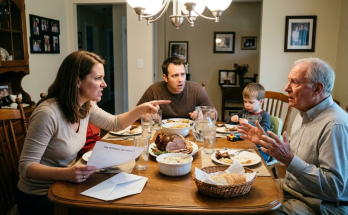
The first cold evening of the year, Ellen drove over for supper.
Rachel and Quinn were coming, too.
I had invited everyone before considering whether I owned enough matching plates.
In the end, I decided matching plates had never improved anybody’s potatoes.
Ellen arrived early and found me extending the dining-room table.
“You could have waited.”
“I’ve been extending this table since you were six.”
“Yes, and now I’m fifty. Let me pull.”
We got the leaf in place.
I went to the closet for another chair.
At the back stood the one my husband had used.
There was nothing special about it. Same wood. Same faded seat cushion. A small scratch on one leg from when we’d moved the table to paint.
Still, I had avoided it.
When company came, I found other chairs.
Ellen stood behind me.
“We can use the kitchen one,” she said.
I rested my hand on the chair back.
“I know.”
She waited.
I pulled it out.
We carried it to the table together.
When Rachel and Quinn arrived, Quinn was holding a covered dish with both hands.
“I made the dessert.”
“With supervision,” Rachel added.
“With unnecessary supervision.”
Ellen laughed and took the dish.
I watched my daughter and Rachel greet one another.
They had met twice before. This time, they didn’t need me to fill the silence between them.
Quinn took off her jacket and looked around the table.
“Where do I sit?”
I pointed to the chair beside mine.
The old chair.
She climbed into it, tucked one foot beneath her, and immediately asked whether she could pour the water.
“For everyone?”
“I can do it.”
I handed her the pitcher.
She spilled a little near Ellen’s plate.
Ellen reached for a napkin without interrupting what she was saying.
Rachel passed the potatoes.
I sat down.
For the first few minutes, I barely followed the conversation.
I could hear forks touching plates. Quinn asking for butter. Ellen telling Rachel about road construction outside Tulsa.
These were the sounds I had taken the greeting job to escape missing.
I had thought the store was my last chance to belong somewhere useful.
Then I had lost it, and for a long time I’d believed that loss was the part of the story I would live in forever.
“Mom?”
I looked up.
Ellen was holding the gravy boat toward me.
“Are you having any?”
“Yes.”
I took it.
Quinn was explaining that her class would put on a winter program.
“Do you sing?” Ellen asked.
“Everybody sings.”
“That wasn’t quite my question.”
“I sing some of the words.”
Rachel covered her smile with her napkin.
After supper, Ellen washed dishes while Rachel dried.
I told them to leave everything.
Neither listened.
Quinn followed me into the living room carrying a library book.
“Can I read to you?”
“Of course.”
She sat beside me on the sofa.
There were several difficult words. She worked at them, sometimes with a finger under each syllable.
When she lost her place, I waited.
From the kitchen came the sound of running water and my daughter laughing at something Rachel had said.
Quinn finished the page and looked up.
“Were you listening?”
“Yes.”
“What happened?”
“The fox hid the key beneath the flowerpot.”
She nodded, satisfied, and turned the page.
Halfway through the next sentence, she leaned against my arm.
I kept still.
Then I settled back into the cushions so she could be comfortable.
When it was time to leave, she searched her jacket pocket.
“I brought you something.”
She placed a small sheet of stickers on the coffee table.
Yellow faces.
A few were missing.
“These are yours?” I asked.
“They can be.”
“You don’t need to give me your stickers.”
“I know.”
I looked at her.
She peeled one off and held it above my hand.
“Can I?”
“Yes.”
She pressed it gently against my skin.
At the door, Rachel hugged me.
“Next time at our place,” she said.
“Tell me what to bring.”
“Yourself.”
“And a dish.”
She smiled.
“We’ll negotiate.”
Ellen stayed until the others had driven away.
Then she helped me put the extra leaf back in the closet.
When we reached for my husband’s chair, I stopped her.
“Leave it.”
“At the table?”
“Yes.”
She looked at me, then nodded.
After she left, I returned to the dining room.
There were crumbs beneath Quinn’s place and a faint ring where somebody had set a glass without a coaster.
I wiped the table.
I swept the floor.
Then I put the cloth away and sat for a moment.
My husband’s chair stood beside mine.
For years, I had kept it empty because I missed him.
Tonight, a little girl had sat there and complained that I served the vegetables before the dessert.
I could almost hear what he would have said about that.
I smiled.
Then I took out my calendar.
On Friday, I wrote: Quinn’s school — ask about winter program.
On Sunday, I wrote: Call Ellen.
There was room beneath both entries.
I left it open.