PART 9 — What Evelyn’s Husband Put Inside the Wall
Evelyn Price answered on the second ring.
“Did your sister tell you to bring a hammer?” she asked.
I looked across the table at Beatrice. She still had one hand resting on the black notebook.
“No,” I said. “She told me to be there at eight.”
“Good. Everybody wants a hammer once they hear there’s something in a wall. Bring a flathead screwdriver and an old towel. And wear shoes you can kneel in.”
“What are we looking for?”
“A tin. The kind fruitcake comes in.”
I waited for her to tell me what was in it.
Instead she asked, “Do the children still use the kitchen?”
“Every day.”
“Then I’d like to put the cupboard back the way we found it before they get there.”
She gave me her address in case it rained and she needed a ride. Before we hung up, I asked the question that had been bothering me since I read Beatrice’s note.
“Evelyn, when your husband said he wanted to show Arthur what he put in the wall before I got hurt, what did he mean?”
For a few seconds, I heard only the faint sound of a television on her end.
“At the time,” she said, “I thought he meant your father was going to ask you to sign something.”
I pressed the phone harder against my ear.
“He did ask me to sign something.”
“Did you?”
“Yes.”
Evelyn turned off the television. I heard the click.
“Do you remember what he told you it was?”
“A receipt for money he’d given me when Arthur and I bought the house.”
“Oh, Audrey.”
I looked through the doorway into the kitchen. The brass knob on the cupboard caught the light. Somebody had left a dish towel looped through the handle.
“What was it really?” I asked.
“Bring whatever copy he gave you,” Evelyn said. “We’ll look at it together.”
I knew exactly where to find my copy.
For years, I’d kept it in the same folder as the instructions for the water heater.
My father had given me the paper on a Sunday.
I remembered because my mother had made a chicken so dry that Arthur poured gravy over everybody’s plate before any of us had the chance to refuse it.
We had just moved into the little house. The bathroom floor needed replacing. There was a window upstairs that wouldn’t stay open unless you propped it up with a wooden spoon. I was teaching full-time and painting the kitchen after dinner, one wall at a time, so we could still use the room.
Three weeks earlier, my father had handed me a check for eight thousand dollars.
“For the roof,” he said.
“We can handle the roof.”
“I know you can. Let your father do something for you anyway.”
He had put his hand on the back of my head and kissed my forehead. I still remembered the smell of his shaving cream. I remembered relaxing against him for the brief second it took to kiss me.
At the Sunday dinner, he reached for the salt, then said he’d left something for me on the counter.
The paper was two pages long. At the top were the words Acknowledgment of Funds Received. The amount matched the check. My father showed me where he had signed and where I ought to sign.
I read the first page. When I turned to the second, my mother called from the dining room to ask if I knew where she’d put the serving spoon. I signed while I was looking over my shoulder to answer her.
On the drive home, I told Arthur what my father had said about wanting a record for his accountant.
Arthur asked if I had a copy.
I held up the two pages.
He said, “Good. Keep it.”
That was as far as the conversation went.
I found the folder after midnight. It had three paint samples stapled to the front, all shades of white I could no longer tell apart. Inside was the furnace warranty, a receipt for the window latch, and the paper I’d signed.
I sat on the kitchen floor and read every word.
There was no mention of a loan. No repayment schedule. No line giving my father an interest in the house.
If a stranger had handed me that document, I would have called it a receipt.
I read it a fourth time anyway.
Then I took a picture of both pages and sent them to David Allen with a message asking him to call me in the morning.
Before I went to bed, I got up to check the front door. I knew I’d locked it. I checked it anyway.
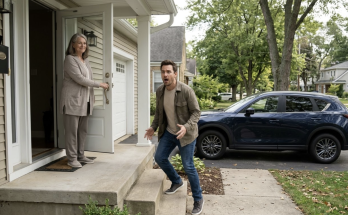
Evelyn was waiting on the porch at seven forty-five.
She wore a tan raincoat and carried a canvas bag with the name of a grocery store that had closed years ago. Her hair was white now. At our wedding it had been brown, pinned neatly off her face. I recognized her by the way she tucked her chin into her collar when she was studying something.
She was studying the handrail.
“This used to wobble,” she said.
“One of our volunteers fixed it.”
“Tell him he’s done a good job.”
“Her name is Denise.”
Evelyn nodded. “Tell Denise I said so.”
I unlocked the door. Inside, the refrigerator hummed, and the coffee machine clicked before the first drop fell. We’d been opening the Learning House long enough that I could tell from the sound whether somebody had remembered to put the pot back under it.
Evelyn walked straight to the kitchen.
“How does it feel being back?” I asked.
She set her bag down.
“I was hoping it would smell the same.”
“Does it?”
She breathed in.
“It smells like peanut butter.”
“That would be the children.”
“I used to have to take my lunch out to the steps if I wanted peanut butter. Arthur didn’t like the smell.”
That made me laugh. Arthur had eaten peanut butter toast standing over the sink for most of our marriage. He’d never once told me he’d objected to it in somebody else’s sandwich.
Evelyn smiled when I told her.
“People are particular about what they get to choose for themselves,” she said. Then she looked at the two pages I’d laid out on the table. “May I?”
I handed them to her.
She read the first page, turned to the second, and pressed the heel of her hand against the bottom corner.
“That’s your signature?”
“Yes.”
“How much room was there above it when you signed?”
“About that much, I think.”
She held the page by its edges and studied it.
“I thought there might be another page.”
“Did your husband see another one?”
“He saw one with the word repayment on it. Your father brought it here the day they opened the wall.” She put the paper flat on the table. “Let’s get the tin. I want to see how much of this I remember right.”
The cupboard below the kitchen window was the oldest one in the room. The door swung open on hinges Arthur had threatened to replace for a decade. Inside, we kept a basket of plastic cups, a box of dry-erase markers, and three rolls of tape the teachers hid from one another.
Evelyn took everything out and put it on the counter. Then she knelt, reached past the bottom shelf, and ran her fingers along the baseboard.
“Len cut a slot behind here. That little scratch beside the screw is his.”
I got down next to her. There was a thin line in the paint, just long enough to fit the head of a screwdriver.
I pressed my ear to the cupboard floor so I could see what I was doing. Evelyn told me to turn slowly. The screw came away on the third turn. The strip of wood lifted on one side. I slid the screwdriver underneath and eased it forward.
Behind it was a piece of blue fabric.
Evelyn put a hand on my shoulder.
“That’s his old work shirt,” she said.
Her grip tightened. I waited until she took her hand away.
Then I reached into the opening.
The fabric came out first, followed by a tin just wide enough to scrape both sides of the gap. I set it on the towel. Somebody had wound a length of masking tape around it. On the lid was a picture of a Christmas tree with presents piled underneath.
Evelyn touched the corner where the paint had worn down to metal.
“He looked everywhere for that tin the Christmas before,” she said. “I told him I threw it out.”
“Why?”
“He kept screws in it and then put it back with the baking things. I went to make cookies one afternoon and ended up sorting drywall screws by size.”
She ran her thumb over the painted presents.
“After he died, I would have given anything to find screws in my baking cupboard.”
I sat beside her on the floor.
We stayed there for a while. Then she asked if I could get the tape started because her nails kept splitting.
Inside the tin were three envelopes and a little brass key.
I looked at the key first.
Evelyn picked it up. “That was for Len’s toolbox. He always said he was going to make a spare.”
She slipped it into her coat pocket.
Then she handed me the first envelope. My name was on it in Arthur’s handwriting. The flap was unsealed.
“I can wait outside if you’d like,” she said.
“Stay. Please.”
So she moved her chair beside mine, and I took out the letter.
Audrey,
Your dad asked me for $80,000 in August. He told me you would be ashamed if you found out what he planned to do with it. I asked him what he planned to do with it. He told me that was what you would say, too.
I gave him $8,000. That was the day I told you I’d lost my wallet and went back to the office. He said he only needed the first part until the end of the month. I asked him to leave your name out of whatever he was doing.
Two days later, he wrote you a check for the same amount.
When you told me he’d offered to help with the roof, I should have told you where the money came from. I let you be happy about it. That’s the excuse I used at the time. I was also relieved you didn’t know I’d lied about where I’d gone.
I stopped.
I remembered telling Arthur about the check. I’d come into the kitchen waving it. He had been drying a plate. I’d said, “Can you believe he did this for us?”
Arthur had put the plate down before he answered.
That was good of him.
I had carried those five words for years as proof that the two men I loved were learning to be kind to each other.
Now I read the next paragraph.
Your father brought a second document here while Len was working on the kitchen. It says the money was an advance secured by the house. It lists $80,000 as the amount and has a copy of your signature attached. Len heard us arguing and came in when your father left.
I have put the papers together so you can see what I saw.
I’m going to tell you after dinner.
That was the end of the letter.
I turned it over.
Nothing.
“Did he?” Evelyn asked.
I looked at the date.
I remembered that dinner, too.
I had taken a lemon out of Arthur’s hand and shown him how to roll it against the cutting board before he squeezed it. He poured me a glass of wine. Later, somebody called him while we were washing up. He went outside to take the call. I remember him standing beyond the window with one hand in his pocket, looking at the oak tree.
When he came in, I asked whether anything was wrong.
He said it was handled.
“No,” I told Evelyn. “He didn’t tell me.”
I opened the second envelope.
There was a copy of the acknowledgment I’d signed. My father’s signature appeared on the first page, exactly where I remembered it. Then came a page I’d never seen.
The figures were typed both ways. Eighty thousand dollars. $80,000.
My name appeared again at the bottom. I turned the document toward the light. There was a dark comma-shaped mark beside my signature, just below the tail of the y.
I reached for my own copy.
The mark was there, too.
I remembered the pen going down harder than I expected because the counter was uneven. I’d made a little stab in the paper trying to get the ink flowing again.
On the page from the tin, that mark was in exactly the same place.
I set the two pages side by side.
My phone rang. David’s name came up on the screen.
I let it ring once more before I answered.
“I found another version,” I told him.
“What’s different?”
“The amount. There’s language about a debt against the house. And somebody copied the page I signed.”
“Is Evelyn there with you?”
“Yes.”
“May I speak to her after you tell me what you found?”
I told him about the tin, and the two amounts, and the little mark under my signature. He asked me to take photographs while the pages were still spread out. I did, and I sent them to him.
Then I asked the question that had kept me awake.
“Could my father take the house?”
“I’ve seen a different set of papers about this house, Audrey. Your father brought them to me after Arthur died. They claimed he’d put money into the property. Those had no signature from you. I asked for the original documentation, and he withdrew the claim.”
“He tried it after Arthur died?”
“Yes.”
“While Beatrice was claiming the estate?”
“Yes.”
I laid the phone down beside the papers and put him on speaker.
“What did my father say when you asked for proof?”
David took a moment to answer.
“He said he’d have to ask your mother where she kept it.”
Evelyn looked up at me.
I thought about the dish my mother had dried over and over while I told her I didn’t understand why Arthur had let me go. I thought about the serving spoon she’d asked me to find while I signed my name.
I hadn’t wanted either memory to mean anything more than it already did.
My hand was on the third envelope. I could feel how thick it was.
“David,” I said, “can you come over?”
“I’ll be there in twenty minutes.”
Inside the third envelope was a small photograph, a square of yellow paper, and a note from Len.
The photograph showed the kitchen wall open to the studs. A man was kneeling beside the cupboard with his tape measure stretched from the floor to the bottom of the window. Arthur was in the corner, holding a flashlight.
The man on the floor was Len. I could tell by the blue shirt.
On the back, Evelyn had written the date.
“I took that,” she said. “Len wanted a picture of where the pipes ran. Arthur kept putting his hand in the way.”
The yellow paper was a check stub for $8,000. It listed my father as the recipient. I placed it beside the paper where he’d claimed he had given that money to me.
Then I read Len’s note.
He had written it in pencil on the back of an invoice for wood and screws.
Arthur asked me to keep the tin a few days. He came by when I was putting the last board back and said Audrey had enough going on. He asked if I could leave it where I’d shown him. I did.
He told me he had paid the rest of what her father wanted. I asked whether that meant her father couldn’t come back for more. He said he had a signed agreement in his desk. I asked whether Audrey had seen it.
He said no.
I told him that was the only part I understood well enough to have an opinion about.
Below that, in smaller writing, was a line clearly added later.
If he ever comes to get this tin, ask him whether he brought Audrey with him.
I could hear cars passing out on the road. A branch tapped against the window. Inside, the refrigerator switched off, and the silence that followed made me realize I’d been counting on the sound.
“Why didn’t Len give it to me himself?” I asked.
Evelyn sat for a while before answering.
“He thought Arthur had finally told you. Arthur came to work one day in a terrible mood and said he’d had a hard conversation with you. Len assumed that was it.”
“Was it?”
“I don’t know. You’d remember what he told you better than I would.”
I tried to think of any hard conversation that had started with Arthur telling me something I didn’t already know. I could think of conversations where I’d had to ask him to turn around and face me. I remembered being told that a problem was over, being asked why I cared how he’d fixed it. There were whole evenings he could have described to Len as difficult.
“If he thought I knew, why did he call so much later?”
“He found out your father was asking questions about the house again. By then, Arthur was married to Beatrice. Len couldn’t drive anymore. He made me promise I’d call.”
“Why did he want to speak to Arthur?”
“Because Arthur was the only person Len knew who had seen every piece of paper. And Len was embarrassed.” Evelyn picked up the photograph of her husband. “He’d thought he was doing Arthur a favor. It took him years to see who he’d helped keep out of the room.”
I looked under the window, where the open cupboard held nothing but a faint line of dust along the bottom.
“I’m glad he wrote it down.”
Evelyn pressed the photograph flat with her fingertips.
“He’d have been glad to hear you say that.”
The front bell rang. David had arrived.
Evelyn stood, smoothed down the front of her coat, and asked if I wanted her to give us a minute.
I looked at the empty space beside my chair.
“You’re part of this,” I said. “Stay.”
David set his briefcase down and read everything before he took off his coat.
He put the pages in date order. My father’s first check. My signed acknowledgment. The altered document. Arthur’s unfinished letter. Len’s note, which had no date, went at the far edge of the table.
Then David asked if I recognized the handwriting beside the check number on the stub.
There was a tiny penciled R.
I shook my head.
“Could mean roof,” Evelyn said.
“Could,” said David.
I was grateful he left it there.
He told me he wanted to find the agreement Arthur had mentioned. If he could establish what Arthur and my father actually signed, I would have a better idea of what my father had agreed to and what he’d tried to claim afterward.
“You took Arthur’s desk after he died,” I said.
“It’s in a storage room at my office. There were business records in it. I catalogued those first.”
“Did you find anything about my father?”
“I found an empty folder with his name on it.”
I waited.
David made a small adjustment to the cuff of his sleeve.
“There was a note clipped to the inside of the folder. Moved to the house. I assumed Arthur meant the house he was living in then.”
“He could have meant this one,” I said.
Evelyn nodded. “This was the first place he ever bought. Every property after it had a street name. This one was always just ‘the house.’”
I looked at the tin.
“If he meant here, where else would he put something?”
Evelyn began looking around the kitchen. I could see little decisions passing across her face. The cupboard above the refrigerator. The shelf where we kept the cookbooks. The slim drawer where the good scissors still lived.
Then she looked down at the empty tin.
“Len said there were three envelopes?”
“There are three.”
She lifted the lid, turned it so the light fell across the inside, and put a finger under a corner of paper stuck to the metal.
“Then what’s this?”
She peeled it back.
It was part of the masking tape that had been wound around the tin. The outer layer had dried out. The piece underneath still held.
The writing was Arthur’s. It was small enough that I had to put the lid flat on the table to read it.
If Audrey is the one who opens this, show her the whole ledger. Start with the entries before we got married.
For a moment, I could hear the children arriving even though it was still too early for anyone to be there. I could practically hear the little stomp they made to get the mud off their shoes before they came inside. I wanted it to be three o’clock. I wanted a child to ask if I could find a pencil with an eraser.
Instead, David said, “What ledger?”
Evelyn took off her glasses. She folded one arm, then the other.
“Arthur used to keep a handwritten ledger in the flat drawer of his desk. He’d record every personal payment he made. When I started working for him, I thought it was because he didn’t trust the bank. After a few years, I realized he liked to have somewhere to write why he’d given somebody money.”
“Did he keep more than one?” David asked.
“One for every few years. The older ones were wrapped in butcher paper. He dated them on the spine.”
I looked down at the words again.
“Before we got married,” I said. “I didn’t introduce him to my father until we were engaged.”
Evelyn put her glasses back on.
“Are you sure?”
“Yes. Dad made a joke about Arthur being the first man I’d brought home who knew how to carve a roast. I can tell you exactly where both of them were standing.”
She asked me how Arthur and I had met.
“At a fundraiser for the school library. The card reader stopped working. He was waiting to pay for a pie, and I asked if he had cash.”
Evelyn looked at David. Then she looked back at me.
“What kind of pie?”
“Lemon.”
She shut her eyes.
“What is it?” I asked.
“The bakery had made two lemon pies that day. I picked them up myself.”
I waited for her to go on.
“Arthur didn’t ask for them,” she said. “Your mother did.”
I thought I must have heard her wrong.
“My mother ordered pies for the fundraiser every year.”
“That could be. I knew her voice by then. She’d called the house three times that week. On Friday she asked whether Arthur could bring both pies himself.”
“Why?”
“She said her daughter would be at the front table, and she wanted him to meet her.”
I got up too fast. The chair scraped across the floor.
The fundraiser had been in the school gym. I’d worn a blue dress with a little stain near the cuff, and my mother had insisted I take off my cardigan so nobody would see it. I had thought she was fussing because the principal was coming.
I remembered Arthur putting two white boxes on the table. One had a piece of tape across the top. He’d opened the other and offered to buy the first slice.
Two months later, he told me he had almost gone straight home that evening.
I made him tell me that story on the anniversaries when we stayed in.
I walked to the sink and turned on the tap. Water hit the bottom of an empty mug. I shut it off.
Behind me, nobody said a word.
Finally I went back to the table and picked up my phone.
My mother answered so quickly I wondered if she’d been holding hers.
“Is everything all right?” she asked.
“I’m at the Learning House with Evelyn Price.”
The silence was immediate.
“We found the papers Dad brought here,” I said. “And a note from Arthur about a ledger. Evelyn remembers you asking him to come to the library fundraiser.”
“Where’s Evelyn now?”
“Sitting at the table with me.”
My mother moved the phone. I heard the sound of a door closing on her end.
“Maybe I should come over,” she said.
“You can tell me one thing first. How long had you known Arthur before you introduced us?”
“Audrey, whatever you find in that ledger, I need you to come to me before you start trying to figure it out on your own.”
“I tried coming to you, Mom. I told you for years how Arthur and I met. I told that story at my wedding while you sat close enough to touch my dress.”
She took a shaky breath.
“I remember.”
“Did Dad know him before that night, too?”
“Yes.”
Evelyn put her hands flat on the table.
I looked down at my father’s two signatures. The one on the check stub was hurried. The one on the acknowledgment looked as if he’d taken his time.
“Was Dad already asking him for money?”
My mother went quiet again. I let her. I had been waiting years for answers to questions I hadn’t known how to ask. I could wait through one more silence.
When she spoke, her voice was low.
“Arthur wasn’t giving your father money back then,” she said. “He was giving it to me.”
I closed my hand around the little brass knob on the cupboard door.
“What did you need it for?”
“To leave your father.”
I let go of the knob.
Outside, a car slowed in front of the Learning House, then drove on. Evelyn reached for the old towel and folded it over the corner of the open tin.
“Did you ever leave?” I asked.
“Once,” my mother said. “I got as far as the bus station.”
“What made you go back?”
“You did.”
I looked at the empty chair by the window. Ellis had left his horse drawing there again. One corner curled toward the glass in the morning sun.
“I don’t remember that,” I said.
“You wouldn’t, sweetheart. You were four.”
 CLICK HERE TO CONTINUE READING PART 10 – My Sister Married My Husband for His $400 Million Fortune—But When the Attorney Opened His Will, Her Smile Disappeared, STORY BY DRAMAVERDICT.