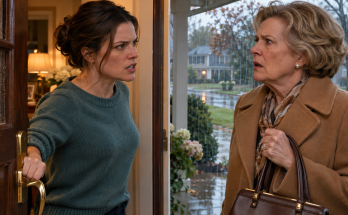
For the first time in my life, I didn’t answer when my father called my name.
I was sitting on the floor of my new apartment in Raleigh, surrounded by unpacked cardboard boxes, drinking coffee from one of my grandmother’s old ceramic mugs.
My old phone continued vibrating against the wooden floor.
Eight missed calls.
Twelve missed calls.
Seventeen.
Then the messages began arriving.
“Sophia, something is wrong with the front door.”
“Where is the furniture?”
“Why is the house empty?”
“Call your mother immediately.”
The first few messages sounded confused. The next several sounded irritated. Eventually, my father’s familiar anger began appearing in every sentence.
“Sophia Reynolds, you have five minutes to explain yourself.”
I stared at those words for a long time.
Five minutes.
Even while standing outside a house he didn’t own, surrounded by luggage he couldn’t bring inside, my father still believed he had the authority to give me deadlines.
I placed the phone facedown and finished my coffee.
Back in Charlotte, my parents were apparently becoming increasingly desperate.
My mother contacted one of the neighbors, Mrs. Patterson, who had lived across the street from my grandmother for nearly twenty years.
According to what Mrs. Patterson later told me, my mother was standing on the porch with tears streaming down her cheeks, insisting that somebody had broken into the house and stolen everything.
My father was threatening to call the police.
He demanded that Mrs. Patterson tell him whether she had seen suspicious vehicles near the property.
She had.
A moving truck.
But when she explained that I had been present throughout the entire process, supervising the movers myself, my father’s expression changed.
“What do you mean Sophia was there?”
Mrs. Patterson told him exactly what she had seen.
Then she mentioned something else.
The house had been sold.
My mother stopped crying.
My father stared at her as though she had spoken in a language he couldn’t understand.
“Sold?” he repeated.
Mrs. Patterson nodded.
“The new owners should be moving in soon. Sophia said everything was handled.”
My father began shouting that this was impossible.
He insisted that the house belonged to the family.
He claimed that no legitimate real estate transaction could have occurred without his permission.
Mrs. Patterson, who had known my grandmother Rose for decades, reportedly looked him directly in the eyes.
“David, that house never belonged to you.”
For several seconds, he said nothing.
Then he pulled out his phone and called me again.
I watched his name appear on the screen.
This time, I answered.
“What have you done?” he shouted before I could speak.
I held the phone slightly away from my ear.
“Hello, Dad.”
“Don’t you dare speak to me like everything is normal! Where is our furniture? Why can’t we get inside? Mrs. Patterson is telling us you sold the house!”
“I did.”
The silence that followed was so sudden that I briefly wondered whether the connection had failed.
Then my mother screamed in the background.
“You did WHAT?”
“I sold the house.”
“You can’t do that!” my father roared.
“It’s already done.”
“That is our home!”
“No, Dad. It was my home.”
He began breathing heavily into the phone.
For years, that sound had been enough to frighten me into apologizing before I even knew what I had supposedly done wrong.
But sitting inside my modest Raleigh apartment, surrounded by things that belonged to me and only me, I felt no obligation to calm him down.
“Where are our things?” my mother demanded.
“In a storage facility. Everything was packed carefully. The rental has been paid for six months.”
“You put our entire lives into storage?”
“I put your belongings somewhere safe.”
“And where are we supposed to live?”
I paused.
Not because I didn’t know the answer.
Because I wanted her to hear it clearly.
“That is something you’ll need to arrange for yourselves.”
My mother began sobbing.
My father called me selfish, ungrateful, heartless, and irresponsible.
He told me my grandmother would be disgusted by what I had done.
That accusation almost made me laugh.
My grandmother Rose had spent her final years trying to protect me from these very people.
And now they were attempting to use her memory as another instrument of control.
“Did you see the envelope on the kitchen counter?” I asked.
My father’s voice changed.
“What envelope?”
“The white one.”
“We can’t get inside!”
“I know.”
“What does it say?”
I looked toward the framed photograph of my grandmother that I had already placed beside the window.
Then I repeated the message I had written inside that envelope.
“You called me a burden. Consider yourself relieved of that burden. From this moment forward, neither my home, my money, nor my future is available to you. Your belongings are safe. Your responsibilities are now your own. — Sophia.”
Neither of them spoke.
For the first time since I could remember, my parents had absolutely nothing to say.
Then my mother whispered something that confirmed every decision I had made.
“You heard us?”
Not an apology.
Not a denial.
Not even an attempt to explain why she had laughed.
Only fear that their private conversation had been exposed.
“Yes, Mom,” I answered. “I heard everything.”
My father immediately attempted to recover.
“You misunderstood.”
“Did I?”
“We were discussing financial matters. Adult matters. You weren’t supposed to hear that conversation.”
“I’m an adult, Dad. And you were discussing my property.”
“You’re being emotional.”
“No. Being emotional would have been screaming at you while you were in Europe. What I did was hire an attorney, sell an asset that belonged to me, secure my finances, and arrange a new place to live.”
“Sophia—”
“You made financial decisions based on owning my house. Remember?”
Another silence.
This one felt different.
My father wasn’t merely angry anymore.
He sounded frightened.
“Listen to me carefully,” he said, lowering his voice. “You need to reverse the sale.”
“I can’t.”
“Then buy it back.”
“No.”
“You don’t understand what you’ve done.”
“Then explain it.”
He hesitated.
In the background, my mother was telling him to stop talking.
That only made me more curious.
“What financial decisions did you make, Dad?”
He didn’t answer.
“Why is losing access to a house you never owned such a disaster for you?”
My mother began crying louder.
My father disconnected the call.
I sat there holding the phone, staring at the dark screen.
Something about his reaction bothered me.
I had expected anger.
I had expected guilt trips.
But what I had just heard was panic.
Real panic.
The kind that comes when someone realizes a carefully constructed lie is about to collapse.
The following morning, I called Andrea Cole.
I explained the conversation and told her that my father seemed unusually desperate to reverse the transaction.
Andrea listened carefully.
“Has he ever asked you to sign financial documents?” she asked.
“Several times.”
“What kind?”
“Mostly things he claimed were related to household expenses or insurance. I always insisted on reading everything before signing.”
“Did you ever give him permission to borrow money in your name?”
“Absolutely not.”
“Keep it that way. And Sophia, preserve every message he sends you.”
Something in her voice made me uneasy.
“Do you think there’s more to this?”
“I think your father may have been promising people something he didn’t have the authority to deliver.”
Those words remained with me throughout the day.
Three days later, I discovered exactly what she meant.
A man named Michael Turner contacted me at work.
He introduced himself politely and explained that he had known my father through several business acquaintances.
He asked whether we could speak privately.
At first, I assumed my father had sent him to pressure me.
But Michael sounded genuinely confused.
“Your father told me the Charlotte property was being transferred into his name,” he explained.
I felt my stomach tighten.
“When did he tell you that?”
“Several months ago.”
“What exactly did he say?”
Michael took a breath.
“He said he had inherited the property through his mother and that there were some temporary administrative complications involving your name on the deed.”
I closed my eyes.
My father had claimed that my inheritance was nothing more than an administrative complication.
“He also said the house was worth close to a million dollars,” Michael continued. “He presented it as evidence that he would be able to repay certain financial obligations.”
“What financial obligations?”
There was a long pause.
Then Michael told me the amount.
One hundred and forty-five thousand dollars.
For a moment, I couldn’t speak.
My father had borrowed $145,000 through a series of private financial arrangements.
He had used part of the money to cover existing debts, support unsuccessful business ventures, and maintain a lifestyle he could not afford.
Some of it had apparently helped finance the European vacation my parents had been displaying so proudly online.
Michael explained that my father had repeatedly assured him that repayment would not be a problem because he would soon control a valuable Charlotte property.
There was no legitimate mortgage against my house.
There was no document transferring ownership.
But there were written messages in which my father had represented the property as an asset he expected to control.
I asked Michael to send those communications directly to Andrea.
He agreed.
When our conversation ended, I remained at my desk for several minutes.
Suddenly, every word from that forgotten telephone call made sense.
My father hadn’t merely wanted my house because he believed he deserved it.
He needed it because he had already spent money against a future that wasn’t his.
He had built his financial survival around taking something from me.
My mother knew.
She had laughed because, in her mind, the daughter who desperately wanted their approval would eventually surrender.
They had mistaken my kindness for weakness.
And they had gambled an enormous amount of money on that mistake.
That evening, my father called from an unfamiliar number.
I answered.
His voice was surprisingly gentle.
“Sophia, sweetheart.”
I almost didn’t recognize the tone.
“We need to talk like a family.”
“About the $145,000?”
The silence told me everything.
Then he asked quietly, “Who told you?”
“It doesn’t matter.”
“Michael had no business contacting you.”
“You had no business making promises about my house.”
“You don’t understand the situation.”
“I understand it perfectly.”
“It was temporary. Everything would have worked out.”
“How?”
He didn’t answer.
“How were you planning to repay the money?”
“Once the property situation was settled—”
“Meaning once I gave you my house.”
“Don’t twist my words.”
“Then tell me how else you expected to settle it.”
He became angry again.
“You’re making this worse than it needs to be!”
“No, Dad. I’m finally seeing how bad it already was.”
Then he said the words that ended whatever remained of my willingness to help him.
“You have nearly a million dollars now. You can afford to fix this.”
There it was.
Not remorse.
Not shame.
Not concern for what he had done to his daughter.
Another demand.
Another assumption that the resources I had worked so hard to protect existed primarily to rescue him.
“No.”
“Excuse me?”
“I said no.”
“You’re going to let your own father lose everything over money?”
“You were prepared to let your daughter lose her home over money.”
“That’s completely different!”
“How?”
He couldn’t answer.
He began shouting again.
I ended the call.
Over the following weeks, the consequences of my father’s decisions began catching up with him.
Michael demanded repayment according to the agreements my father had signed.
Other people began asking difficult questions.
Several of my father’s acquaintances discovered that the expensive lifestyle he had presented to them was supported by debt rather than wealth.
The man who had spent years speaking about financial success and family authority suddenly found himself explaining why he had no house, no substantial assets, and no ability to fulfill his promises.
My parents moved into an inexpensive extended-stay motel.
The room was small.
There was no spacious kitchen.
No beautifully decorated living room.
No favorite chair occupying the center of somebody else’s property.
And, most importantly, there was no daughter silently paying the bills.
My mother called relatives.
She told them I had abandoned my elderly parents.
She claimed I had thrown them into the street without warning.
She described me as a greedy woman who had sold a family home simply to punish the people who raised her.
For a while, several relatives believed her.
My aunt called me and demanded that I explain how I could do something so heartless.
I calmly told her the truth.
I explained that the house belonged solely to me, that my parents had never paid rent, that all their belongings were safely stored, and that six months of storage had already been paid.
Then I explained the conversation I had overheard.
The attempted manipulation.
The financial promises my father had made based on a property he didn’t own.
My aunt became very quiet.
“Your mother didn’t mention any of that,” she said.
“I know.”
“Did they really expect you to give them the house?”
“Yes.”
“After everything your grandmother did to protect it?”
“Yes.”
She sighed.
“Rose would have been furious with them.”
For the first time, somebody within my extended family had said exactly what I had been thinking.
My mother continued trying to turn people against me, but her story became increasingly difficult to maintain.
Especially when some of those relatives started asking whether my parents intended to stay with them for free.
Suddenly, everyone understood why my parents had remained in my home for so many years.
Their generosity toward my mother became considerably less enthusiastic when they realized they might be expected to provide the same financial support I had provided.
Meanwhile, I continued rebuilding my life.
I purchased a small dining table for my Raleigh apartment.
I unpacked my grandmother’s recipes and began cooking meals without hearing somebody criticize every ingredient.
I bought flowers for myself.
I slept through the night.
I went to work without receiving messages about bills my parents expected me to pay.
The silence that once made me feel lonely began to feel like freedom.
Then, nearly two months after selling the house, my parents appeared outside my workplace.
I hadn’t given them my new address.
But they knew where I worked.
My mother looked exhausted.
Her expensive vacation scarf was gone.
My father wore a wrinkled jacket, and the confidence he usually carried seemed noticeably diminished.
“Sophia,” my mother said when she saw me.
I stopped several feet away.
“What are you doing here?”
“We need our daughter.”
For years, those words would have been enough to make me drop everything.
But now I heard them differently.
They didn’t say they missed me.
They didn’t say they regretted hurting me.
They said they needed me.
My grandmother’s handwriting appeared in my mind.
Never mistake being needed for being loved.
My father stepped forward.
“We’re in serious trouble.”
“I know.”
“We could lose everything.”
“I know.”
“We need help.”
“What kind of help?”
My mother looked at him.
He took a deep breath.
“We need you to pay off the debts.”
I stared at them.
After everything that had happened, after their lies had been exposed and their plans had collapsed, they had come to my workplace expecting me to hand them the money anyway.
“How much?” I asked.
My father’s expression brightened slightly.
“With the interest and everything else, probably around $170,000. Maybe a little more.”
My mother quickly added, “And perhaps enough for a small house. Nothing expensive. We don’t need anything extravagant.”
I actually laughed.
I couldn’t help it.
They looked offended.
“You want me to pay your debts and buy you another house?”
“We’re your parents,” my mother whispered.
“Yes. You are.”
“Then you owe us some consideration.”
“I gave you years of consideration.”
My father clenched his jaw.
“Don’t start bringing up the past.”
“The past is exactly why we’re standing here.”
He stepped closer.
“You have the money, Sophia.”
“And you had the opportunity to treat me with respect.”
My mother began crying.
“We made a mistake.”
“No, Mom. Forgetting to hang up the phone was a mistake. Planning to manipulate me into giving away my inheritance was a decision.”
She covered her face with her hands.
My father looked around, embarrassed by the possibility that someone might overhear us.
“Can we discuss this somewhere private?”
“No.”
“Stop humiliating us.”
“I’m not humiliating you. I’m refusing your request.”
He stared at me with such bitterness that I briefly recognized the man whose voice I had heard in the kitchen.
Then he said something I would never forget.
“Your grandmother ruined this family when she gave you that house.”
My expression changed.
“No, Dad. Grandma understood this family when she gave me that house.”
My mother lowered her hands.
“You really aren’t going to help us?”
I looked at her for a long moment.
Some part of me still wanted her to apologize.
I wanted her to tell me that she regretted laughing.
I wanted her to acknowledge that I had deserved better.
But even then, she was looking at me as though my refusal to rescue them was the greatest betrayal anyone had committed.
“I already helped you,” I said. “For years.”
My father called me a disgrace.
I told him to leave.
When he refused, I informed workplace security.
The moment he realized other people were watching, he lowered his voice and walked away.
My mother followed him without looking back.
That was the last time I saw them for nearly a year.
During that time, my father’s financial situation deteriorated.
He attempted to negotiate repayment arrangements.
He sold his expensive possessions.
He gave up the car he could no longer afford.
He eventually took a regular job because the lifestyle he had spent years pretending to possess was no longer sustainable.
My mother also returned to work.
For the first time in years, she had to calculate how much money she actually had before purchasing something.
They rented a small apartment.
They argued constantly about money.
According to relatives, my father blamed my mother for encouraging his plans, while my mother blamed him for borrowing money he couldn’t repay.
The two people who had laughed together about manipulating me were now turning their anger toward each other.
Without me standing between them and the consequences of their choices, their marriage began revealing cracks they had previously hidden behind comfortable surroundings and expensive vacations.
I didn’t celebrate their financial difficulties.
I didn’t send insulting messages.
I didn’t interfere with their employment or attempt to make their situation worse.
I simply refused to rescue them.
That was enough.
Eventually, I purchased another home.
It was smaller than the Charlotte property, but it had a beautiful garden, wide kitchen windows, and enough sunlight to make every morning feel welcoming.
I paid for it using money from the sale while keeping the remainder carefully protected for my future.
In the kitchen, I placed my grandmother’s recipes inside a wooden box.
I framed her handwritten birthday card and hung it on the wall.
Every time I passed it, I remembered the woman who had believed I deserved something of my own.
On the first anniversary of the day I sold the Charlotte house, I received a letter from my mother.
It was several pages long.
She described their struggles.
She explained how difficult their lives had become.
She mentioned the embarrassment my father experienced whenever somebody asked about the house.
She wrote about the sacrifices they had made raising me.
And near the end, she included a sentence that made me realize how little had fundamentally changed.
“We hope you have had enough time to punish us and are finally ready to put this family back together.”
I read it twice.
Then I put it down.
Even after an entire year, she believed my independence was something temporary.
A punishment.
A tantrum.
A decision I would eventually reverse.
I wrote her a short response.
“Mom, I haven’t spent the past year punishing you. I’ve spent it living my own life. The difference is that you no longer have access to it whenever you need something. I hope you and Dad eventually understand that.”
I mailed the letter and continued with my day.
Several months later, my father contacted me one final time.
His voice sounded older.
Tired.
“Sophia,” he said, “I suppose you’re happy now.”
“I’m doing well.”
“You know what happened to us.”
“Yes.”
“We lost the house.”
“You never owned the house.”
“We lost our savings.”
“I’m sorry to hear that.”
“We’ve had to start over.”
“I did too.”
He was quiet for a moment.
Then he asked, “Was it worth destroying your family?”
I looked around my kitchen.
There were fresh flowers on the table.
A pie was cooling beside the window.
My grandmother’s birthday card hung on the wall.
Every bill was paid.
Every account was secure.
Nobody was waiting to criticize me.
Nobody was planning to take what belonged to me.
Nobody was demanding that I prove my love by surrendering my future.
“Dad,” I said softly, “I didn’t destroy our family when I sold the house.”
He said nothing.
“You destroyed my trust when you decided I was worth less than the property you wanted to take from me.”
His breathing became unsteady.
For a moment, I thought he might finally apologize.
Instead, he whispered, “You could still make things right.”
I closed my eyes.
There it was again.
The same expectation.
The same entitlement.
Even after losing everything he had counted on obtaining from me, my father still believed I should be responsible for repairing the damage he had caused.
“I already did,” I answered.
Then I ended the call.
That evening, I sat in my garden and watched the sunlight slowly disappear behind the trees.
I thought about the Charlotte house.
The marble countertop.
The empty rooms.
The white envelope.
And the father who had stood outside screaming my name while twisting a key that would never work again.
For years, he had believed my love made me incapable of leaving.
He had believed my money belonged to him, my home would eventually become his, and my future could be sacrificed whenever his own plans required it.
He had called me a burden while depending on nearly everything I provided.
In the end, I gave him precisely what he claimed he wanted.
A life without that burden.
No more property taxes paid by his daughter.
No more groceries purchased with her salary.
No more emergency expenses quietly covered.
No more comfortable home maintained at somebody else’s expense.
No inheritance to rescue him from his debts.
No obedient daughter waiting to answer whenever he called.
He and my mother were finally free of me.
And they discovered that freedom was considerably more expensive than they had imagined.
My revenge wasn’t taking something that belonged to them.
It was taking back everything that belonged to me.
They had spent years making me feel guilty for having needs of my own. Now they had to survive without the woman whose generosity they had mistaken for weakness.
As for me, I finally understood what my grandmother had been trying to teach me.
Love should never require someone to surrender her dignity, her security, or her entire future simply to earn the right to belong.
I was no longer the frightened daughter standing motionless in a kitchen, listening to her father describe her as an inconvenience.
I was a woman who owned her life.
And this time, nobody else had a key.
My father once called me a burden.
The bitterest punishment he received was discovering that the burden he had so desperately wanted to be rid of had been carrying him all along.
THE END.