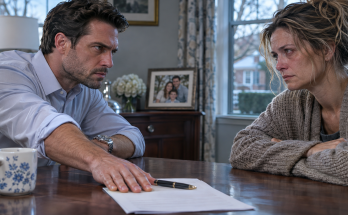
Amanda stared at the folder as though I had placed something poisonous in front of her.
For the first time that evening, she didn’t have a clever remark ready. She didn’t laugh, didn’t reach for her wine, and didn’t attempt to disguise her discomfort with another carefully rehearsed smile.
Brian shifted beside her.
“Heather,” Amanda finally said, “what exactly are you trying to accomplish here?”
“Open it.”
She looked at our mother.
“Mom, seriously? Are we going to allow her to turn a perfectly nice family dinner into some ridiculous accusation?”
My mother looked between us, visibly confused.
“Heather, sweetheart, what’s going on?”
I kept my eyes on Amanda.
“Two weeks ago, a bank contacted me about a mortgage that was three months overdue. The original loan was for six hundred and twenty-three thousand dollars.”
My father frowned.
“A mortgage? You bought a house?”
“No, Dad. I didn’t.”
I paused long enough for everyone to understand the significance of my next words.
“But Amanda did.”
The silence that followed was suffocating.
Jessica slowly lowered her wineglass. Mark stopped chewing. My mother turned toward Amanda, whose face had suddenly become unnaturally pale.
Brian cleared his throat.
“There must be some misunderstanding.”
I looked at him.
“There are approximately six hundred and twenty-three thousand reasons why I don’t think this is a misunderstanding.”
Amanda laughed, but this time the sound was hollow.
“You’re being dramatic, Heather. Banks make mistakes all the time.”
“They do,” I agreed. “But they don’t usually make mistakes involving my Social Security number, my employment records, my birthday, a forged signature, and your exact home address.”
My father’s expression changed.
“What?”
I opened the folder myself.
The first document was a copy of the mortgage application. I placed it in the center of the table, turning it so my father could read it.
There was my name.
My salary.
My employer.
My personal information.
And underneath it all, a signature that looked almost like mine.
Dad picked up the paper.
His eyes moved slowly across the printed words.
Then he looked at Amanda.
“Explain this.”
Amanda’s lips parted.
Nothing came out.
Brian leaned forward.
“Richard, listen. Financial arrangements can be complicated. There are things here Heather probably doesn’t understand.”
My father turned toward him.
“Then explain them to me.”
Brian looked at Amanda.
Amanda looked at Brian.
And in that exchange, in those few seconds of desperate silence, I watched the first crack appear in their carefully constructed marriage.
Neither wanted to speak first.
Because whoever spoke first would have to decide how much of the truth to sacrifice.
Finally, Amanda sighed.
“Fine. We had some financial difficulties when we were purchasing the house.”
Mom placed a hand against her chest.
“What kind of difficulties?”
“Temporary difficulties,” Amanda insisted. “Brian’s credit wasn’t where it needed to be, and mine wasn’t perfect either. We were dealing with some complications.”
I almost laughed.
“Complications?”
She glared at me.
“You don’t understand how difficult it is to maintain a household like ours.”
“You’re right,” I replied. “I’ve never maintained a household by stealing someone else’s identity.”
“Heather!”
Mom’s voice was sharp.
For one terrible moment, I thought she was going to defend Amanda again.
After all, she had spent our entire lives interpreting Amanda’s cruelty as ambition, her arrogance as confidence, and her selfishness as determination.
But this time, even Mom couldn’t ignore the documents lying in front of her.
Amanda folded her arms.
“We intended to pay everything back.”
My father stared at her.
“You took out a mortgage in your sister’s name?”
Amanda looked away.
“It wasn’t supposed to become a problem.”
I felt something inside me break.
Not because she had finally admitted it.
But because she sounded inconvenienced rather than ashamed.
As though the real tragedy was that I had discovered what she had done.
“Was the home equity line also temporary?” I asked.
She looked at me sharply.
“Were the three credit cards temporary? The personal loan? The purchases? The money transfers?”
I pulled additional pages from the folder.
One after another, I placed them on the table.
Jessica covered her mouth.
Mark picked up one of the statements and stared at it.
“Jesus, Amanda.”
She turned toward Brian.
“Say something!”
Brian’s jaw tightened.
“What do you want me to say?”
“Tell them!”
“Tell them what?”
“That we were going to fix it!”
Brian suddenly slammed his palm against the table.
“You told me she would never find out!”
Nobody moved.
Amanda stared at him in horror.
Brian seemed to realize what he had just said.
But it was too late.
My father slowly stood.
“What did you say?”
Brian opened his mouth, then closed it again.
Amanda’s voice rose.
“You idiot!”
My mother’s face crumpled.
“Oh, my God.”
I sat perfectly still.
For years, Amanda had been the person who knew how to control every room she entered.
She knew how to redirect conversations, manipulate emotions, and make other people question their own judgment.
But Brian had just destroyed her performance with a single sentence.
You told me she would never find out.
My brother Mark leaned back, looking physically sick.
“You both knew?”
Amanda began crying.
Not quietly.
Not naturally.
It was the kind of crying that demanded immediate attention from everyone around her.
“We were desperate!” she screamed. “You have no idea what we were dealing with!”
I watched her without moving.
“You were drinking champagne on your porch.”
“Heather, stop!”
“You were buying diamonds.”
“Stop!”
“You were renovating your sunroom while I was working hospital shifts and trying to save money.”
Amanda pressed both hands against her face.
“You’re making me sound like a monster!”
I leaned forward.
“No, Amanda. I’m describing what you did.”
My mother began to cry.
“How could you do this to your own sister?”
Amanda looked at her desperately.
“Mom, please. You know me. You know I would never intentionally hurt Heather.”
That was when I removed the final set of documents.
Until that moment, I had been surprisingly composed.
But my hands felt colder as I looked at those pages.
Because the mortgage had been devastating.
The additional loans had been horrifying.
What came next was something worse.
The detective had uncovered evidence suggesting that Amanda and Brian weren’t merely borrowing money they intended to repay.
They had been researching how to leave me responsible for everything.
I placed the documents in front of Amanda.
“Then explain this.”
She looked down.
Her crying stopped.
Completely.
Brian leaned closer.
The color disappeared from his face.
My father reached for the documents, but Amanda suddenly tried to pull them toward herself.
I held them down.
“No.”
“Heather, give me those.”
“No.”
“Those are private!”
I stared at her.
“My identity was private.”
My father took the documents from beneath my hand.
He began reading.
His brow furrowed.
Then his expression hardened into something I had never seen before.
“Bankruptcy?”
My mother looked up.
“What?”
Dad continued reading.
“Information about filing for bankruptcy. Discharging personal debt. Consequences of insolvency.”
He slowly turned toward Amanda.
“Why were you researching bankruptcy for Heather?”
Amanda shook her head.
“You’re misunderstanding everything.”
“Then explain it!”
My father’s voice thundered through the dining room.
Even the children in the living room seemed to grow quieter.
Amanda recoiled.
Dad had rarely raised his voice at her.
She had always been his successful daughter.
His ambitious daughter.
The daughter whose beautiful house and expensive lifestyle made him proud.
Now he was looking at her as though he barely recognized the person standing before him.
Amanda tried to speak.
Her voice cracked.
“It was Brian’s idea.”
Brian’s head snapped toward her.
“Excuse me?”
“You said bankruptcy could make the debt disappear!”
“You were the one who gave me Heather’s information!”
My mother gasped.
I closed my eyes briefly.
There it was.
The truth.
Ugly, direct, and impossible to misunderstand.
Brian pointed at Amanda.
“You said she didn’t have any property. You said she didn’t have a husband or children to worry about. You said she could rebuild her credit.”
Amanda screamed at him.
“Shut up!”
But Brian was no longer willing to protect her.
“You told me she would recover eventually!”
Something inside me went painfully still.
I looked at my sister.
She refused to meet my eyes.
All those years of hearing that my career was unimpressive, that my apartment was too small, that my ambitions were too modest, suddenly took on an entirely different meaning.
Amanda hadn’t simply looked down on my life.
She had considered it disposable.
Because I didn’t own a house, she believed I could afford to lose my chance of buying one.
Because I wasn’t married, she believed my financial future mattered less.
Because I lived modestly, she believed destroying my credit wouldn’t cost me anything important.
My life had been nothing more than collateral for hers.
“Did you really say that?” I asked.
Amanda wiped her cheeks.
“Heather, things were complicated.”
“Did you say it?”
She looked toward Mom.
“Please make her stop.”
My mother didn’t move.
For once, Amanda’s tears failed to rescue her.
I repeated the question.
“Did you tell Brian that I could recover after you destroyed my credit?”
Amanda finally looked at me.
Her expression changed.
The helplessness disappeared.
And underneath it, I saw anger.
“Yes!” she shouted. “Because you could! You’re responsible. You’ve always been responsible. You have a stable job. You don’t have the expenses we have!”
I stared at her.
She continued, her voice becoming more frantic.
“You live alone! You don’t have a house to maintain! You don’t have our obligations! I thought you could handle it!”
My father stepped away from the table as though he couldn’t bear to stand near her.
Jessica was crying silently.
Mark shook his head.
And I realized Amanda still didn’t understand.
She believed my responsibility was a resource she was entitled to exploit.
She believed my independence made me easier to sacrifice.
She believed that because I had always managed to survive without asking anyone for help, she had the right to make my life harder.
“You thought I could handle it,” I repeated.
Amanda looked relieved, as though I had finally understood her reasoning.
“Yes. Heather, exactly.”
I nodded slowly.
“Then I suppose you can handle what happens next.”
Her expression changed again.
“What does that mean?”
I began gathering the documents.
“The police already have everything. The bank has opened a fraud investigation. The credit bureaus have been notified. I’ve retained an attorney.”
Amanda froze.
“You hired a lawyer?”
“Yes.”
“But we’re sisters.”
“We were sisters when you forged my name.”
Her mouth trembled.
“Heather, you can’t do this.”
“I didn’t do this.”
“Please!”
She stood abruptly and reached toward me.
I moved my chair back.
“Don’t touch me.”
My mother whispered, “Amanda, sit down.”
But Amanda was unraveling.
“If you press charges, we could lose everything!”
I looked at the diamond ring on her hand.
“Everything?”
“Our house! Our savings! Brian’s career! My reputation!”
I let the silence stretch between us.
Then I answered.
“You should have considered those things before deciding that mine didn’t matter.”
Brian rose from his chair.
“We need to leave.”
Amanda ignored him.
She turned toward my father.
“Dad, please. Tell her to stop this. Tell her we can resolve it privately.”
Dad looked at her for a long time.
Then he said something that stunned everyone.
“No.”
Amanda blinked.
“What?”
“No,” he repeated. “I will not ask your sister to protect you from the consequences of stealing from her.”
“But I’m your daughter!”
“So is Heather.”
My mother covered her face.
Amanda stared at Dad as though he had betrayed her.
And perhaps, in her twisted understanding of family, he had.
For the first time, being the favorite daughter wasn’t enough.
Brian collected his jacket.
Amanda grabbed her handbag.
At the doorway, she turned back toward me.
“You’re going to regret destroying this family.”
I looked at her.
“The family was already destroyed, Amanda. I’m just refusing to pay the mortgage on the ruins.”
She stormed out.
Brian followed.
A moment later, the front door slammed so violently that the wineglasses trembled.
Nobody spoke for several minutes.
The chocolate mousse cake remained untouched on the kitchen counter.
I could smell the sweetness of it from where I sat.
My favorite dessert.
Something Amanda had brought because she thought a familiar kindness might distract me from the unfamiliar cruelty she had inflicted upon my life.
My mother eventually reached for my hand.
“Heather, I’m so sorry.”
I looked down at her fingers.
She was shaking.
“I didn’t know,” she whispered.
“I know.”
“We should have noticed something.”
I didn’t answer immediately.
Because the truth was that they should have noticed many things.
Not the stolen mortgage, perhaps.
But the years of belittling remarks.
The way Amanda treated my accomplishments as insignificant.
The way she spoke over me, criticized me, and disguised her arrogance as concern.
They had taught her, without realizing it, that my feelings could always be dismissed.
And eventually, Amanda had decided my entire future could be dismissed too.
Dad sat beside me.
“What can we do?”
It was the first time anyone had asked that question without immediately suggesting what I should sacrifice.
“Tell the truth,” I answered. “If the investigators contact you, tell them exactly what happened tonight.”
He nodded.
“We will.”
And they did.
Over the following weeks, Amanda’s perfect life began collapsing.
The bank’s investigation expanded.
The authorities examined financial records and communications.
The mortgage and other fraudulent accounts were investigated separately, while my attorney helped me dispute the debts and begin the exhausting process of reclaiming my identity.
It wasn’t quick.
It wasn’t painless.
There were countless telephone calls, forms, interviews, and documents.
Some evenings, I returned from the hospital too exhausted to cook.
I would sit among my houseplants in my little Ballard apartment, staring at paperwork until the words blurred.
And every time I felt overwhelmed, I remembered Amanda’s voice.
You could handle it.
She had been right about one thing.
I could handle it.
But I was no longer going to handle it for her.
Amanda called me repeatedly.
At first, she was furious.
“You’ve made your point. Now withdraw the report.”
Then she became emotional.
“I’m your sister. Doesn’t that mean anything?”
Eventually, she tried bargaining.
“We’ll sell some things. We’ll pay you back. Just tell the police you misunderstood.”
I saved the messages and forwarded the relevant ones to my attorney.
I didn’t argue.
I didn’t threaten her.
And I certainly didn’t lie to protect her.
Brian tried a different approach.
He contacted Mark and claimed Amanda had manipulated him.
Amanda, meanwhile, insisted Brian had pressured her into everything.
The same couple who had proudly shared photographs of their perfect marriage were suddenly competing to blame each other.
Their expensive house became the center of a legal and financial nightmare.
The mortgage lender pursued its remedies.
The other lenders began investigating their losses.
Financial obligations they had previously concealed started emerging.
The contractors they had hired were no longer impressed by their address.
The social gatherings became less frequent.
The invitations stopped coming.
And Amanda’s social media account, once overflowing with photographs of champagne, sunsets, and expensive decorations, became strangely silent.
Months later, I learned that the house on Highland Drive would no longer be theirs.
The property they had proudly presented as the reward for years of hard work had become the most visible symbol of their deception.
The beautiful Viking appliances.
The polished floors.
The sunroom.
The porch overlooking Puget Sound.
Everything Amanda had wanted people to associate with her success was slipping away.
She called my mother in hysterics.
“I’m going to lose my home!”
Mom listened.
Then she quietly answered, “It was never worth stealing your sister’s future.”
Amanda stopped speaking to her for weeks.
By then, the criminal investigation had resulted in charges against both Amanda and Brian.
Their attorneys advised them to take the proceedings seriously.
The evidence was extensive.
The financial records were damaging.
Their attempts to blame each other only revealed more about the scheme.
Eventually, both accepted plea agreements rather than take their chances at trial.
At the sentencing hearings, I was given the opportunity to explain how their actions had affected me.
Amanda looked different when I saw her in court.
Her expensive jewelry was gone.
Her blonde hair was pulled back simply.
There was no champagne glass in her hand.
No designer blouse catching the light.
No carefully arranged audience waiting to admire her.
For once, she couldn’t talk her way out of the situation.
When my turn came, I stood and unfolded the statement I had prepared.
I looked at Amanda.
She looked down.
“My sister didn’t steal from a stranger,” I began. “She stole from someone whose trust gave her access to information she should never have used against me.”
My voice remained steady.
“She took the name I had spent my life building and used it to obtain things she couldn’t afford. She damaged the financial security I had earned through years of work. Then she planned to leave me responsible for the consequences.”
Amanda began crying.
I continued.
“For months, I wondered why she believed her beautiful house was more important than my ordinary life. Why her comfort mattered more than my future. Why she thought my hard work existed to protect her from the consequences of her own decisions.”
I paused.
“I understand now that I may never receive an honest answer.”
My parents sat behind me.
I could hear Mom crying softly.
“I am not asking for revenge through cruelty. I am asking for accountability. I want the opportunity to live without carrying debts that never belonged to me. I want my name returned to me. And I want my sister to understand that being family does not grant someone permission to destroy another person’s life.”
When I finished, I folded my statement.
Amanda finally raised her eyes.
For the first time, she looked directly at me without arrogance.
But I couldn’t tell whether she regretted hurting me or simply regretted getting caught.
The court imposed criminal sentences and restitution obligations as part of the outcome.
Both Amanda and Brian faced incarceration and the long-term consequences of their convictions.
Their marriage, already shattered by mutual accusations, did not survive.
Their beautiful house was gone.
Their carefully maintained reputation was gone.
And every time Amanda applied for something that required an honest explanation of her past, she would have to confront the truth she had spent so long hiding.
Meanwhile, my life slowly began returning to me.
The fraudulent accounts were removed from my credit reports as the disputes and investigations were resolved.
The damage didn’t disappear overnight, but eventually my credit recovered.
I continued working at the hospital.
I continued watering my plants.
I continued returning each evening to the modest apartment Amanda had always considered evidence of my limited ambitions.
Only now, when I opened the door, I felt something I hadn’t felt in months.
Peace.
Nearly two years after that disastrous family dinner, I finally began looking for a home of my own.
Nothing extravagant.
Nothing designed to impress strangers.
Just a small, comfortable place with plenty of windows, enough sunlight for my plants, and a little garden where I could sit after work.
When the sale was completed, I sat at the closing table with a pen in my hand.
The loan officer turned the documents toward me.
“Sign here, Miss Wilson.”
I looked at my printed name.
For a moment, I couldn’t move.
I remembered the first mortgage application.
The forged signature.
The cold hospital hallway.
The police report resting beside my dinner plate.
And Amanda’s face when I pushed it toward her.
Then I signed.
My own name.
With my own hand.
On a home purchased with money I had earned honestly.
I cried in the parking lot afterward.
Not because the house was especially impressive.
But because nobody had stolen this moment from me.
It belonged entirely to me.
My parents came over for dinner after I moved in.
Mark and Jessica brought flowers.
Dad carried a bottle of Oregon Pinot.
Mom brought homemade lasagna.
For the first time in a long time, those familiar smells didn’t remind me of betrayal.
They reminded me that some things could be repaired.
Not everything.
But enough.
We ate beside the windows overlooking my little garden.
Nobody discussed luxury renovations.
Nobody compared salaries.
Nobody made jokes about my career or suggested I needed a more impressive life.
We simply enjoyed being together.
After dinner, Mom handed me an envelope.
“Amanda sent this,” she explained quietly. “You don’t have to open it.”
I recognized the handwriting immediately.
I waited until everyone had gone home before reading it.
Amanda’s letter was several pages long.
She wrote about losing the house, losing Brian, losing her reputation, and watching people she once considered friends disappear.
She wrote about how humiliating it was to start again.
Then, near the end, she finally mentioned what she had done to me.
I wish I could undo everything.
I wish you could forgive me.
I wish we could be sisters again.
And beneath those words, she had written one final sentence.
You’re the only person I know who has always managed to rebuild her life. Please help me rebuild mine.
I read that sentence several times.
Then I understood that even after everything she had lost, some part of Amanda still expected my strength to become her safety net.
She had stolen my identity because she believed I could survive the damage.
Now she wanted to borrow my compassion because she couldn’t survive the consequences alone.
I sat at my kitchen table for a long time.
Eventually, I took out a piece of paper.
I wrote:
Amanda,
I hope you eventually build a life that you can be proud of without taking anything from another person.
I hope you learn the difference between love and entitlement, between forgiveness and obligation.
But I will not rescue you from the consequences of decisions you made while believing my future was expendable.
You once told everyone that I could rebuild my life.
You were right.
Now it is your turn.
Heather.
I mailed the letter the following morning.
And that was the last personal communication I ever sent her.
Years later, I sometimes thought about that Friday evening.
The cream silk blouse.
The white wine.
The sparkling wedding ring.
The effortless laughter of a woman who believed she had successfully purchased a beautiful life with somebody else’s future.
Amanda had wanted the world to believe she was more successful than me.
She had wanted the expensive house, the admiration, the photographs, and the envy.
She had wanted everything without accepting responsibility for the price.
And when the bill finally came due, she discovered that there was one thing her stolen credit could never purchase.
An escape from the truth.
My revenge wasn’t taking her house.
I never took anything that belonged to her.
My revenge wasn’t destroying her marriage.
Her own dishonesty accomplished that.
My revenge wasn’t making her suffer.
It was refusing, once and for all, to suffer in her place.
She had used my name to purchase the life she wanted.
In the end, I reclaimed my name.
And she was left with the one thing she had spent years trying to give me.
The consequences.
Every bitter, devastating, well-deserved consequence.
This time, they belonged entirely to her.