Pourtant, je l’ai ouvert. Comme toute personne arrivant en retard dans un groupe de discussion, j’ai fait défiler vers le haut pour voir ce que j’avais manqué. La première chose que j’ai vue m’a coupé le souffle. Meera : « Est-elle toujours célibataire ? Elle est pratiquement en train de gagner le prix de la ‘tante solitaire’. » Tante Leela : « Aisha était-elle ‘Project Charity’ ou ‘Poor Soul Project’ ? Je ne m’en souviens jamais. » Meera : « Projet Charity. Ça a toujours été elle—notre petit projet de pitié. » Mère (Ananya) : « Ne sois pas cruelle… eh bien… ça lui va un peu. » Je fixai l’écran jusqu’à ce que mes yeux brûlent. Projet Charity. Ils avaient un surnom pour moi. Ma propre mère — la femme qui m’avait tenu quand j’avais de la fièvre enfant — avait ri avec elle. J’aurais dû partir immédiatement. J’aurais dû faire semblant de ne jamais l’avoir vu. Mais j’ai continué à faire défiler. Et faire défiler. Et faire défiler. Il y avait des messages qui remontaient à des années. Sept ans de ce genre. Huit cent quarante-sept messages de blagues, de paris et d’inquiétudes déguisées. Ils ne parlaient pas de moi comme d’une fille, d’une sœur ou d’une nièce. Ils parlaient de moi comme si j’étais une étude de cas ratée destinée à leur divertissement. Ma cousine Sana a écrit en 2019 : « Combien de temps avant qu’Aisha commence à nous demander de l’argent ? » Tante Leela répondit : « Deux mois. Les infirmières ne gagnent pas grand-chose. » Meera : « Je dis six semaines. Elle fait semblant d’être fière, mais elle finit toujours par avoir besoin d’aide. » Mère (Ananya) : « Vous êtes horribles, les filles… Je dirais huit semaines. » Ils misaient littéralement sur le moment où je serais obligé de demander de l’aide. Pendant que je faisais des gardes de seize heures, survivant avec des biscuits d’hôpital et des nouilles instantanées, ils riaient de mon épuisement.
Mais le pire est arrivé quand j’ai atteint l’année de mon divorce.
Mes mains se sont glacées en cherchant en août 2024.
Meera : « Réunion d’urgence ! Aisha divorce ! »
Tante Leela : « Enfin ! Je savais que le mariage ne durerait pas. »
Sana : « Qui a gagné le pari ? »
Meera : « Voyons voir… Tante Leela a dit quatre ans et deux mois. Cela a duré quatre ans et trois mois. Presque exact. »
Tante Leela : « Très bien, je veux mon argent. »
Mère (Ananya) : « Je viens de lui parler. Elle est dévastée. »
Tante Leela : « Qu’est-ce qu’elle attendait ? Elle n’était jamais à la maison. Toujours coincé à l’hôpital. »
Meera : « Au moins, elle n’a pas eu d’enfants. Un problème de moins. »
Mère (Ananya) : « Oui. Un petit-enfant de moins à s’inquiéter. »
Mon téléphone est tombé par terre dans la voiture.
Ce n’était pas seulement de la douleur. C’était du dégoût. Un dégoût profond et étouffant qui rendait la respiration difficile.
J’avais appelé ma mère en pleurant le jour où j’ai trouvé Arjun avec une autre femme dans notre lit. En pleurs, brisée, la suppliant de me dire que j’irais bien. Et pendant que je m’effondrais, elle mettait à jour le groupe de discussion sur ma « crise ».
Mais la phrase sur le petit-enfant m’a complètement détruite.
Parce qu’il y avait une chose que j’avais dite à ma mère en secret absolu : la grossesse que j’ai perdue lors de ma deuxième année de mariage. Personne d’autre ne savait. Personne.
« Un petit-enfant de moins à s’inquiéter. »
Cette phrase m’a transpercée comme un couteau.
Je ne me souviens plus comment je suis rentré à mon appartement. Je me souviens seulement d’être assise par terre dans la salle de bain, pleurant jusqu’à ce que ma voix disparaisse.
Et puis quelque chose a changé.
Peut-être était-ce de l’épuisement. Peut-être de l’humiliation. Peut-être des années à avaler des commentaires, des comparaisons, le silence—être traitée comme la fille indésirable. Mais vers 4 heures du matin, les pleurs se sont arrêtés et se sont transformés en autre chose. Quelque chose de froid. Contrôlé. Dangereux.
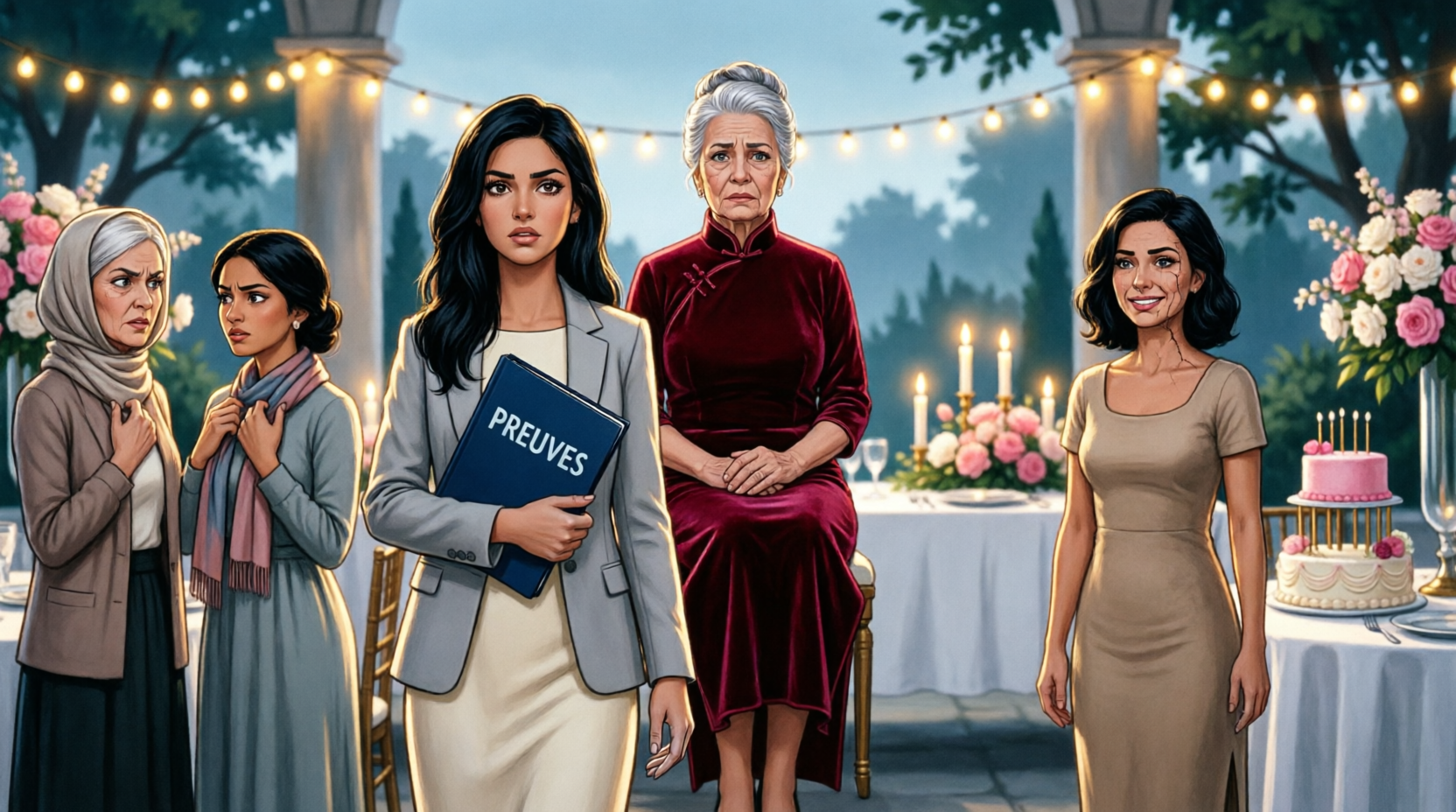
J’ai ouvert mon ordinateur portable et créé un dossier : PREUVES.
Pendant quatre heures, j’ai pris des captures d’écran de tout. Chaque insulte. Toutes les blagues. Tous les paris. Chaque message cruel. Je les ai organisés par date, par nom, par degré de cruauté. Je n’avais jamais rien documenté aussi soigneusement—même dans mes cas les plus difficiles en réanimation.
À 4h23, j’ai rejoint le groupe une dernière fois. Ils dormaient tous, tandis que j’étais assis seul parmi les ruines.
J’ai tapé une phrase :
« Merci pour les preuves. À bientôt. »
Je l’ai envoyé et quitté le groupe.
Mon téléphone a explosé immédiatement.
Meera a appelé six fois. Je n’ai pas répondu une seule fois.
Puis les messages sont arrivés.
Meera : « Aisha, RÉPONDS, je te jure que je peux t’expliquer. »
Mère (Ananya) : « Ce n’est pas ce que ça semble être, bêta. Les familles se défoulent parfois. »
Tante Leela : « Ne faites pas de scène avec ça. C’était privé. Tu es trop sensible. »
Trop sensible.
La même femme qui avait profité de mes paris sur mon divorce me traitait de trop sensible.
J’ai éteint mon téléphone et je suis allé travailler.
Pendant trois jours, j’ai vécu dans un étrange calme. Je sauvais des patients, changeais de pansements, tenais la main d’inconnus tout en ignorant les appels de mon propre sang. Meera est venue deux fois dans mon immeuble. Je l’ai vue à travers le judas — pleurant, frappant, suppliant. Je n’ai pas ouvert la porte.
Parce que j’avais déjà un plan.
Et ce plan a commencé lors de la célébration des 70 ans de ma grand-mère Kamala.
Six semaines plus tôt, elle m’avait appelé elle-même.
« Aisha, mon enfant, j’organise une grande fête d’anniversaire. Je veux que tu sois là. Promets-le-moi. »
« Bien sûr, Dadi. »
« Bien. Parce que cette nuit-là, je vais dire quelque chose d’important. »
À l’époque, je pensais qu’elle parlait d’un toast. Des souvenirs. Quelque chose de normal.
Maintenant, je n’en étais plus si sûr.
Trois jours avant la fête, Meera m’a coincée dans le couloir de mon immeuble.
Son maquillage était flou. Ses cheveux étaient en bataille. Pour la première fois de sa vie, elle avait l’air humaine.
« Il faut qu’on parle. »
« Je t’écoute. »
« Ce que tu as vu… Ça a dégénéré. Nous n’avons jamais voulu que ça aille aussi loin. »
« Tante Leela a littéralement parié sur mon divorce, Meera. »
« C’était son idée ! »
« Et tu as participé. »
« J’étais jeune. »
« Tu avais vingt-cinq ans. »
Son expression changea. Le masque glissa.
« Très bien. Tu as tout vu. Mais tu ne peux pas le dire à Dadi. »
J’ai ri une fois, bruyamment.
« Ah bon ? »
« Elle a un cœur faible, Aisha. Si tu fais une scène à son anniversaire et qu’il se passe quelque chose, ce sera de ta faute. »
I stared at her.
“So now you care about her health? Interesting. Because I’m the one who takes her to every hospital appointment. I’m the one who visits every Sunday. I’m the one who buys her medication.”
Meera clenched her jaw.
“That’s why no one can stand you. You always play the victim.”
I looked at her properly for the first time in years. The girl I grew up sharing a room with. The one I defended. The one I helped when no one else did.
“Yes,” I said slowly. “I’ve been the victim for years. But that role is over now.”
I shut the door in her face.
And on the night of the party, as I stepped into my grandmother’s garden, I knew something huge was about to explode.
Because everyone went quiet when they saw me.
And smiled too late—too stiffly—as if they already knew the blow was coming… but had no idea from where.
PART 2
The party looked like something out of a magazine. Fairy lights hung across the trees, flowers everywhere, a string quartet playing softly, waiters moving through the crowd with trays of drinks. The sky was clear, deep blue, almost unreal.
I wore a navy dress I had carefully chosen. My mother had told me the dress code was casual. But I overheard Meera telling my cousin Sana that it was cocktail formal.
Another trap.
Another way to make me stand out in the wrong way.
But not this time.
I walked in smiling.
“Hi, Mom. You look beautiful.”
She froze, as if she had expected me to explode the moment I stepped inside.
I didn’t.
For two hours, I played the perfect guest. I greeted everyone, congratulated my grandmother Kamala, spoke politely to relatives, helped arrange gifts. I even posed for photos—though somehow I was always placed at the back, half-hidden, as if they were still trying to erase me quietly.
Even the waiters seemed to have trouble noticing me. Whenever they passed snacks near me, Meera would give them a subtle gesture, and they would walk right past. I noticed. Everyone noticed. No one said anything.
Grandmother Kamala called me over with her hand.
“Come here, my child.”
I sat beside her. She wore a deep maroon saree, looking strong and elegant, like age had softened her but not broken her.
“Stay until the end,” she said quietly. “No matter what happens, don’t leave.”
“I’m not leaving, Dadi.”
She squeezed my hand.
“That’s what I hope.”
When the speeches began, Meera rushed to grab the microphone first.
“Good evening, everyone,” she said in her soft, practiced voice. “Today we celebrate an incredible woman—the heart of our family…”
She spoke about memories she never made, meals she never cooked with Dadi, lessons she never lived. Every sentence was performance. Every tear carefully staged.
She ended with, “Thank you, Dadi, for teaching me what it means to always be present. You know I’ve always been by your side.”
The applause was loud.
I looked at my grandmother. She didn’t clap.
A distant cousin leaned toward me.
“Aren’t you going to say anything, Aisha?”
Before I could answer, Meera grabbed my arm.
“Aisha is too busy with work, poor thing. Barely sleeps. She didn’t have time to prepare anything.”
Her smile was sharp.
I smiled back.
“Yes, better leave speeches to the experts.”
Then Grandmother Kamala stood up.
The entire garden went silent.
She wasn’t someone who usually spoke much at gatherings. She observed more than she talked. But that night, she walked to the microphone with a strength I hadn’t seen in months.
“I want everyone to stay a little longer,” she said. “Today I turn seventy, and at this age, I think I’ve earned the right to put some truths on the table.”
My mother stiffened. Aunt Leela took a slow sip of her drink.
“I want to talk about family. And especially about the person who has truly been my family for the past ten years.”
Meera adjusted her hair, already expecting praise.
“The person who took me to every cardiology appointment. Who cleaned this house every Sunday. Who held my hand on nights when I couldn’t breathe properly from fear. The one who never asked for recognition.”
My face burned.
She looked directly at me.
“Aisha, come here.”
The garden seemed to open up as I walked forward. I stood beside her.
She raised my hand.
“This,” she said firmly, “is what real family looks like.”
Meera let out a nervous laugh.
“Oh Dadi, we are all family…”
“Don’t interrupt me,” Kamala cut her off sharply. “Because I actually keep records.”
She reached into her purse and pulled out a small leather notebook. I recognized it. It always sat on her bedside table. I thought it was just for grocery lists.
“March 15th, 2019,” she read. “Aisha took me to the cardiologist. Meera canceled because she had a photoshoot.”
People exchanged uneasy glances.
“August 22nd, 2020. Aisha made soup and cleaned the house when I had pneumonia. Sana said she would come, but instead went to a wine tasting.”
My mother went pale.
“September 17th, 2024. The day of Aisha’s divorce. I called her every day for a month. Her own mother didn’t call even once.”
“Mom…” my mother whispered, breaking.
Kamala shut the notebook.
“That is not all.”
At that moment, Uncle Robert—Aunt Leela’s husband—stood up. A quiet man, a lawyer, someone who almost never spoke. Aunt Leela tried to grab his arm, but he pulled away.
“Six months ago,” he said calmly, “I accidentally saw a chat on my wife’s phone. It was called ‘Real Family.’”
A murmur spread through the garden.
“I read seven years of messages. Seven years of humiliating Aisha. Betting on her failure. Celebrating her pain.”
“Robert, stop!” Aunt Leela snapped. “That was private!”
“Private doesn’t mean right,” he replied. “And I showed every screenshot to Kamala.”
My grandmother nodded without looking away from my mother.
“I read all 847 messages. Every single one. I saw how they mocked her when she could barely stand. I saw how they laughed at her divorce. I saw someone write: ‘One less grandchild to worry about.’”
My mother covered her mouth.
No one breathed.
The golden evening light was fading. The musicians had stopped playing. Even the neighbors outside the gate were watching in silence.
Kamala reached into her pocket again.
And pulled out an envelope.
“I didn’t want to do this in private,” she said. “I wanted witnesses.”
Meera stepped forward, panicked.
“Dadi, please…”
Kamala’s eyes hardened.
“Sit down.”
Meera froze, then slowly stepped back, like a child being scolded.
Kamala lifted the document.
“This,” she said, “is my updated will.”
A sharp sound escaped Aunt Leela’s throat.
I didn’t know what was coming. But looking at Meera’s face, I understood something—she did. And she was terrified.
Kamala took a deep breath, unfolded the paper, and brought it closer to the microphone.
And just before she began reading, Meera screamed with a desperation that froze my blood:
“You can’t do this to us because of her!”
The entire party jolted.
And in that moment, I knew—
for them, the worst had only just begun.
PART 3
Meera’s scream hung in the air like a slap.
Grandmother Kamala slowly lowered the page. She looked at her granddaughter with a mix of exhaustion and contempt, then spoke with a calmness that was more frightening than any outburst.
“No, Meera. This is not happening because of her. This is happening because of you.”
Silence swallowed the entire garden.
Kamala lifted the document again.
“This house,” she read clearly, “the house that Aisha has cared for, cleaned, and filled with life for the past ten years, will belong to her.”
A wave of disbelief moved through the crowd.
My mother stepped forward.
“Mom, no—”
Kamala continued as if she hadn’t spoken.
“The rest of my assets will be divided equally among my children and grandchildren. Because I believe in fairness. But this house goes to the granddaughter who turned it into a home.”
Meera stood frozen, mouth open. Aunt Leela looked like she might faint.
“This is not revenge,” Kamala said, scanning the crowd. “This is balance. Aisha gave years of her life to a family that mocked her behind her back. I am simply putting things where they belong.”
Aunt Leela stood up sharply.
“This is madness! She isn’t even the real—”
Kamala cut her off with a look so sharp it stopped her mid-sentence.
“Finish that sentence, Leela. I dare you.”
Aunt Leela went silent.
Kamala’s voice dropped, but grew even heavier.
“Aisha is my blood. And even if she weren’t, she has shown more love than any of you ever did.”
Then she turned to me.
“Do you want to say something, my child?”
I looked around.
My mother was crying. Meera’s makeup was ruined, her hands shaking. Aunt Leela looked like she was deciding whether to scream or run. Several relatives avoided my gaze. Others looked away in shame, finally realizing there was no hiding place left.
I could have taken out my phone.
I could have read every screenshot aloud.
I could have repeated every cruel sentence they wrote about my divorce, my grief, my salary, my loneliness.
But it wasn’t necessary anymore.
I stepped toward the microphone.
“I have screenshots of all 847 messages,” I said calmly. “Seven years of them. But there’s no need to show them. Tonight already said enough.”
I turned to face them.
“Long ago, you decided I wasn’t part of your ‘real family.’ I’m simply respecting that decision. You excluded me first. I’m just making it official.”
Meera broke.
“You can’t do this to us!” she cried.
I looked at her without anger.
“I’m not doing anything to you. You already did it.”
My mother stepped toward me, desperate.
“Aisha, please…”
I didn’t answer.
Instead, I gently took Kamala’s arm.
“Let’s go inside, Dadi. It’s getting cold.”
She smiled softly.
“Yes, my child. Let’s go home.”
We walked away together, while behind us the party collapsed into chaos. I heard Aunt Leela arguing with her husband. I heard Meera trying to explain the unexplainable to guests who were already leaving. I heard my mother calling my name through tears.
But I didn’t look back.
Because for the first time in years, my chest felt light.
What followed came fast and brutal.
Someone at the party posted it online. Within a day, half the neighborhood knew what happened at Kamala’s 70th birthday. Meera lost thousands of followers. Her carefully curated image of the perfect granddaughter and “ideal family woman” collapsed overnight. She deleted her accounts and disappeared for weeks.
Aunt Leela didn’t just lose friends—she lost her husband. Two weeks later, he filed for divorce.
My mother changed the most. Invitations stopped. Her book club suddenly “had no space.” At church gatherings, people smiled less. In small communities, shame travels faster than gossip.
Three days after the party, I found Kamala in the garden with her black notebook on her lap.
“Are you writing about that night?” I asked, sitting beside her.
She shook her head.
“I’m writing about today. ‘Aisha came over. We planted tulips. The sun was beautiful.’”
I smiled, then glanced at her.
“Why didn’t you tell me earlier that you knew?”
She was quiet for a moment.
“Because if I told you alone, they would have convinced you it wasn’t that bad. That you were overreacting. We needed witnesses. Justice isn’t only about being done, my child. It’s about being seen.”
She was right.
My grandmother wasn’t just kind. She was brave.
Two weeks later, my mother came to my door holding an old photo album. She looked older. Dimmer.
“I don’t deserve your attention,” she said. “But I want to try. I want to be your mother again, if you ever let me.”
We talked for three hours.
She admitted things I never expected: that I reminded her too much of my father; that my independence made her feel small; that the group chat started as venting and turned into something ugly.
“I can’t undo what I did,” she said through tears. “But I want to do better.”
I looked at her for a long time before answering.
“Three months. No calls, no visits, no messages. After that, we’ll see.”
She agreed without arguing.
I still work long ICU shifts. I still come home alone some nights. I still get exhausted down to my bones. But I no longer carry the weight of trying to earn love from people who decided long ago not to give it.
Yesterday, while watering the new flowers, Kamala asked me:
“Do you know what’s good about getting old?”
“What?”
“You stop living to be liked. And you start living for what actually matters.”
I think I’m finally learning that.
That night, I didn’t lose my family.
I lost the lie I was forced to call family.
And in the space it left behind, I found something far more valuable.
My peace.
My dignity.
My place.
So if anyone ever makes you feel like you are the leftover in your own home, remember this: you don’t have to burn yourself just to keep others warm. Keep the truth. Wait for your moment. And when it comes, walk away with your head held high.
Because no one deserves to be anyone’s charity project.
We all deserve to be chosen with love.