Rodrigo’s voice trembled on the other end of the phone. “Mom… what do you mean the house is no longer in my name?” I leaned back in the chair on the deck as the wind moved softly through my hair. For the first time in decades, nobody was calling me to clean something. Nobody needed medicine. Nobody expected dinner at six. I took a slow sip of coffee before answering. “It means exactly what it says.” Silence. Then I heard Paulina screaming in the background. “She can’t do this! Tell her she can’t!” I smiled at the ocean. Actually, I could. Three years earlier, after my second surgery for a herniated disc, Armando and I had updated the paperwork for the house. At the time, Rodrigo had pressured his father constantly. “You should put the property in my name now,” he used to say. “It’ll make things easier later.” Later. As if our deaths were just paperwork waiting to happen. But Armando, despite all his flaws, had one moment of clarity near the end of his life. One night in the hospital, while Rodrigo complained in the hallway about parking fees, Armando held my hand and whispered: “They only see us as things now.” I said nothing. Because I knew.
A week later, he signed everything back into my name only.
Not Rodrigo’s.
Not shared.
Mine.
And six months before he died, after Paulina casually asked me if I planned to move into “a smaller place for elderly people,” I made another decision.
I created a living trust.
If anything happened to me, the house would be sold, and part of the money would go to animal rescue centers, women’s shelters, and a scholarship fund for older women returning to school.
Rodrigo would receive exactly one dollar.
Enough so he could not contest the will claiming I forgot him.
The lawyer had laughed when I suggested it.
Then he saw my face and stopped laughing.
Back on the phone, Rodrigo’s breathing became heavier.
“You’re being manipulated,” he snapped. “Who’s filling your head with this nonsense?”
“No one,” I replied calmly. “That’s the problem. For the first time in my life, I’m finally thinking for myself.”|
Paulina grabbed the phone.
“Elena, this is cruel! After everything we’ve done for you—”
I almost laughed.
Everything they had done for me?
Like leaving me alone every Christmas to care for Armando while they posted beach photos online?
Like forgetting my birthday three years in a row?
Like treating me as free labor with gray hair?
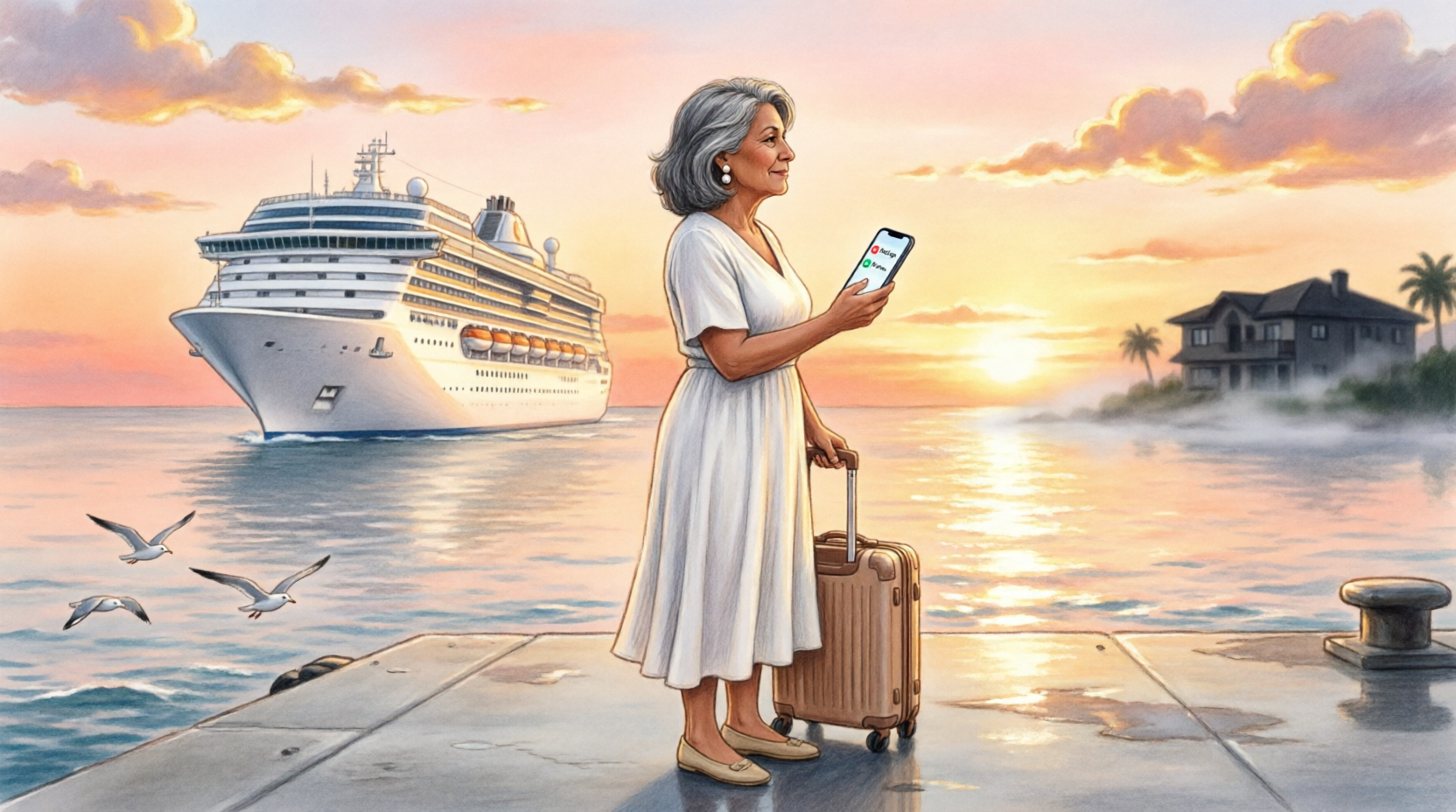
I looked around the cruise deck.
An older couple danced near the railing while music played softly from hidden speakers. A woman in a red hat read peacefully beside the pool.
Life continued.
Without permission.
Paulina,” I said gently, “if taking care of your own pets ruins your vacation, imagine taking care of an entire family for forty years.”
Then I hung up.
I turned off the phone completely after that.
Not because I was afraid.
Because I was done.
The first weeks on the ship felt unreal.
I slept eight hours straight for the first time in years.
I ate food while it was still hot.
I walked through little coastal towns in Mexico without pushing a wheelchair or carrying grocery bags for someone else.
In Colombia, I bought a yellow dress that hugged my waist.
In Italy, I drank wine at noon with strangers who called me beautiful.
In Greece, a retired history professor kissed my hand and told me my smile looked “dangerous.”
Imagine.
At sixty-three, I was apparently dangerous.
Meanwhile, back home, chaos bloomed beautifully.
My friend Lupita eventually broke her promise and told me everything during one of our video calls.
The dogs destroyed Rodrigo’s imported leather sofa…………………………………..
The parrot learned new insults from Paulina and screamed them during a dinner party with her boss.
The Persian cat disappeared for four days and returned sleeping inside Rodrigo’s car engine.
And my son—my serious, important son—had to cancel two vacations because nobody would watch the animals anymore.
Apparently, pet hotels were “too expensive.”
I nearly choked laughing.
But the real explosion came two months later.
Rodrigo discovered he was drowning in debt.|
For years, he and Paulina had lived beyond their means because they assumed the house would eventually save them.
Inheritance had become part of their financial plan.
Without the property, their entire fantasy cracked open.
He called me after midnight one evening.
I answered this time.
Not because I missed him.
Because I wanted to hear whether he sounded different.
He did.
Smaller.
“Tía Lupita says you’re in Spain now,” he murmured.
“I am.”
A pause.
Then quietly:
“Are you really not coming back?”
I looked out from my balcony cabin toward the lights of Barcelona glowing against the dark sea.
For a moment, I remembered the little boy who used to fall asleep on my chest after nightmares.
The teenager who once bought me flowers with his first paycheck.
Children do not become selfish overnight.
It happens slowly.
One convenience at a time.
One entitlement at a time.
One ignored sacrifice at a time.
“I might come back someday,” I said. “But I’m never returning to the life I had before.”
He started crying.
Actual crying.
Not loud.
|Just broken.
“I didn’t realize,” he whispered.
And that hurt more than anger would have.
Because he meant it.
He truly had not realized.
Not the exhaustion.
Not the loneliness.
Not the humiliation of becoming useful instead of loved.
“I know,” I answered softly.
We stayed silent for a while.
|Then he asked the question that finally mattered.
“What do you want from me?”
Not money.
Not the house.
Me.
What did I want?
I closed my eyes.
Respect.
That was all.
Respect before flowers at funerals.
Respect before speeches about family.
Respect while I was still alive enough to hear it.
“I want you to learn how to take care of your own life,” I told him. “Including the people and responsibilities inside it.”
After that call, things slowly changed.
Not perfectly.
Life is not a fairy tale.
But differently.
Rodrigo began visiting animal shelters with his daughter on weekends because, according to Lupita, “the dogs humbled him.”
Paulina got a job instead of spending afternoons planning vacations they could not afford.
And my youngest granddaughter—the one who asked about my bedroom—sent me a handwritten letter saying:
“Grandma, I think I forgot you were a person too.”
I cried when I read that.
Not because it was cruel.
Because it was honest.
A year later, when the cruise finally returned to Puerto Vallarta, I stood at the same port where I had once left trembling with fear and freedom tangled together inside my chest.
But I was not the same woman anymore.
The Elena who boarded that ship had spent her entire life apologizing for existing.
The Elena who stepped off understood something else completely:
|Love that demands your exhaustion is not love.
Family that only values your usefulness is not family.
And sometimes the most courageous thing an invisible woman can do… is disappear long enough to finally be seen…………………………
The Funeral, The Pets, and the Cruise They Never Saw Coming
My name is Elena Márquez. I am sixty-three years old, and for most of my life, I existed for other people.
I was a wife before I was a woman.
A mother before I was a person.
A caretaker before I was ever allowed to be tired.
For forty years, my days belonged to someone else.
And then my husband died.
Armando passed away early on a Tuesday morning while rain tapped softly against the hospital windows. I held his hand when the machines finally went quiet. I cried, yes. I truly did love him once. Maybe I always would in some complicated way.
But grief is a strange thing when exhaustion has been living inside you for years.
Part of me mourned him.
Another part of me felt something dangerous beginning to breathe underneath the sadness.
Relief.
At the funeral, people hugged me so tightly I could barely breathe.
“Now you can finally rest, Elena.”
“You’ve done enough.”
“Your children will take care of you now.”
I almost laughed every single time.
Nobody wanted me to rest.
They wanted to repurpose me.
After the burial, my son Rodrigo arrived at the house wearing an expensive black suit and sunglasses despite the cloudy weather. He always dressed like a businessman when he wanted something.
His wife Paulina walked beside him carrying shopping bags and her usual expression of mild irritation, as if the world constantly failed to meet her standards.
“Mom,” Rodrigo said while loosening his tie, “we need to talk about the future.”
The future.
Interesting word to use less than two hours after burying his father.
I thought perhaps we would discuss memorial arrangements.
Or legal paperwork.
Or maybe—even briefly—my emotional state.
Instead, Paulina opened the front door wider and clapped her hands.|
Two giant dogs stormed into my living room.
Behind them came an enormous Persian cat inside a carrier and a parrot in a cage screaming:
“USELESS OLD WOMAN!”
Paulina burst out laughing.
Rodrigo laughed too.
I stood completely still.
“Isn’t he hilarious?” Paulina said.
The parrot screamed again:
“USELESS OLD WOMAN!”
I slowly looked at my son.
“Rodrigo… what is this?”
He waved casually toward the animals.
“We’re traveling more this year for work and vacations,” he explained. “So we figured you could help with the pets now that you’re alone.”
Alone.
Such a cold little word.
Paulina sat on my couch like she owned it already.
“It’ll be good for you,” she said brightly. “You need company.”
Company.
Not responsibility.
Not unpaid labor.
Not being turned into an elderly pet-sitter two hours after becoming a widow.
Company.
Then my youngest granddaughter wandered upstairs without greeting me.
A minute later she shouted:
|“Mom! Which bedroom is going to be mine when Grandma dies?”
Paulina laughed nervously.
Rodrigo didn’t correct her.
And in that exact moment, something inside me became very, very calm.
Not angry.
Certain.
They weren’t here because they loved me.
They were here because they believed my life was already over.
Rodrigo placed papers on the kitchen table.
Feeding schedules.
Medication instructions.
Dog walking times.
Veterinary appointments.
Even alarm codes to their apartment in case I needed to “help out” while they traveled.
“Son,” I said quietly, “your father was buried today.”
Rodrigo sighed dramatically.
“Mom, please don’t start with emotional drama right now. Everybody has responsibilities.”
Everybody.
Except him, apparently.
I looked around the kitchen where I had spent decades cooking meals nobody thanked me for.
The same kitchen where I crushed Armando’s medication into applesauce.
The same kitchen where I learned how to cry silently so nobody would accuse me of ruining dinner.
And suddenly I realized something horrifying:
If I stayed here, this would be the rest of my life.
Not grieving.
Serving.
So I smiled.
A soft, obedient smile they had trained me to wear for decades.
“Of course,” I said gently. “I understand.”
Paulina visibly relaxed.
“I told you she’d be reasonable,” she whispered to Rodrigo.
Reasonable.
Another interesting word.
That night, after everyone left, the house finally became quiet.
The dogs snored loudly in the hallway.
The Persian cat stared at me with judgment from the sofa.
And the parrot screamed one more time:
“USELESS OLD WOMAN!”
I walked calmly toward the cage.
Covered it with a blanket.
Then whispered:
“Oh, little bird… tomorrow you’re going to be surprised too.”
I climbed the stairs slowly and entered my bedroom.
Armando’s side of the closet still smelled faintly like cologne and hospital soap.
I opened the bottom drawer beneath his ties.
And there it was.
The blue envelope.
Inside:
- my passport
- cruise documents
- boarding confirmation
- one-year luxury cruise ticket departing from Puerto Vallarta at dawn
I had bought it six months earlier.
On an afternoon when Armando slept beside an oxygen machine and I realized something terrifying:
If I didn’t save myself, nobody else would.
So I made a plan.
Quietly.
Carefully.
Without asking permission.
I told nobody.
Not my friends.
Not the church women.
Certainly not Rodrigo, who still believed I barely understood online banking.
How adorable.
At four in the morning, I got dressed in silence.
White linen dress.
Comfortable shoes.
Pearl earrings I had hidden for years because Armando once told me they were “too elegant for ordinary women.”
I made coffee one final time in that kitchen.
Then I left food and water for the animals.
Beside the bowls, I placed a handwritten note.
Not a goodbye letter.
An invoice.
Forty years overdue.
The Uber arrived quietly outside.
One suitcase.
That was all I took.
Not because I owned little.
Because I was finally leaving behind what was heavy.
As the car pulled away, I looked back at the dark house.
No tears came.
Only silence.
And freedom so unfamiliar it almost felt illegal.
By sunrise, the ship had already begun moving across the ocean.
The water glowed gold beneath the morning light.
I stood alone on the deck with coffee warming my hands when my phone exploded with notifications.
Rodrigo.
Paulina.
Rodrigo again.
I ignored all of them.
Then messages started arriving rapidly.
“WHERE ARE YOU?”
“The dogs destroyed the kitchen!”
“Mom, answer your phone immediately!”
“We have a flight in two hours!”
I smiled softly at the ocean.
Blue.
Endless.
Mine.
Then another message appeared.
A photo.
Rodrigo had entered my bedroom.
The closet was empty.
The drawers were cleared out.
And resting perfectly in the center of the bed was the second blue envelope.
The one he wasn’t supposed to open until I was already far away.
A minute later, my phone rang again.
This time, when I answered, my son no longer sounded irritated.
He sounded afraid.
“Mom…” he whispered shakily.
“What do you mean the house isn’t going to me?”
NEXT PART: I buried my husband and told no one that I had already bought a one-year cruise. A week later, my son ordered me to take care of his new pets every time he traveled.