I used to think love was a quiet thing. Not the loud, cinematic kind with grand gestures and sweeping vows, but the steady, reliable kind. The kind that shows up in grocery bags carried up the stairs, in hands held during bad news, in the way someone remembers how you take your coffee. When I met Ryan, he felt like that kind of love. He was thirty then, charming in a way that didn’t feel rehearsed. He spoke about building something of his own, about leaving his family’s comfortable but suffocating orbit and proving he could stand on his own two feet. I believed him. More than that, I wanted to be part of it.
We married two years later in a small garden ceremony. His mother, Patricia, wore cream silk and smiled so brightly I mistook it for warmth. She hugged me tightly and said, “Welcome to the family, Emily. Ryan needs someone who understands what it means to protect him.” I should have asked what exactly needed protecting. At first, it was subtle. Patricia’s “helpful” suggestions about our home decor. Her insistence on funding Ryan’s startup because “family sticks together.” Her casual remarks about how my waitressing job was “adorable” but hardly a career. Ryan always smoothed it over. *She’s just traditional. She doesn’t mean it that way. You’re reading too much into it.* I told myself he was right. I told myself love meant patience. I told myself I was building a life.
Then Lily was born.
Everything shifted overnight, and not in the way I expected. Ryan’s startup stalled. His confidence frayed. Patricia’s presence expanded, filling the silence with advice, groceries, babysitting schedules, and a quiet but steady rewiring of our finances. “For the baby’s future,” she’d say. Joint accounts were restructured. Savings were moved. I signed papers I barely understood because I was exhausted, breastfeeding, and convinced I was being a good partner by trusting them.
By the time Lily turned two, I was working double shifts again. Ryan’s “business” existed mostly on letterhead and investor meetings that never closed. Patricia managed the household budget. She paid the mortgage. She controlled the accounts. She smiled at church potlucks and charity luncheons, the perfect matriarch, while slowly turning me into a guest in my own home.
The worst part wasn’t the money. It was the erosion.
It was in the way Ryan stopped looking at me when I spoke about my day. It was in the way he deferred to his mother’s opinion on Lily’s pediatrician, her preschool, even what she should wear. It was in the way my voice grew smaller in our house until I barely recognized it.
I tried to talk to him. I really did. I sat him down after Lily fell asleep, laid out my fears, asked if he saw what was happening. He rubbed his temples and said, “Mom’s just trying to help. You’re stressed. Maybe you should cut back at the diner.”
That was the night I started keeping copies of everything. Bank statements. Email threads. Text messages. Receipts. I didn’t know what I was building a case for. I just knew I was drowning, and if I went under, I wanted to leave a trail.
PART II: THE FRACTURE
The breaking point came on a Tuesday in October.
Lily had a fever. One hundred and three. She was clingy, whimpering, burning up in my arms. I called Ryan twice. He didn’t answer. When I finally reached him, he said he was at a meeting and Patricia would handle it.
Patricia arrived twenty minutes later, carrying a designer bag and a look of mild inconvenience. “Honestly, Emily, children run fevers. It’s not the apocalypse. Ryan’s father had strep at this exact age and turned out fine.”
She gave Lily acetaminophen, checked her watch, and told me to get some rest. “I’ll stay with her. You look wrecked.”
I went to the bedroom. I didn’t sleep. I listened to the quiet hum of the house, to the distance between the nursery and the living room, to the realization that my child’s illness was being treated like a scheduling conflict.
At 3 a.m., I went to check on Lily. Patricia was asleep on the couch. Lily was awake, crying softly, her tiny hands clutching the bars of her crib.
I picked her up. I held her. And I knew, with a certainty that felt like ice in my veins, that I could not stay in this house another day.
The next morning, Ryan came home smelling like coffee and cologne. I handed him a printed stack of bank statements, email screenshots, and a timeline of transfers. I told him I wanted a divorce. I told him I wanted primary custody. I told him I would not be maneuvered out of my own life.
He stared at the papers like they were in a foreign language. Then his face hardened. “You’re overreacting. My mother has been carrying this family while you’ve been playing martyr. If you walk away now, don’t expect sympathy.”
That afternoon, I filed for divorce. I requested a temporary restraining order. Not because he’d hit me. Because he’d locked me outside in the rain while Lily cried in the back seat of the car, screaming for me, while Patricia watched from the window and told him to “let her cool off.”
It was the first time I used the word *custody* out loud. It was the first time I stopped apologizing for taking up space.
PART III: THE HEARING
I stood in the courtroom with my hands trembling so badly I had to lock them together just to stop anyone from noticing. My name is Emily Harper. I’m thirty-two years old, and until that morning, I still believed my marriage could end quietly.
I was wrong.
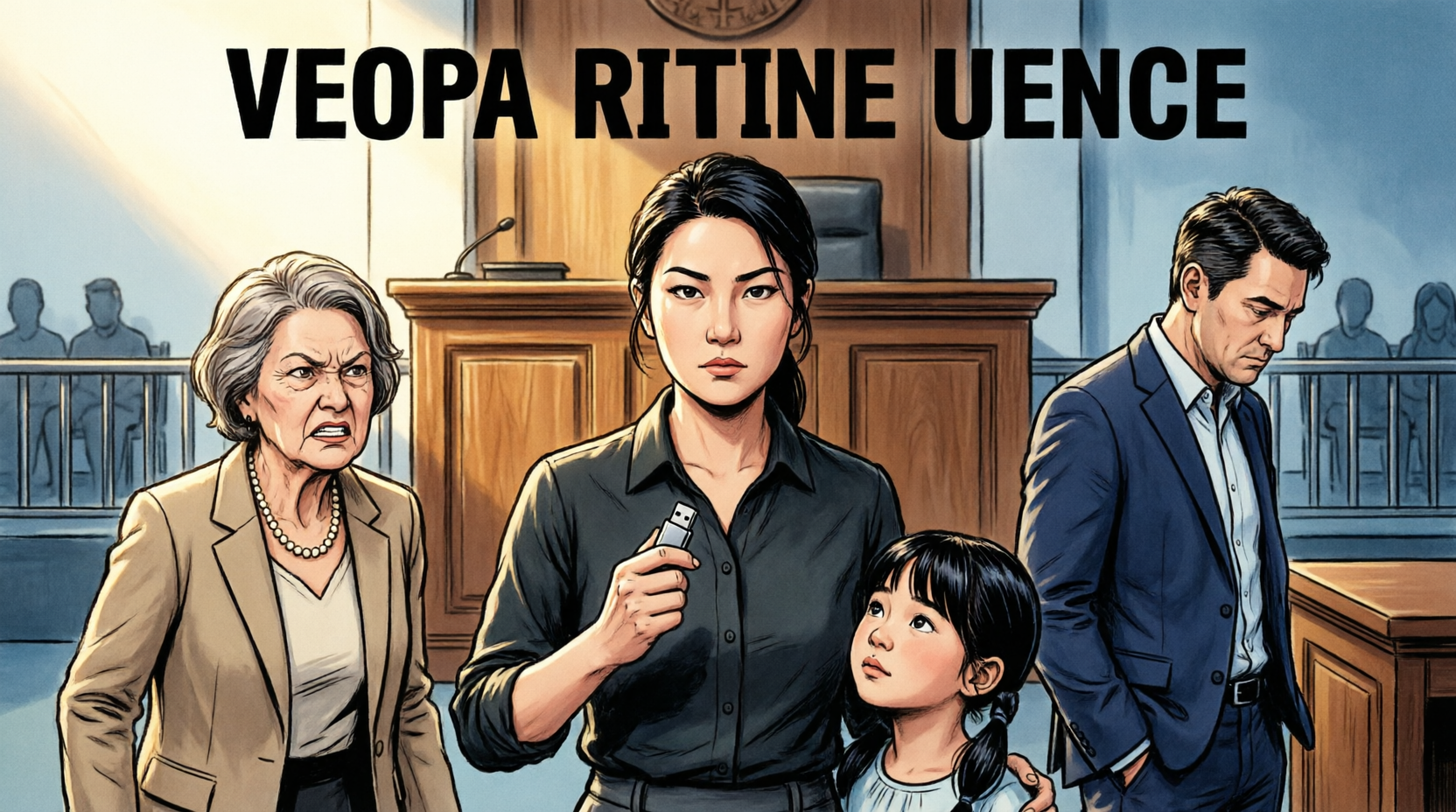
Across the courtroom sat my husband, Ryan Harper, wearing the navy suit I bought him two Christmases earlier. Beside him sat his mother, Patricia Harper—a woman who spent seven years smiling at church events, volunteering at charity luncheons, and dripping poison into my husband’s ear whenever nobody else was listening.
The divorce hearing should have been simple. Custody. The house. The savings account. The restraining order I filed after Ryan locked me outside in the rain.
Then my attorney, Ms. Coleman, placed a small flash drive onto the table.
“Your Honor,” she said, “we have evidence showing that Mrs. Patricia Harper knowingly transferred marital assets from the defendant’s accounts in an effort to conceal them from my client.”
Ryan’s face immediately went white.
Patricia leaned forward slowly, her pearl necklace resting against her expensive cream blazer. “That is a disgusting accusation.”
I looked from the judge to Ryan. “It’s not an accusation,” I said, my voice cracking. “I found the bank statements. I found the emails. And I found the messages where both of you discussed making sure I ‘left with nothing.’”
A murmur spread across the courtroom.
Ryan finally looked at me.
Not with guilt.
Not with love.
With anger.
Patricia stood so quickly her chair scraped violently against the floor.
“You ungrateful little nobody,” she snapped. “After everything my family gave you?”
The bailiff stepped forward immediately. “Ma’am, sit down.”
But Patricia ignored him.
She stormed straight toward me, her heels striking the floor like gunshots.
I froze.
She stopped inches from my face, eyes blazing.
“You dared to fight me?!” she hissed.
Before anyone could react, her hand cracked across my cheek.
The slap echoed through the courtroom.
My head snapped sideways. Someone gasped loudly. Lily, sitting beside my sister in the back row, burst into tears.
Ryan looked down at his shoes.
The judge slowly stood from the bench, his expression pale but tightly controlled.
“Madam,” he said, his voice slicing through the silence, “do you realize what you’ve just done?”
Patricia lifted her chin proudly. “I defended my family.”
The judge stared at her for a long moment.
“No,” he replied quietly. “You just confirmed everything I needed to know.”
For three long seconds, nobody moved.
My cheek burned, but the pain barely registered compared to the ache inside my chest when I saw Lily covering her mouth with her tiny hands. My sister Rachel pulled her close, whispering comfort into her ear, but Lily kept staring at me like she had just watched the world split apart.
The bailiff guided Patricia backward, though she fought him every step.
“This is outrageous!” Patricia screamed. “She provoked me! She’s been trying to destroy my son since the beginning!”
Judge Whitaker looked toward the bailiff. “Remove Mrs. Harper from the courtroom.”
Patricia’s eyes widened instantly. “You cannot remove me. I’m a witness.”
“You are also someone who committed assault inside my courtroom,” the judge replied sharply.
Ryan finally stood up. “Your Honor, please. My mother is under tremendous stress.”
Judge Whitaker turned toward him slowly. “Sit down, Mr. Harper.”
Ryan sat immediately.
And somehow, that was the exact moment I finally understood him clearly.
Not as the man I married.
Not as Lily’s father.
But as a coward willing to watch his mother strike his wife in front of his child and still excuse her behavior.
Patricia was escorted out while still screaming my name.
Then the judge turned toward me. “Mrs. Harper, do you require medical attention?”
I touched my burning cheek gently. “No, Your Honor. I just want to finish this.”
He nodded once. “Then we will continue.”
Ms. Coleman stood again and connected the flash drive to the courtroom monitor. Emails appeared across the screen. Bank transfers. Messages exchanged between Ryan and Patricia.
One text from Patricia read: *Make sure Emily cannot access anything until she gives up custody. Mothers with no money always fold.*
My stomach twisted.
Ryan’s attorney shifted uncomfortably in his seat.
Then the recording played.
My entire body went cold when Ryan’s voice echoed through the courtroom speakers.
*“If Emily fights custody, we’ll say she’s unstable. Mom knows people at the school. We can make it look bad.”*
Then Patricia responded, *“Good. That little girl belongs with our family, not with a waitress pretending to be a mother.”*
I worked double shifts for two years while Ryan “built his business,” which was mostly funded by his parents. I packed Lily’s lunches. Took her to doctor appointments. Helped with homework. Slept three hours a night when she had the flu.
But in their eyes, I was still nothing.
Judge Whitaker leaned back in his chair, jaw tight.
Ms. Coleman continued calmly. “Your Honor, we also have documentation showing Mr. Harper violated the temporary custody agreement by refusing to return Lily on three separate occasions.”
“That’s not true,” Ryan interrupted quickly.
I looked directly at him. “Ryan, you kept her from me on Mother’s Day.”
His face hardened immediately. “Because you were being dramatic.”
The judge narrowed his eyes. “Mr. Harper, I strongly advise you to stop speaking unless instructed otherwise by your attorney.”
Ryan’s lawyer grabbed his sleeve.
Ms. Coleman turned toward me. “Emily, did you ever threaten to keep Lily away from her father?”
“No,” I answered softly. “I wanted her to have a father. I just didn’t want her growing up believing love means control.”
The judge studied the evidence silently before looking toward Ryan.
“What I have witnessed today is not merely a family disagreement,” he said carefully. “It is a pattern. A pattern of financial concealment, emotional manipulation, and disregard for court-ordered parenting time. This court does not reward those who treat family law as a negotiation table.”
Ryan swallowed hard.
Then Judge Whitaker spoke the words that changed everything.
“Temporary full custody is granted to Mrs. Harper, effective immediately. A forensic accounting review of all marital assets is hereby ordered. All joint and business accounts tied to the marital estate are frozen pending that review. Mrs. Patricia Harper is prohibited from unsupervised contact with the minor child until further order of the court. Any violation will result in contempt charges.”
For the first time all day, I finally breathed.
PART IV: THE AFTERMATH
Ryan shot to his feet. “You can’t do that!”
The judge’s voice sharpened instantly. “I can, and I just did. Court is adjourned.”
The gavel fell. The sound was final.
Ryan’s attorney whispered urgently beside him, but Ryan shook him off violently. His face had turned bright red now, the carefully polished mask finally gone.
“She’s turning my daughter against me,” he snapped. “She’s always hated my mother. She wanted my money, my house, my family name—”
“I wanted a husband,” I said quietly.
The courtroom went silent again.
I turned toward him, my cheek still stinging, my heartbeat pounding so loudly I could hear it in my ears.
“I wanted you to come home when Lily had a fever. I wanted you to stop letting your mother call me trash inside my own kitchen. I wanted you to tell the truth just once.”
Ryan opened his mouth.
Nothing came out.
Judge Whitaker looked at him with a disappointment heavier than anger. Then he gathered his papers, stood, and disappeared through the door behind the bench.
After the hearing ended, I walked into the hallway beside Rachel and Lily. My daughter ran into my arms so hard I nearly lost balance.
“Mommy,” she whispered, “are you okay?”
I knelt down and held her face gently between my hands. “I am now.”
She carefully touched my cheek. “Grandma was mean.”
I swallowed the tears rising in my throat. “Yes, baby. And sometimes adults have to learn that being cruel has consequences.”
Behind us, Ryan stepped out of the courtroom.
For one brief moment, I thought maybe he would apologize.
Instead, he said, “Emily, please. Don’t do this to me.”
I stood up slowly while holding Lily’s hand.
“I didn’t do this to you, Ryan,” I replied quietly. “You did.”
He looked at Lily, then back at me. “Can we talk?”
“Through the attorneys,” I answered.
Then I walked away.
The next six months were not magical. They were hard. They were exhausting. They were filled with depositions, forensic accountants, mediation sessions that ended in stalemates, and nights where I sat at the kitchen table staring at legal invoices while Lily slept down the hall.
But for the first time in seven years, I was making decisions without asking permission.
The forensic investigation uncovered more than seventy thousand dollars hidden through Patricia’s accounts, funneled through shell LLCs and “consulting fees” that never existed. Ryan’s business had never been profitable. It had been a tax shelter and a status symbol, propped up by family money and maintained by my silence.
When the final settlement offer landed on Ms. Coleman’s desk, Ryan accepted it two days before trial. No fight. No theatrics. Just exhaustion and the realization that the foundation he’d been standing on was made of glass.
I kept the house. I received full primary custody. Child support was structured. The remaining assets were divided fairly. Patricia was ordered to complete a court-approved anger management program before petitioning for supervised visits. Her petitions were denied twice before a judge finally allowed one-hour monthly sessions with a court-appointed supervisor present.
Lily adapted slowly. She asked questions. She cried sometimes when Ryan’s visits ended. She called me from school once, panicked, because Patricia had told her over a supervised phone call that “Mommy doesn’t know what’s best.” I drove to the school, held her, and told her the truth: *“People who love you don’t make you choose between them and the truth.”*
It wasn’t perfect. But it was honest.
PART V: EPILOGUE — SAFETY IS PEACE
Life didn’t magically become perfect overnight.
Lily still asked painful questions. I still woke up some mornings feeling like I survived a storm I never saw coming. Therapy became part of my routine. Not because I was broken, but because I was learning how to speak again without apologizing for taking up space.
I went back to school part-time. I took a job managing a local café, then started consulting for small hospitality businesses. I built something quiet. Something mine.
Ryan’s supervised visits continued on a strict schedule. He tried, sometimes. Other times, he canceled last minute or showed up distracted. I stopped keeping score. I stopped waiting for him to become the man I married. I accepted him as the father he was capable of being, and I protected the space around us from what he wasn’t.
Patricia never apologized. She sent birthday cards with crisp fifty-dollar bills and perfectly typed notes. Lily thanked her politely. I didn’t read the notes. I archived the cards. Some bridges aren’t meant to be crossed. They’re meant to be observed from a distance, with clear boundaries and locked doors.
Sometimes the person everyone calls “dramatic” is simply the first brave enough to tell the truth. Sometimes the villain doesn’t wear a mask. Sometimes she wears pearls, sits proudly in the front row, and believes the courtroom belongs to her.
But that day, everyone finally saw who she truly was.
And when the judge spoke, the entire room listened.
I still keep that flash drive on my desk. Not as a trophy. As a reminder.
A reminder that silence is not peace. That compliance is not love. That fighting isn’t about winning for yourself. It’s about modeling for your child that they deserve to be seen, heard, and protected—even when the people who are supposed to do it look away.
Six months after the settlement, I sat on the porch with Lily while she drew chalk pictures on the driveway. She looked up at me, squinting against the late afternoon sun, and said, “Mommy? Are we happy now?”
I didn’t hesitate.
“Yes, baby. We’re safe. And that’s how we start.”
She smiled and went back to drawing.
I leaned back in the chair, listened to the quiet hum of the neighborhood, and let the truth settle into my bones.
Safety isn’t boring. It’s peace.
And peace, I finally learned, is worth every single fight.