My hands stopped shaking years before St. Catherine’s Hospital called. That is not a boast. It is what twelve years of teaching close combat to Army Rangers did to me. You learn where panic lives in the body. You learn how fear changes breathing, how rage changes balance, and how a man looks right before he decides to do something stupid. Mostly, you learn that hands are never just hands. They can hold a door open for a kid carrying groceries. They can fix a loose bike chain. They can make a peanut butter sandwich at 6:30 in the morning before school.
They can also break things that should never be broken. That Tuesday night, mine were wrapped around a damp bar towel at McGrevy’s Tavern, wiping beer rings off the polished wood while rain tapped at the front windows. McGrevy’s was mine. Not fancy, not historic, not the kind of place anyone drove out of their way to see, but mine. A little brick-and-neon tavern with sticky floors, framed baseball photos, a jukebox that worked when it felt like it, and a small American flag tucked beside the register because Charlie said it made the veterans smile. The place smelled like fried onions, lemon cleaner, old wood, and wet jackets. Charlie was counting quarters by the jukebox.
Two regulars were arguing about baseball at the far end like their opinions had legal weight.
I had just thought about calling Jacob before bedtime.
Then my phone buzzed.
St. Catherine’s Hospital.
I stared at the screen for half a second, and the whole room seemed to step backward from me.
A father always knows.
“Mr. Horn?” a woman said when I answered.
“Yes.”
“This is Reba Cervantes from St. Catherine’s emergency department. Your son, Jacob, was brought in about twenty minutes ago. You’re listed as his primary emergency contact.”
The towel slid out of my hand.
“What happened to my son?”
There was paper moving on her end.
A voice called out in the background.
Somewhere behind her, a child cried once, sharp and frightened, then went quiet.
“Sir, you need to come down immediately. Dr. Mendoza is with him now.”
“Is he alive?”
The question came out before I knew I had asked it.
“Yes.”
That word held me together.
For about three seconds, it was the only thing in the world.
I told Charlie to lock up if I was not back.
He asked what happened.
I did not answer because I did not have room for language yet.
Rain hit me sideways when I stepped outside.
My boots struck puddles across the parking lot, and my truck started on the second turn.
The drive to St. Catherine’s usually took fifteen minutes.
That night, I made it in eight.
Jacob was nine years old.
He was the kind of kid who lined up his crayons by shade and apologized when adults bumped into him.
He kept a plastic dinosaur on his nightstand because he said it looked brave.
He hated loud arguments.
He loved blueberry pancakes.
He had a habit of pressing his small hand against my shoulder when he wanted my attention, as if he was afraid even asking for love might be too much.
After the divorce, he grew quieter.
After Josie married Darren Parker six months later, he grew quieter still.
Josie and I had not ended well.
No divorce with a child really ends well, no matter how many people claim they are mature about it.
We had once loved each other in the tired, practical way young parents do, packing lunches, paying bills late, trading shifts when Jacob had fevers.
Then resentment got into the house like mold.
It spread behind everything.
When we finally separated, I gave her the family SUV, half the savings, and a promise that I would never use Jacob as a weapon.
I kept that promise.
Even when she married Darren.
Especially then.
Darren Parker had big shoulders, prison tattoos, cheap cologne, and a smile that never looked like happiness.
It looked like ownership.
The first time I met him, he crouched in front of Jacob and said, “You’re a little soft, aren’t you?”
Josie laughed too quickly.
Jacob did not.
I told her later I did not like him.
She said I was jealous.
Maybe I was.
Jealous men can still be right.
At St. Catherine’s, the sliding doors opened to the smell of antiseptic, vending-machine coffee, wet coats, and fear.
Emergency rooms have their own weather.
Too bright, too cold, too full of people pretending not to listen.
Reba found me before I reached the desk.
She was in her forties, dark hair pinned badly, scrubs wrinkled at the waist, eyes too kind for the information she was carrying.
“Mr. Horn. Come with me.”
She moved quickly down the corridor.
Not quickly enough.
“What happened?” I asked.
“Your son has bilateral humeral fractures,” she said.
I stopped.
The word bilateral hit first.
Then humeral.
Then the meaning.
“Both arms?”
“Yes.”
“How?”
Her face changed.
It was small, but I saw it.
A person who works in an ER learns to keep horror organized.
“The injuries are consistent with forceful twisting,” she said.
The hallway narrowed.
The buzz of the fluorescent lights grew louder.
“We contacted child protective services,” she continued. “A hospital intake form has been opened. Security is aware. Dr. Mendoza is documenting everything.”
Not anger.
Not yet.
Anger is red and loud and careless.
What moved through me then was colder than anger.
“Where is his mother?” I asked.
“On her way.”
“Who brought him in?”
Reba hesitated for one beat too long.
“Mr. Parker.”
I turned before she finished.
“Mr. Horn,” she said, but I was already walking.
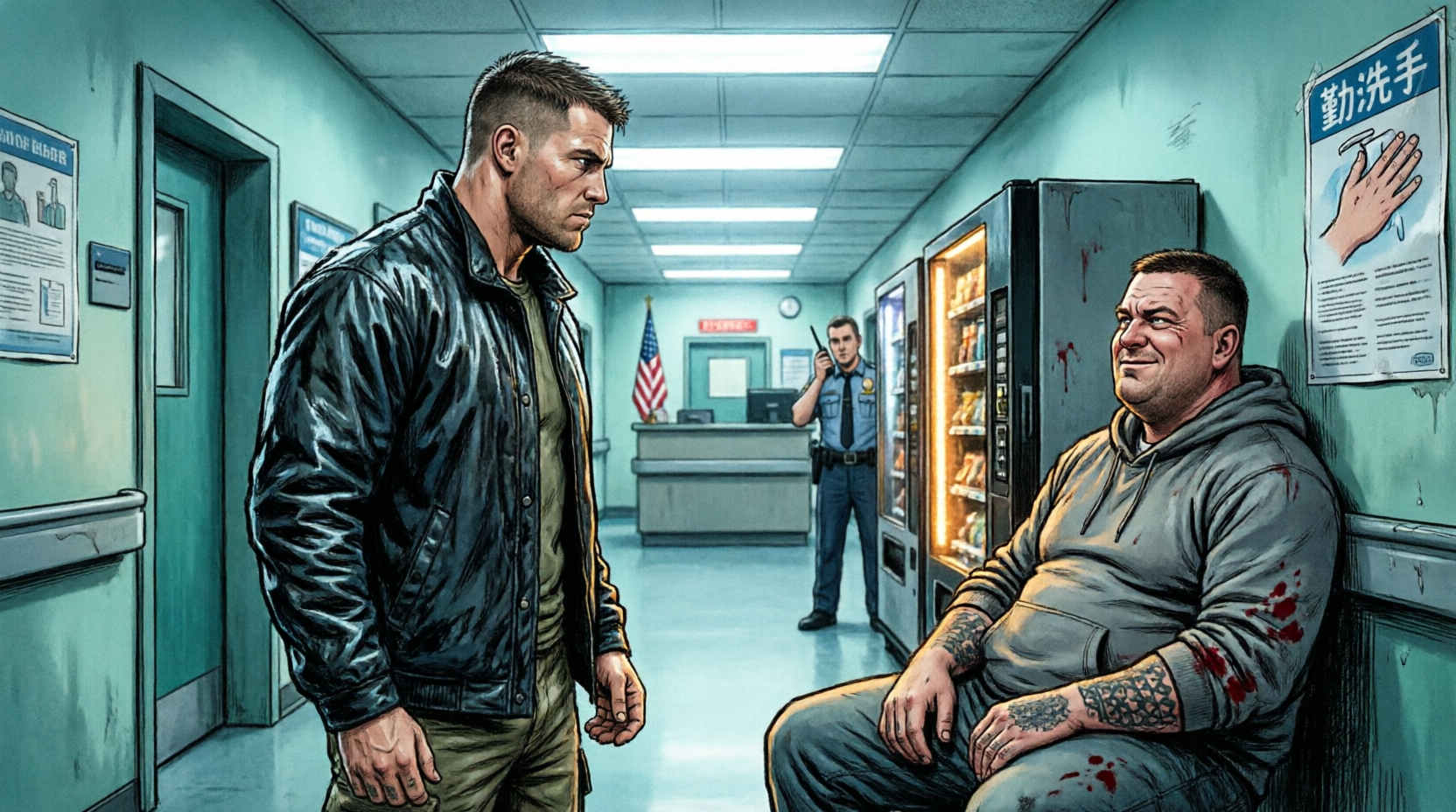
I found Darren near the vending machines.
He was sitting like a man waiting for a tire rotation, one ankle crossed over his knee, scrolling through his phone.
Blood speckled one cuff of his dark sweatshirt.
A half-empty paper coffee cup sat on the floor beside him.
The small American flag sticker on the reception window behind him had one corner peeling loose.
He looked up and smiled.
“Nate,” he said. “Glad you could make it.”
I stopped six feet away.
Six feet is a clean distance.
One step.
Two strikes.
No wasted motion.
“What happened to Jacob?” I asked.
Darren stood slowly, rolling his neck.
“Kid fell down the stairs.”
His breath smelled like gas-station whiskey.
I looked at him.
“Both arms?”
“You know kids,” he said. “Clumsy.”
He lifted his hands like the whole thing was unfortunate but simple.
Then he grinned wider.
“Weak too. Cried the whole ride. Like a little baby.”
A vending machine hummed behind him.
Somewhere down the hall, a nurse laughed at something she had not yet heard about.
A janitor pushed a mop bucket past the triage doors.
Normal sounds.
Wrong world.
“What did you do?” I asked.
Darren leaned slightly forward.
“Maybe I taught him respect.”
Reba had followed me.
I could feel her standing a few feet behind my right shoulder with a clipboard pressed against her chest.
A security guard near the double doors shifted his stance.
Darren noticed them watching.
It pleased him.
Men like Darren do not just enjoy cruelty.
They enjoy witnesses.
“Maybe your boy needs a stronger man in the house,” he said.
For one ugly heartbeat, I saw everything I could do.
His knee.
His throat.
His wrist.
The angle of his jaw against the edge of the vending machine.
Training does not leave you because you become a father, a bartender, or a divorced man driving a used truck in the rain.
It waits.
The difference between a dangerous man and a good one is not whether he knows how to hurt someone.
It is whether he decides not to until there is no other door left.
I looked past Darren toward the pediatric bay.
Somewhere behind those curtains, my son was lying with both arms broken.
So I made myself still.
Darren stepped close enough that the whiskey on his breath touched my face.
“Honestly?” he whispered. “Weak little thing like that? World won’t miss him.”
My hearing narrowed.
My heartbeat slowed.
I looked at the blood on his cuff.
I looked at the phone glowing in his hand.
I looked at Reba’s clipboard, where the first pieces of his lie were already becoming ink.
“Parking lot,” I said.
His eyes lit up.
“You want to go, old man?”
“Five minutes,” I said. “I need to see my son first.”
That was when his smile twitched.
Not disappeared.
Not yet.
Just twitched.
He had expected shouting.
He had expected begging.
He had expected the kind of father he could bait into losing control in front of hospital security.
He had not expected quiet.
Quiet scares men who only understand volume.
I turned away from him and followed Reba into the pediatric bay.
Jacob was behind a half-drawn curtain.
He looked smaller than I had ever seen him.
Both arms were wrapped and held still.
His face was swollen from crying, his hair damp at the temples, his lips cracked from breathing through panic.
A hospital wristband circled one tiny wrist.
When he saw me, his mouth opened, but no sound came out at first.
Then he whispered, “Dad.”
I moved beside the bed and bent until my forehead touched his hair.
He smelled like hospital soap, rain, and fear.
“I’m here,” I said.
His eyes filled again.
“I tried not to make him mad.”
I have heard men scream.
I have heard bone break.
I have heard soldiers cry for their mothers in training rooms and combat hospitals.
Nothing in my life had ever cut me the way that sentence did.
I put one hand gently on the blanket near his leg because there was nowhere safe to touch his arms.
“You did not do this,” I said. “You hear me? You did not do this.”
Jacob blinked hard.
“He said if I told, Mom would hate me.”
Reba looked down.
Dr. Mendoza stepped in then, a lean man with tired eyes and a chart tucked beneath one arm.
“Mr. Horn,” he said softly, “I need you to understand that we are documenting this as suspected abuse.”
“Good.”
He seemed surprised by the flatness of my voice.
“Security copied the intake timestamp at 8:29 p.m. We photographed the visible bruising. We also found something with Jacob’s belongings.”
He opened a drawer beside the bed.
Inside a clear evidence bag was Jacob’s little phone.
The screen was cracked.
My stomach dropped.
“It was recording when he arrived,” Dr. Mendoza said.
Reba’s hand tightened around the clipboard.
“Did you play it?” I asked.
“Only enough to confirm there is audio relevant to the report,” he said. “The rest should be handled by law enforcement.”
Jacob turned his face into the pillow.
His voice came out so small I almost missed it.
“Mom heard him too.”
The room went still.
Outside the curtain, Darren laughed.
Not loudly.
Just enough.
A careless little sound from a man who still believed the night belonged to him.
The phone lit up in the evidence bag.
Missed call.
Josie.
Her name sat there on the cracked glass like a second injury.
I looked at Jacob.
Then I looked at Dr. Mendoza.
“Call the police,” I said.
“They are already on their way.”
I nodded.
Then I stood.
Reba stepped closer.
“Mr. Horn.”
I knew what she was afraid of.
I was afraid of it too.
Not because I doubted myself.
Because I knew exactly what I was capable of when the line disappeared.
“I’m not going to touch him in here,” I said.
That was the most honest sentence I had.
When I stepped back into the waiting area, Darren had moved closer to the exit.
He was still smiling, but it looked different now.
Thinner.
Less certain.
“You kiss the kid better?” he asked.
I walked past him toward the glass doors.
He followed.
Of course he followed.
Men like Darren cannot resist a door they think leads to applause.
The parking lot was wet and bright under the hospital lights.
Rain had slowed to a mist.
Cars hissed along the street beyond the entrance.
A family SUV sat near the curb with its hazard lights blinking.
Darren pushed through the doors behind me and laughed.
“You really think that Army stuff matters?”
I turned around.
“No,” I said. “I think my son matters.”
He came at me first.
That mattered later.
It mattered to the security camera mounted above the ER entrance.
It mattered to the guard who had followed at a distance.
It mattered to the police report filed that night and to every person who tried to turn the story into two angry men fighting in a parking lot.
Darren swung wide and drunk.
I stepped inside it.
I did not lose control.
I did not give him the beating I wanted to give him.
I gave him the stop he had earned.
One wrist.
One shoulder.
One knee.
Three clean breaks in less than five minutes, none of them accidental, all of them caused after he attacked first and refused to stay down.
By the time the security guard shouted for me to step back, I already had.
Darren was on the wet asphalt, howling in a way he would have mocked if it had come from a child.
His phone lay near the curb.
It was still connected to someone.
A voice shouted from the speaker.
“Darren? Darren, what happened?”
He spat rainwater and bloodless panic.
“Call Ray,” he gasped. “Call my brother.”
That name landed hard.
Ray Parker.
I knew it because every town has names people lower their voices around.
The guy with men at the gas station.
The guy with a cousin in every bad room.
The guy people called a businessman when they were afraid to say anything else.
The police arrived six minutes later.
Josie arrived two minutes after that.
She came running through the mist in yoga pants and a gray sweatshirt, hair pulled into a messy knot, face white with panic.
For a second, she looked like the woman I had married.
Then she saw Darren on the ground.
Then she saw me.
“What did you do?” she cried.
I did not answer.
Officer Hale, who had come through McGrevy’s enough times to know I did not start trouble, held up one hand.
“Ma’am, step back.”
“He attacked Darren!” she shouted.
Reba came through the sliding doors behind her.
She was still holding the clipboard.
“No,” Reba said.
One word.
Steady.
Josie turned on her.
Reba did not flinch.
“Your husband brought a nine-year-old child into this emergency department with bilateral fractures consistent with forceful twisting,” she said. “He smelled of alcohol. He gave a stair-fall explanation that does not match the injuries. The child’s phone contains audio evidence. Police have been notified.”
Josie’s mouth opened.
Nothing came out.
The first siren had already brought people to the waiting room windows.
Faces watched from behind glass.
The whole entrance froze.
A paramedic stopped with one hand on the ambulance door.
A woman holding a sleeping toddler covered her mouth.
A man near the vending machines stared at the floor like shame had finally become visible.
Nobody moved.
Darren rolled onto his side and screamed, “Tell them he threatened me!”
Josie looked at him.
For the first time since I had known her new husband, she looked at him like she was actually seeing him.
Then Dr. Mendoza stepped outside with the evidence bag.
He handed it to Officer Hale.
“Chain of custody starts here,” he said.
Those words changed the night.
Not because they were dramatic.
Because they were boring.
Boring words save children more often than speeches do.
Timestamp.
Intake form.
Incident report.
Evidence bag.
Security footage.
The world Darren understood was made of threats.
The world that caught him was made of records.
Ray Parker arrived before they loaded Darren into the ambulance.
He pulled up in a black pickup with two men inside and stepped out wearing a leather jacket that looked too clean for the weather.
He did not rush.
That was supposed to make him look powerful.
He looked at Darren on the ground.
Then at me.
Then at the officers.
“My brother needs a lawyer,” he said.
Officer Hale said, “He can have one.”
Ray smiled faintly.
“And this one?” he asked, nodding toward me.
Officer Hale did not move.
“This one is a witness and a victim’s parent until the report says otherwise.”
Ray’s smile thinned.
He had expected fear.
He had not expected paperwork either.
I should say I felt satisfaction.
I did not.
I felt tired.
I felt wet down to my socks.
I felt the shape of Jacob’s sentence inside my chest.
I tried not to make him mad.
That sentence would stay with me longer than the parking lot.
Longer than Darren’s threats.
Longer than Ray Parker’s stare.
At 11:14 p.m., Josie sat in a plastic chair outside Jacob’s room with both hands pressed to her mouth.
She had listened to the first forty seconds of the recording with Officer Hale, Dr. Mendoza, and a child protective services worker present.
I did not hear it then.
I did not need to.
I watched her face collapse.
That told me enough.
“He told me Jacob was being dramatic,” she whispered.
No one answered.
“He said he slipped.”
Still no one answered.
Excuses need an audience to survive.
That night, hers had none.
Jacob slept after midnight.
Pain medicine softened his face, but even asleep, he looked guarded.
I sat beside him with my elbows on my knees and my hands clasped tight enough to ache.
Josie stood in the doorway once.
She did not come in.
“I didn’t know,” she said.
I looked at her.
“Jacob says you heard him.”
Her face folded.
“I heard yelling,” she said. “I heard Darren say things. I didn’t think he would—”
“Break both his arms?”
She flinched.
Good.
Some sentences should hurt.
“I was afraid of him too,” she whispered.
I believed that.
I also knew fear does not excuse handing a child over to danger and calling it a household.
By morning, Darren was under guard in another wing of the hospital.
Ray Parker had called three times, left two messages, and sent one man into McGrevy’s to ask Charlie where I lived.
Charlie took a picture of the man’s license plate while pretending to smoke by the back door.
Charlie had his faults, but stupidity was not one of them.
At 9:03 a.m., I filed my own written statement.
At 10:20 a.m., Officer Hale confirmed the hospital security footage showed Darren swinging first.
At 11:45 a.m., the child protective services worker told me there would be an emergency custody hearing.
Words I had never wanted to learn became my morning.
Temporary order.
Protective placement.
Recorded evidence.
Medical documentation.
Family court hallway.
Jacob woke around noon and asked if he had to go back to his mom’s house.
I told him no.
I did not say maybe.
I did not say we would see.
Some promises are too important to soften.
“No,” I said. “You’re coming home with me.”
His eyes filled.
“Even with my arms like this?”
I leaned closer.
“Especially with your arms like this.”
The emergency hearing happened two days later.
It was not like television.
No one gave a speech that fixed everything.
The hallway smelled like copier toner and coffee.
People sat on benches holding folders that contained the worst days of their lives.
Josie looked like she had not slept.
Ray Parker stood near the elevators until Officer Hale spoke to the deputy by the metal detector.
Then Ray left.
Darren did not appear in person.
His attorney tried to make the parking lot the center of the story.
The judge did not let him.
Dr. Mendoza’s report came first.
Then the intake timestamp.
Then the photographs.
Then the audio from Jacob’s phone.
Josie began crying before the worst part played.
I kept my eyes on the table.
Not because I was calm.
Because if I looked at Darren’s lawyer while my son’s voice filled that room, I did not trust my face.
The judge granted temporary full custody to me before lunch.
He ordered supervised contact for Josie.
He ordered no contact from Darren.
He ordered law enforcement to investigate threats connected to Ray Parker.
The gavel sound was small.
The result was not.
When we left the courthouse, Jacob was waiting with Charlie in the truck.
Charlie had bought him a chocolate milk and placed it in the cupholder with a straw bent toward him so he would not have to lift his arms.
That is what care looks like most of the time.
Not speeches.
A straw bent the right way.
A blanket tucked around casts.
A man sleeping in a chair because a child wakes up scared at 3:00 a.m.
For six weeks, Jacob slept in my room.
For six weeks, I learned how to help him brush his teeth, pull shirts over casts, scratch his nose, and hold a spoon when pride mattered more than speed.
He apologized constantly at first.
Sorry for needing help.
Sorry for crying.
Sorry for moving wrong.
Every time, I said the same thing.
“You do not apologize for being hurt.”
Little by little, he believed me.
Josie visited under supervision.
Some days Jacob wanted to see her.
Some days he did not.
I did not force him either way.
She started counseling.
She filed for divorce from Darren.
I am not going to pretend that erased what happened.
Regret is not a time machine.
But it was something.
Darren took a plea months later after the recording, medical report, and security footage left him very little room to perform innocence.
Ray Parker stopped calling after Officer Hale added the McGrevy’s license plate photos to the harassment file.
Men like that do not love consequences.
They love silence.
Once the silence broke, they found somewhere else to stand.
Jacob’s arms healed before the rest of him did.
That is the thing people do not understand about children.
Bones can knit faster than trust.
At first, he flinched when someone moved too quickly.
He hated staircases.
He asked three times in one month if being scared made him a coward.
The first time, I almost cried.
The second time, I got angry in a way I could not show.
The third time, I sat beside him on the front porch while rain tapped softly on the mailbox and told him the truth.
“Being scared means your body is trying to keep you alive,” I said. “Cowards hurt people who can’t fight back.”
He thought about that for a long time.
Then he leaned his head against my shoulder.
My hands did not shake.
But I kept them open anyway.
Years in uniform had taught me how much force a hand could hold.
Jacob taught me what hands were really for.
Holding still.
Holding safe.
Holding on when a child thinks the world might let go.
My hands had stopped shaking years before the hospital called, but that night changed what calm meant to me.
Calm was not the absence of rage.
It was choosing, again and again, not to become the thing your child needed protection from.
And every time Jacob reached for me after that, careful at first, then certain, I remembered the ER lights, Darren’s smile, the cracked phone, and my son’s small voice saying he had tried not to make him mad.
Then I remembered what I told him in that hospital bed.
You did not do this.
And I made sure the rest of his life proved it.
