THE VENTILATOR
The hospital room smelled like antiseptic, warm plastic, and the kind of fear no window could air out. It was a smell that would haunt me for years—the sharp sting of cleaning agents mixed with the synthetic warmth of medical equipment, all underscored by something deeper, something primal: the scent of a mother’s terror.
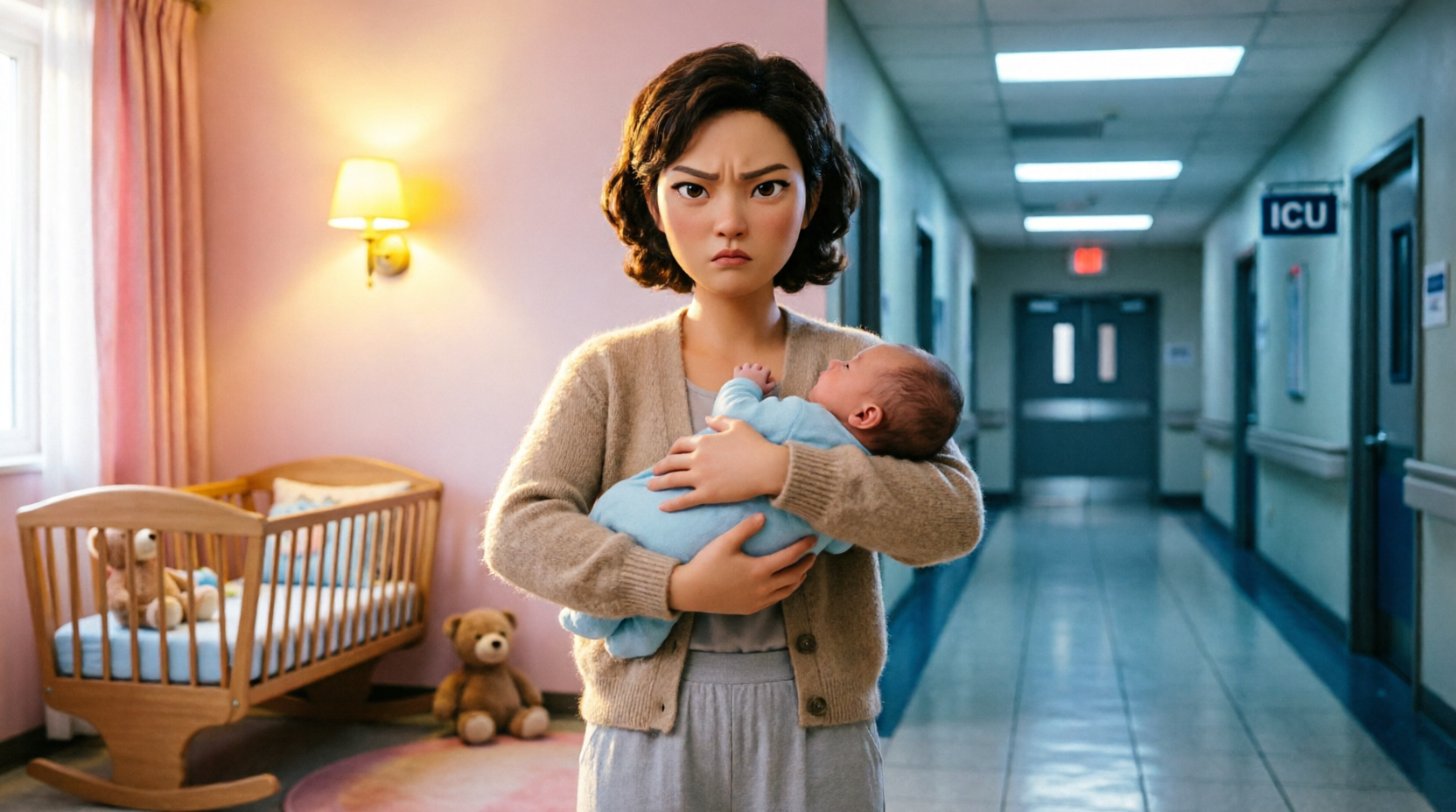
Lily’s ventilator made a soft mechanical sigh beside her crib-sized bed. In. Out. In. Out. A machine doing what my daughter’s body had forgotten how to do because someone in my family thought cruelty became harmless if they called it funny.
I sat in the uncomfortable vinyl chair, my spine pressed against the backrest like a prisoner, watching my six-month-old daughter breathe through a tube. Her chest rose and fell in perfect rhythm with the machine, a grotesque puppet show where strings were made of plastic and electricity. Every rise was a prayer answered. Every fall was a new plea beginning.
My cheek still burned where my father’s hand had landed. My scalp still pulsed from my mother’s fingers. The physical pain was almost comforting—it was real, tangible, something I could understand. It made sense in a way that this scene did not. A father doesn’t slap his daughter in a pediatric ICU. A mother doesn’t drag her child by the hair past nurses and medical equipment. But they had. And I had stood there, stunned, while my baby fought for air.
On the other side of the glass, Natalie stood near the nurses’ station with her mouth open and her face emptied of color. My little sister. The golden child. The one who could do no wrong, or at least, the one whose wrongs were always reframed as misunderstandings, as youthful mistakes, as evidence of her “sensitive nature.” She looked smaller now, diminished by the fluorescent lights and the weight of what she’d done. Or maybe she was finally seeing herself clearly for the first time.
Dr. Morrison had been with us for three hours straight. She was a woman in her fifties with kind eyes and a voice that never rose above a gentle register, even when delivering devastating news. She had explained everything twice, then a third time when I asked her to repeat the part about lung damage. I needed to hear the words again, as if repetition might transform them into something else, something less final.
“Chemical pneumonitis,” she had said. “The powder caused severe inflammation. Her airways are swollen. She can’t breathe on her own.”
I had nodded like I understood. Like I was a medical professional instead of a mother whose world had just cracked open.
Now, Dr. Morrison stood in the doorway, holding her phone. Her expression had shifted from professional concern to something harder, something that made my stomach clench.
“Jenna,” she said quietly. “I need you to see something.”
I stood on legs that felt like they belonged to someone else, someone who hadn’t just spent hours watching her baby’s life measured in mechanical breaths. I walked toward her, each step an effort, as if gravity had doubled in this room.
Then Dr. Morrison turned the phone toward me.
The last message on the screen began with my daughter’s name.
“Lily only needs one scare.”
For a moment, I did not understand the sentence because my brain refused to live in a world where anyone could write those words about a six-month-old baby. My mind scrambled for context, for explanation, for anything that might transform those words into something else. A joke taken out of context. A misunderstanding. A terrible autocorrect error.
But there was no error. There was no context that could make this acceptable. There were only words, black on white, sent from my mother’s phone to my sister’s, discussing my daughter like she was a prop in their twisted drama.
Dr. Morrison did not let me touch the phone. She kept it angled in her hand while the nurse stood beside her with the sealed plastic bag and the incident report. Security had already moved my parents and Natalie out of Lily’s room, but they had not moved them far enough. Through the glass, I could still see my mother whispering too fast, my father pretending not to look afraid, and Natalie staring at the floor like it had betrayed her.
My hands began to shake. Not from fear, not from grief, but from rage. A cold, crystalline rage that cut through the fog of exhaustion and terror. Someone had done this to my baby. Someone I knew. Someone who had held Lily, who had smiled at her, who had kissed her forehead while planning to hurt her.
Dr. Morrison’s voice pulled me back. “Jenna, I need you to stay calm. The police are on their way. But first, you need to see everything.”
She scrolled up on the phone, and I saw more messages. More words. More evidence of a conspiracy I never saw coming.
[END OF PART 1]