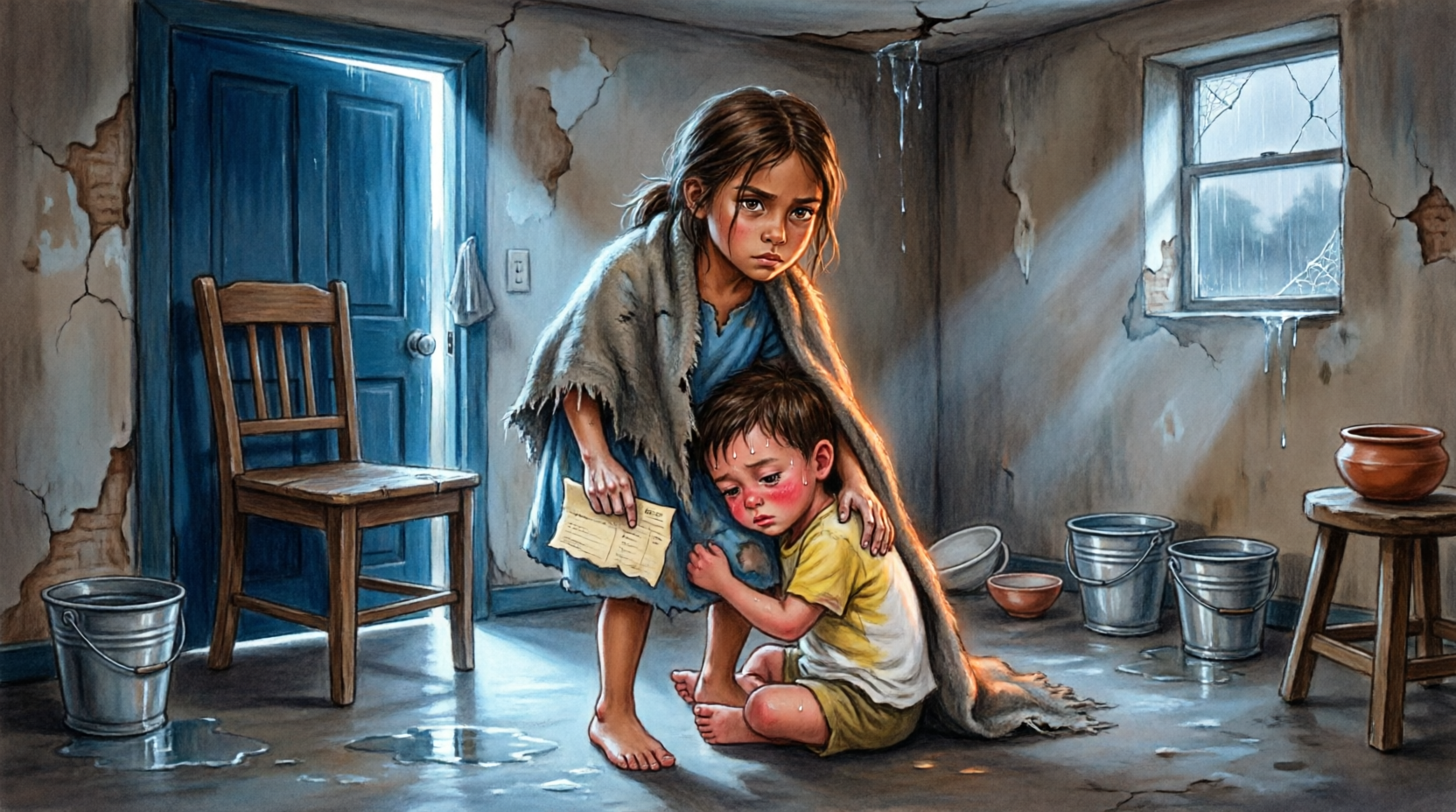
“What’s your dad’s name, sweetheart?” Camila clutched the prescription against her chest. “Oscar.” “Oscar what?” The girl glanced toward the door before answering. “Oscar Renteria. But Mom says not to say his last name if there are neighbors around.” Adriana exchanged a glance with her partner. It was no longer a case of abandonment.
It was a missing woman, two children at risk, and an address written in red ink by someone who knew she might not make it back.
“Camila,” Adriana said, crouching down. “Your mom didn’t do anything wrong by leaving you instructions. You didn’t do anything wrong by calling.”
The girl swallowed hard. “Are they going to scold her?”
That question shattered something deep inside the officer.
“No, my love. We’re going to find her.”
Mateo was admitted for a high fever and dehydration. A doctor explained to Adriana that the boy wouldn’t have lasted much longer without medical attention. Camila sat in a chair, her feet dangling, eating a cookie a nurse had given her. She didn’t bite it. She watched it. As if even the food might disappear if she let her guard down.
Meanwhile, the video continued to spread across social media.
“Mother abandons children in Gary.”
“Neighbors report kids left alone.”
“What a terrible mother.”
People commented with the frantic speed of those who have never been afraid of leaving home for medicine and failing to return.
Adriana demanded that no one film the children. It was useless. Someone had already captured Camila’s face—her wide eyes, her tattered blanket, the blue door behind her.
“Officer,” Julian said from the 911 dispatch booth when she called him back, “I’m saving all the audio. The girl said something about a man who knocks without saying his name. It didn’t sound made up.”
“It isn’t,” Adriana replied. “Send me everything you have.”
At four in the morning, while the rain continued to wash the dark streets of Gary, the search for the mother was officially activated.
Her name was Marisol Vega.
Twenty-nine years old.
A housekeeper who worked day jobs in the suburbs. No criminal record. There had been one prior report of domestic violence that never went to court because she withdrew the accusation after Oscar found her outside the courthouse and told her that if he were locked up, their children would pay the price.
They found that in an old file. A neglected report. A woman who had asked for help and received nothing but paperwork, stamps, and waiting.
The address in red ink was in the upper part of the city, near steep streets overlooking the hills. An area of half-finished houses, skinny dogs, utility poles thick with tangled wires, and shops with barred windows where people still sold loose cigarettes at four in the morning.
Adriana didn’t go alone. She called for backup. She didn’t want to knock on a door with a seven-year-old carrying the truth, only to end up hearing another excuse.
When they arrived, the street was dark. Water ran along the gutters like a dirty river. In the distance, the highway roared with long-haul trucks and early-morning commuters. The city didn’t sleep; it just closed its eyes so it wouldn’t have to watch.
The house had a green metal gate.
A light was on on the second floor.
And a black motorcycle sat outside.
Adriana recognized something on the motorcycle seat: a wet pharmacy bag, snagged under an elastic cord.
She took it with her gloves.
Inside was pediatric acetaminophen, oral rehydration salts, and cough syrup.
The receipt was from that very night.
Time: 12:06 a.m.
Marisol had gone for the medicine. And she hadn’t returned because someone had stopped her afterward.
“Probable victim inside,” Adriana said over the radio.
They knocked.
Nothing.
They knocked again.
A man’s voice responded from above:
“Who is it?”
Adriana stood at attention.
“Police. Open the door.”
Silence.
Then footsteps.
Then a thud inside.
It wasn’t furniture.
It was a body.
Adriana knew before she even processed the thought.
“Open up!” she ordered.
The gate didn’t give way. A neighbor came out looking sleepy.
“That man lives alone,” he muttered. “He’s always causing trouble. But you don’t get involved.”
Adriana looked at him.
“Well, today, you are going to get involved as a witness.”
The backup team forced entry.
The patio smelled of dampness, gasoline, and cigarette butts. They climbed a narrow staircase. On the wall was a framed image of St. Jude with a burnt-out candle, as if even the saint had grown tired of listening to broken promises.
Oscar appeared in the bedroom doorway.
Barefoot.
Stained shirt.
The wide-eyed look of someone who hadn’t been asleep.
“What do you want?”
“We’re looking for Marisol Vega.”
He feigned surprise.
“She doesn’t live here.”
“But her pharmacy bag is on your motorcycle.”
Oscar looked down.
It was just for a second.
It was enough.
“She came by, sure. She left. She always creates drama. She was probably with someone else.”
Adriana pushed forward.
“Step aside.”
“You can’t come in.”
From inside, a moan was heard.
Very low.
Almost covered by the rain.
But real.
Oscar tried to shut the door.
He didn’t make it.
Two officers pinned him against the wall. He screamed that it was his house, that Marisol was crazy, that she abandoned her children, that he was only trying to help.
Adriana entered.
The room was dark, with a television playing without sound. A chair was overturned on the floor. Beside the bed, Marisol was tied at the wrists with an electrical extension cord. She had dried blood on her eyebrow and her mouth was swollen.
But she was alive.
Adriana crouched down.
“Marisol, I’m Officer Salazar. Your children are alive. They are at the hospital.”
The woman opened her eyes.
She didn’t ask about herself.
She didn’t cry from her own pain.
The first thing she said was:
“Does Mateo have his medicine?”
Adriana felt her throat constrict.
“Yes. They’re taking care of him now.”
Marisol broke down.
She didn’t scream.
She just let out a tiny sound—the sound of a wounded animal that finally stops holding on.
Oscar was still yelling in the hallway.
“She came alone! She provoked me! She’s my woman!”
Marisol squeezed her eyes shut.
“Not anymore,” she whispered.
Adriana listened.
And she tucked that phrase away too. Because there were statements that didn’t need a signature to be the truth.
The ambulance arrived quickly. In the city, when an emergency is activated correctly, everything happens the way it should have happened from the start: radio, dispatch, patrol, hospital, protective custody. The problem is that many women arrive at that machinery far too late.
Marisol was taken to the same hospital as her children.
Before they loaded her into the ambulance, she asked for one thing.
“My bag.”
Adriana handed it to her.
Inside there was no makeup, no significant amount of money, and nothing that explained the speed with which the world had judged her.
There was another note.
“Camila, if I don’t come back, call 911. Don’t open the door for your dad. It’s not your fault.”
The handwriting was shaky.
But it was clear.
When Camila saw her mother at the hospital, she didn’t run at first.
She stood paralyzed, as if she feared that touching her might break her. Marisol, with a bandage on her forehead and an IV in her arm, opened her arms just a little.
“Forgive me, my little girl.”
Camila approached slowly.
Then she threw herself against her mother.
“I called,” she sobbed. “I really did call.”
“You did well. You did so, so well.”
Mateo was asleep, his fever breaking. He had his little hand closed around a piece of gauze, as if he were holding onto something invisible. Marisol looked at him and wept without a sound.
Adriana stood in the doorway.
She had seen many scenes in her life. Fights, car crashes, deaths, mothers screaming names on streets with no answers. But this—a little girl hugging her mother after half the neighborhood had called her an abandoner—left her with a different kind of rage.
The next morning, the same neighbors who had recorded from the hallway didn’t want to talk anymore.
Mrs. Petra, who had said “who knows what she’s mixed up in,” arrived with a bag of bread.
“I didn’t know,” she repeated.
Adriana looked at her.
“But you spoke up.”
The woman lowered her head.
The original video began to disappear from the internet, but it was already too late. Other users had shared it. Julian, the dispatcher, asked for authorization to release part of the call to the investigation file. Not to expose the girl. To prove that Camila asked for help, that her mother left instructions, that the “abandonment” was a convenient lie.
The District Attorney took their statements.
Child Protective Services intervened, not to rip the children from Marisol’s arms, but to dictate protective measures. A social worker spoke with kindness. She checked for support networks. She asked about relatives. Marisol gave the name of an aunt in a neighboring county, a woman who sold tacos on weekends and who arrived at the hospital with her apron still on, crying with pure indignation.
“I told her to come live with me,” she kept saying. “But that miserable man threatened her.”
Marisol couldn’t stop saying she was sorry.
To her children.
To the doctor.
To the police.
To her aunt.
As if surviving in fear were a character flaw.
Adriana sat down next to her.
“Marisol, listen to me. You left a note, you left a cell phone, you left a chair, you left instructions, and you went out for medicine. That is not abandonment. That is a mother doing the impossible in the middle of terror.”
Marisol covered her face.
“People are going to say…”
“People already spoke. Now they’re going to have to listen to the truth.”
Oscar was arrested.
At first, he smiled for the curious onlookers, as if he could still tell his own version of the story. He said Marisol was unstable. That he just wanted to see his children. That she made up the bruises to get money from him.
Then the messages appeared.
“If you don’t come back, I’m going in for the kids.”
“I saw you at the pharmacy.”
“Today, you’re finally going to learn.”
Then a store camera showed Marisol buying the medicine. Then Oscar following her on his motorcycle.
Then, nothing.
The part that wasn’t recorded was told by Marisol’s body.
And by Camila’s voice.
The neighborhood changed the subject.
They stopped saying “bad mother.”
They started saying “poor woman.”
But Adriana was bothered by that phrase too.
Poor woman.
As if Marisol were only an object of pity.
They didn’t see the mother who left instructions in a note. The woman who hid money in an old bag. The one who taught her daughter not to open the door for the man who shared her blood but not her care. The one who, even while tied up, asked first for her children’s medicine.
Three days later, Camila returned to the tenement.
Not to stay.
Only to pick up clothes and documents with her aunt, Adriana, and a social worker.
The blue door was still there.
The chair was still there.
The room smelled of dampness and spoiled soup. Camila walked in slowly, picked up her school backpack, a math notebook, two changes of clothes, and a drawing taped to the wall: her, her mom, Mateo, and a house with a yellow sun.
There was no dad in the drawing.
Adriana noticed.
Camila peeled the paper off carefully.
“I’m taking this one.”
“Of course.”
As they left, several neighbors stared.
No one recorded.
No one dared.
Mrs. Petra tried to approach.
“Camila, tell your mom that I…”
The girl hid behind her aunt.
Adriana stepped in.
“Don’t ask a child for messages.”
The woman stood there with the bread still in her hand.
The hallway, which days before had been a courtroom, suddenly felt narrow with shame.
Marisol was released from the hospital a week later.
She didn’t return to the blue room.
She moved in with her aunt in the neighboring town, to a small house near an avenue where busy commuter buses and tamale vendors passed by at dawn. It wasn’t perfect. It wasn’t hers. But it had a secure door, a bed for the kids, and a neighbor who actually knocked before judging.
Mateo recovered.
Camila went back to school with her hair in two braids. Her teacher greeted her without asking for details. She just put a fresh sheet of paper on her desk and told her she could draw if she didn’t want to talk.
Camila drew a telephone.
A number.
And a patrol car in the rain.
Julian, in the dispatch booth, kept taking calls.
Car accidents.
Gas leaks.
Pranks.
Screams.
Silences.
But since that dawn, every time he heard a child’s voice, he moved his coffee far from his keyboard and sat up straight, as if his entire life depended on not missing a single word.
Adriana visited Marisol two weeks later to update the case file.
She found her in the kitchen, preparing rice with zucchini. Camila was doing homework at the table. Mateo was playing with a plastic cap on the floor. The house smelled of simple food, soap, and fatigue.
But not of trapped fear.
Marisol served coffee.
“I don’t have much,” she said.
“I didn’t come to be served.”
“I know. But my mom used to say that if you’re helped, you offer something in return, even if it’s just coffee.”
Adriana accepted.
Camila walked over with a folded drawing.
“It’s for you.”
The officer opened it.
It was a policewoman holding an umbrella over a little girl and a boy. Above, in crooked letters, it said:
“My mommy did come back.”
Adriana swallowed hard.
“Thank you, Camila.”
The girl looked at her seriously.
“Are they going to lock up the man who knocks without saying his name?”
Marisol stopped stirring the spoon.
Adriana crouched down.
“We are doing everything necessary so he can never come near you again. And you are not going to be alone.”
Camila nodded.
She didn’t smile.
But she breathed easier.
That night, in the city, it rained again.
The rain pounded against tin roofs, water tanks, windows, shuttered stalls, and patrol cars. In the old tenement, the blue door remained empty. Someone ripped down the last flyer that had advertised the room for rent. No one mentioned the “abandoning mother” anymore.
Because the truth, when it finally enters, doesn’t ask for permission.
In the 911 booth, Julian checked the time.
2:17.
The same time.
He sat still for a second.
Then he went back to work.
In the new town, Marisol checked the lock three times before sleeping. Not out of paranoia, but because fear takes a long time to leave, even when the danger is far away. Camila watched her from the bed.
“Mom.”
“Yes, my angel?”
“If you’re late one day, can I call again?”
Marisol sat next to her and stroked her hair.
“Yes. Always. Even if you think it’s not an emergency. Even if someone says you’re bothering them. Even if you feel embarrassed. You call.”
Camila hugged her drawing of the telephone.
“I knew you were going to come back.”
Marisol kissed her forehead.
“And I knew you were going to be brave.”
Mateo slept between them, breathing peacefully.
Outside, the water kept falling over the valley, over its enormous avenues, its forgotten neighborhoods, its houses crammed against the hills, its mothers running at dawn for medicine, and its daughters learning all too soon how to distinguish an emergency from a secret.
Marisol turned off the light.
But this time, she didn’t leave a farewell note.
She left the cell phone charging on the table.
She left water by the bed.
She left the door locked.
And, above all, she stopped carrying alone a threat that could no longer hide behind the word family.
Camila closed her eyes.
The rain sounded loud.
But it didn’t sound like it wanted to break the roof anymore.
It sounded like it was washing away the night when everyone judged her mother.
And preparing, slowly, a morning where, at last, no one could call them abandoned.
Just survivors.

