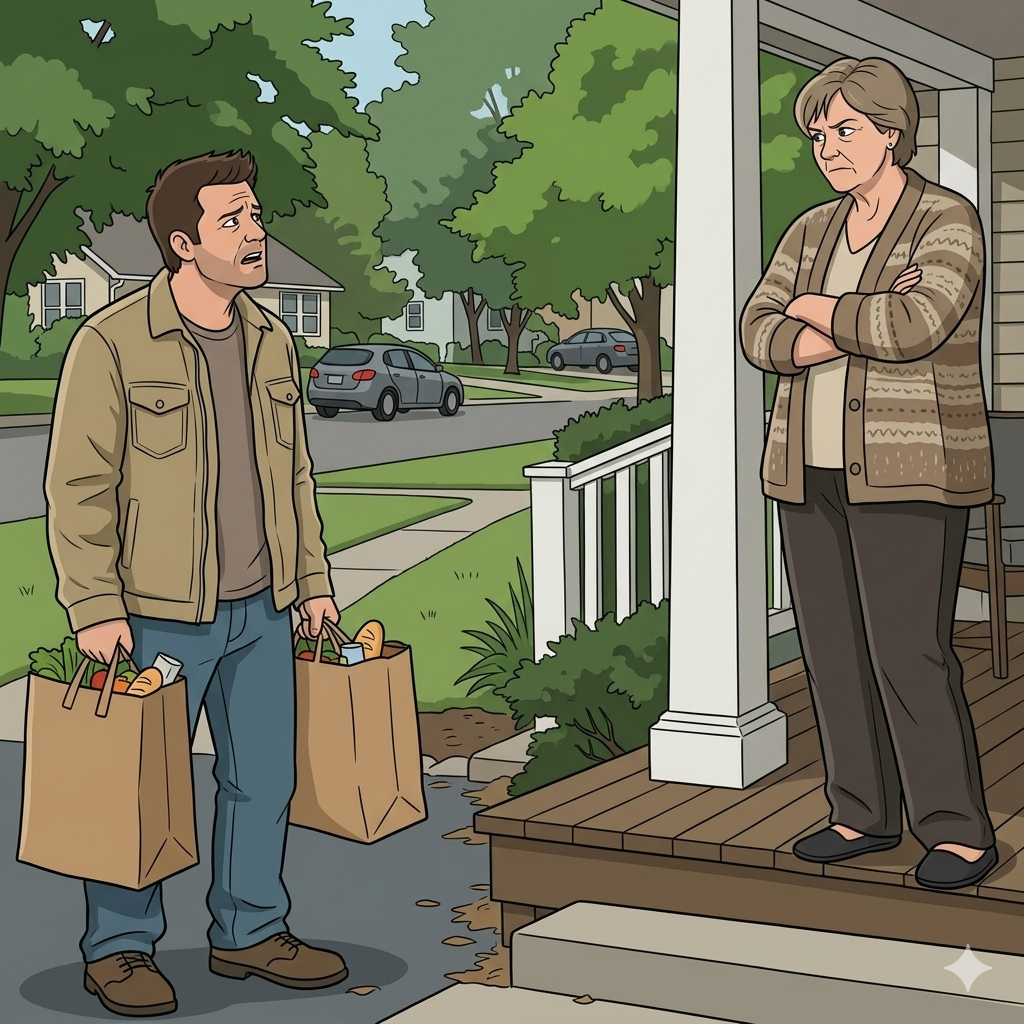
When I pulled into the driveway that Wednesday afternoon, Mrs. Halvorsen was already waiting on her porch with the posture of a woman who had been rehearsing a complaint long enough to resent the delay in delivering it.
She stood in her cardigan and orthopedic sandals with her arms crossed tightly over her chest, chin lifted, eyes fixed on my car before I had even cut the engine. Her white curls, usually arranged in a tidy cloud around her head, looked slightly wind-tossed, which meant she had been out there longer than was comfortable. That alone made me uneasy. Mrs. Halvorsen did not loiter unless she felt morally authorized to do so.
I stepped out of the car with two grocery bags hooked into my fingers. The plastic handles bit into my skin hard enough to leave dents, but I barely registered the sting. Her expression had already done what she intended: it had made me feel as if I were arriving late to a problem with my name on it.
“Marcus,” she called, before I had made it halfway up the walkway.
Her voice had that clipped, irritated precision she reserved for barking dogs, misdelivered mail, and lawns she considered irresponsible. I stopped automatically.“Yes, Mrs. Halvorsen?”
She didn’t bother with any pleasantries. “Your house gets loud during the day.”
I blinked. “My house?”
“Yes, your house.” She pointed with two fingers as if to eliminate any possible confusion. “Someone is shouting in there. A man. I heard him again today around noon.”
For one second, I just stared at her.
There are sentences that do not make sense on first contact, so the mind refuses to absorb them. That one landed like that. Not because I hadn’t heard the words clearly, but because none of the available categories fit them. My house was empty during the day. I lived alone. I worked downtown from eight-thirty to five most weekdays. There was no man in there shouting unless I had developed a second life without informing myself.
I gave a short laugh that sounded wrong to my own ears. Thin. Defensive.
“That’s not possible.”
Mrs. Halvorsen’s mouth tightened, offended by the suggestion that possibility had any authority over what she had already witnessed.
“Well, someone is in there,” she said. “I heard a man’s voice. Loud. Angry, maybe. I even came over and knocked.” She paused, drawing herself up a little taller. “No one answered.”
The bags grew heavier in my hands.
A strange heat rose through me, half embarrassment and half something colder. It is humiliating in a very specific way to have a neighbor imply there are unknown men in your house while you are out earning a living. It feels less like a security concern than like a comment on your ability to manage your own existence.
I shifted the bags and forced another smile.
“Probably the TV.”
“The TV,” she repeated flatly.
“Sometimes I leave it on,” I said. “You know. To make it sound like somebody’s home.”
She stared at me long enough that I knew she did not believe a word of it. Mrs. Halvorsen had lived next door for twelve years, and in that time she had developed the kind of proprietary awareness retired people sometimes cultivate when their primary occupation becomes noticing patterns. She knew which mornings I left late for work, which weekends I mowed the lawn, which Thursdays the trash collectors came too early. If she said she’d heard something unusual, there was a very good chance she had.
But she let it go.
Not because she was satisfied. Because she had delivered the warning and no longer considered the consequences her problem.
“Well,” she said, drawing the word out. “I’ve done my duty.”
I nodded, because that was easier than telling her there was no version of duty in which any of this was comforting.
As I unlocked my front door, I became aware of the silence inside before I even stepped over the threshold. Houses have different kinds of quiet. There is ordinary daytime quiet, the kind that settles naturally over furniture and dust motes when nobody is home. Then there is the quiet of a place that feels as though it has just stopped making noise. Not peace. Interruption.
The air inside was cooler than I expected. The kitchen smelled faintly of lemon dish soap and old wood polish. Sunlight from the back windows lay across the hardwood in pale yellow stripes, perfectly undisturbed.
I set the groceries down on the counter and stood still.
Listening.
Nothing.
No television murmuring from another room. No floorboard settling under hidden weight. No faucet dripping. No footsteps retreating. Just the refrigerator’s low hum and the blood moving in my own ears.
I checked the living room first.
Then the hallway closet.
Then the bathroom, the spare bedroom, the utility room, and finally my bedroom at the back of the house.
Everything looked untouched.
No open drawers. No disturbed cushions. No footprints on the rug. No strange smell of cigarette smoke or cologne or rain-damp fabric. The windows were latched. The back door was locked. My laptop was still on the desk where I’d left it. The watch tray on my dresser still held the same cheap watch and coins I emptied out of my pockets every evening. The framed photograph of my father on the bookcase looked exactly as it always had: his smile halfway between amusement and apology, his flannel shirt collar open, his eyes shadowed by summer sun.
I stood in the middle of the room, listening again.
Nothing.
So I told myself Mrs. Halvorsen must have heard something from another house. Sound carried strangely in our neighborhood. Kids yelled in the cul-de-sac. Roofers used walkie-talkies. Televisions got turned up too loud in kitchens with open windows. Human beings are notorious for forcing patterns out of incomplete information, and lonely afternoons in suburban developments do not generally improve the quality of interpretation.
I unpacked the groceries. I started a load of laundry. I answered two work emails from my phone while heating leftover chili for dinner. I did all the ordinary things people do when they are trying to prove to themselves that nothing has changed.
But that night I barely slept.
Every sound the house made seemed to arrive sharpened.
The old siding clicked once as the temperature dropped, and I sat upright in bed before I understood it was only the siding. A branch scraped the back window, and my stomach dropped as if someone had laid a hand against the glass. The heater kicked on and I held my breath, listening between its breaths for something else.
At one-thirty in the morning I walked through the house barefoot, checking the locks.
At three I did it again.
At four-thirty I stood in the dark hallway outside my bedroom and listened to my own house breathe—the soft murmur of pipes in the wall, the refrigerator cycling down, wind against the guttering, all of it suddenly transformed into evidence that the world was full of things I no longer trusted.
By dawn I had progressed past tired and into the clearer, harder state that comes after fear has been given too many hours to deepen in private. Exhaustion had burned away embarrassment, leaving only decision.
If someone was coming into my house during the day, I needed to see it happen.
I called my manager at seven fifteen.
“I’m not feeling well,” I told her, and my voice sounded remarkably normal for a man who had spent half the night imagining strangers in his hallway. She told me to rest, to take the day, and to feel better. I hung up, set the phone down on the kitchen counter, and stood there for a full minute staring at the blank wall above the sink.
Then I made it look like I left.
At seven-forty-five, I opened the garage door with the usual groaning rattle and started my car. I backed slowly down the drive, paused long enough that anyone watching from a window would register the departure, then circled the block and came back by the alley behind the row of houses where my garage sat. I slipped the car back inside, cut the engine, and lowered the garage door by hand until the last foot so the motor wouldn’t announce me.
The whole procedure felt ridiculous.
Like the sort of paranoid performance a man gives himself permission to stage only when he is too frightened to care how stupid he might look later. But fear has its own logic, and by then mine had settled on exactly one proposition: if I was being absurd, I would know by evening. If I wasn’t, I might survive because I had stopped pretending.
I came through the side door and moved quietly down the hallway toward my bedroom. The house was dimmer than usual with the blinds still half-drawn, morning light filtering in thin and gray through the slats. I took my shoes off at the door. I put my phone on vibrate instead of silent because my hands were trembling and I forgot. I almost laughed when I realized it and then didn’t, because laughter would have sounded too much like panic.
My bed sat low enough to the floor that hiding under it was not elegant. I had to crouch first, then lower myself one shoulder at a time into the narrow dark space beneath the frame. Dust coated the backs of my hands immediately. The smell under there was stale and close—dust, wood, dry carpet fibers, the faint mineral tang of trapped air. I reached up and tugged the comforter down so it hung lower, then lay flat on my stomach with my cheek nearly against the floorboards.
My heart beat so hard at first I was sure anyone entering the room would hear it.
I checked my watch.
8:03.
The absurdity of what I was doing arrived in waves. I was a grown man with a mortgage, a steady office job, a decent credit score, and a life so uneventful that my biggest monthly decision was usually whether to replace the gutters or wait another season. And there I was hiding beneath my own bed like a frightened child, trusting a woman next door whose favorite hobbies included reporting on hydrangea neglect and recycling violations.
At eight-thirty the house settled.
At nine the silence became its own physical thing, a pressure against my eardrums.
I tried to focus on practical details instead of fear. My breathing. The cool floor under my ribs. The angle of morning light creeping across the edge of the rug. But the mind, once trapped with itself long enough, stops accepting reasonable assignments. It wanders. It bargains. It manufactures.
Maybe Mrs. Halvorsen had misheard.
Maybe I was going to stay hidden all day for nothing.
Maybe by two in the afternoon I would crawl out aching and filthy and ashamed of myself, and then I’d have to make eye contact with my own reflection and explain why I had willingly spent six hours under furniture because a retiree with strong opinions had heard a man yelling at noon.
But beneath that embarrassment was a harder thought I couldn’t shake.
The voice.
She had said a man’s voice.
Around noon.
It shouldn’t have mattered. But it did. The details made it real in a way vaguer fear does not. A voice implied presence. Presence implied access. Access implied intent. Every minute under the bed seemed to deepen rather than dissolve the question of who had been standing inside my rooms when I wasn’t there.
My gaze fixed on the strip of light under the comforter.
Time thinned and thickened at once.
At some point I began thinking about my father.
Not because the situation had anything obvious to do with him, but because fear loves old rooms in the mind, and my father still occupied many of mine. He had died when I was nineteen, old enough for the loss to be fully conscious and young enough not to know what to do with it. A brain aneurysm, sudden and stupid and ruinously efficient. One week he was fixing the back fence and grumbling about the Tigers, the next he was gone before I understood that goodbye had already happened.
The house I lived in had been his before it was mine. Not inherited directly—my mother kept it after he died, and after she moved to Arizona to remarry five years later, I bought it from her at a price she insisted was fair and I knew was sentimental charity. But it was still his in all the structural ways that matter. The hallway runner she never replaced because he liked it. The notch on the kitchen doorframe where he’d once marked my height in pencil every birthday until I outgrew the ritual. The garage shelves he built himself and never quite leveled. The faint smell of cedar in the coat closet from blocks he nailed in after a moth problem in 1998.
Lying under the bed that morning, dust crawling into my nose, I found myself remembering his footsteps in the hall. The weight of them. The rhythm. Slow when he was tired. Quicker when he was irritated. The way he would mutter to himself while looking for something he’d misplaced, as if narrating the search made it more dignified.
At eleven, fear started turning strange.
I was thirsty. My shoulder hurt. My right foot had gone numb. The pressure of waiting had become so complete it no longer felt like suspense but like another atmosphere. It occurred to me that I could abandon the whole idea. Crawl out, stretch, make coffee, tell myself I’d lost perspective.
That was exactly when I heard the front door open.
Not a bang. Not a forced entry. It opened the way a person opens a door when they expect the lock to cooperate and the house beyond it to receive them. There was a soft click of metal, the whisper of the door moving inward, then the solid shut behind it.
I stopped breathing.
Footsteps crossed the foyer.
Measured. Unhurried. Not the nervous creep of a burglar. Not the heavy, chaotic pace of someone high or desperate. Just the easy movement of a man entering a place he already knows.
The sound came closer.
Down the hallway.
Into my bedroom.
My pulse slammed once, hard enough to hurt.
Then I heard him.
“You always leave such a mess, Marcus.”
The voice was low, threaded with irritation, and so oddly familiar that for one wild second I thought I had fallen asleep under the bed and was dreaming my father alive.Not the same voice. Not exactly. But something in it—some cadence, some roughness at the edges, some shape of impatience—pulled at old recognition with such force my skin went cold all over.
I lay perfectly still.
From under the bed, all I could see at first were boots.
Brown leather. Old, creased at the ankle, recently polished but not expensive. Work boots, maybe, or boots that had once belonged to a man who worked with his hands and now belonged to someone who could not afford to replace them. They moved around the room with an intimate certainty that filled me with a horror more personal than fear of theft. He was not searching blindly. He was navigating.
A drawer slid open.
“God,” he muttered. “You still do this.”
Do what?
He sounded annoyed. Familiar. Possessive, almost. The kind of annoyance reserved for people whose habits have inconvenienced you many times before.
The drawer shut.
Then the closet door scraped open. Hangers clicked softly. Something on the top shelf shifted.
He whispered again, too low for me to catch the words.
My mind lurched through explanations and rejected all of them.
A relative? Impossible. I had no male relatives who would do this. A former owner? Ridiculous. Someone from my father’s life? Too absurd to even hold. Yet the house did not sound invaded. It sounded known.
My phone vibrated in my pocket.
The sound was tiny. Almost nothing. A brief insect hum against denim.
But in that room it might as well have been an alarm siren.
The man went completely still.
The closet hangers stopped moving.
The silence after the vibration was so intense it seemed to hum on its own.
Then, slowly, the boots turned toward the bed.
I could hear my own blood.
He crossed the room one careful step at a time.
Then he crouched.
A hand appeared below the hanging edge of the comforter. Large hand. Broad knuckles. Scar across one finger. It curled into the fabric and lifted.
Light poured in.
He bent lower.
I moved before I had decided to.
I rolled hard toward the far side of the bed, scraping my elbow against the floor, shoved myself upright in a scramble of mattress, blanket, and adrenaline, and came up half-stumbling against the nightstand. The lamp toppled. My hand caught the base by instinct, gripping it like a club.
The man straightened.
For one terrifying fraction of a second we simply stared at each other.
Then my mind lurched again, this time because the fear had made room for something even more destabilizing.
He looked like me.
Not perfectly, no. He was older, maybe by three or four years. His jaw was wider, more weathered. His nose had a slight bend mine didn’t. His hair was darker and thicker, his face roughened by work and some harder kind of living than the one I’d known. But the resemblance was not subtle. It sat there between us, glaring. The eyes set deep in the same shape. The brow. The line of the mouth. Enough that if he had been standing in a crowd, I would have looked twice and felt something unsettled before I knew why.
He took in the lamp in my hands and lifted his palms slightly.
“You weren’t supposed to be here,” he said.
That voice again. Familiar not because I knew him, but because some part of it echoed through my own.
“Who are you?” I demanded.
He did not answer immediately. His expression was infuriatingly calm under the circumstances, not bored but resigned, like a man who had prepared for many outcomes and disliked this one only because it complicated the rest.
“My name is Adrian.”
“What are you doing in my house?”
He looked at the floor for a second, then back at me.
“I’ve been staying here.”
The words were so outrageous I almost laughed.
“Staying here?”
“During the day,” he said quickly. “Only during the day. When you’re at work.”
“For how long?”
He hesitated just long enough to tell me the number mattered.
“About four months.”
The lamp base grew slippery in my hand.
“Four months?”
“I wasn’t trying to hurt you.”
My voice came out harsher than I expected, almost a bark. “You broke into my house.”
“No.”
“No?” I repeated, incredulous. “What exactly do you call entering someone else’s home for four months without permission?”
He swallowed. There was the first sign of nerves.
“I didn’t break in,” he said again. “I have a key.”
That sentence changed the temperature of the room.
I stared at him.
“Where did you get a key to my house?”
His eyes flicked past me once, toward the dresser where the framed photograph of my father stood among a tray of loose change and a dead watch battery.
Then back to me.
“From your father.”
Every muscle in my body seemed to tighten at once.
“My father died when I was nineteen.”
He nodded.
“I know.”
“Then how did he give you a key?”
For the first time, Adrian’s composure seemed to fracture. Not dramatically. Just enough that I saw the strain beneath it.
He drew in a breath.
“Because he was my father too.”
The sentence did not land all at once. It moved through me in pieces, each one rejected on entry.
No.
It did not fit. It could not fit. My father had not been many things, but he had been legible. He made pancakes on Saturdays and fixed everything with the wrong tools. He coached Little League. He whistled while mowing the lawn. He cried once, in the garage, the day he sold my grandfather’s truck and thought I wasn’t there to see it. Men like that did not produce secret sons in hidden chapters.
“You’re lying.”
“I’m not.”
“Get out.”
“I can prove it.”
“I said get out.”
He didn’t move. That, more than anything, sent fresh anger through me.
He reached into the blue box sitting on my bed—the one I’d barely registered in the confrontation—and lifted a stack of letters bound with a thin, frayed ribbon. Yellowed envelopes. Folded pages. Familiar handwriting so unmistakable that the sight of it hit me physically, like being shoved backward into memory.
My father’s handwriting.
He held them out.
I did not want to take them. That is the truth. Not because I doubted what they were. Because I knew, even before touching them, that once I read those pages whatever remained of my uncomplicated version of him would begin to burn.
But I took them.
My fingers recognized the looping capitals, the particular slant he gave his y’s, the way he pressed too hard on downstrokes when he was emotional. I had seen that handwriting on birthday cards, toolbox labels, permission slips, old receipts taped to the refrigerator. It was as intimate as a voice.
The top envelope was addressed to Elena.
Not my mother.
Elena, in thick blue ink.
My mouth went dry.
I opened the letter with my thumb and read the first lines standing there beside my overturned lamp while the man who claimed to be my brother watched me as if my reaction might alter the structure of his life.
My dearest Elena,
I know I have no right to ask forgiveness again, but I am asking anyway…
By the second paragraph there was no room left for doubt.
Love. Regret. Money enclosed. Promises. Fear. References to “our boy.” A sentence about how he looked “more like me every day,” written in a tone I had never heard directed anywhere but toward me. Then another letter. Another. Different years. Different birthdays. A mention of school fees. A mention of a visit canceled because “things are difficult here.” A mention of guilt so heavy I had to stop reading because my vision had gone blurry and I could no longer distinguish one line from the next.
My knees touched the edge of the bed and gave way.
I sat down hard.
The lamp slipped from my hand and thudded onto the rug.
For a while the room was silent except for my breathing.
Then I heard my own voice, distant and ragged, asking the question that had been waiting under all the others.
“Why didn’t he tell me?”
Adrian exhaled slowly.
“I don’t know.”
I looked up sharply, but he only shrugged once, a tired, helpless motion that carried none of the smugness I would have preferred.
“Maybe he thought he was protecting your mother. Maybe he thought he was protecting you. Maybe he was just a coward in the way men can be when they love two different truths and don’t want to lose the one that looks more respectable.” He rubbed a hand over his mouth. “Maybe he kept telling himself there’d be a good time to explain it and then there never was.”
I looked back at the letters.
My father had always taught me that lies turn poisonous when you keep them. It was one of those moral lessons parents like to offer children in simple language, as if speaking it aloud grants them immunity from violating it later.
My father had built a whole second son beneath that advice.
The room shifted around me. The dresser, the closet, the framed picture, the blue box. Everything was still physically mine, and yet the meanings had changed. I no longer trusted where anything had been placed in the story.
I swallowed hard.
“Why come here?” I asked without looking at him. “Why not show up at the door like a normal person? Why do this?” My voice rose on the last word, crackling with some mixture of fear and fury I had not sorted enough to name. “You’ve been inside my house. In my bedroom.”
He nodded, accepting the accusation.
“I know.”
“That isn’t an answer.”
He sank down into the chair by the window like his legs had finally remembered how tired they were. Up close, in calmer light, he looked more worn than dangerous. Stubble along his jaw. Shadows under his eyes. Knuckles nicked and dry. The face of a man who had been surviving badly for a while.
“It wasn’t supposed to be like this,” he said. “Six months ago I lost my job. The shop shut down, and the owner skipped out on two pay periods. Then my landlord sold the building. I bounced around a couple of places, then started sleeping in my truck. That truck got stolen three weeks later.” He laughed without humor. “Everything kind of collapsed in order.”
I watched him but said nothing.
“My mother died last year,” he continued. “Cancer. Fast. Ugly. After she was gone, I found some papers in her sewing cabinet. A key. A note from him. Just a line—‘If you ever really need somewhere to start, the box is in the Parker house. Don’t go there unless you have to.’”
He looked around my room as if seeing it fully for the first time through my eyes.
“I didn’t come to steal from you. I came because I didn’t know where else to stand. I needed to see if any of it was true. Needed…” He stopped, jaw tightening. “Needed to be somewhere connected to him that wasn’t already gone.”
Something inside me wavered against my will.
“You could have talked to me.”
He gave me a look so nakedly skeptical I almost resented it.
“And said what? ‘Hi, we’ve never met, but I’m the son your father hid from you and I’ve been sleeping badly in parking lots so can I sit in your kitchen and maybe borrow your grief?’”
The bitterness in his voice wasn’t aimed at me exactly. It was older than that.
“I didn’t think you’d believe me,” he said. “And I didn’t want your first reaction to be calling the police before I had proof.”
That, at least, felt honest.
I looked at the blue box.
“What were you doing in here today?”
He hesitated, then rubbed his neck. “Looking for a letter I thought I left.”
“Why was my neighbor hearing shouting?”
A shadow crossed his face.
“I was yelling at him.”
“At my father?”
“At ours,” he said quietly. “Or at the room. I don’t know. Yesterday I found a letter in the box where he wrote that he hoped one day his sons would know each other. It made me mad.” He let out a slow breath. “I said some things.”
The answer was so absurd and sorrowful at once that I almost couldn’t process it.
“You were standing in my house yelling at a dead man.”
“Yes.”
We sat in the wreckage of that fact for a few moments.Fear does not evaporate cleanly. Mine didn’t. Even then, even with the letters in my lap and the resemblance staring back at me from across the room, my body still remembered the sound of the door opening while I lay under my own bed. The violation was real. The danger had been real too, because ignorance is its own danger. He had been a man in my house. He had moved through my rooms without permission. He had known my name before I knew his.
But layered under the fear now was something I had not wanted at all.
Recognition.
Not of him. Of the loneliness in him.
I had lived enough alone to know what it looked like when someone had spent too much time carrying a truth no one around them wanted. His posture had it. His voice had it. The way he kept glancing at the floor instead of the walls, as if he were trained not to assume he belonged anywhere.
I looked down at the letters again.
“You can’t keep coming here,” I said at last.
He nodded immediately. “I know.”
The quickness of the agreement startled me. It meant he had expected to be banished and maybe thought he deserved it.
I ran a hand over my face.
“You cannot come into my house when I’m gone. You cannot use this place like it’s empty just because I’m not in it.”
“I understand.”
The words should have ended the conversation. I should have told him to leave, changed the locks, and spent the next year trying to decide whether the whole thing was tragedy or trespassing or both.
Instead I heard myself say, “But you don’t have to disappear.”
His head lifted.
I hated the fragility in my own voice then. Hated how quickly pain can soften into dangerous forms of mercy.
“If you’re telling the truth,” I said, “I want to know. About him. About all of it. I just…” I looked at the room, at the opened drawers, the blue box, the half-shattered shape of my own memory. “Not like this.”
Something in Adrian’s face loosened. Not relief exactly. Something more tentative. The expression of a man who had not expected grace and didn’t fully trust it when it appeared.
“I’d like that,” he said.
I called a locksmith within the hour.
Adrian stood on the front walk while the man changed every lock in the house. Mrs. Halvorsen peered through her curtains three separate times, then finally came out under the pretense of deadheading petunias. She cast Adrian a long, suspicious look and me an even longer one.
When the locksmith left, I took a bottle of water from the fridge, walked outside, and handed it to Adrian.
“We need rules.”
He took the bottle carefully, like I was handing him something more fragile than plastic.
“Okay.”
“It looks like this,” I said. “You don’t come onto the property without telling me. We meet somewhere public. You bring every document you have. Every letter, every photograph, every official paper. We verify everything.”
He nodded.
“And if any part of this turns out to be some kind of scam—”
“It isn’t.”
“If any part of it is,” I repeated, “I go to the police.”
He held my gaze. “Fair.”
“Also,” I said, surprising myself with the pettiness of the concern as it rose, “if there are more hidden boxes in my house, you tell me where.”
For the first time, his mouth twitched.
“There aren’t.”
“How do you know?”
“Because I’ve looked.”
The answer was so blunt I almost laughed. Instead I rubbed my forehead.
“Tomorrow,” I said. “Diner on Maple at ten.”
“I’ll be there.”
He started to walk away, then stopped and turned back.
“For what it’s worth,” he said, “I really am sorry I scared you.”
I watched him cross the yard and disappear down the sidewalk, shoulders slightly hunched against the wind. He did not look back.
That night, I spread the letters across my kitchen table in chronological piles and sat with them until well past midnight.
The house sounded different already.
Not safer, not yet. Just altered. As if a secret had been extracted from inside the walls and the rooms hadn’t decided what new shape to take around the absence.
My father’s handwriting traveled across the pages in years and intervals. Some letters were full of apology. Some were practical, almost administrative—money enclosed, trip delayed, call me if the landlord gives trouble again. Some were openly tender in a way that made my throat tighten because I recognized the tone. It was the same tone he used in birthday cards to me. The same softness. The same careful affection that always made his otherwise stubborn face seem briefly younger.
He had loved Adrian.
That was undeniable.
He had also hidden him.
That was just as undeniable.
The truth would have been easier to bear if it were simpler. If he had been a villain or a saint. But the letters destroyed both possibilities. He was cowardly and loving. Faithful in some ways, faithless in others. Generous, secretive, weak, sincere. The whole muddled human mess of him spread in blue ink across my table, and I hated him a little for becoming more complicated when I had spent nearly two decades grieving him in cleaner shapes.
I found one letter dated three months before his death.
I had just started community college then. My mother had been obsessed with getting me out of the house, into classes, toward some future she could explain to other people. My father wrote to Elena about feeling tired all the time and not wanting to worry “the boy.” Which boy, the letter didn’t specify. The omission made my chest ache in a way I hadn’t known possible.
He wrote, I know I am asking too much of the world by keeping both of my failures and both of my loves alive this way.
I read that line six times.
Both of my failures and both of my loves.
Was that what I was? A love and a failure at once? Was Adrian? Had my father spent his life splitting language the way he split responsibility—never fully relinquishing either side, never giving either enough honesty to stand whole?
At one-thirty in the morning, my phone lit up with a message from an unknown number.
Thank you for not calling the police. I’m sorry I scared you. I didn’t know how else to exist near the only piece of him I had left.
I stared at the message a long time before answering.
There are moments when language must be simple because anything more elaborate turns false in the mouth.
We’ll figure it out, I typed. But no more secrets.
His reply came almost immediately.
No more.
I slept badly again, but differently.
The fear was no longer a faceless thing moving through the house in imagined footsteps. It had a face now. A name. A history. That didn’t make it smaller. It made it specific.
At ten the next morning, Adrian was already in the diner booth when I arrived.
The diner on Maple had red vinyl seats, coffee strong enough to revive the dead, and a waitress named Linda who called every man under fifty “hon” and every man over fifty “darlin.” I’d been eating there on Saturday mornings since I was sixteen. There was comfort in starting something this destabilizing in a place that still smelled like bacon grease, old coffee, and dependable routines.
Adrian rose when he saw me. He had shaved. He was wearing a clean denim shirt and the same brown boots. The effort unsettled me more than if he had come in unchanged. It suggested he understood the meeting mattered.
A thick manila folder lay on the table beside his coffee.
“You came,” he said, as if that were still somewhat uncertain.
“I said I would.”
He gave a small nod and sat.
I slid into the booth opposite him. Up close in daylight, the resemblance was worse. Better. I didn’t know which. The longer I looked, the more tiny familiar things surfaced: the way his left eyebrow lifted a fraction higher than the right when he was tense, the way he wrapped both hands around the coffee mug as if warming them was a serious task, the slight downward angle of his mouth when listening.
Our father sat between us whether either of us liked it or not.
Linda appeared, poured coffee into my mug, and glanced between us. Her expression sharpened.
“You two related?”
Neither of us answered quickly enough.
“Huh,” she said, and moved on.
Adrian nudged the folder toward me.
“Birth certificate,” he said. “My mother’s death certificate. Letters. Some photographs. A copy of the note he left with the key.” He looked down. “I don’t have much else.”
I opened the folder and began sorting through the documents one by one.
Birth certificate: Adrian Keller. Father line blank.
Hospital bracelet with a date. An old photograph of a dark-haired woman holding a toddler in a yellow windbreaker while my father stood half in frame beside them, smiling the way people do when they don’t know the photograph will one day become evidence.
Then another photo. Adrian at perhaps ten or eleven, awkward-limbed and solemn, holding a baseball glove too large for his hand. My father behind him with one palm on his shoulder. A public park I recognized from the old side of town. They had gone there together. Maybe once. Maybe more.
My stomach tightened.
“He visited?” I asked.
“A handful of times.” Adrian’s voice had gone flat, disciplined. “Some years more than others. Sometimes birthdays. Sometimes nothing for months. Depends which version of his life was winning.”
It was a cruel sentence, but not inaccurate.
“How old are you?”
“Forty.”
I looked up sharply. “You’re older than me.”
“By three years.”
That fact hit differently than the rest had. It rearranged the timeline in ways I hadn’t fully confronted.
“He was with your mother before mine?”
Adrian looked at the sugar caddy, not at me. “I think he was with both of them at the same time by the end. My mother never gave me a clean version. She said only that he promised something and then chose something else.”
I leaned back.
My parents had married forty-two years before. That meant that while my mother was planning a wedding and picking curtains and teaching herself how to live with a man, somewhere else there was Elena. Pregnant maybe. Or newly a mother already. And my father, in the middle, dividing himself by deceit and then spending decades trying to maintain both halves by apology.
I thought of my mother laughing in the kitchen, flour on her forearms, calling him useless for pretending he couldn’t reach the top shelf. I thought of her sitting beside him in the hospital nineteen years ago, eyes swollen from crying, holding his hand until the machines stopped. Did she know? Had she suspected? Had she buried it? Or had she truly lived and died without knowing the scale of the betrayal she shared her life with?
The question opened beneath me like rotten floorboards.
“Did your mother ever try to contact us?” I asked.
“No.”
“Why not?”
He gave a tired half smile. “Dignity, mostly. And pride. She hated the idea of begging for acknowledgment. She said if he wanted to be a father, he’d act like one without needing to be chased.”
I could almost admire her for that. Almost. A better woman than I might have been, perhaps. Or simply more tired of men by the time she made the decision.
“So how did you end up with the key?”
Adrian took a sip of coffee, bought himself a few seconds, then said, “He gave it to me when I was eighteen. We met at a diner, actually, not unlike this one. He looked terrible. Older than I was prepared for. Guilty too. He handed me the key and told me it was to the side door of the house his family lived in. He said there was a box in the attic rafters with letters and papers in it. He said if anything ever happened to him and I needed proof I existed, I’d know where to start.” Adrian laughed once under his breath. “He said not to go unless I absolutely had to. Which I guess tells you everything.”
“And you didn’t use it then.”
“No.”
“What changed?”
For the first time since I sat down, Adrian met my eyes steadily.
“I ran out of easier choices.”
Something in the plainness of that answer stripped away my remaining appetite for self-righteousness. Not entirely. I was still angry. Still unsettled. Still not ready to call him anything tender. But the story had begun to take on the shape all real human disasters do: less dramatic villainy than accumulation. Bad choices, postponed truths, people too ashamed to ask directly for what they need.
We spent two hours in that diner.
We compared dates. Places. Memories.
His mother, Elena, had worked in a dry-cleaning shop on the south side. My father had met her while managing inventory for the hardware distributor that employed him before I was born. Their relationship predated my mother by a year or two, maybe less. When Elena got pregnant, my father promised to “figure it out.” Instead, he married my mother. But he didn’t disappear completely. He sent money. He visited when he could invent reasons. He made promises he sometimes kept, which can wound more deeply than never showing up at all.
Adrian described childhood in fragments. Waiting for birthdays. Learning not to hope too loudly. Watching his mother pretend indifference after missed visits and then cry over the sink when she thought he was outside. Working at fifteen because there was never enough money and pride is not edible. Listening to neighbors use words like bastard in the relaxed, unthinking way people use knives when they believe the person being cut isn’t present.
I told him about my own childhood with the version of our father I knew. Camping trips. Saturday pancakes. Baseball practice. The old truck. The habit he had of singing half the wrong lyrics to every radio song and still somehow sounding pleased with himself. The night he sat up with me after my first breakup and told me men don’t have to become mean just because they’ve been embarrassed.
That line made Adrian close his eyes briefly.
“He said things like that to you?”
“Yes.”
He laughed then, but the sound hurt to hear.
“My version taught me how to change brake pads and said trust was a luxury.”
We sat with that.
It would have been easier if jealousy had made us cruel. If he had accused me of getting the better father and I had accused him of poisoning the memory of mine. But what emerged instead was worse and gentler at once: the understanding that we had each gotten only a fraction. I got consistency without truth. He got truth, maybe, but only in scraps and without the structure of actual belonging. Neither of us had received the whole man.
When we finally stood to leave, Linda caught my arm as I passed the register.
“You okay, hon?”
I looked back at the booth where Adrian was carefully re-stacking the folder.
“No,” I said. “But I think I’m being introduced to the reason.”
She studied my face, then his, and did some fast private arithmetic.
“Well,” she said, leaning closer, “some family arrives late.”
That became, for a while, the truest sentence I had.
The next weeks turned into a pattern of verification and disruption.
I called a lawyer, not because I intended to start a war over inheritance but because I needed someone outside the emotional blast radius to explain what any of this meant. The attorney, a blunt woman named Tessa Klein who had once handled my house closing and frightened the seller into honest disclosure with three very well-timed pauses, agreed to review the documents.
“You want the legal answer or the emotional one?” she asked after an hour with the file.
“Start with legal.”
“Legally, if the documents are authentic and the man is biologically related to you, then your father maintained an undisclosed extramarital relationship and provided some level of support without formal acknowledgment. But your father’s estate was probated nineteen years ago. Unless there’s hidden property or fraud relevant to distribution, this isn’t an inheritance matter now. It’s a family matter.”
“And the emotional answer?”She took off her glasses.
“The emotional answer is that dead people remain capable of ruining your week.”
I almost smiled.
We ordered a DNA test not because I needed more proof than the letters, but because some truths deserve the mercy of scientific clarity. Adrian agreed without protest. If anything, he looked relieved to have the burden shifted from memory to numbers.
While we waited, I started going through the attic.
The blue box Adrian found had come from a crawlspace tucked behind old insulation and holiday decorations. I spent a Saturday up there in jeans and a flashlight with dust in my hair and the old rafters creaking above me, looking for evidence that maybe some part of my father had intended honesty and simply run out of time.
What I found instead were smaller things.
A tackle box filled with receipts and fishing lures.
An envelope of my old report cards.
A stack of unpaid parking tickets from 1994.
Then, beneath a mildewed blanket in a cardboard file box, I found another envelope.
My name was on it.
Marcus.
Just that.
No stamp. No address. The handwriting was unmistakable.
I sat cross-legged on the attic floor with my knees suddenly weak and opened it there under the weak flashlight beam.
If you’re reading this, son, then I did not do what I kept meaning to do while I was still alive.
The letter was five pages long.
Not a confession exactly. More like an apology rehearsed too late. He wrote that there was “a boy” I deserved to know about. That he had loved us both and failed us differently. That my mother “deserved better than the truth arriving after so much of life had already been built around the lie.” He wrote that he had convinced himself for years that secrecy was a form of protection, then realized eventually that it was only fear made habitual.
He did not name Adrian until page three.
When he did, I had to stop reading because my eyes had filled with tears so suddenly I could no longer see.
There is no clean way to grieve a man twice.
The first grief had been for his death.
This second one was for his incompleteness.
I sat in that attic for nearly an hour with the flashlight beside me and the letter in my lap, thinking about how many families are built not on singular betrayals but on the long labor of keeping them hidden. My father had not made one bad choice and then corrected course. He had constructed an entire architecture around avoiding consequence, and all of us had lived inside it without fully seeing the beams.
When I finally climbed down, my shirt was streaked with dust and my legs felt strange, as if they no longer belonged fully to this version of my life.
That evening, Adrian met me in the park by the river.
I handed him the letter without speaking.
He read it on a bench while the wind rattled dry leaves against the concrete path. The sun was already low, turning the water metallic and mean. Halfway through, he stopped and pressed the heel of his hand against his mouth. When he reached the end, he sat very still.
“So he meant to tell you,” he said eventually.
“Yes.”
“But he didn’t.”
“No.”
He stared at the river. “That sounds like him.”
The bitterness in the sentence was so matter-of-fact it hurt.
I sat down beside him.
For a while we said nothing.
Then Adrian asked, “Do you remember the way he laughed?”
I turned to him.
“What?”
“The laugh. Like a cough that got surprised into becoming happy.”
It hit me so hard I barked out an actual laugh myself.
“Yes,” I said. “God. Yes.”
Adrian nodded, eyes still on the water.
“I used to imitate it when I was a kid just to make my mother smile,” he said.
And there it was again—that impossible, involuntary kinship, arriving in some tiny shared detail no lie had managed to erase.
Not everything softened. Some days I hated him for existing because existence alone forced revisions I had not asked to make. Some days he hated me, I think, for having gotten the version of our father who stayed for dinner and came to school plays and knew how I took my cereal. We did not always say those things directly, but they moved between us.
The first real fight came two weeks after the diner.
I had agreed—reluctantly, cautiously—to let him come by on Sunday afternoon while I sorted more boxes in the garage. I was not ready to offer him the house, but I was starting to understand that the easiest way to learn whether a person can be trusted is to give them a small job and watch what they do with it.
He showed up on time. Brought coffee. Helped lift two old trunks without being asked twice. For half an hour, it almost felt normal in a rough, awkward way.
Then he picked up an old photograph from the workbench.
My father and me at a county fair. I was maybe nine, missing one front tooth, my father crouched behind me with one hand on my shoulder and a blue ribbon from some stupid ring toss pinned crookedly to his shirt.
Adrian looked at it too long.
“You had all of it,” he said.
The words were quiet, but the charge in them was immediate.
I set down the box I was carrying. “What is that supposed to mean?”
He turned the photo over in his hands. “It means you got the whole version. The dad who showed up. The dad who belonged in daylight.”
Anger came up in me so fast it startled me.
“You think this was easy for me? Finding out everything I believed about him was partial at best?”
“At least you had something worth losing.”
The cruelty of that lodged under my ribs.
I stepped closer. “You invaded my house.”
“Because it was the only place he was still real.”
“It was my home.”
“And he was my father.”
We stood there in the garage with years of other people’s decisions crackling between us. The old smell of oil and dust and cut grass felt suddenly airless.
“You don’t get to take what was mine because you were denied it,” I said.
His face hardened. “And you don’t get to act like his secret only injured you because you discovered it late.”
There it was.
The truth neither of us wanted but both of us knew.
This was not just about documents or trespassing or even our father. It was about scarcity. About love rationed in different currencies. About each of us staring at the other and seeing a life we had not been given.
He set the photograph down too carefully, which was somehow worse than if he had thrown it.
“I should go,” he said.
I wanted to tell him yes, go. Stay gone. Solve this by absence the way my father had solved everything until it became impossible.
Instead I said nothing.
He left.
That night the house felt old in a way it hadn’t before.
Not haunted. Used up.
As if it had held too many versions of the same man and was tired of pretending architecture can keep secrets from leaking into the grain.
Three days later the DNA results came back.
Tessa called while I was at work.
“Do you want the simple version?”
“Yes.”
“He’s your half-brother.”
I leaned back in my chair and stared at the gray wall of my office cubicle.
There was a world in which I had expected relief or devastation from that final confirmation. What I felt instead was a sort of weary click, like a lock turning on something already open.
“Okay,” I said.
Tessa let the silence sit a moment.
“What do you do now?” she asked.
I thought of Adrian’s hands around the coffee mug at the diner. The way he looked at my father’s handwriting like it was a map. The rage in the garage. The fact that he had still shown up with coffee.
“I don’t know,” I admitted.
“Well,” she said, “figure it out before the holidays. Family is more expensive after Thanksgiving.”
My mother did not know.I learned that two days later in a phone call I almost didn’t make.
She lived in Tucson now with her second husband, a retired electrician who sent me barbecue sauce for Christmas and never overstepped in conversations about my father. We spoke every Sunday, sometimes more. She had sounded good lately. Gardening. Book club. Slightly annoyed by the heat. I nearly protected her from it out of reflex.
Then I thought of how many years had already been spent letting women carry the cost of men’s silence.
So I told her.
Not all at once. Not cruelly. Carefully. As if each sentence might bruise on contact.
She did not interrupt until I mentioned the letters.
Then she asked, in a voice so controlled it frightened me, “What was the woman’s name?”
“Elena.”
I heard her inhale.
There are certain sounds in a child’s life that remain unbearable no matter how old the child becomes. Hearing your mother realize an old intuition was true is one of them.
“She wore green nail polish,” my mother said softly, as if to herself. “Once. He came home from a work trip with green polish on his shirt cuff. I asked him about it. He said it was paint.”
I closed my eyes.
“I’m sorry.”
“No,” she said immediately, the schoolteacher firmness back in her voice. “You did not do this.”
We were quiet for a while.
Then she said, “Is he kind?”
The question startled me.
“Who?”
“Your brother.”
It took me a second to realize that was the first time anyone had used the word aloud.
“I don’t know yet,” I said. “He’s… wounded. Proud. Tired.”
My mother laughed once, bitter and soft. “Then he’s probably his father’s son.”
I almost objected. Then didn’t.
She exhaled slowly. “I did wonder, you know.”
“You did?”
“Not every day. Not enough to leave. But there were stretches when your father seemed absent even in the room. Like he was trying not to think too hard around me. I thought maybe there had been an affair once, before me or during the first years. I never knew enough to prove anything, and by the time I had enough suspicions to matter, we’d built a life. So I did what women of my generation often did. I edited reality until it was livable.”
The honesty in that sentence nearly crushed me.
“Are you angry?” I asked.
She was quiet a beat too long.
“Yes,” she said. “But not at you. Not at this poor man either, if he’s really been carrying the other half of your father around by himself.” Another pause. “Do you want to know the ugly truth, Marcus? I am less angry about the affair than I am about the cowardice. If he had loved someone else once, that was his sin. But to leave two boys with different versions of the same wound…” Her voice thinned. “That was laziness of the soul.”
I wrote that down later because it was the best description of my father’s greatest failure I had heard.
After that call, something in me shifted.
Not toward forgiveness. Toward proportion.
My mother had survived the truth in one conversation and still found room to ask whether Adrian was kind. That made my own resistance feel less like loyalty and more like fear of having my grief rearranged.
I texted him that evening.
Dinner tomorrow? My place. If you want.
He did not answer for fifteen minutes.
Then: I’ll bring something.
He arrived at six-thirty carrying a grocery bag and standing on the porch like a man approaching a church he had no right to enter. The porch light caught the lines around his eyes. He looked more tired than forty should.
“I brought beer,” he said. “And bread from the place on Cedar. I remembered Dad liked their rye.”
The word dad hung there. Not because it was wrong. Because it still felt unstable in the mouth when applied by both of us.
I stepped aside.
“Come in.”
This time the sound of the door closing behind him did not make me flinch.
Dinner was spaghetti, because I am not a symbolic cook and because pasta is what people make when they need food to be dependable. We ate at the kitchen table with the awkwardness of people performing a role they have not rehearsed enough. He complimented the sauce. I told him it was from a jar because I was not interested in building intimacy through culinary fraud. That made him laugh.
His laugh was closer to mine than our father’s had been.
That unsettled me too.
After we ate, I showed him the hall closet where my father used to keep tools and extension cords. He ran his fingers over the cedar blocks my father had nailed in for the moth problem.
“He did that in my mother’s apartment too,” he said quietly. “Only there he never finished. Half the closet smelled like cedar, half like damp cardboard.”We moved through the house slowly then, as if mapping it for each other.
My bedroom, now properly entered by invitation.
The living room with the old dent in the baseboard from when I was twelve and tried to rollerblade indoors despite direct instruction.
The back porch where my father taught me to sand wood along the grain instead of against it.
The garage, where our fight still hovered faintly between the lawnmower and the paint cans.
Adrian stood in the doorway for a long time before stepping in.
“He kept a second toolbox at our place,” he said. “Smaller. Mostly just screwdrivers and socket wrenches. I used to think it was because he didn’t trust himself to remember what to bring.”
“Maybe it was because he wanted to feel useful in both places.”
Adrian looked at the workbench. “Maybe.”
We sat in the garage for nearly an hour after that, not doing anything, just talking while the evening cooled around the driveway and a dog barked somewhere down the block.
He told me about his mother, Elena, beyond the letters.
That she sang while ironing.
That she hated pears but always bought them because they were cheap.
That she once slapped a landlord with a phone bill because he called her son illegitimate in front of him.
That she believed in steam for every illness and swore all decent men knew how to cook at least three meals without help.
I told him about my mother too.
Her temper when tired.
The way she used to hum while balancing the checkbook.
How she would pretend she wasn’t watching for my father’s truck every evening, then stand up the second it turned into the driveway.
The stories braided in the air between us until I realized we were doing the only thing possible now: reconstructing a man neither of us had fully possessed by offering each other the details we were missing.
The arrangement that emerged over the next month was not sentimental.
I did not invite him to move in immediately like some television brother I had always been waiting for. Trust is not built by plot convenience. It is built by repetition.
But winter was coming, and Adrian was still sleeping in unstable places—sometimes his friend Luis’s couch, sometimes a shelter, sometimes wherever a shift of luck and dignity aligned briefly enough to count as shelter. One December evening, after hearing him describe a shelter fight over a blanket with such exhausted matter-of-factness that I felt shame move through me like heat, I said, “The spare room is empty.”
He looked up sharply.
“I’m not asking you to save me.”
“I know,” I said. “I’m asking if you want a room with a lock while we figure out what this is.”
He stared at the table between us.
“For how long?”
“Long enough to be human about it.”
He laughed once under his breath. “That’s a dangerous amount of time.”
“Probably.”
He moved in two days later with a duffel bag, three shirts, steel-toe boots, a box of his mother’s photographs, and more caution than belongings.
Mrs. Halvorsen nearly choked on her own curiosity.
She cornered me by the mailbox the first Saturday after Adrian’s car appeared in my drive.
“So,” she said, in the tone of a woman attempting casual inquiry and achieving felony-level transparency instead. “Your visitor has become a resident.”
I held my mail against my chest and considered several lies. Then dismissed them.
“He’s my brother.”
Her eyes widened to an almost comic size. “Brother? Marcus, you don’t have a brother.”
“I do now.”
The answer silenced her in a way I had not thought possible.
A week later she knocked on my door with a lemon loaf and said, to no one in particular, “Families are strange.”
It was the kindest thing she ever said to me.
Living with Adrian was not easy at first.
He rose too early. He made coffee strong enough to strip paint. He left boots by the door in the exact place my father used to leave his, which made me want to scream the first three times I saw them. He was quiet for long stretches and then suddenly intensely talkative when some memory or irritation got hold of him. He had the unnerving habit of cleaning while angry. If something upset him, the kitchen counters ended up polished.
I, in turn, learned that I clenched my jaw when reading bills, that I still ate standing up when stressed, and that I was more territorial about the arrangement of my bookshelves than any adult should admit aloud.
We irritated each other.
We also learned.
He learned to text if he’d be home late because vanishing into silence hit every bad nerve I had. I learned not to interpret his quiet as hostility every time. He learned that if he shouted at a football game in the living room, Mrs. Halvorsen would appear at the fence within seven minutes. I learned that he could fix a furnace pilot light, patch drywall, and make omelets with onions so thinly sliced it looked like skill rather than food.
The first time I came home and heard a man’s voice in the house after he moved in openly, I froze in the foyer anyway.
My keys went cold in my hand.
Then I heard him in the kitchen on the phone saying, “No, Luis, I told you the radiator’s not haunted, you’re just cheap.”
And I laughed so hard I had to sit down on the stairs.
That was when I understood the fear had begun to loosen.
Not vanish. Transform.
Around Christmas we went to the cemetery together.
Snow had crusted along the edges of the graves, and the wind made the bare trees sound like bones rubbing together overhead. My father’s headstone looked smaller than I remembered. That happens with time. The dead do not shrink, but their markers often do in the mind.
We stood there side by side, two men with the same brow line and different histories, looking down at the name of the man who had split himself badly enough that we had needed a grave to meet at.
Adrian shoved his hands into his coat pockets.
“I used to imagine him buried somewhere anonymous,” he said. “Some place where nobody really came.”
I looked at the thin wreath someone from the church had left weeks earlier.
“My mother used to bring mums every fall until she moved,” I said. “I came less often after thirty. It felt…” I searched for the word. “Settled. Like grief had become maintenance.”
Adrian nodded. “Mine never got that far.”
We were quiet a long time.
Then, to my own surprise, I started talking.
Not to Adrian. To the stone.
“You should’ve done better,” I said.
The words blew white in the cold air.
Beside me, Adrian let out a breath that might have been a laugh and might have been a shudder.
“You should’ve told us,” I continued, my voice roughening. “Both of us. You don’t get points for loving people you force to live in fragments.”
The cemetery remained politely indifferent.
Adrian stepped closer to the grave.
“I hated you for a long time,” he said softly. “Then I hated that I still wanted you to show up.” He rubbed his nose with the back of his hand. “That was probably the worst part.”
I looked at him then, really looked.
And for the first time, I understood that what Adrian had carried all his life was not just the wound of absence. It was the humiliation of wanting from someone who had made wanting look cheap.
I had carried a version of that too. Just in reverse. Wanting my father to remain uncomplicated long after the evidence suggested otherwise.
We stood there until our fingers went numb.
On the way back to the car, Adrian said, “He made pancakes?”
“Every Saturday.”
A pause.“I hate pancakes.”
I looked at him.
He grinned for the first time that day, small and crooked and almost boyish.
“My mother burned them once a month because she thought men who could cook breakfast were suspicious.”
I barked out a laugh that startled a crow from a nearby tree.
That was how it kept happening after that—grief loosening one small absurdity at a time.
Spring brought work for both of us.
Adrian found part-time construction and handyman jobs through Luis and then, gradually, steadier work with a restoration contractor who liked that he showed up early and didn’t pretend to know things he didn’t. I stayed at the office, did taxes, mowed the lawn, paid bills, and slowly adjusted to the fact that the spare room was no longer a temporary kindness but a room occupied by someone whose toothbrush stood beside mine in the upstairs bathroom.
We talked more.
About childhood.
About women.
About our mothers and how they handled humiliation differently.
About the things our father taught us that turned out to be useful despite himself.
He taught you baseball, Adrian said once.
He taught you brake pads, I answered.
He taught you to fish.
He taught you to throw a punch, but not to start one.
One evening, while sorting more attic boxes, we found an old cassette tape in a cracked plastic case labeled August 1987.
“Do you even have anything that plays this?” Adrian asked.
I did, because my garage is the retirement home for obsolete electronics.
The tape contained forty-two minutes of static, accidental radio capture, and then my father’s voice recording himself over dinner prep in what sounded like a kitchen with worse acoustics than ours.
At first we thought it was nothing.
Then he started talking to someone off tape.
A woman laughed—Elena, presumably.
Then a baby cried.
Then my father, younger than either of us had ever heard him, said, “Hand him here. I know, I know, I’m late. Don’t start.”
We looked at each other.
The tape went on.
Five minutes later, another child’s voice. Mine? No. Impossible. Wrong year. We did the math later and realized it was Adrian at maybe seven months, maybe eight. My father singing tunelessly while washing dishes. Elena telling him the rice was sticking. My father asking whether “the boy” had another cough.
No grand confession. No explanatory monologue. Just domestic fragments from a life that had existed parallel to mine while I was somewhere else entirely, maybe being tucked into bed by the same man on a different night.
Adrian cried listening to that tape.
Not loud. Not dramatically. He just sat with both elbows on his knees, head bowed, while tears fell onto his hands.
I turned the cassette off and sat beside him in the garage while evening moved in through the open door.
After a long time, he said, “I didn’t know there was ever a day that ordinary.”
That sentence has never left me.
Because that was the cost of secrecy, maybe more than anything else. It had stolen ordinary from him. He had memories of visits, apologies, half-days, promises. But not the mundane fullness that tells a child this person belongs to my life rather than passing through it.
A week later, on a Sunday morning, I made pancakes.
Not because I felt nostalgic.
Because I wanted to see what happened.
Adrian came into the kitchen in an old gray T-shirt and stopped dead.
“No.”
I raised an eyebrow. “No what?”
“No emotionally manipulative breakfast recreation before coffee.”
“You want some or not?”
He stood there suspiciously while I slid butter into the pan.
“Fine,” he muttered. “But if they’re bad, I’m blaming nostalgia.”
They were not bad.
We ate them at the kitchen table with syrup pooling too far across our plates and the windows open to spring air. At some point Adrian said, through a mouthful, “Okay, these are annoyingly good,” and I laughed so hard I nearly spilled coffee.
That might have been the first morning the house felt fully inhabited rather than negotiated.
By summer, Mrs. Halvorsen had evolved from suspicion to surveillance-backed approval. She began waving at Adrian when he came home from work. She once sent over tomatoes “because men living without women often forget vitamins.” He sent back repaired cabinet hinges she hadn’t asked anyone to fix but had been complaining about for six years. That seemed to settle the relationship permanently.
One evening she caught both of us in the driveway while Adrian was changing the oil in my car and I was pretending to help.
“You know,” she said, peering over the hedge, “I told Earl years ago your father had another look in his face sometimes. Like he was arriving from somewhere else.” She sniffed. “Earl said I was imagining things.”
I wiped my hands on a rag.
“You never mentioned that before.”
She gave me a pointed look. “No one asked me the right question before.”
That, too, felt like family.
Not everything resolved.
There were still days when I looked at my father’s photograph and felt anger before tenderness. Days Adrian came home hollow-eyed from a bad memory I had accidentally touched. Days when my mother called and wanted updates but also didn’t, because knowing about Adrian made her lonelier in odd ways I could hear but not fix. Days when I wondered what version of us would have existed if our father had been braver in any one crucial year.
But we were no longer living in secrecy’s architecture.
The rooms changed because of that.
The house changed.
Its silences stopped sounding watched. The night creaks became wood and weather again instead of threat. The hallway no longer felt like a corridor something unknown might pass through while I slept. It held shoes now—two pairs by the door, two voices in the kitchen, two cups left in the sink.
One Wednesday in late August, almost a year after Mrs. Halvorsen first stopped me on the walkway, I came home from work to find her standing on her porch again.
Her posture was identical. Arms crossed. Chin up. Complaint already loaded.
I got out of the car and just started laughing.
“What now?”
She pointed at my house.
“Your place gets so loud during the day.”
I waited.
“There was shouting again.”
I turned toward the open front windows. Through them I could hear Adrian yelling at the television in the living room.
“Throw the ball, you idiot! You have one job!”
I looked back at Mrs. Halvorsen.
She narrowed her eyes. “Is that baseball?”
“Yes.”
She sniffed. “Terrible sport.”
Then, after a pause long enough to count as kindness from her, she added, “It sounds like a house with life in it, though.”
I stood there with my keys in my hand and felt the truth of that settle through me.A year earlier those words would have terrified me.
Now they felt like weather finally changing.
Inside, Adrian was still shouting at the television when I opened the door.
“You see this?” he barked at me without looking away from the screen. “This man gets paid millions and can’t make a basic read.”
I set my keys in the bowl by the door.
“Mrs. Halvorsen says hello.”
He winced. “Was I that loud?”
“Yes.”
He looked back at the game, unrepentant. “He deserved it.”
I stood for a moment in the foyer, just watching.
The living room looked lived in. His boots by the couch. My mail on the side table. The blue box from the attic on the bookcase now, no longer hidden. A second mug on the coffee table. Evening light falling across everything in ordinary stripes.
A man’s voice in my house.
Shouting.
And no fear in me at all.
Later that night, after dinner, after the dishes, after Adrian went to the garage looking for a screwdriver he swore I’d moved, I sat alone at the kitchen table with one of my father’s letters unfolded in front of me.
I don’t know why I keep returning to them. Maybe because paper holds contradiction better than memory does. Maybe because reading his hand helps me remember that people are capable of tenderness and cowardice at the same time, and that knowing both is sometimes the closest thing we get to understanding.
The letter I had that night was short. No date. Just a page and a half, written in the hurried slant he used when emotional honesty outran his patience with penmanship.
There is no good way to live divided, he had written. There is only the hope that the pieces of you don’t grow up hating each other for your failure to keep them whole.
I looked at that sentence a long time.
Then I folded the paper carefully and put it back in the box.
He had failed.
That remained true.
He had lied, hidden, deferred, and let women and children absorb the cost of the truths he lacked courage to speak aloud. Nothing Adrian and I built afterward erased that.
But failure is not always the final inheritance.
Sometimes what comes after it is a different kind of labor. Not forgiveness, exactly. Not repair, because some things do not repair. Something more practical and human than either of those words. An agreement to stop continuing the damage once you can see it clearly.
No more secrets, I had texted Adrian that first night.
No more, he had answered.
We kept that promise.
And in the keeping of it, something unexpected happened. The house that had once felt like a held breath became a place where sound could stay. The grief that had once belonged to me alone made room for another witness. The father I had thought I knew dissolved and reassembled into a man I could finally see without needing him to be simpler than he was.
The strangest part was that none of it made the house feel smaller.
It made it more honest.
Years from now, if someone asks when I met my brother, I could say on a Wednesday in my bedroom with a lamp in my hand and dust in my mouth. That would be technically true, and a better story than most people get.
But the truer answer is this:
I met him gradually.
In a familiar cadence under a stranger’s voice.
In my father’s handwriting on paper addressed to someone else.
In a blue box hidden above old rafters.
In the way he held a coffee mug.
In the bitterness of his jokes.
In the stillness after anger.
In the first meal eaten without suspicion.
In the first night my house sounded loud again and I did not mistake it for danger.
Sometimes family arrives the normal way.
Sometimes it enters through the front door while you are under the bed, convinced you are waiting for an intruder.
And sometimes, if you are lucky enough to survive the fear long enough to look up, what you find is not safety exactly, but something that can grow into it.
That was the real surprise.
Not that my father had another son.
That once the secret was dragged into daylight, it stopped acting like a ghost.
And the house, at last, no longer sounded like it was holding its breath.