The first time I realized my family could turn love into a weapon, it wasn’t during a fight.
It was during a silence.
My mother sat at the head of the table with her hands folded, lips pressed together like she was holding back words she’d already decided not to say. My father stared at his plate like it had answers. My sister Madison stood across from me in my parents’ dining room, face flushed, eyes wild—screaming that I’d gotten pregnant on purpose to hurt her.
And the worst part wasn’t Madison’s accusation.
It was that my parents let it hang in the air like it might be true.
That was the moment a small, stubborn part of my heart began to harden. Not into hatred—into something quieter and more dangerous.
Distance.
Two years later, that distance would save me.
But I didn’t know that yet.
Two years earlier, all I knew was that I was fourteen weeks pregnant and so nervous about telling my family that my hands shook when I set down the serving spoon.
Marcus squeezed my knee under the table—my husband, my anchor, the only person in that room who didn’t feel like he was bracing for impact.
“Okay,” my dad said, voice overly cheerful as he carved the roast. “Who wants the first slice?”
Madison laughed too loudly at something my aunt said, a laugh that landed wrong in my ears, sharp at the edges. Madison had always been the solar system our family revolved around—my mother’s pride, my father’s project, the one whose mood determined the weather in our house.
She was two years older than me. Two years doesn’t sound like much until you grow up living in someone’s shadow. Madison was the kid who won spelling bees, got recruited to play varsity soccer as a freshman, got into a fancy private college with scholarships and a handwritten note from the dean. She had a way of walking into rooms like they were already hers.
I loved her anyway. I wanted her approval the way some people want air.
But the older we got, the more her love came with conditions: don’t outshine me, don’t inconvenience me, don’t remind me of what I don’t have.
That year—two Christmases after Marcus and I got married—Madison and her husband Jake had announced they were “taking a break” from trying to have kids.
My parents threw them a party.
A party.
For not trying.
They called it a “celebration of life changes,” invited the extended family, ordered a custom cake with little paper suitcases and the words NEW ADVENTURES! piped in frosting.
It was bizarre. But I smiled, because that’s what you do in a family like mine. You smile so nobody has to admit the truth: that Madison’s emotions were treated like a fragile heirloom, and everyone else’s were considered… optional.
Three weeks after that party, Marcus and I found out I was pregnant.
We’d been married eight months. We’d been trying in the casual, newlywed way—no spreadsheets, no ovulation strips, just hope and a little nervous excitement. When the test turned positive, Marcus lifted me off the bathroom floor and spun me around like we were sixteen and life was simple.
We were thrilled. We were terrified. We were also acutely aware that my sister’s infertility wasn’t a topic in our family—it was a landmine.
So we waited. Like everyone told you to.
Past the first trimester. Past the fear. Past the point where it felt a little safer to say the words out loud.
At fourteen weeks, we invited my parents, Madison and Jake, and a few relatives over for Sunday dinner.
I’d practiced the announcement in the mirror twice. I’d even planned it carefully, trying to make it gentle. I’d bought a tiny pair of white baby socks and wrapped them in tissue paper.
My hands shook when I placed the small box in front of Madison.
“I got you something,” I said, forcing a smile.
She looked suspicious immediately. Madison didn’t trust gifts unless they were about her.
Jake nudged her playfully. “Open it.”
Madison lifted the lid.
Her face went white.
For a second, I thought—Oh, she’s shocked, she’s processing, maybe she’ll cry happy tears.
Then her face went red.
Then she slammed the lid down and screamed, “ARE YOU KIDDING ME?”
The room froze.
Even the clock seemed to stop.
I felt the blood drain from my own face. “Madison, I—”
“You did this on purpose!” she shouted, standing so fast her chair scraped. “You did this to rub it in my face! You selfish, cruel—”
“Madison,” my mother said faintly, but she didn’t tell her to stop. She didn’t tell her to sit down. She didn’t defend me.
My father stared at his plate.
Madison’s finger stabbed the air toward me. “You waited until I announced we were taking a break, and then you got pregnant to upstage me. You couldn’t stand the attention being on me for once!”
“Madison, we didn’t—” I started, my voice small.
Marcus leaned forward, calm but firm. “This is completely inappropriate.”
Madison whipped around on him like he’d lit a match. “You don’t understand what it’s like to want something so desperately and watch other people get it without even trying!”
Marcus’s jaw tightened. “We’ve been married eight months,” he said, measured. “Trying isn’t exactly shocking.”
Madison’s eyes flashed with fury. “You’re both disgusting.”
And then she stormed out.
The door slammed so hard a framed photo on the wall tilted.
The silence that followed was brutal.
I looked at my parents, waiting for them to say something. Anything.
My mother’s eyes were shiny, but she just whispered, “She’s been struggling, Minnie.”
As if that explained why my announcement had become her meltdown.
As if my joy was collateral damage.
I blinked hard, refusing to cry in front of them.
Marcus reached across the table and took my hand. His grip was steady, a quiet promise: you’re not alone, even if your family wants you to feel that way.
A week later, I miscarried.
There’s no gentle way to write that sentence. It was sudden, cruel, and surreal—like my body decided to betray me without warning.
One moment I was folding laundry and thinking about nursery colors. The next I was doubled over on the bathroom floor, shaking, blood pooling like a nightmare.
We went to the ER. The fluorescent lights made everything look too sharp, too real. A nurse with kind eyes handed me tissues while I stared at the ceiling and tried not to scream.
The doctor’s voice was soft. “I’m so sorry.”
Marcus held my hand until his knuckles turned white.
We left the hospital with empty arms and a grief that didn’t fit in the car.
I took two weeks off work. I barely moved from the couch. Some days I cried until my throat hurt. Some days I just stared at the wall, numb, as if my mind had stepped away to protect me from the reality.
Madison didn’t call.
Not once.
My mother called her to tell her what happened.
Later, my mom repeated Madison’s response with a tight voice, as if she didn’t realize how poisonous it sounded until she said it out loud.
Madison had said, “Maybe this is the universe teaching Minnie not to take things for granted.”
That was the moment something in me snapped.
I didn’t scream.
I didn’t send a dramatic text.
I just… stopped.
Stopped reaching. Stopped trying. Stopped pretending that if I loved Madison hard enough, she’d become the sister I remembered.
Marcus was furious. “That’s unforgivable,” he said, pacing our living room like he needed motion to contain his anger. “Your parents should’ve shut her down. They should’ve defended you.”
“They’re not malicious,” I whispered, because part of me still needed to believe that. “They’re just… afraid of her falling apart.”
Marcus’s eyes softened, but his voice didn’t. “So they let you break instead.”
And he was right.
The months after the miscarriage felt like living in a house that had lost its foundation. Everything looked normal from the outside—work, dinners, birthdays—but inside, I was rebuilding myself from rubble.
Marcus and I focused on healing. We went to therapy together. We avoided family gatherings. When we couldn’t avoid them, we stayed polite and shallow, like tourists in our own lives.
Madison wasn’t done.
She started posting vague, passive-aggressive things on social media—quotes about “fake family,” about “people who get everything handed to them,” about “real pain.”
At first, I tried to ignore it. I told myself it wasn’t about me.
Then she posted right after a Sunday dinner where we’d actually gotten along.
A photo of a dark sky with the caption: Some people will never understand what real pain feels like.
My friends started noticing.
My college roommate Jessica called me one afternoon, voice hesitant. “Um… is everything okay with you and Madison?”
Heat rushed to my face. “Why?”
Jessica sighed. “Her posts. They’re… concerning. They feel pointed.”
I explained the whole thing to Jessica, my voice shaking with humiliation and old grief. When I finished, there was a pause.
Jessica exhaled. “Minnie… she’s thirty-something. That’s… not normal.”
No. It wasn’t.
But my family treated it like weather—unfortunate, unpredictable, and everyone’s job to adjust around.
The worst incident came about eight months after my miscarriage. Marcus and I went to a baby shower for friends from nursing school who’d had their first baby through IVF after years of trying. It was beautiful and emotional, the kind of moment where you can feel joy and grief coexist in your chest without one canceling the other.
We took one innocent photo—me and Marcus smiling with the new parents.
I didn’t mention babies. I didn’t mention pregnancy. I just wrote: So happy for these two amazing people.
Within an hour, Madison posted a long rant about people who “flaunt their ability to be around babies” and “use other people’s joy to make themselves feel better about their own failures.”
She didn’t name me.
She didn’t have to.
Relatives commented: Everything okay?
I deleted my post, mortified.
That night, I called my parents furious.
“I can’t post a picture without Madison turning it into a public attack,” I said, voice trembling. “This is humiliating.”
My mother’s response was calm, familiar, deadly.
“Well, honey… maybe you could be more sensitive about what you post. You know Madison’s struggling.”
That’s when I realized my parents weren’t just enabling Madison.
They were making me responsible for managing her emotions.
Marcus heard my side of the call and went cold.
“We should go no contact,” he said, voice low and controlled. “Until they treat you with basic respect.”
Part of me wanted to. But I couldn’t cut my parents off completely. They weren’t evil. They were just trapped in a cycle they refused to name.
Then Madison started involving Jake’s parents.
Robert and Carol—lovely people who’d always been kind to me—got pulled into Madison’s narrative.
Carol called me one day, clearly uncomfortable.
“Minnie,” she said softly, “I hope you know… we don’t believe what Madison’s been saying about you.”
My stomach dropped. “What has she been saying?”
Carol sighed. “That you got pregnant to hurt her. That you used your miscarriage to manipulate your parents. That you turned everyone against her.”
I felt physically ill.
“I’m so sorry,” I whispered.
“No,” Carol said quickly. “I’m sorry. This shouldn’t be happening. Jake asked her to stop involving us. She’s been calling… crying… saying you’re a mastermind.”
A mastermind.
I almost laughed, except nothing about this was funny.
The weeks after that call felt like watching a fire spread while everyone pretended it was just smoke. My parents grew more exhausted. My mother developed a nervous habit of changing the subject anytime babies came up. My father’s eyes looked strained whenever Madison’s name was mentioned.
Family gatherings became exercises in collective anxiety management.
Everyone walking on eggshells.
Everyone responsible for Madison’s emotional state except Madison.
The breaking point for Marcus came during Easter dinner, about eight months before the Christmas Eve I’m telling you about.
My aunt casually mentioned my cousin had gotten engaged.
Madison’s face changed instantly. She went quiet, excused herself, and returned ten minutes later with red eyes.
The entire dinner shifted into Madison-care mode.
Everyone fussed over her.
My cousin’s engagement got two minutes of attention, then vanished under the weight of Madison’s tears.
On the drive home, Marcus exploded.
“This is insane, Minnie,” he said, hands gripping the steering wheel. “One person is controlling your entire family. They can’t even celebrate a normal life event because Madison can’t handle it.”
He was right.
And I hated that he was right, because it meant I had to accept something I’d been avoiding my whole life:
My family wasn’t just dysfunctional.
It was organized around Madison.
So Marcus and I pulled back. We declined invitations. We arrived late, left early. We protected our peace in small, careful ways.
My parents noticed and weren’t happy.
They accused me of “abandoning the family,” of “punishing everyone because of Madison.”
They couldn’t see their enabling was driving us away.
They only saw me as dramatic.
And the worse things got, the more my parents tried to “fix it” with plans that involved everyone else accommodating Madison. Family therapy. Vacations. Interventions.
But never Madison taking responsibility.
Never Madison changing.
By the time Christmas Eve rolled around—two years after my miscarriage—I was done.
Marcus and I had been trying to conceive again, but we’d decided: no news to my family until absolutely necessary.
We planned to spend Christmas morning together, then make a brief appearance at my parents’ house for dinner.
Then my mother called three days before Christmas Eve, voice shaky with desperation.
“Please come for the gift exchange,” she begged. “Madison’s been having a hard time. It would mean the world to have everyone together.”
Against my better judgment, I agreed.
Because no matter how many times you learn your family can hurt you, some part of you still wants to believe this time will be different.
Christmas Eve arrived cold and clear, the kind of winter night where the air smells like pine and chimney smoke.
Marcus and I pulled into my parents’ driveway at seven. The house glowed with warm yellow light, garland wrapped around the porch railing, a wreath big enough to qualify as a small planet.
Inside, my mother had decorated like she was trying to drown out reality with sparkle. The tree was massive, ornaments glittering, gifts piled underneath like a magazine spread.
Madison and Jake were already there.
Madison… hugged me.
An actual hug.
My body stiffened in reflex, then forced itself to soften.
“Hi,” she said, voice bright.
“Hi,” I replied cautiously.
Dinner was prime rib—my dad’s specialty. Conversation flowed. Madison asked about my work. I asked about her marketing campaign. Jake was unusually talkative. Marcus kept things light.
For the first time in a long time, I felt a fragile hope bloom in my chest.
Maybe this Christmas won’t be a disaster.
After dinner, we moved to the living room.
My dad rubbed his hands together like a kid. “Okay! Linda and I have some very special gifts this year,” he said. “We’re saving the big surprises for last.”
We opened the usual stuff first—sweaters, books, gift cards, a bottle of wine.
Madison gave Marcus an expensive bottle of scotch he’d mentioned once in passing. Marcus thanked her politely, but his eyes flicked to mine like he was checking if I was okay.
Then my parents exchanged a look.
And my mother stood up and went into the kitchen.
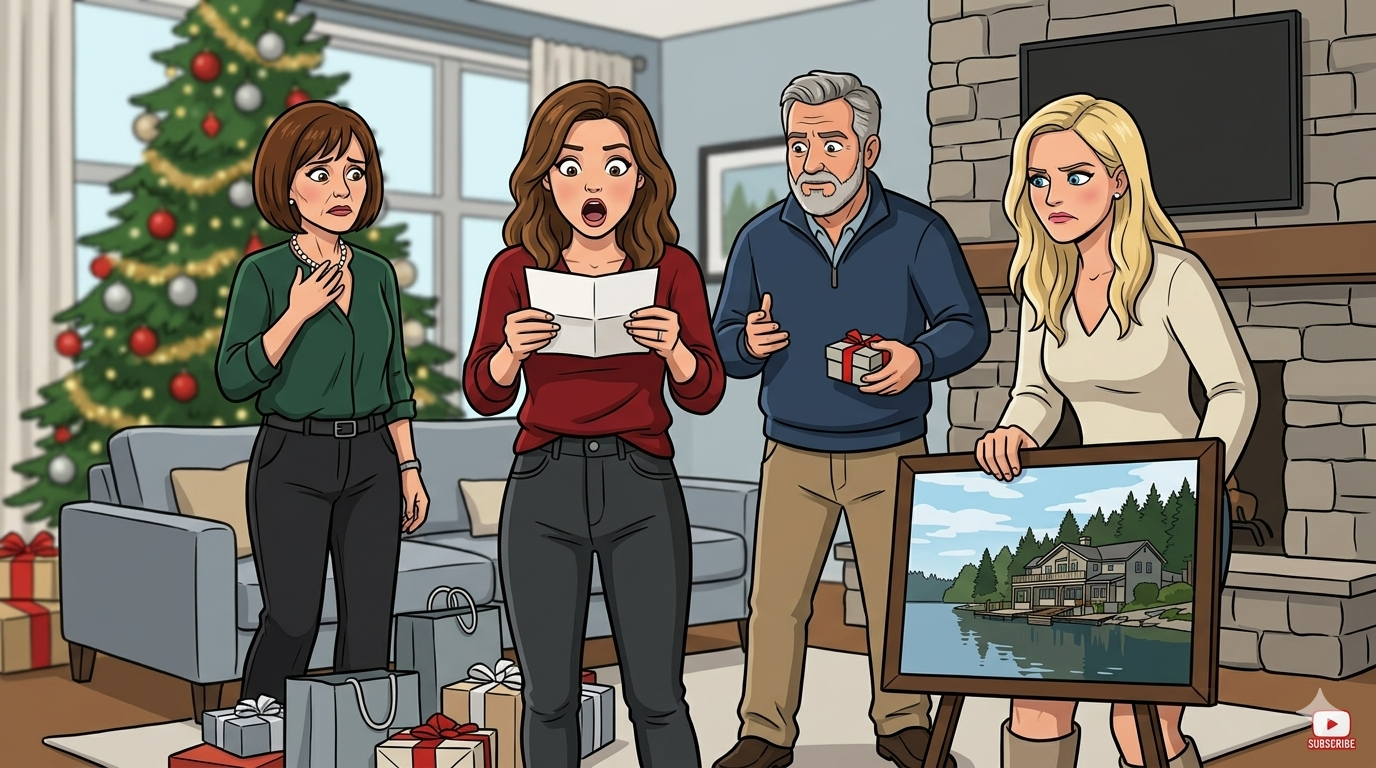
She returned carrying a large envelope and handed it to Madison.
“This is from both of us,” my dad said, voice thick with emotion. “We wanted to do something really special for you and Jake this year.”
Madison’s fingers trembled as she opened it. She pulled out what looked like a deed or legal document.
Jake leaned in to read.
Madison’s eyes went wide.
“Oh my god,” she whispered—then she started crying, happy tears streaming down her face.
“Jake,” she choked out, “they bought us the lakehouse. They bought us the cabin at Lake Geneva.”
The words hit me like a punch.
The lakehouse was a place we’d vacationed when we were kids—three bedrooms on the water, private dock, the kind of property you daydream about but don’t expect to own.
I’d looked it up once out of curiosity. Similar cabins went for around four hundred grand.
Madison jumped up and hugged my parents, sobbing with joy. Jake shook my dad’s hand, thanking him over and over.
My mother wiped tears. “We know how much you two love it there,” she said. “And we thought it would be perfect for when you’re ready to start your family. Kids love the lake.”
I sat there trying to keep my face neutral.
Four hundred thousand dollars.
Marcus squeezed my hand, and I could feel the thought he didn’t say: We’re still thirty thousand short on our down payment.
I swallowed jealousy, forced myself to smile.
Be happy for them.
Be the bigger person.
That’s what I’d been trained to do.
Madison was glowing, talking about memories, about summers, about Christmas mornings at the cabin.
For a moment—just a moment—it felt like maybe we could rewind to before resentment poisoned everything.
Then my dad cleared his throat.
“All right,” he said, eyes turning toward me and Marcus. “Minnie. Marcus. We have something for you too.”
My mother reached under the tree and pulled out a small envelope. Much smaller than Madison’s.
She handed it to me with a smile that looked… strained.
“Go ahead, honey,” she urged. “Open it.”
I expected tickets. A gift card. Something polite.
Inside was a single folded piece of paper, torn from a legal pad, covered in my mother’s handwriting.
My heart started racing.
“Read it out loud,” my dad said. “We want everyone to hear it.”
My fingers shook as I unfolded it and scanned the first lines.
This couldn’t be what I thought it was.
I looked up at my parents. They watched me expectantly.
Madison and Jake watched too.
“Um,” I started, voice catching. “Are you sure you want me to read this out loud?”
“Of course,” my mother said. “We want the whole family to hear it.”
Marcus nodded encouragement beside me, though his brows were furrowed with suspicion.
I swallowed hard and began.
“Dear Minnie and Marcus,” I read, my voice unsteady at first. “We have watched you both work incredibly hard to build your life together, and we are so proud of the adults you’ve become…”
As I read, something warm spread through my chest—hope mixed with disbelief.
My mother had written about my nursing career. About Marcus’s support. About sacrifices. About student loans. About how we’d never asked for help even when things were tight.
Madison’s smile faltered.
Confusion crept across her face like a shadow.
Then I read the lines that made the room go razor-silent:
“We also know that you’ve had to deal with unfair treatment from certain family members… You’ve been excluded, had your achievements minimized, and even had your personal tragedy used against you.”
Madison’s face went white.
The smile was gone completely.
I kept reading, my voice gaining strength because the truth was finally being spoken in the open.
“We have decided to give you the wedding gift we never properly gave you, plus a little extra for everything you’ve had to endure.”
I paused, breath catching, because the next line made my eyes burn:
“We are giving you $50,000 toward the purchase of your first home… and we are covering all of your remaining student loan debt, approximately $37,000.”
Marcus gasped.
I felt like the room tilted.
I read on:
“This is not a loan. This is not something you need to pay back or feel guilty about… We hope this helps you start your family in your own home… We also hope this makes up in some small way for the times we failed to defend you when you needed us most.”
Madison looked like she’d been slapped.
Jake looked like he wanted to disappear into the couch.
I read the line that made my throat tighten with something dangerously close to relief:
“We love both our daughters, but we have realized that we have enabled behavior that has hurt our family and hurt you specifically.”
Madison’s breathing turned sharp.
The letter finished with a sentence that landed like a benediction:
“Use this money to build the life you want with people who celebrate your happiness instead of resenting it.”
I folded the paper slowly and looked around.
Marcus had tears in his eyes, squeezing my hand so tight it hurt.
My parents were watching Madison, not me.
Madison stared at the letter like it was a betrayal wrapped in my mother’s handwriting.
“What the hell is this?” she finally said, voice low and dangerous.
My father’s voice was calm. “It’s exactly what it sounds like.”
Madison’s head snapped toward him. “This isn’t the same thing at all! You gave us a house!”
“And we’re giving Minnie and Marcus help,” my father said. “Just like we gave you help.”
Madison stood abruptly, rage rising. “You just humiliated me in front of everyone. You made me look like some kind of monster.”
“The letter didn’t make you look like anything,” my father said evenly. “It wrote down facts.”
Madison turned on me, eyes burning. “You planned this, didn’t you? You convinced them. This is your revenge for me not kissing your ass when you got pregnant.”
Marcus stood up.
“That’s enough,” he said, voice controlled but shaking with suppressed fury. “You’re proving their point right now.”
Madison sneered. “Oh, shut up, Marcus. This doesn’t concern you.”
“It does,” he said, steady. “I’ve watched you treat my wife like garbage for years. I’ve watched her cry after family dinners because of things you’ve said. I’ve watched her blame herself for your infertility problems because you’ve made her feel like her existence is offensive to you.”
Madison’s voice cracked. “I never said that.”
“You didn’t have to say it directly,” I said, standing too, my voice trembling but clear. “You said it when you screamed at me for getting pregnant. You said it when you told Mom my miscarriage was the universe teaching me a lesson. You said it every time you posted about fake family members.”
Madison’s face crumpled. “That’s not… I didn’t mean—”
“Yes, you did,” my father said firmly, and the sound of him finally taking a side made my chest ache. “Madison, we love you. We will always love you. But the way you’ve treated Minnie is unacceptable. And the way we’ve enabled it is unacceptable.”
Madison let out a bitter laugh. “Enabled it? You just gave her almost ninety thousand dollars while calling me jealous and insecure in front of my husband. How is that enabling me?”
“We gave you a house worth around four hundred thousand,” my mother pointed out, voice steady. “We’re not leaving you empty-handed.”
“That’s not the point!” Madison shouted. “The point is you’ve decided I’m the villain, and now you’re rewarding Minnie for being the victim!”
“No,” I said, and my voice surprised even me with its steadiness. “They’re not rewarding me for being a victim. They’re acknowledging I’ve worked hard and handled a difficult situation with maturity—something you’ve never been willing to do.”
Madison’s voice shot up. “Difficult situation? What difficult situation? You got everything you wanted! You got married. You got your nursing degree. You have a husband who worships you. What has been so hard about your life?”
The room went silent.
And I realized this was the moment I’d been building toward for two years—the moment where I either shrank back into my old role, or I finally stood up for myself.
“You want to know what’s been difficult?” I asked, my voice getting stronger with every word. “Watching my sister turn into someone I don’t recognize because she can’t handle other people being happy. Having to tiptoe around my own accomplishments because they might trigger you. Planning my wedding around your emotional state. Being screamed at for getting pregnant and then being told my miscarriage was cosmic justice.”
Madison opened her mouth to interrupt, but I kept going, two years of swallowed pain pouring out.
“Realizing that the person I looked up to my whole life can only be happy if everyone around her is miserable,” I said. “That you see other people’s joy as a personal attack.”
Madison’s tears fell freely now. “That’s not true,” she whispered.
Jake spoke quietly—his voice gentle, exhausted, and devastating.
“Yes, Madison,” he said. “It is.”
Everyone turned to look at him.
Jake had been quiet for so long I’d almost forgotten he had opinions of his own. Now he looked at his wife like a man who loved her, but couldn’t protect her from herself anymore.
“Madison,” he said, “I love you. But I’m not going to watch you do this anymore. Minnie lost a baby, and you told her mother it was the universe teaching her a lesson. Do you understand how cruel that is?”
Madison covered her face. “I was hurting.”
“You’re always hurting,” Jake said softly. “And somehow it always becomes everyone else’s responsibility.”
Madison dropped her hands, eyes flashing. “So now my own husband is ganging up on me too?”
“I’m not ganging up,” Jake said. “I’m telling you the truth. I’ve been telling you for months.”
He took a breath, like the next words cost him.
“This doesn’t just affect your relationship with Minnie,” he said. “It affects our marriage. It affects everything.”
Madison stared at him, stunned.
“When’s the last time you celebrated something good happening to someone else without making it about what’s missing from your life?” Jake asked quietly. “When’s the last time you felt joy without keeping score?”
Madison’s lips parted.
No answer came.
That silence told us everything.
My father cleared his throat, voice thick. “Maybe we should take a break.”
“No,” Madison said, and her voice had changed—less rage, more exhaustion. “Don’t stop on my account. Clearly this is… an intervention you all planned.”
“We didn’t plan anything,” my mother said. “We just decided we were tired of pretending.”
Madison’s eyes moved around the room. For the first time in years, I saw something other than anger or self-pity.
Shame.
“So what now?” she asked, voice small. “You’ve told me I’m terrible. You gave her money. Jake’s decided our marriage is broken. What do you want from me?”
“We want you to get help,” my mother said simply. “We want you to talk to someone about why other people’s happiness feels like a threat.”
My father nodded. “And we want you to apologize. A real apology.”
Madison’s gaze found mine. For one brief second, I saw the sister who used to teach me friendship bracelets and share her Halloween candy.
“I’m sorry,” she whispered.
The words were so quiet they barely existed.
My throat tightened.
“I’m sorry too,” I said softly—not for what I’d said, but for what we’d lost.
Madison shook her head, tears falling. “Don’t apologize. You didn’t do anything wrong. I did. I just… I don’t know how to stop.”
Jake reached for her hand. “You stop by getting help,” he said gently. “You stop by doing the work.”
Madison nodded slowly, like each nod was a surrender.
“I want to do better,” she said, voice trembling. “I want to be the kind of person who can be happy for my sister.”
For the first time in years, the room felt honest.
Not healed. Not fixed. But honest.
Marcus broke the silence with the softest possible joke, like he was giving us a rope back from the cliff.
“So,” he said, clearing his throat, “should we open the rest of the presents?”
A small laugh escaped my mother.
Then my father.
Then—surprisingly—Madison, a shaky sound that didn’t erase anything, but made room for breath.
Madison and Jake left shortly after, Madison promising—quietly, sincerely—to find a therapist after the holidays.
My parents and Marcus and I stayed up past midnight talking through years of hurt that had calcified into silence.
That letter changed everything.
Not just because of the money—though being debt-free and having a down payment was life-changing.
It changed everything because it was the first time my parents admitted out loud that the family dynamic wasn’t working.
It was the first time someone called Madison’s behavior what it was, instead of making excuses.
And most importantly, it was the first time I felt seen—fully, clearly—not as Madison’s little sister, not as a consolation prize, but as their daughter who deserved to be defended.
Madison started therapy.
It was slow. Uneven. Real.
There were setbacks—days she spiraled, days she slipped into old patterns. But she kept going.
A few months later, she apologized properly—naming what she’d done, not hiding behind pain as an excuse.
We weren’t magically back to childhood closeness. We might never be.
But we began building something new—something adult, something honest.
Six months after Christmas Eve, Marcus and I bought our first house.
Madison showed up on moving day with boxes and work gloves and an awkward smile.
“I brought coffee,” she said, like she didn’t know what else to bring.
It was a small thing.
But it meant the world.
Because sometimes the best gift isn’t what’s wrapped under the tree.
Sometimes it’s the truth delivered with love—and the chance, finally, to start over.
The next spring arrived the way healing did in our family—quietly, without fanfare, almost suspiciously normal.
By March, the house Marcus and I bought didn’t smell like fresh paint anymore. It smelled like us: coffee, laundry detergent, the basil plant I kept killing and resurrecting on the windowsill. We’d painted the spare bedroom a soft, undecided white—not a nursery, not a guest room, not a statement. Just space. Possibility without pressure.
Madison came over on a Saturday with two lattes and a cardboard box labeled KITCHEN—FRAGILE in her neat handwriting. She stood in the doorway like she wasn’t sure she was allowed to cross the threshold.
“I didn’t know if you’d want help,” she said.
“I do,” I replied, and meant it more than I expected.
Marcus was in the backyard wrestling with a grill we’d gotten from Facebook Marketplace. He looked up when Madison stepped in and gave her a nod—not warm, not cold. Something earned.
Madison set the lattes on the counter. Her eyes tracked the room the way they always used to—cataloging, comparing—but now there was something else under it. A restraint. Like she’d learned that not every thought deserved a spotlight.
We unpacked in silence for a while, wrapping glasses in dish towels, fitting plates into cabinets. Normal chores, but my body stayed half-braced, waiting for the old dynamic to reappear. Waiting for the moment she’d make a joke that cut too deep, or a comment that turned my happiness into a provocation.
Instead, Madison cleared her throat and said, “I saw my therapist yesterday.”
I didn’t look at her right away. “Yeah?”
She nodded, eyes fixed on a stack of bowls. “We talked about… the scorekeeping.”
The word landed softly but it still made something in my chest tighten.
“Turns out,” she added, attempting a humor that didn’t quite reach her mouth, “I’ve been running a whole invisible spreadsheet in my head for years.”
I snorted before I could stop myself. “Of course you have.”
Madison’s shoulders sagged with relief at my reaction. “It’s not funny,” she said, then sighed. “Okay, it is a little funny. But also—” Her voice wobbled. “It’s exhausting.”
I slid a plate into the cabinet and finally looked at her. “So stop.”
She swallowed. “That’s… the hard part. I keep wanting the world to balance. Like if I suffer enough, I’ll get what I’m owed. And if someone else gets something, it feels like the universe picked them instead of me.”
I waited. Part of me still wanted to protect myself by staying silent, by keeping everything on the surface. But the new version of our family—if we were really doing this—required honesty.
“I didn’t pick being pregnant,” I said quietly. “And I didn’t pick losing it.”
Madison’s face tightened, pain flashing through her like a shadow crossing sunlight. “I know,” she whispered. “I know that now.”
I should’ve felt satisfied hearing that. Vindicated. Instead, it just made me tired. Years of fighting to be believed will do that—you stop craving victory and start craving peace.
Madison rubbed her palms against her jeans. “I brought something,” she said, and pulled an envelope from her bag. Not a fancy one—just plain white, my name written across it.
My stomach dipped. “What is it?”
“A letter,” she said quickly. “Not—like Mom and Dad’s. Not… a performance.” Her eyes met mine. “Just for you. You don’t have to read it now. You don’t have to read it ever. But my therapist said part of accountability is doing the work even if you never get the forgiveness you want.”
My fingers closed around the envelope. It felt heavier than paper should.
“Okay,” I said, voice small. “Thank you.”
Madison nodded, swallowed, then went back to wrapping glasses like she hadn’t just handed me a piece of her pride.
That night, after she left, Marcus and I sat on the living room floor surrounded by half-unpacked boxes. The sun was down, the house dim except for the warm lamp by the couch.
“You okay?” Marcus asked, watching my face.
“I don’t know,” I admitted. “I feel like I’m waiting for the other shoe.”
He reached over and tucked my hair behind my ear. “It might not drop this time.”
I stared at the envelope in my lap. “I want to believe that.”
“Then read it,” he said softly.
So I did.
Madison’s handwriting filled two pages—messy in a way hers never used to be, like she’d written fast before she could talk herself out of truth.
She didn’t blame infertility. She didn’t blame “pain.” She didn’t blame me.
She wrote: I made your pregnancy about me because I didn’t know how to live in a world where my grief wasn’t the center. I used your miscarriage as punishment because I was angry at the universe and I pointed it at you instead.
I felt my throat tighten.
She wrote: I’ve been jealous of you since we were kids. Not because you had more, but because you could still feel joy without permission. I thought if I controlled the room, I could control how hurt I felt. All I controlled was you.
At the bottom, she wrote: I’m sorry for the baby you lost, and I’m sorry I made that loss heavier. I will spend the rest of my life trying to become someone who doesn’t need other people to shrink so I can feel tall.
When I finished, I set the letter down and stared at the wall until Marcus’s hand found mine.
“She actually gets it,” he murmured.
“Maybe,” I said, wiping my cheeks. “Or maybe she’s learning how to sound like she does.”
Marcus squeezed my hand. “Either way, she did something she’s never done before—she took responsibility without making it your job to comfort her.”
That was true. And it mattered.
Two weeks later, my parents invited us over for Sunday dinner.
For the first time, it didn’t feel like an obligation.
My mother had started going to therapy too—apparently Madison’s therapist had gently suggested “family patterns” and my mother, to her credit, had listened. My father didn’t go, but he’d started doing something new: speaking up.
At dinner, when Madison began spiraling because my cousin mentioned a new job, my dad said calmly, “Madison. Breathe. This isn’t about you.”
The table went quiet, stunned by the sheer novelty of boundaries.
Madison blinked like she’d been splashed with cold water, then nodded. “You’re right,” she said, voice shaky. “Sorry. I’m working on it.”
My mother’s eyes filled with tears—not from guilt this time, but from something like relief.
After dinner, while Marcus helped my dad carry plates to the kitchen, my mother pulled me aside in the hallway.
“I need to say something,” she whispered.
I braced automatically.
My mother took a shaky breath. “I am sorry,” she said, voice breaking. “For sitting there when Madison screamed at you. For making you responsible for her feelings. For acting like peace was more important than fairness.”
I didn’t answer immediately, because the old me would’ve rushed to fix her discomfort. The new me let her sit in it.
“I wanted to keep the family together,” she continued, tears spilling. “And I didn’t realize I was doing it by… sacrificing you.”
The honesty hit me harder than I expected.
“I’m not asking you to forgive us quickly,” she said. “I’m asking you to let us earn your trust again.”
I swallowed. “Okay,” I said finally. “But it has to be real.”
“It will be,” my mother whispered, and for once I believed her.
That summer, we gathered at the lake—not the lakehouse, not Madison’s cabin, but the public beach near our town. Neutral ground. No ownership, no symbolism that could twist into resentment.
Clare—my cousin—brought her fiancé. Someone grilled burgers. Kids ran through sprinklers. Madison sat beside me on a folding chair, sunscreen on her nose, sunglasses hiding her eyes.
“This feels weird,” she said quietly.
“Good weird or bad weird?” I asked.
She hesitated. “Good. Like… I forgot this could exist.”
I watched Marcus across the yard, laughing with my dad while trying to teach him how to use his phone’s camera timer. The sight made my chest ache—because it was so ordinary, and ordinary had been missing for so long.
Madison cleared her throat. “If you ever get pregnant again,” she said, voice small, “I want you to tell me. And if I freak out, I want you to leave. Immediately. Don’t stay and manage me.”
I turned to look at her, surprised.
She shrugged, blinking fast. “I’m serious. I don’t want to be that person anymore.”
I studied her face—older than she used to be, softer in some places, marked by work she couldn’t hide. Healing had edges. It wasn’t pretty, but it was real.
“Okay,” I said.
Madison exhaled like she’d been holding her breath for years.
In October, Marcus and I found out I was pregnant again.
We sat on the bathroom floor, staring at the test, the same way we had the first time. I expected joy to feel uncomplicated. It didn’t. It came braided with fear—fear of loss, fear of my body, fear of my family’s reactions.
Marcus kissed my forehead. “This time,” he said gently, “we do it differently.”
So we did.
We waited long enough for a heartbeat scan and a doctor’s calm reassurance. Then we invited my parents and Madison and Jake over.
My hands shook as I set a small box on the table.
Madison’s eyes flicked to it and I saw a flash of the old panic.
Then she pressed her palm to the table and breathed, the way she’d been practicing.
“Okay,” she whispered to herself.
I watched her. “You’re allowed to feel whatever you feel,” I said softly. “But you’re not allowed to hurt me with it.”
Madison’s eyes glistened. She nodded once.
I opened the box and slid out a tiny onesie that said Hello, Auntie.
The room went silent.
Madison stared at it like it was both a miracle and a threat.
Then she covered her mouth and started crying—not the sharp, angry crying I remembered, but something quieter.
“I’m—” she choked, wiping her cheeks. “I’m happy for you.”
My mother sobbed openly. My father’s face crumpled, and he walked around the table to hug me like he was afraid I’d vanish.
Jake put an arm around Madison, whispering something in her ear. Madison nodded against his shoulder, still crying.
“I’m scared,” she admitted, voice muffled. “But I’m happy. And I’m sorry it took me this long to learn the difference.”
I felt tears spill over too—grief for what we’d lost, gratitude for what was still possible.
Marcus’s hand found mine under the table, steady and warm.
And in that moment, I realized the ending I’d always wanted wasn’t Madison becoming perfect.
It was all of us finally choosing truth over performance.
Choosing accountability over comfort.
Choosing love that didn’t require anyone to disappear.
Outside, the first snow of the season began to fall—soft, quiet, covering the yard in white.
Inside, for the first time in years, my family felt like a place I could breathe.
Not because everything was fixed.
But because we were finally doing the work.
THE END