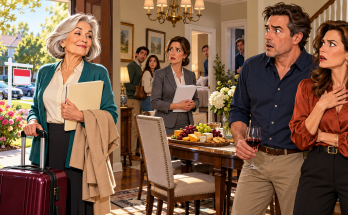
The audience gasped. Even through the monitor, I could hear it.
Then the Dean did something that wasn’t in the script.
He paused. He looked directly at the front row of the VIP section. And he let the silence stretch out just long enough for everyone to notice where he was looking.
“What makes this achievement even more remarkable,” he said slowly, “is that this graduate did all of it while working full-time night shifts as a nursing assistant at Northbridge Medical Center. She paid her own way. She asked for nothing. She worked harder than anyone in this building, and most of the time, very few people even knew she was doing it.”
On the monitor, my father’s face changed. It wasn’t a big change. Just a small crease between his eyebrows, the kind of look someone gets when they hear a song they almost recognize.
Denise had stopped whispering.
Haley lowered her phone an inch.
“Ladies and gentlemen,” the Dean said, “it is my honor to present this year’s valedictorian, keynote speaker, and recipient of the Whitmore Award.”
Behind him, the enormous screen above the stage lit up with a photo. It was my research ID picture, taken in the lab during my second year. I was wearing safety glasses pushed up on my head and smiling at something someone had said off camera.
Under the photo, in bold white letters, was my name.
DR. CLARA ELENA HENSLEY
I will remember the next three seconds for the rest of my life.
Marianne squeezed my hand and said, “That’s you. Go.”
I walked out of the green room, down the short hallway, and through the side curtain onto the stage. The lights hit me all at once, warm and bright and almost blinding.
The applause started slowly. Then my classmates realized who it was.
They stood up.
All of them. Row after row of black gowns rising to their feet, clapping and cheering. Someone near the back whistled. Someone else shouted, “Let’s go, Clara!” I recognized the voice. It was Marcus Reid, my lab partner, the one who’d stayed up with me for thirty-six hours straight before our first publication deadline.
Then the faculty stood. Then the parents in the general seating stood.
And in the front row of the VIP section, three people stayed frozen in their seats.
I didn’t look at them right away. I couldn’t. I walked to the center of the stage, where Dean Bradley was waiting with a heavy glass award engraved with my name. He placed it in my hands and leaned close enough that only I could hear him.
“Take your time,” he said. “This moment is yours.”
I turned toward the audience.
And then I looked down at the front row.
My father was staring at me like he was seeing a stranger. His mouth was slightly open. His arms, which had been crossed so tightly a few minutes ago, had dropped into his lap. Denise had gone pale under her makeup. Her hand was pressed against her pearls.
Haley was still holding her phone. But she wasn’t filming anymore. She was just staring at the screen above the stage, then back at me, then back at the screen, like she was trying to make the two images match.
The gold invitation was still in her other hand.
My invitation.
I set the award down on the podium, adjusted the microphone, and waited for the room to settle.
“Good morning,” I said.
My voice shook on the first word. I took a breath and started again.
“Good morning. I want to begin by thanking the faculty of this medical school, the Board of Trustees, Dean Bradley, and every single person in this room who made it possible for us to be here today. And I want to thank my classmates. You are the most brilliant, exhausted, caffeinated, stubborn people I have ever met, and it has been an honor to be one of you.”
They laughed. Some of them cheered again. It helped. My hands stopped shaking.
“I had a speech prepared,” I said. “It was a good speech. It had statistics and quotes from famous doctors and a really nice line about the future of medicine. I practiced it a thousand times.”
I looked down at the note cards in my hand. Then I folded them in half and set them beside the award.
“But something happened this morning that made me realize I wanted to say something different.”
The hall went very quiet.
“When I was twelve years old, my mother collapsed in our kitchen. She was a nurse. She had spent her entire life taking care of other people. She had been to the doctor three times that year complaining that her heart felt strange, that she got dizzy when she climbed the stairs, that sometimes she felt like her chest was fluttering. Every time, she was told she was just tired. Just stressed. Just overworked. Just a nurse who needed more sleep.”