“Turn it sideways, Dad.”
Adrian stopped.
Only for a second.
But I saw it.
So did Miles.
Neither looked at the other.
“Which sideways?” Adrian asked.
“The other sideways.”
“There are several.”
“The one that gets it through the door.”
I turned toward the kitchen before either of them saw me smile.
At dinner, Adrian spoke normally.
Miles complained about homework.
I asked someone to pass the salt.
The word remained in the room without being examined.
Later, when Miles went upstairs, Adrian stood beside the sink holding a dish towel.
“He said—”
“I heard.”
His eyes filled.
I handed him a plate.
“Then keep drying.”
He laughed through the tears.
That was the life we built.
Not one where the past vanished.
One where there were eventually more things to talk about than the past.
There were parent evenings.
Arguments over screen time.
A broken window Miles insisted had been caused by an unusually unpredictable baseball.
There was the winter Adrian became quieter than usual and told us, plainly, that he was having a difficult period and had arranged additional support.
I watched Miles carefully.
So did he.
“What does that mean?” Miles asked.
“It means I’m taking care of it,” Adrian said. “And if a plan needs to change, I’ll tell you. I won’t disappear.”
It was not a perfect season.
Some visits were shorter.
One weekend became a daytime meal.
But Adrian kept communicating.
He kept showing up in the ways he could.
Miles learned something important then.
That a person could struggle without abandoning him.
That honesty could arrive before a crisis.
That he did not have to monitor an adult’s face every minute to make sure the adult would stay.
Marianne became part of our lives more cautiously.
She never became the grandmother who had raised him.
There was no need for her to.
She came to know him in her own place.
She learned how he took his tea.
Which questions made him talk for an hour.
Which questions made him shut down.
She began volunteering with organizations supporting families affected by controlling relationships.
For a long time, she said very little about it.
When I finally asked, she looked uncomfortable.
“I don’t want you to think I’m doing it to balance an account.”
“You can’t.”
“I know.”
I believed her.
That mattered more than I expected.
We did not become close friends.
There were things between us that neither kindness nor time could remove.
But eventually, we could sit at the same school concert and share a program.
Eventually, I could ask her to stay for tea without feeling I had betrayed Lena.
The day Miles called her Grandma Marianne, she went very still.
Then she answered the question he had asked.
Nothing more.
She had learned, at last, not to make every small gift carry the weight of her relief.
At eighteen, Miles told us he wanted to change his surname.
He announced it after graduation while we were eating cake in the garden.
My fork stopped halfway to my mouth.
Adrian looked at me immediately.
Miles noticed.
“You’re both doing that thing.”
“What thing?” I asked.
“Where you look at each other because you’re worried about what I’m going to say.”
“We’re listening,” Adrian said.
Miles set down his plate.
“I want to be Miles Mercer-Vale.”
The garden seemed suddenly quiet.
I had known this might happen.
Still, hearing it hurt in a place I had not prepared.
Mercer had been Lena’s name.
My name.
The name on every form I had filled out while learning how to raise him.
Miles reached across the table and took my hand.
“I’m not removing you.”
“I know.”
“You look like you don’t.”
I swallowed.
“I’m catching up.”
He nodded.
“I don’t want to choose one half of my life so nobody gets upset about the other.”
Adrian looked down.
Miles turned toward him.
“And I’m not doing it because you earned a prize.”
“I understand.”
“It’s my name.”
“Yes,” Adrian said. “It is.”
A relative objected later.
Someone always does.
She told Miles that adding Vale sounded disloyal to his mother.
He listened until she finished.
Then he said, “Both names are part of my story. Mom doesn’t become less my mother because I know who my father is.”
I was standing in the next room.
He knew I could hear.
I let the words settle.
Then I brought out the tea.
Miles studied engineering.
Of course he did.
He had been taking apart the world since he could hold a screwdriver.
Adrian tried not to look too proud when the acceptance letter arrived.
He failed completely.
Before Miles left for university, he and I packed the last box in his room.
Under his bed, I found an old envelope.
Inside were the first letters he and Adrian had exchanged.
The paper smelled faintly of dust.
“Do you want these packed?”
He looked up.
“Yes.”
I held the first one.
The one that ended with the question no child should have needed to ask.
Why didn’t you send even one letter?
“Do you still read them?”
“Sometimes.”
“Does it hurt?”
“Sometimes.”
He took the envelope from me.
“But I like knowing where we started.”
Years continued.
Not quickly while we were living them.
Only quickly when I looked back.
Miles graduated.
Found work.
Moved into an apartment with windows he could barely afford and a kitchen too small for two people to stand in comfortably.
He called me about rice.
Then about laundry.
Then, one evening, about a young woman named Nora.
“She’s an urban planner,” he said.
“Do you like her?”
“Yes.”
“Then why are you telling me her profession first?”
He laughed.
“Because I’m nervous.”
I liked her before I met her.
Marianne died when Miles was twenty-four.
By then, she had been ill for some time.
There was room for goodbye, though room never makes it easy.
At her funeral, Miles stood with a folded sheet of paper.
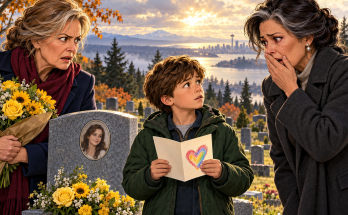
For a moment, I saw the boy carrying a handmade card up a cemetery hill.
Then he began.
“My grandmother taught me something difficult,” he said. “An apology matters. But it matters most when it changes what you do afterward.”
Adrian bowed his head.
I held his hand.
Miles spoke about the years Marianne had spent listening without demanding that he soften the truth.
About the stories she eventually told him about Lena.
About learning that loving someone did not require pretending they had never failed.
After the funeral, we returned to my house.
Someone put on the kettle.
Someone cut bread.
Grief entered the kitchen again, but this time, we did not face it as strangers separated by secrets.
That night, after everyone left, I found Miles standing by Lena’s photograph.
“Grandma?”
“Yes?”
“I’m glad you let me decide.”
I went to stand beside him.
“I was frightened.”
“I know.”
“I still am sometimes.”
He put his arm around my shoulders.
By then, I had to tilt my head to look at him.
“You stayed anyway,” he said.
For once, I let myself accept the words.