Part 2
By the time my flight lifted off the tarmac, Mark believed he had already won.
That was the part I kept turning over in my mind as London shrank into nothing but a line on the departure board and the city I was leaving behind dissolved beneath a layer of cloud. Mark wasn’t dangerous because he was loud. He was dangerous because he was certain. Certain that charm could replace loyalty. Certain that polished shoes and a tailored suit could disguise greed. Certain that I would do what I had always done during our ten-year marriage—absorb the insult, smooth over the damage, and make his life easier.
He thought my trembling hand at the desk had meant fear.
It hadn’t.
It had meant restraint.
Because if I had spoken in that moment—if I had said what I knew, if I had shown him the screenshots I had already sent to my father’s attorney, the copied messages, the “Exit Strategy” folder, the draft petition he had saved under the smug filename Freedom Day—I might have ruined the timing.
And timing was everything.
At thirty-eight thousand feet, I unfastened my seat belt, opened the leather folio on my lap, and reread the email Elias had sent just before boarding.
All mechanisms are in motion.
Primary accounts closed. Proxy authority revoked. Family trust protections activated at 8:10 p.m. EST.
He can posture if he likes. He cannot touch a dollar.
I stared at those lines until the cabin lights dimmed.
For the first time in three days, I allowed myself to breathe.
Not relax. Not yet.
Just breathe.
Across the aisle, a little girl in pink headphones slept against her mother’s shoulder. A man two rows up snored softly. One of the flight attendants passed with a tray of champagne, asking in that careful whisper reserved for first class whether I’d like a glass.
“Yes,” I said.
My voice sounded calm. That almost made me smile.
I took the flute, lifted it once in the empty air, and thought of my father.
Harold Whitmore had built our family legacy the way some men built cathedrals—stone by stone, with reverence, discipline, and a deep suspicion of anyone who loved appearances more than foundations. He was not sentimental. He did not believe money made people noble. He believed money revealed people. He used to tell me that wealth was never the real inheritance. Judgment was.
When I married Mark Reynolds, my father had smiled politely, shaken his hand, and pulled me aside later that night in the library.
“He wants access,” he had said quietly, looking not at me but at the rain against the windows. “I’m not sure yet whether he wants you.”
I had been furious with him for that.
I was twenty-nine, in love, convinced I was mature enough to know the difference between cynicism and wisdom. Mark had dazzled everyone else—a man in luxury real estate, articulate and driven, with perfect manners and a talent for making every room seem to tilt toward him. He remembered people’s birthdays. He sent handwritten thank-you notes. He could charm museum trustees and contractors in the same afternoon. When he looked at me, I felt seen.
Now I understood what my father had seen instead.
An appraiser.
My father never said, “Don’t marry him.” He simply changed the structure of my inheritance.
The family assets—my mother’s antique jewelry collection, the holding company that owned the flagship boutique on Madison, the London townhouse, the private investment accounts, the trust distributions scheduled after his death—were layered behind instruments designed to resist coercion, predatory marriage, and fraud. At the time, I called it excessive. Elias had called it prudent. My father called it love.
The most aggressive protection of all sat buried in a clause so dry and technical most people would skim past it:
If a spouse or third party could be shown to have engaged in deception, coercion, or bad-faith inducement in relation to the beneficiary’s inheritance, then all pending distributions would bypass personal ownership and transfer immediately into an irrevocable discretionary trust outside marital reach.
The beneficiary—that was me—would retain use.
The spouse would get nothing.
Not a percentage.
Not a settlement advantage.
Not leverage.
Nothing.
At the time I signed it, I rolled my eyes and told Elias my father had spent too much time with litigators.
Three days ago, with Mark’s “Exit Strategy” open on his laptop and Tiffany’s messages glowing on the screen, I had called Elias at 11:42 p.m.
“Activate the contingency clause,” I’d said.
He had not wasted a single breath on pity.
“Do you have proof?”
“Yes.”
“Do you have the stomach to finish this cleanly?”
I had looked down at the messages again.
Once she signs Monday, I’m filing Tuesday. I’ll buy you that five-carat ring with her father’s money.
“Yes,” I said. “I do now.”
So while Mark laid decoy papers in front of me with a gold pen and a predator’s smile, Elias had prepared the real transfer sequence. What Mark thought I was signing that Sunday night was a handoff of control. In reality, he was walking me straight into legal shelter he did not know existed.
He had built a trap.
He just didn’t realize he was the one stepping into it.
My phone vibrated against the fold-down tray.
A message from Olivia.
Olivia had managed the flagship store for seven years. She had a memory like a vault, taste so precise it bordered on violence, and a face that became dangerously serene whenever she was insulted. She had adored my father, tolerated Mark, and despised Tiffany on sight the one time she’d seen her at a gala.
They came in. He brought her to the store first just to gloat. Said, and I quote, “Everything here is half ours now.”
He had her try on the pear-cut yellow diamond suite from the private case.
I smiled so hard my jaw nearly dislocated.
Then they left for Tiffany & Co. because apparently he thought the joke was clever.
Elias timed the account closure beautifully.
You should see the security footage.
I read the message twice, then laughed—softly at first, then hard enough that I had to cover my mouth.
A flight attendant glanced over in concern.
“I’m all right,” I said.
And for the first time in a very long while, it was true.
The scene was described to me in fragments before I saw the footage myself.
Mark and Tiffany had arrived at Whitmore & Vale just after opening, all arrogance and fresh scandal. Olivia said Mark didn’t even hesitate at the threshold; he strode in the way men do when they’ve mistaken access for ownership. Tiffany followed on his arm in cream silk and oversized sunglasses, though it was raining.
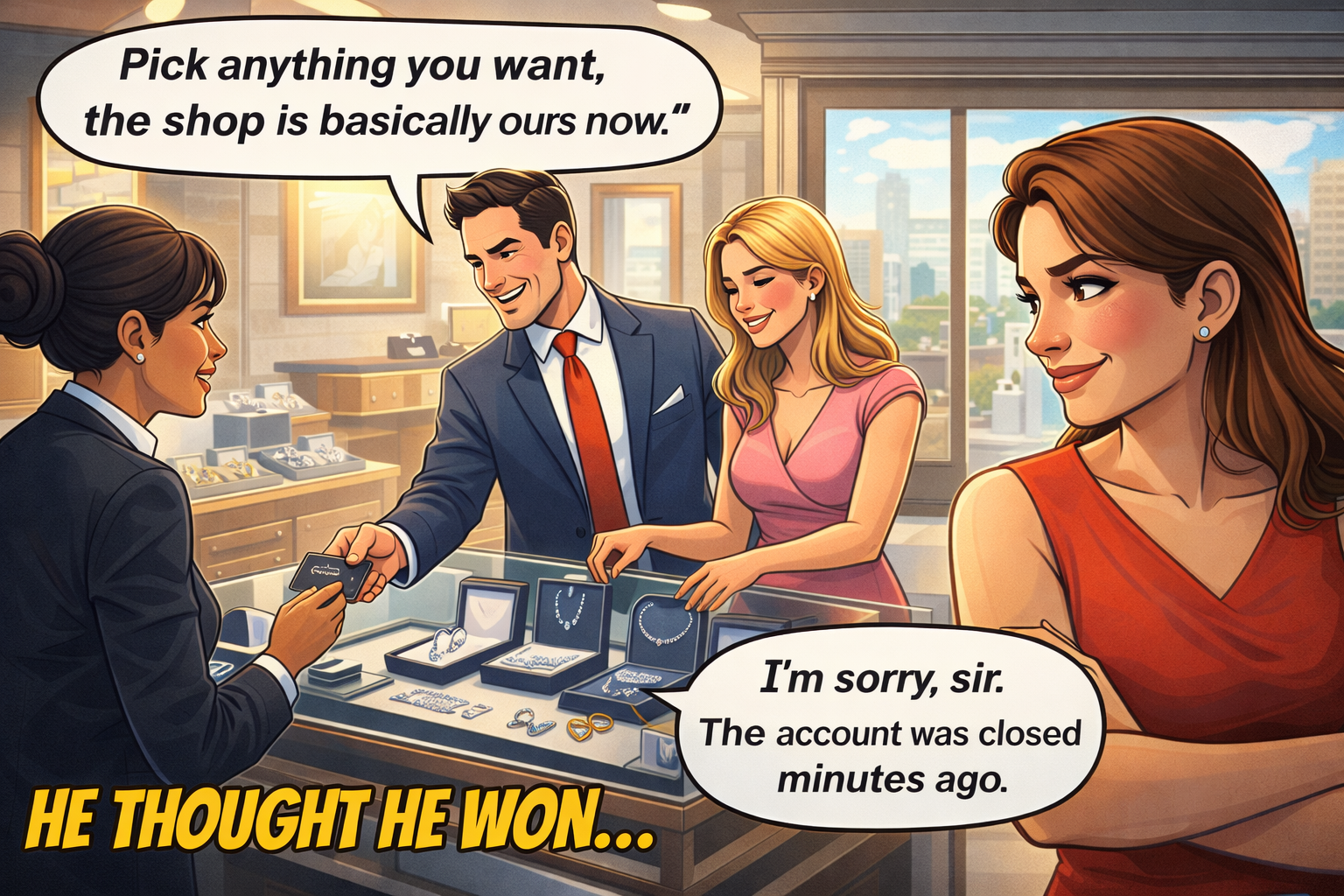
“Take your time,” Mark announced loudly enough for the associates near the bridal cases to hear. “Pick whatever you want, babe. The shop is half ours now.”
Olivia, elegant in black, materialized at his side as if summoned by bad taste.
“Good morning, Mr. Reynolds,” she said. “Ms. Tiffany.”
Mistress Tiffany apparently smiled and said, “Just Tiffany.”
Olivia later told me, “That was the moment I nearly committed a felony.”
Instead, she had done what great women in luxury do when confronted with vulgarity: she became unfailingly polite.
Tiffany asked to see the yellow diamond necklace from the Whitmore archive collection—the one my father designed around a Colombian stone he’d bought in Geneva in the eighties. A one-of-a-kind piece. Not for public sale. Mark told Olivia to bring it anyway.
“She’ll look stunning in it,” he said. “Let her enjoy what’s about to be hers.”
Olivia didn’t argue.
She simply opened the case, gloved her hands, lifted out the necklace, and placed it around Tiffany’s throat with the expression of a queen fitting a temporary costume on a court jester.
Then Mark asked her to prepare the transfer paperwork.
“Of course,” Olivia said. “Will this be charged to your private purchasing account?”
“Yes,” he said, flashing that black card. “Or Sarah’s family account. It’s all the same now.”
Olivia took the card.
Smiled.
And said, “I’m afraid Mr. Elias Whitmore requested that all account actions be processed through Tiffany & Co. directly this morning for external purchases.”
That was enough bait for Mark. He liked the theater of prestige too much to question it. So he whisked Tiffany out again, drove her downtown, and headed straight for Tiffany & Co., certain he was walking into his own little coronation.
He had no idea the actual closure command would hit at 10:10 a.m., precisely ten minutes before he reached the register.
I imagined it clearly: the mirrored glass, the velvet trays, Tiffany’s triumphant little smile, Mark’s smug hand sliding the black card across polished marble.
Then the clerk’s pause.
The second scan.
The discreet frown.
One more attempt.
And then the sentence that cracked his illusion down the middle.
“Sir, I’m sorry, but this account was closed ten minutes ago.”
According to Olivia, a sales associate she knew from there called her the minute it happened.
Mark actually laughed at first. That was exactly like him. He thought systems failed around lesser people, never around him. He told the clerk to run it again. She did. It failed again. He asked for the manager. The manager came. The manager confirmed the account had been terminated and the purchasing authority revoked by the family office.
Tiffany, the mistress, had apparently gone very quiet by then.
Then Mark made his mistake.
He said, in a voice loud enough for three nearby customers to hear, “This is my wife’s account.”
And the manager, who had probably endured rich men inventing legal rights all morning, answered, “Not anymore, sir.”
That was when the first crack appeared.
Not in the account. In him.
By the time I landed in London, my phone was a graveyard of missed calls.
Mark.
Mark.
Mark.
Unknown number.
Mark.
Tiffany.
Mark again.
I did not listen to the voicemails at Heathrow. I did not owe rage an audience. Instead, I let Elias’s driver collect me and take me straight to Whitmore House, the old townhouse in Belgravia my parents had kept for business and summers long before the city became an archive of our happier years.
The brass door knocker still shone.
The housekeeper still kept white roses in the front room.
The clocks still chimed softly on the quarter hour.
Home, in other words—not because I lived there, but because nothing inside it had ever demanded I become smaller.
Elias was waiting in the study with two cups of tea and a stack of folders so thick they made the walnut desk look occupied by fortifications.
He stood when I entered.
Elias Carrow had been my father’s attorney for thirty years and my legal guardian in spirit since I was twenty-two and signed my first investment documents without understanding a line of them. He was in his sixties now, silver at the temples, exact in speech, and incapable of melodrama unless it served a strategic purpose.
He looked at me over his glasses.
“Did you sleep?”
“Not really.”
“Did you answer him?”
“No.”
“Good.” He handed me tea. “Let him panic in his natural habitat.”
I sat down opposite him and finally allowed myself to feel the fatigue in my bones.
“How bad is it?” I asked.
“For him?”
“For me.”
Elias gave the faintest hint of a smile. “For you, expensive but manageable. For him, catastrophic if he keeps behaving like a peacock with a concussion.”
Despite everything, I laughed.
Then he began laying out the facts.
The contingency clause had moved every pending distribution scheduled for Monday into the Whitmore Protective Trust before Mark filed anything. The private investment accounts he believed would soon become “marital wealth” were now shielded. The holding company that owned Whitmore & Vale was never in my personal name to begin with; I had voting rights and income rights, but not transferable title. The London house and the jewelry archive collection sat behind separate entities with anti-alienation provisions. Our prenuptial agreement, which Mark had considered a formality because he assumed he’d eventually maneuver around it, remained brutally enforceable.
“And the documents I signed Sunday?” I asked.
“Decoys,” Elias said. “Legally harmless. Deliberately plausible. Enough to make him complacent for twelve hours.”
“And the divorce?”
“He filed this morning at 9:18 a.m. Exactly as predicted.” Elias slid a copy of the filing across the desk. “Aggressive demands. Challenge to valuation. Claim on future distributions. Temporary request for joint control over liquid assets.”
I skimmed the pages, feeling not grief but contempt.
He had moved fast.
He thought speed was power.
“What did we file?”
Elias handed me another folder.
“Response, emergency motion, financial misconduct disclosure, and preservation notice. Also a sealed evidentiary submission regarding his communications with Ms. Tiffany and the coercive scheme.”
My fingers rested on the folder.
“And?”
“And,” Elias said, voice turning cooler, “the judge assigned to the preliminary hearing is not known for rewarding fraud.”
I looked up.
“You already know what he’s going to do, don’t you?”
“I know what judges dislike. Predatory inducement. Hidden intent. Spousal deception tied to inheritance manipulation. Also, your husband was stupid enough to write everything down.”
That was the thing about Mark. He believed he was smarter than caution. He treated digital footprints the way gamblers treated odds: something unfortunate for other people.
Elias folded his hands.
“There is one more matter.”
His tone changed. I knew immediately I wasn’t going to like the next sentence.
“What?”
“We initiated a forensic review of joint accounts and business reimbursements. There are irregularities.”
“How irregular?”
“A mistress apartment in Tribeca billed through a development consulting shell. Travel. Gifts. A watch. Restaurant charges. ‘Client entertainment’ that appears to consist almost entirely of blondes under thirty.”
I closed my eyes.
“How much?”
“Enough to matter.”
I laughed once, bitterly. “He was spending my money on the woman he planned to replace me with.”
“Worse,” Elias said. “He was using the credibility attached to your family name to support lines of credit and deal guarantees that may now be called into question.”
That got my full attention.
“Explain.”
“He has built more of his empire on your social and financial aura than you realized,” Elias said. “A number of partners extended confidence because he was attached to Whitmore capital. Once that confidence disappears, things may become… unstable.”
“Unstable for him?”
“For everyone doing business under the assumption he was backed by substance instead of marriage.”
And there it was—the second layer of truth.
Mark had never just wanted my inheritance for comfort. He wanted it as proof. As collateral. As a permanent credential he could convert into influence.
He wanted my father’s name more than he ever wanted me.
Something inside me hardened with almost surgical precision.
“Pull everything,” I said.
Elias nodded, as if he’d been waiting for that answer.
“I already have.”
Mark reached me that evening.
I was in the blue sitting room overlooking the square when the international call came through a number I didn’t recognize. I let it ring twice, then answered.
“Hello?”
For a second there was silence. Then his voice came like a blade hitting marble.
“What the hell did you do?”
No greeting. No performance. No wounded-husband routine.
Good.
I set down my wineglass.
“Hello, Mark.”
“Don’t play with me. Every account is frozen. My access is gone. Tiffany & Co. said—”
“I know what Tiffany & Co. said.”
His silence sharpened.
“You knew?”
“Yes.”
“You planned this.”
I looked out at the rain silvering the London windows.
“No,” I said. “You planned something. I responded.”
His breathing came louder through the line.
“Undo it.”
I nearly admired the simplicity of his mind in crisis. As if I were withholding a password.
“No.”
“You can’t lock me out of what is marital property.”
“According to your filing this morning, you seemed very eager to define that.”
“You signed the transfer!”
“Yes,” I said softly. “I signed exactly what Elias wanted you to think I signed.”
He swore. A vicious, unfiltered sound.
Then came the pivot, the one he always used when brute force slipped: persuasion.
“Sarah, listen to me. We are both upset. We can still handle this privately. Don’t let your father’s people turn this ugly.”
My father’s people.
As if I had no mind of my own. As if I were a daughter being managed, not a wife betrayed.
“I found the folder on your laptop.”
Silence.
I could practically hear him recalculating.
“Mark,” I said, almost kindly, “did you really believe you could write ‘Exit Strategy’ on a desktop in our house and I’d never open it?”
When he spoke again, his voice had lost its polish.
“You went through my computer?”
“You went through my life.”
“That proves nothing.”
“The messages with Tiffany prove quite a bit.”
Another silence. This one longer.
Then he did something so predictable it felt scripted.
“She means nothing.”
I actually smiled.
“That line might work better if you hadn’t promised her a five-carat ring with my father’s money.”
He inhaled sharply.
So he knew, now, exactly how much I had seen.
“Sarah—”
“No,” I interrupted. “You don’t get to say my name like that anymore.”
His tone snapped again. “You vindictive bitch.”
There it was. The real voice. The one he usually kept behind his teeth.
I did not flinch.
“You should be very careful,” I said. “Every call is being documented. So are your reimbursements, your filings, and your false assumptions about what belonged to you.”
“You think you can ruin me?”
“No,” I said. “I think you mistook me for someone who couldn’t live without you. That was your first mistake. Your second was confusing proximity to wealth with ownership. Your third was assuming my father loved me less carefully than he actually did.”
His breathing turned ragged.
“Where are you?”
“Somewhere you can’t charge to my account.”
Then I ended the call.
My hand was steady when I set down the phone.
That was when I knew I was no longer afraid of him.
Not because he had become harmless. Men like Mark rarely became harmless all at once.
But because I had finally seen the machinery behind the performance.
And once you saw the machinery, the magic was over.
The collapse didn’t come as a single dramatic explosion.
It came as withdrawals of faith.
Banks first.
Then investors.
Then partners.
Then the women who had mistaken expensive dinners for permanence.
Within seventy-two hours, two pending real estate deals tied to Reynolds Urban Capital stalled when counterparties requested enhanced disclosure. One lender demanded clarification on personal guarantees. A second quietly withdrew. A board member at Mark’s firm—someone who had once toasted our marriage under a chandelier in Palm Beach—called Elias’s office to ask whether the Whitmore family remained “constructively aligned” with Mark’s long-term ventures.
Elias gave exactly one answer.
CONTINUE THE FINAL STORY BELOW: