My grandfather flew six hours to attend my brother’s wedding—but my parents sat him behind the trash cans. My mother hissed, ‘That old beggar will embarrass us.’ When I spoke up, she slapped me and threw me out. 20 minutes later, his private jet landed.
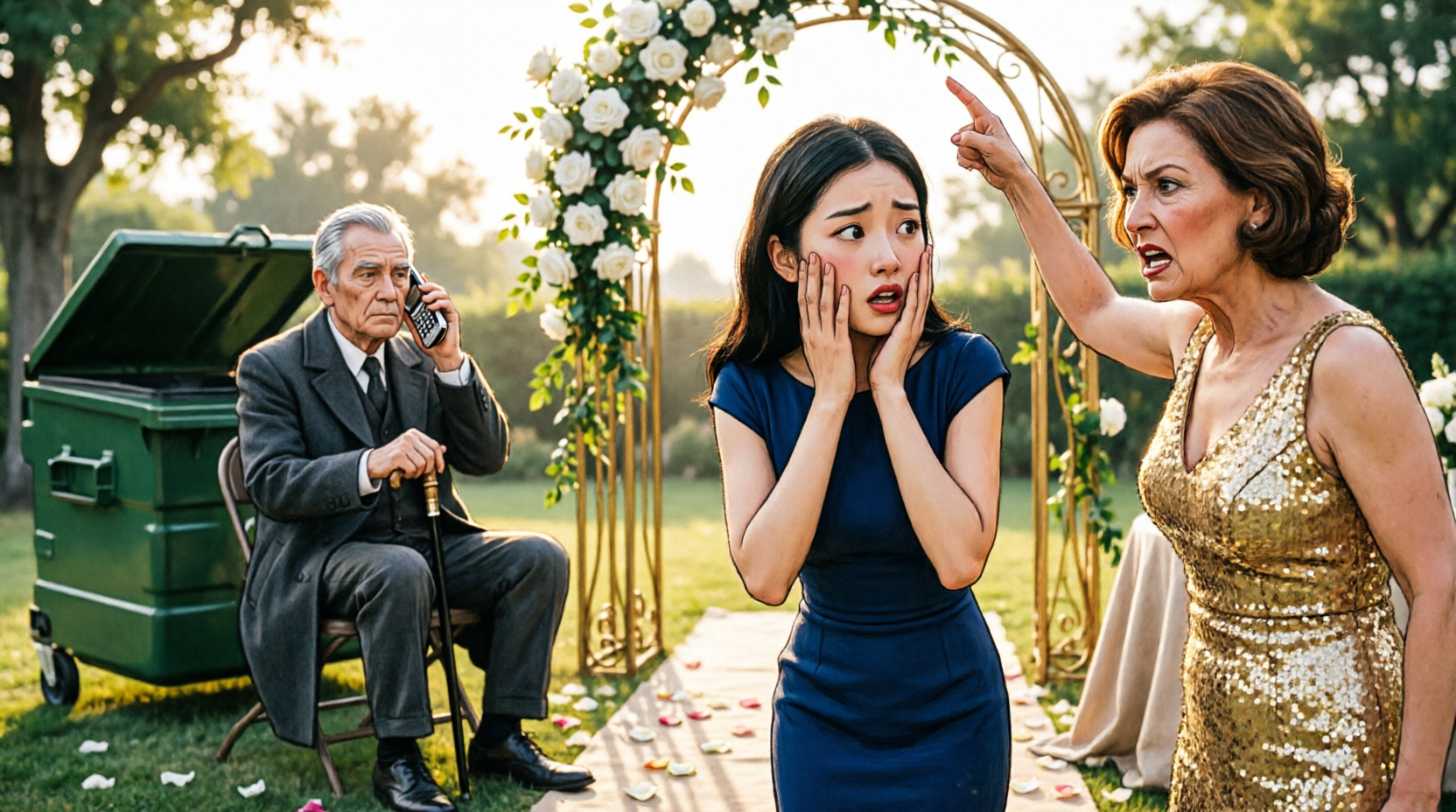
My mother slapped me so hard my earring tore free, and the sound cracked across the wedding lawn louder than the violin quartet. Before the sting even settled, she pointed to the gate and said, “Get out if you want to defend that old beggar.”
The guests pretended not to stare. Crystal glasses glittered under the afternoon sun. White roses climbed the gold archway. My brother Daniel stood near the altar in his custom tuxedo, jaw tight, saying nothing while my grandfather sat alone behind two green catering bins that smelled like spoiled fruit and champagne dregs.
Six hours. That was how far he had flown to be here.
He had arrived in a dark wool coat, carrying the same scuffed leather bag he always used, the one my mother hated because it looked “cheap.” He hugged me first, gently, like I was still ten and coming home bruised from school. “You look strong,” he said. “That matters more than pretty.”
Then my mother swept in, diamonds blazing at her throat. “Not there,” she snapped when he moved toward the family section. “We don’t need the bride’s family asking questions.”
Grandfather had blinked once. “Questions about what, Elena?”
“About why Daniel’s grandfather looks homeless.”
I had heard cruel things from her before. But that landed like a knife. My grandfather was seventy-eight. His shoes were old because he liked them old. His watch was plain because he hated showing off. He lived quietly, spoke softly, and never once in my life asked anyone for anything.
Still, the wedding planner obeyed my mother. A server dragged a folding chair across the gravel path and placed it near the service lane, half-hidden behind the floral waste and stacked cardboard. Like he was something to be concealed until photographs were done.
“Mom,” I said, “that is disgusting.”
Her smile never moved. “Then sit with him.”
So I did.
For ten minutes, I sat beside him behind the trash cans while expensive guests floated past with shrimp towers and laughter. Daniel looked over once, then away. My father adjusted his cuff links and avoided us completely. My future sister-in-law, Vanessa, whispered something into Daniel’s ear, and they both smirked.
Grandfather rested his hands on the cane across his knees. “You don’t need to burn for me, Mira.”
“I’m already burning.”
His eyes moved toward the sky, calm and unreadable. “Good. Fire has its uses.”
That was when my mother marched over, furious that I was ruining the image. Her perfume hit before her words did. “You always do this,” she hissed. “You always choose embarrassment.”
“He is your father-in-law.”
“He is a stain.”
I stood. “No. He’s the only decent person in this family.”
Her hand flew before I finished. The slap snapped my head sideways. Gasps rose nearby. Then my father grabbed my elbow, hard enough to bruise, and shoved me toward the exit path. “Leave. Now. Don’t come back and ruin your brother’s day.”
I stumbled, caught myself, and turned. Grandfather had not moved. But there was something different in his face now, some ancient stillness that chilled me more than shouting ever could.
Then he reached into his old leather bag, took out a phone I had never seen before, and made one quiet call.
“Bring it in,” he said.
Only that….
PART 2
PART 3
The moment my grandfather said those words, something shifted in the air—sharp, irreversible. My father’s confidence cracked first. I saw it in the way his shoulders stiffened, like a man realizing he had miscalculated something fatal. Guests leaned closer, drawn not by curiosity anymore, but by instinct—the kind that senses a fall before it happens. And I stood there, cheek still burning, suddenly understanding that everything I had just lost… was nothing compared to what they were about to lose.
Grandfather didn’t raise his voice. He didn’t need to. “You built a future on a lie,” he said, looking at my parents, then at Daniel. “And you expected me to bless it.” His words weren’t loud, but they carried—cutting clean through the murmurs, through the music, through the illusion of elegance they had spent months constructing. Vanessa’s smile had vanished now. Her mother clutched her arm, whispering urgently. The performance was over. Truth had walked onto the stage, and it refused to leave.
My father tried one last time. “Arthur, we can fix this. Let’s go somewhere private—”
“No,” Grandfather replied. “You wanted an audience.”
And just like that, the folder in my hands became something heavier than paper. Evidence. Not just of greed—but of betrayal so deliberate it made my stomach turn. “You forged his approval,” I said, my voice shaking despite myself. “You sold his name.” The silence that followed was suffocating. No one defended them now. Not even Daniel.
That hurt the most.
My brother wouldn’t even look at me.
Grandfather turned to me then, softer. “You stayed,” he said. “That matters.”
It was such a simple sentence. But after everything—after the slap, the humiliation, the way I had been discarded—it felt like someone finally saw me. Not as a problem. Not as an embarrassment. But as something… worth standing beside. My chest tightened, emotion rising fast and fierce. Because in that moment, I realized—I hadn’t lost my family.
I had finally found the only one that mattered.
Behind us, the jet engines roared again, closer now. The symbolism wasn’t subtle—but it didn’t need to be. My grandfather didn’t belong to the world they tried to shrink him into. He never had. And now, neither did I. “Come with me,” he said quietly. No pressure. No demand. Just a choice. A real one. Something I had never been given in that house of appearances.
So I stepped forward.
Not toward the wedding. Not toward the life they had mapped out without me.
But toward him.
Behind us, chaos bloomed—voices rising, alliances breaking, reputations unraveling in real time. But I didn’t turn back. I didn’t need to. For the first time in my life, I wasn’t walking away in shame. I was leaving with clarity.
They had everything. The money, the image, the control.
And still, they lost.
Because in the end, the only thing they couldn’t buy…
was the one person who chose not to abandon the truth.